

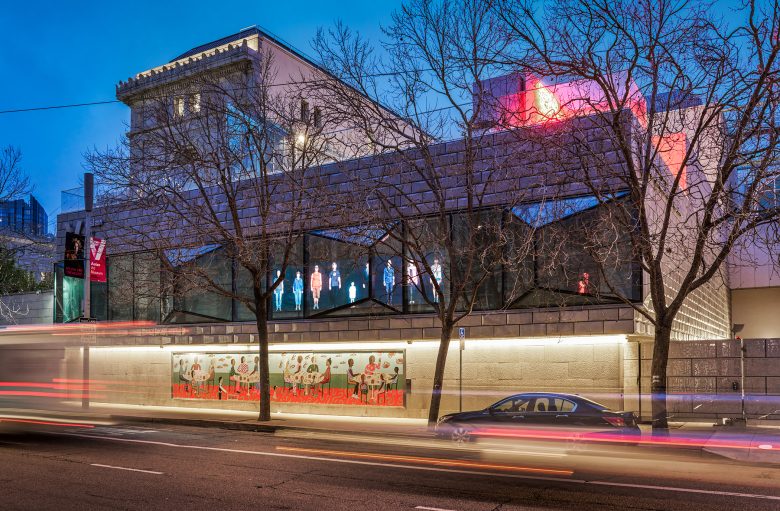
A museum show called “Everyday War” is probably a hard sell during a week when the president has sent 4,000 National Guard troops and at least 700 Marines to face off against Angelenos protesting ICE raids.
But you might find a surprising comfort in Taiwanese artist Yuan Goang-Ming’s video installations at the Asian Art Museum through Aug. 4. Long acclaimed internationally, this is Yuan’s first solo exhibition in North America.
I never understood the catharsis that horror fans find in seeing their worst nightmares enacted in movies until I saw Yuan’s work. To be clear, you won’t see any blood or monsters or people fleeing for their lives here.
But taken together, Yuan’s images and soundscapes resonate with the pervasive anxieties and concurrent glimpses of available beauty, and even hope, in the present season.
“Dwelling” (2014) and “Everyday War” (2024) feature the destruction of intimately detailed domestic spaces by unseen forces. The rooms are staged to appear as if the occupants have only just stepped out.
The “Dwelling” screen hangs across from a boxy sofa and chairs illuminated by a floor lamp that could have come from Ikea. Settling on the sofa to watch something on a screen reminded me of the infinite number of times I’ve kicked back in front of a television. This arrangement invites the viewer’s identification with the invisible dwellers.
“Dwelling” (5:00) opens in a cluttered living room with a table, chairs and lamp mirroring the set-up in the gallery. There’s the teapot and vase of flowers on the coffee table, the dusky shaft of light coming from an unseen window, the rocking horse, the bookshelf and other artifacts of home life. One might imagine a family, with a small child, perhaps having supper in another room.
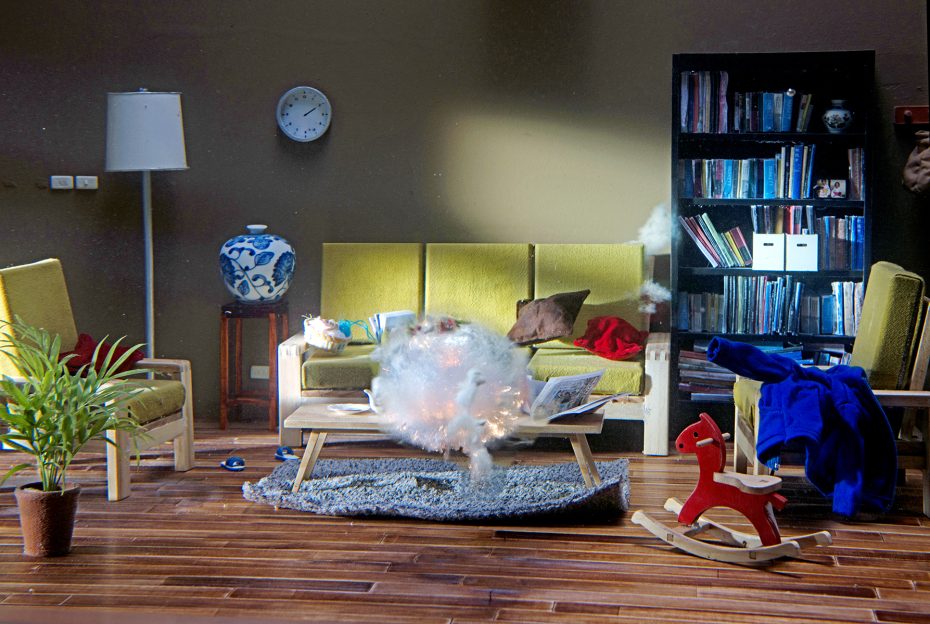
It wasn’t until my second viewing that I noticed a single tiny bubble rising towards the ceiling and a breeze tousling the potted palm’s fronds, riffling a paperback’s pages and lifting a white shirt draped on a chair.
The room explodes in slow motion, and the screen fills with what looks like smoke or clouds of debris as fat water bubbles drift upwards. Shards of a broken urn float and tumble among the splinters and shreds of the flat-pack sofa, the toys, books, the coffee table. The white shirt dances like it’s in a dryer. Only the cheap floor lamp stays in place.
Yuan gives us time to appreciate the materiality of the room’s ingredients. Then, almost as quickly as the initial explosion, there’s a series of bright flashes around the room and everything reassembles into the cozy nest at the beginning. The journey from comfort to disaster to repair was so quick it left me relieved and awed.
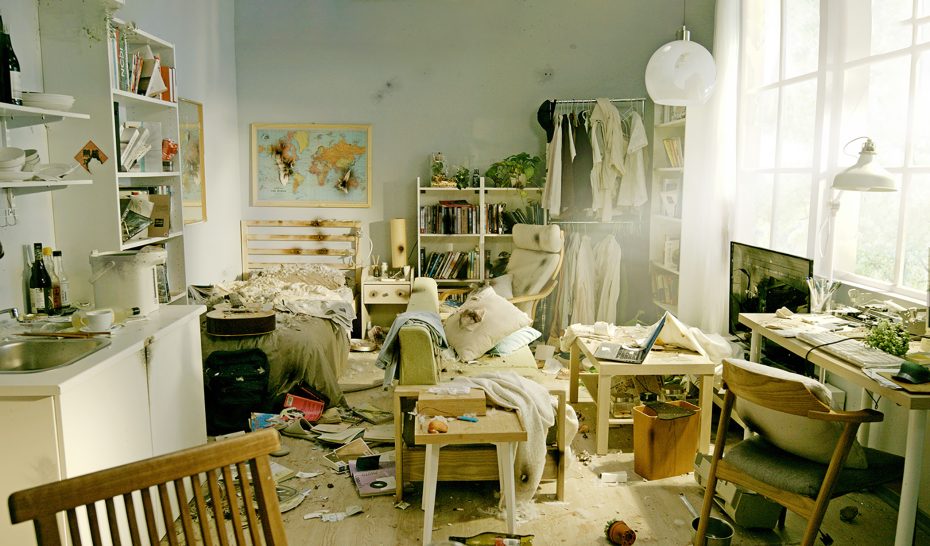
“Everyday War,” which Yuan created for the Venice Biennale, appears to be set in the studio apartment of a busy, messy, male graduate student. What looks like a History Channel program about bomber pilots is playing on a small flat screen television sitting alongside a laptop and some apples on a coffee table.
There’s a wristwatch and a big bottle of supplements on the bedside table, a rumpled bed. A packed bookshelf (including a volume called “The Art of Power”) holds a tank of goldfish and a houseplant. A fan is running and sunlight streams through the open windows. I could almost smell the sleep funk and stale coffee.
Soon, bullets start flying through the window, pocking pillows and the bed, shattering the aquarium, the coffee pot, the fruit on the table. At one point, a bullet flies from inside of the room into a cushion.
Flames burst from behind the bookshelves and we hear an American telling a story about pranking at a Boy Scout Jamboree before abruptly shifting to talking about an active military operation.
At other times, we hear what sounds like a radio announcement about a shooting and the air raid siren coming from “Everyday Maneuver,” Yuan’s drone video of Taiwan’s annual national air raid drill playing on another gallery wall.
Unlike “Dwelling,” “Everyday War” doesn’t show the complete reassembly of the blasted studio. There are moments when petals appear to float back onto a flower, but the full restoration only comes when the video loops back to the beginning. The flat screen television appears to be the only thing that survives undisturbed.
Comprising five videos, a table-scape installation and a sketch based on a 1951 photograph of U.S. military officials in protective goggles watching a nuclear test explosion in the West Pacific, “Everyday War” was Taiwan’s contribution to the 2024 Venice Biennale.
In his artist statement, Yuan wrote that these works use “the allegories of ‘war amidst daily life’ and ‘daily life amidst war’ to address our current realities, and the conditions that challenge the idea of dwelling in poetry. In contemporary existence, notions of ‘war’ transcend tangible artillery and military conflicts to encompass broader struggles of post-capitalist disparities, viral pandemics, cyber aggression, climate change, and racial injustices. These daily battlefronts have become normalized aspects of our everyday life.”
Sounds familiar, no?
The concept “dwelling poetically” comes from philosopher Martin Heidegger, said Abby Chen, who is based in the Bay Area and curated the Venice and San Francisco exhibitions. She told me, Yuan “was thinking, ‘I want to dwell poetically but my world is not poetic.’”
Chen says seeing how Yuan addresses that problem is what lifts visitors who may be expecting something depressing from “Everyday War.”
“They come out of the show feeling energized and satisfied,” she says. “The way he is dealing with these issues is, no matter how bad the world is, we should never forget about the efforts to be poetic. … How we feel our mind is exploding, he helps detonate that. Exploded, destroyed, right in front of us. So there is this satisfaction that he knows where the pain point is. And he helps capture that and release it.”
The works from the Biennale occupy one large gallery and play simultaneously. The sounds from the five videos and a dining table installation intentionally overlap to form a shared audioscape. Because the pieces are only about five to 10 minutes long, it’s easy to move from site to site.
When Yuan saw the museum’s Civic Center neighborhood, around the museum, he was inspired to create a six-minute LED video installation piece that can only be seen at night and from the outside of the building on Hyde Street.
“He felt there’s a lot of local residents in the area that probably would never set foot into the museum,” Chen said. “And he said, ‘I want to make a piece for them. Especially at night, when they’re out and about.’ And this piece, is giving it to the unlimited audience. And even if you pay [for a] ticket, you’re not seeing this piece unless you make the effort, but it’s free!”
The Asian Art Museum exhibition also includes “Disappearing Landscape — Passing II” (2011), a gentle prelude to what’s to come in the big gallery.
“Disappearing Landscape — Passing II” unfolds like a video picture book for grown-ups. The 9:14 triptych begins and ends under the deep, green sea and soars over treetops and the roofs of a neighborhood and through the home of a young family.
The father is on the patio, bouncing a ball for one of their two dogs, while the mother and toddler watch from inside, a couple of stories up. The camera zooms out of their house, past a burned-out building next door and into a darkened room with a wicker bed, an office chair, a desk, and a typewriter, all circa 1930.
It’s clear from the bright lamplight on the furniture, the white jacket hanging on a hook and the somber darkness all around, that this scene is a memorial. The camera moves through these scenes at various speeds, creating urgency as it moves forward and wistfulness as it pulls away.
You don’t need to know what this piece is about, or that the family is Yuan and his wife and daughter, to get the feeling that, despite change, destruction and death, there is joy in the mundane, and whatever one might be experiencing personally is part of larger natural and man-made cycles.
Yuan’s deep focus on the universal in the specific, whether the drone video showing not a single person outside in all of Taiwan during the annual air raid drill, or the invitation to see oneself in the student Sunflower Revolution protesters or the absent dwellers, is a reminder of how much we share, and how fragile and precious the world is.
Not my favorite “art” exhibit quite