


The San Francisco Unified School District says it’s cutting 205 central office positions to help address a $113 million budget deficit. Under the SFUSD’s Central Office Reduction Plan, the district would reduce central office expenditures from 25 percent to 16 percent of the total budget.
But, while the SFUSD targets administrative bloat, and has promised that there will be “no layoffs to our teachers,” the plan would nonetheless hit schools. Despite being classified as central office positions, many roles slated for elimination are located in schools, directly with students.
John O’Connell High School, located in the Mission District, with a student body at a low-income rate of nearly 75 percent, is one of those schools facing significant impact.
District materials and interviews with educators indicate that the jobs of at least 64 “central office” employees who work at school sites are on the chopping block. These include a nurse and a special education teacher at O’Connell, whose contracts won’t be renewed in September.
While the SFUSD has recently reversed layoffs for 151 staff members, including counselors and teacher aides, vulnerable schools like O’Connell remain affected.
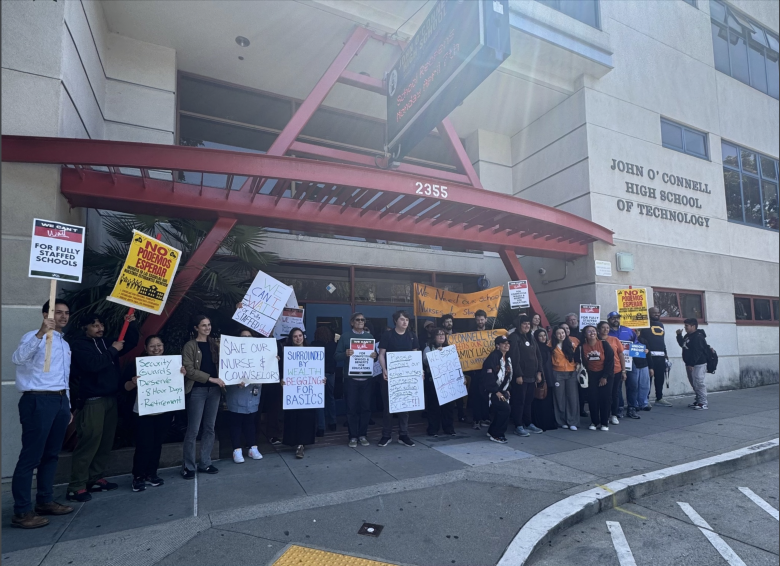
“When counselors or nurses are cut, it makes a big difference, since staff often play dual roles,” said O’Connell special education teacher Sekani Spero during an April protest by students and teachers.
One critical loss is O’Connell’s sole “career technical education” coordinator, a “central office” role teachers say is vital to O’Connell’s flagship career-readiness program.
Teachers and O’Connell’s principal, Amy Abero, say that eliminating this position means losing someone who coordinates opportunities with employers and helps students get jobs during the school year. Without the coordinator, fewer students will gain work experience and earn college credit.
At least eight additional career technical coordinator positions across the district have been reassigned or entirely eliminated, according to Marisa Varalli, the career technical education coordinator at O’Connell, who will no longer work at O’Connell in her current role after this year.
These positions are largely federally funded. Varalli worries their elimination could cause millions of dollars in federal funding to go unused and returned to the government.
When asked about the loss of student support from “central office” positions, the district did not answer the question directly. Instead it sent a link to this slide regarding the plan, and did not clarify how such cuts align with maintaining direct student services.
Last year, the summer employment program gave 2,000 students district-wide critical job experience and income. This year, only about 200 students will be able to participate, according to Varalli.
Varalli wrote a formal statement to the school board in April about a young woman who was the first in her family to graduate from high school and go to college.
The woman, who is currently a high-school senior, was enrolled in the school’s career program at “a low point in her sophomore year” and got an internship at the VA hospital. That, Varalli said, “sparked an interest in healthcare” that led to internships at the University of California, San Francisco, the Boys and Girls Club, and the Giants. The young woman is now finishing a nursing program, Varalli said.
She “is likely one of the last students to have access to these opportunities,” Varalli warned. Career readiness roles, she said, “are not central office roles. They are educators embedded in the school community.”
In addition to reducing access to the college and career readiness program, O’Connell will lose its after-school program, and class sizes are projected to increase by more than 30 percent with the special education teacher cut.
This would reduce the school’s ability to provide special education classes that are taught jointly by a general education teacher and special education teacher, which is required to support students with disabilities.
For O’Connell, the financial hit comes at a hard time: The school has already suffered the loss of $1.2 million and six staff positions over the past three years from district-wide budget cuts, according to Abero.
This was due partly to the district adopting a so-called new unduplicated model for equity funding, meaning that even if a student meets multiple high-need criteria, such as being unhoused, in foster care, or an English learner, the school receives funding as if the student met only one of those criteria. The district did not explain why it switched to this approach.
Additionally, this year O’Connell narrowly lost out on $217,000 in federal funds. With a student body classified as 74.4 percent from low-income families, it fell 0.6 percent under the 75 percent requirement for Title I funds.
The school community is now organizing. Abero, parents and teachers have sent letters to the SFUSD and the district’s superintendent, Maria Su. O’Connell students have organized demonstrations outside the school, holding signs protesting the budget cuts. Teachers and parents are calling for urgent investment in basic infrastructure, support for high-needs students, and restoration of equity funding.
“These are our kids, and they deserve better,” said Spero, the special ed teacher, at a recent O’Connell protest. “We aren’t going anywhere until our voices are heard.”
Any reader of Paul Gardiner’s “SFEDup” newsletter already knows that SFUSD plays accounting games to hide ginormous subsidies to low performing schools by paying their staff through the central office budget. Surely UESF knows this which makes you wonder why they complain so much about “bloat” at the central office in budget negotiations.
Geee really hard to have anticipated that the “progressive” assignment policy of using lack of education and where you live as a proxy for race, giving them priority, and then forcing Asian/white/middle-upper class kids to accept assignments at cruddy schools far from where they lived would not cause huge numbers of parrents to bail on SFunifail. And oh, top it off by killing GATE and advanced math programs, that will get highly achieving parrents to send their kids to SFUnifail’s schools with 5% reading at grade level.
I was a huge supporter of public education, but at this point who cares. Sf voted for these bozos, and they destroyed the schools.