

When Supervisor Jackie Fielder and Assistant Chief David Lazar sparred at a San Francisco city hearing this week, two questions arose: Is it good for public safety that the city’s police officers can go work private security after work, and are those officers spread out equitably across San Francisco’s neighborhoods?
Lazar said yes, full stop. The program “is a big win for the community, the public, the city, and for the department,” he said. Allowing SFPD to act as a broker for off-duty police officers is a way to have police ”visible in public” and “out in the community” reducing crime, but with private businesses paying the tab. It’s a great program that needs to continue, he said. SFPD should actually look to expand it.
Fielder countered. The program, known as 10(b), gives certain parts of the city a stronger police presence, she said, based on the ability of local businesses to pay for it. The police department “should be equitably allocating public safety resources, including officers” where they’re most needed, without an option to buy your way into city-trained and subsidized security.
Which raises the question: When off-duty police officers are working side gigs as security guards, where are they?
Mostly downtown, it turns out.
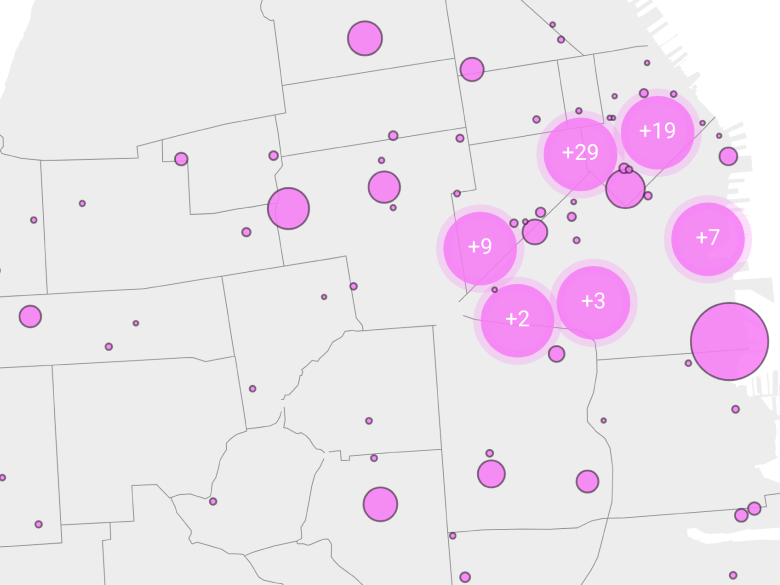
A Mission Local analysis of data compiled by the Budget and Legislative Analyst found that, over the past five years, police officers largely worked private security gigs in areas like the Financial District, Union Square, and Mission Bay.
Businesses on Market Street, like Salesforce and Twitter, for instance, were frequent customers, as were Union Square stores like Macy’s and Victoria’s Secret. Officers were also spread out to a handful of retail spots elsewhere in the city, chiefly Walgreens, Target and Safeway.
Walgreens, in fact, was by far the largest user of private security hours from police officers between 2018 and 2023, and many of the blips that appear away from the downtown core are Walgreens stores. (The large bubble in Golden Gate Park? The Outside Lands music festival.)
The Giants stadium and Chase Center were also big customers: They each shelled out for thousands of officer-hours working events like Warriors games, The Who concerts, and WWE smackdowns. When Dave Chappelle came to the Chase Center in 2022, for instance, officers worked 69 private security hours; when Metallica was there in 2019, it was 284 hours.
Of the top 10 spots for officers doubling up as security guards, half were in the downtown area: The Giants stadium, Lululemon, Salesforce, Union Square and Bank of America.
This city-certified side gig, known informally as “10(b)” for its place in San Francisco’s administrative code, has existed since 1978. Sports stadiums, concert venues, retailers, banks, or “any person, corporation, firm or organization” in the city can hire police officers to serve as private security. They simply have to ask the police chief and pay those officers overtime rates.
Officers working private security are considered on-duty and can make arrests. They must wear police uniforms and their badge, and carry department-issued firearms. And they make time-and-a-half: At an officer’s starting salary, that’s $83.49 an hour. By the time an officer is a sergeant, it’s $123.54 an hour, and for a lieutenant, it’s $141.06.
For police brass, the focus on retail is still a win.
“If you think about Apple and Lululemon and all these places that we staff our officers, that has also contributed to reducing crime,” Lazar said at the Wednesday hearing. Twenty officers are currently assigned to retail stores under the program, he said. These officers are “strategically placed” and would otherwise be home. “That’s 20 more officers at any given time that are on the street.”
Lazar emphasized that officers working as security guards would not otherwise be out “walking a beat on Mission Street” or otherwise doing police work; this is a second job, after all.
But Supervisor Shamann Walton said that was not necessarily the case: Officers might prefer to work private security to shifts in their district stations. The fact that they can easily call out sick and, that very same day, work a private security gig, a practice that was documented extensively in a city audit last year, is a major problem, he said.
“You cannot guarantee that police officers would be at home if they weren’t at a 10(b) assignment,” Walton said. For one thing, they could be working overtime for the city, at their local precinct. The department is short 500 officers from a level recommended by its own staffing analysis. Its full-duty staff has cratered from a recent high of 1,869 in 2019 to 1,466 in 2023.
The program, Walton added, “is a big win for corporations, for private businesses, for overtime abuses, and not for the entire city.”
10(b) program underlies SFPD’s overtime abuse
Concern over geographic equity is not the only criticism of the 10(b) program. It’s now at the center of uproar over overtime misconduct within the San Francisco Police Department.
At the city hearing this week, six supervisors lambasted police brass for asking for another $61 million in overtime for the year.
The department, for its part, says the use of overtime is mostly due to short-staffing. And it has adopted 85 percent of the recommendations made to reform its overtime system, it said.
Still, even strongly pro-police supervisors said the department too often underbudgets its overtime use early in the fiscal year, and then comes asking for millions in extra funds.
The repetitive nature of these requests, and reports of its mismanagement of overtime, has eroded public trust, they said.
Specifically, the 10(b) program costs the city money because other officers have to cover shifts. If an officer calls out sick for a morning shift and then goes to work private security at night, for instance, those morning hours have to be backfilled by another officer, who will be paid overtime.
Calling out sick and working as a security guard the same day, ventured city analyst Nicolas Menard at the hearing, “may not be a legitimate use of sick time,” since it indicates officers might not be ill. Sick leave has increased dramatically in recent years, from an average of 14.4 days per officer per year in the 2018-2019 fiscal year, to 25.5 days in 2022-2023.
The police union contract does forbid working private security after using up a certain number of sick hours. But the city found at least 51,000 hours of 10(b) overtime between 2020 and 2023 were improper because officers had already maxed out their sick leave.
The city audit found scant internal controls on officers flouting overtime policy, and rule-breaking was common.
Filling in for other officers who were not able to come in for their shifts was by far the top use of overtime within SFPD in 2024 and 2025, according to SFPD data. The data was for backfill generally, however, and did not specifically break out how many of those hours were used on filling in for those working in 10(b).
SFPD, for its part, has disputed that there is widespread abuse of the program.
Lazar, during Wednesday’s hearing, gave an example of a beat officer whose husband says she has to take care of their sick child. “That officer calls her lieutenant and says, ‘I can’t come in, my child’s sick,’” he said. But when the officer’s husband comes home from his job, Lazar continued, she decides to “work overtime later on in the evening” doing her side gig as a security guard “because they don’t want to let anyone down.”
“The store’s relying on them,” he said. “They want to keep their commitment.”
Officer numbers are dwindling and, as staffing has decreased, the use of the 10(b) program has plateaued. On average, officers were using 79 10(b) hours in the 2022-2023 fiscal year, down from 109 in 2018-2019.
That leveling off followed a rapid expansion in the years before the pandemic, however. Between 2016 and 2019, use of 10(b) almost doubled.
Both Fielder and Walton maintain that 10(b) is in need of serious reform.
“It’s not about officers being at one place,” said Fielder. “It’s about officers being all over the city.”
“If I didn’t go to school growing up, I couldn’t go outside and play,” added Walton. “So officers shouldn’t be able to call in sick and then go work for the 10(b) program.”
If the City of San Francisco’s previous Police Commissions had not allowed SFPD and the POA to railroad the Patrol Special’s out of existence you would not have this problem. The elimination of the Specials was a 10-b money grab which has robbed the taxpayers and hurt the entire department.
1. Hire enough cops and return the majority of desk jockeys to the streets to reach the mandate. Eliminate any 10-b for full time Cops and have a zero tolerance for outside employment. Pay them well enough so they’re not working outside jobs, it’s ridiculous to have an officer working an 8-hour patrol shift and then go work another 8 hours sitting at some PG&E site. It’s burning them out and they actually are liability to the city.
2. Reinstall the Patrol Special program, appoint enough specials to fill in all 10-b work and restore their full police powers when on duty, to and from work. The city should have an advisory committee made up of one former patrol special assistant, two patrol special former beat owners, one current SFPD lieutenant and one SFPD captain. This committee would have full authority to appoint patrol specials as well as make any rules and regulations deemed effective by this committee. MCD could still handle any complaints on patrol specials and the police commission could adjudicate any conduct issues which arise.
Instead of cutting back on police education, the academy ought to set up a less intense program to train security guards. Academy students may even work their way through the police program by gettin their start as security guards. That would solve two problems at one time and get a lot more people on the street faster.
I noticed at Target down town the off duty officers ..But as I shop I still see thievery happening in the store..The shoplifters load up on meat ,other expensive things ,and just go through the emergency fire doors..They get away while the supposedly vigilant guards sometimes 3 deep gang out at the front entrance..WHAT KIND OF A DETERRENT IS THAT?
1. When police officers work overtime on these private security gigs, do these overtime hours help to spike their overall salaries, and would that result in higher pensions that end up getting paid by taxpayers?
2. What process is in place to ensure that overtime pay from private security gigs are not incorrectly mixed into overtime pay for public SFPD work? Has there ever been a mix-up as to which bucket the overtime pay went into? If so, was how did it impact pension calculations?
3. How can the city make it illegal for SFPD officers to work private security gigs?
Good article.
Great article! Where do the 10B payments by the companies hiring police officers for security go? Directly to the officer, as unrestricted revenue to the General Fund, or back to the Police Dept. budget as revenue to help reduce the total overtime expense? Are most of these traffic control officers and therefore not out doing traffic enforcement?
Very telling that police are being hired to work privately .
That is further evidence the city is unsafe and lawless.
Not everyone can or should citizens have to hire security .
If police were doing adequate patrol
And enforcement , there would be much less crime .
The drug supply and demand here is bad .
Until the consequences are severe enough and police are strong enough and present to deter the selfish persons who wreak havic with their lawless behavior and think it is cute , the city will remain a drug ghetto .
Really getting old with the same scene and lack of being able to get the mess cleaned up at this point .
Billions of taxpayer dollars spent , 35k city employees , countless taxpayer funded nonprofits and the dealers still operate openly and poison people .
Please keep reporting .
How about starting to cover the totally ruined neighborhood on Lower Polk/Larkin where drug dealers are the only business and addicts keep coming for years to get high and destroy everyones wellbeing ?
Why is this harmful and sick behavior still being allowed and tolerated ?
Clean it up.