


Despite an ambitious plan passed nearly a decade ago that put the city in charge of taking care of street trees, San Francisco is losing them — and it’s worse in the city’s poorer, southeastern neighborhoods.
When the total number of street trees in the city was first surveyed in 2017, there were 124,795 trees, and a goal to plant 50,000 more by 2035.
Today, there are just 124,487. Peering down from a bird’s eye view, Golden Gate Park, Mt. Sutro, and other large parks make the city appear one mass of green, but its urban canopy is one of the smallest in the United States: It covers just 13.7 percent of its area, compared to 21.5 percent in Oakland and about 22 percent in New York City.
San Francisco’s northern and central neighborhoods have more street trees
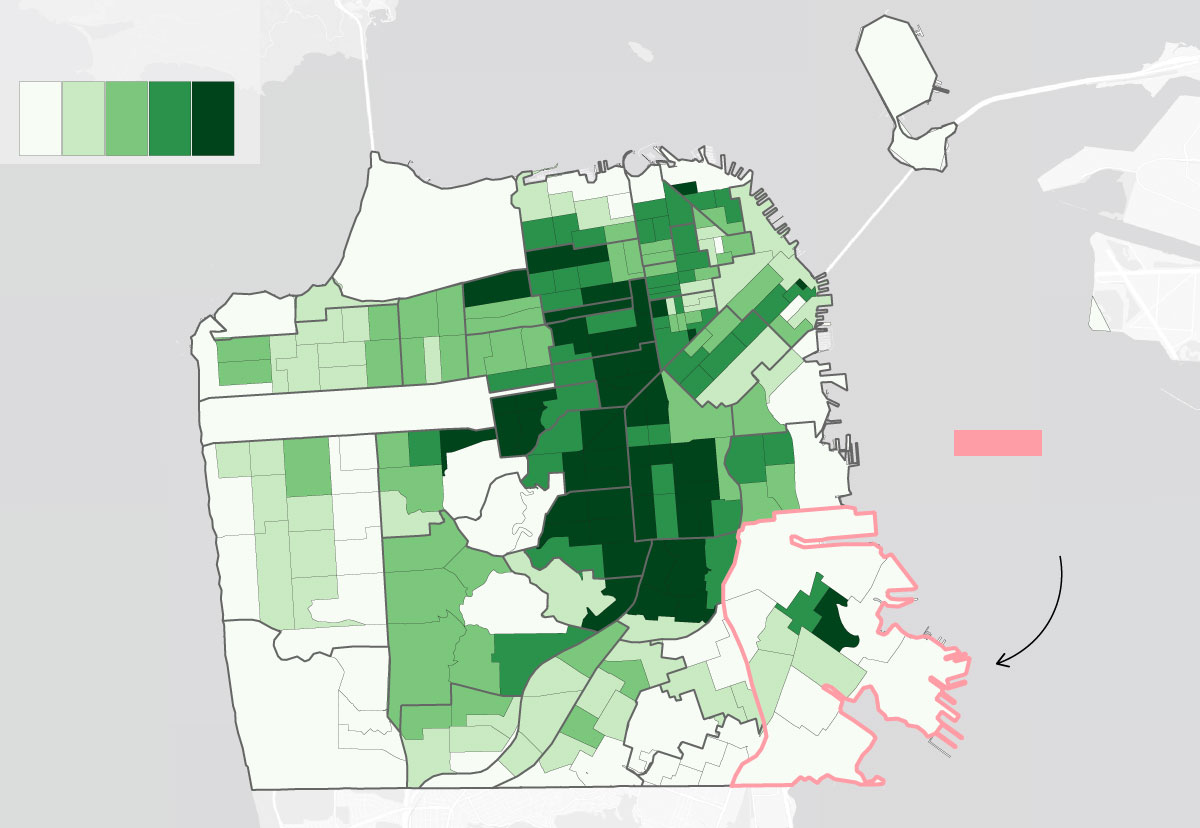
Trees per acre:
25.6
0.5
In Bayview, the average
number of trees per acre
is 4, compared to 18 in
Hayes Valley
Trees per acre:
25.6
0.5
In Bayview, the average number
of trees per acre is 4, compared
to 18 in Hayes Valley
Note: Data only includes street trees maintained by the Department of Public Works. Source: S.F. Open Data. Density is shown by census tract. Map by Kelly Waldron.
And in Bayview, where industrial sites and concrete predominate, coverage is only 6.7 percent — and getting worse: Bayview has lost 350 trees since 2022, and neighborhood activists want to know why.
“All of those trees look really terrible,” said Marsha Maloof, the president of the Bayview Hill Neighborhood Association, of trees planted by the city over the last year. Many of them, according to Maloof and others, withered within months of being planted. “They died so quickly,” said Maloof. “I have a feeling they were neglected.”
“If you go there, you’ll see barren blocks of land,” said Arieann Harrison, a Bayview resident and founder of the Marie Harrison Foundation, about areas where new trees were placed.
Harrison was especially disappointed to lose the trees planted near major trucking routes — diesel exhaust is a major source of pollution in the area, she said, and the trees would have helped mitigate that. “It would be nice to have at least something there,” she said, “to put some anxiety to the side.”
The city, for its part, acknowledges the loss. Newly planted trees are a “challenge” to keep alive, said Rachel Gordon, spokesperson for the Department of Public Works. They must be consistently watered for three years while they establish roots — a task Public Works takes on — and not all make it.
Others, Gordon said, “have been lost due to winter storms, but they will be replaced.” Some, she says, have been lost due to vandalism.
Few neighborhoods could benefit from street trees more than Bayview.
Air pollution from the neighborhood’s high number of industrial sites, construction projects and truck traffic, has had dire health impacts on residents of Bayview: The neighborhood scored a 92 out of 100, indicating high exposure to pollutants, in a the Healthy Places Index of community vulnerability to environmental health hazards conducted by the state.
Many of the neighborhood’s pollutants are located near where residents live, which, according to the Bay Area Air Quality Management District, leads to elevated rates of chronic illness, asthma, and increased stress.
Harrison knows this first hand. Her environmental justice nonprofit is named after her mother, Marie Harrison, an environmental justice stalwart who died of lung disease. And while Harrison said that the biggest difference “by far” in local air quality would come from “accountability for industry polluters,” trees are still important.
“Studies have shown an urban tree canopy, if done in a well-planned manner, can have an overall positive effect on mitigating air pollution,” said a representative from the Bay Area’s air district. If planted near industrial sites and other polluting areas, the air district added, trees can create a buffer, protecting residents who live nearby.
According to Joe McBride, a professor emeritus of environmental planning at UC Berkeley, a dense urban tree canopy creates a filter between residents and the air above. That can have a significant impact on air pollution, in addition to creating shade and mitigating the effects of the heat waves that climate change is making more prevalent in the Bay Area.
It can take 20 to 30 years before young sapling trees, which are often planted by cities in urban areas, grow large enough to create a canopy, and have the greatest impact on air quality, says McBride. But the years when a tree is young are the most critical. Neglect, poor planting technique or even missing a watering could easily kill it.
San Francisco’s richer neighborhoods also happen to be rich in trees. The city’s tree census shows 4,228 trees in Pacific Heights, for example — over 6,000 per square mile, or four times the density of trees in Bayview-Hunters Point.
Presidio Heights and Hayes Valley also have over 6,000 trees per square mile. The Mission has about 4,800 trees per square mile, while Excelsior has 2,700 trees per square mile.
The locations of street trees maintained by the San Francisco Department of Public Works were identified using data from S.F. Open Data. Background image source: Google Earth.
This should not come as a huge shock, according to McBride. Trees are expensive (he estimates a young tree can cost around $350, not including delivery and installation). Watering them is also expensive. So is pruning and maintenance.
In a neighborhood that is majority low-income, with many residents working more than one job, buying and caring for a tree — even if they have a place of their own to plant it — can be difficult.
“There is typically a lack of yard trees in poorer neighborhoods,” said McBride. “There is not only a lack of discretionary money, but also people just don’t have the time to ask the city to plant more trees — that’s a big contrast with more well-to-do neighborhoods.”
To plant a street tree on their own, a resident must first find a legal and non intrusive spot, apply for a permit, choose a tree species that will survive in the environment, buy the tree, rent a concrete saw or hire a private concrete contractor to cut the sidewalk, but all the necessary tools to plant the tree, and then care for, and water, the tree for years as it establishes roots in the ground.
In July 2017, voters passed a proposition meant to level out some of these differences in accessibility to street trees. Public Works formed StreetTreeSF to maintain all of San Francisco’s street trees and repair any sidewalk damage caused by them. The city vowed to plant 50,000 trees.
Before that ballot measure, private property owners were responsible for nearly two thirds of all street trees in San Francisco; Public Works maintained the other third.
Now Public Works is responsible for all of them, a significant escalation of responsibility.
Every week, Public Works, or someone acting on its behalf, refills the green water bags installed around the base of every young tree in the city, in order to keep the soil consistently moist as it grows. Public Works never plants a tree if there isn’t a plan for watering it, said Gordon. Some of the watering is done by the nonprofit Friends of the Urban Forest, which has a tree care team and a crew of volunteers to water street trees.
Despite this, there are fewer trees in Bayview today than there were three years ago.
Harrison says she would like to see more, specifically trees planted where they could make a difference: Near schools, parks, and busy roads. They could be taken care of by local residents, and provide a source of green jobs for the community.
“I feel that we could benefit from having more greenery,” said Harrison. “More eco-friendly and eco-salvageable kinds of things that should already be in this community.”
Other Bayview residents agree.
“The air quality here is so poor that the trees are imperative,” said Maloof of the Bayview Hill Neighborhood Association. “We need trees because it’s necessary … we need them across the neighborhood — otherwise we can’t breathe, that’s the bottom line.”
Tree-removals are the first step to tree-replacements. If a tree is dead, or diseased, or storm-damaged, then it makes sense to remove it to make room for a future young tree. Focusing on the number of trees lost is just one indicator but doesn’t reveal the full story.
Thanks to Marina for highlighting this ongoing inequality. However she failed to mention the 2 most important reasons this problem continues to exist:
1) It is not a priority for Supervisor Shamann Walton and he will openly tell you that. In a City with minimal resources, other Supervisors who prioritize this get more access to resources for planting street trees. If you have ever attended Saturday morning tree plantings hosted by Friends of the Urban Forest in those neighborhoods, you will notice that he never shows up. Other Supervisors in other neighborhoods show up.
2) A majority of Bayview-HP residents DON’T WANT street trees planted in front of their home. And they actively discourage the City and non profits from planting there. So while its great that community activists want to plant trees there, perhaps they should convince their own neighbors that they need them. The REAL primary reason they don’t want them: they lose a vehicle parking spot on their sidewalk.
Yikes, don’t put the green water bags (aka Gator bags) around the base of a tree! Put it around the supporting stake. A bag around the base of a tree will introduce rot and make the base vulnerable to rodent damage. Also, once the tree is well established you should remove the bag. I see a lot of improperly maintained new trees and maybe this is why so many planted are lost.
Someone needs to look into Friends of the Urban Forest’s choices of trees. In my experience in the Crocker Amazon and the mission they chose completely inappropriate trees. I was surprised that their choices were so poor. You can plant it, water it and take care of it, but if it’s not correct for the environment, it’s going to die.
If you care about trees in the Bayview, please join the Bayview Beautification Day, a monthly event hosted by Together SF that involves community volunteers and San Francisco Public Works staff to clean and beautify neighborhoods. Sign up here: https://www.mobilize.us/togethersf/event/407708/
The event is held at different locations throughout the month. Here’s the upcoming schedule:
May 18: Gilman Playground
June 15: Bayview Letters (933 Meade Ave @ 3rd Street)
July 20: Silver Terrace Playground
August 17: Bayview Playground @ MLK Pool
September 21: Gilman Playground
October 19: Bayview Playground @ MLK Pool
November 16: Hilltop Playground (La Salle & Whitney Young Circle)
December 21: Bayview Playground @ MLK Pool
Can’t be asking departments for a reduction in budgets and more deliverables at the same time. How can we hire more people to find the appropriate sites plus water and plant the trees if there is a city-wide hiring freeze? Sounds like a call to the mayor is in order….
Yes, the Bayview needs more trees. I see FUF and DPDW tending to trees in our neighborhood on a semi-regular basis. Unfortunately, the vandalism is what does most of them in…not neglect. I’ve seen cars back over them (parking on the sidewalk), people cutting limbs off, throwing hot BBQ coals on the water bags, etc. Our family planted 2 w/ FUF nearly 7 years ago…1 is still going strong while the other is barely hanging on thanks to knuckleheads.
BUF uses the bulk of their money to pay contractors to cut down trees or repair sidewalks.