

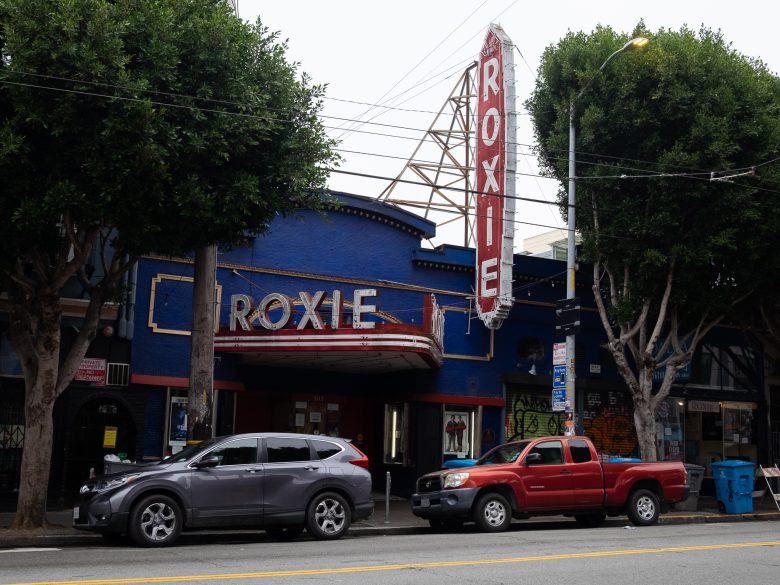

At least 28 art nonprofits in San Francisco — literary, dance, theater and film organizations — discovered on Friday that their federal grants from the National Endowment for the Arts had been cancelled.
The lost grant money, ranging from $15,000 to $100,000, has hit nonprofits across the city, including the Bay Area Video Coalition, Dance Mission Theater, Gray Area, the San Francisco Contemporary Music Players, the Roxie and the Embodiment Project.
In the termination email sent from the National Endowment for the Arts, the federal agency said it is changing its grant-making policy to focus on “projects that reflect the nation’s rich artistic heritage and creativity as prioritized by the President.”
That said, it’s unclear how those future grant-making policy changes will be implemented, as a budget proposal released by President Donald Trump’s office on May 2 called for the elimination of the National Endowment for the Arts.
The endowment awarded some $4.5 million in grants to nonprofits in San Francisco in fiscal years 2024 and 2025. While some organizations have received part or all of their reimbursements, those with programs scheduled for later in 2025 have lost essential funding for upcoming projects. They’re scrambling to find alternative funding sources.
Here’s a list of all the San Francisco nonprofits that receive NEA funding, according to the endowment’s grant data. Mission Local was able to confirm 28 organizations that had grants cancelled, but others may also be subject to the cuts.
The termination email included a list of themes that would be prioritized for funding, projects that do the following:
- “Elevate the Nation’s HBCUs [historically Black colleges and universities] and Hispanic Serving Institutions”
- “Celebrate the 250th anniversary of American independence”
- “Foster AI competency”
- “Empower houses of worship to serve communities”
- “Assist with disaster recovery”
- “Foster skilled trade jobs”
- “Make America healthy again”
- “Support the military and veterans”
- “Support tribal communities”
- “Make the District of Columbia safe and beautiful”
- “Support the economic development of Asian American communities”
But San Francisco nonprofits facing cuts found these criteria “confusing” and “ironic,” as the cuts directly affect programs that were carrying out these priorities.
Voice of Witness, an oral-history storytelling nonprofit based in San Francisco, lost a $50,000 grant this year and another potential $50,000 for a second year.
That funding was meant to support two artists, one Chinese American and the other Peruvian American, who are working on projects on water privatization and fishery restoration, respectively. That would seem to nail the requirement to support “Hispanic serving institutions” and “economic developments of Asian American communities.
“It feels a bit contradictory,” said Fanny García, a program manager at Voice of Witness.
Organizations have seven days to appeal their cancellations, according to the NEA email.
Richard Aldag, executive director of the San Francisco Contemporary Music Players, said he will appeal, even though the music group is in production this week. The nonprofit was recommended for a $20,000 grant back in November, which usually means a grant will be approved after the next NEA commissioner meeting. Instead, the funding was cancelled. The grant would’ve covered compensation for musicians.
Voice of Witness, too, plans to appeal.
“It’s important to not stay silent,” García said. “We do oral history because we believe that people have the right to speak the truth about their lives and to use their lived experience as a source of education.”
Dance Mission Theater, a Mission performance venue and dance school, also lost its $75,000 grant to support a series of art events at the 24th Street BART Plaza to increase foot traffic to local businesses in the area.
“We are in extraordinarily scary times,” the theater wrote in an email. “Now they have officially come for art. Because they know that with art, we can activate people’s minds and hearts and effect change.”
The Roxie, the independent cinema on 16th Street, lost a $20,000 grant that would have supported RoxCine, its year-round program of Spanish-language and U.S. Latinx film. The 3rd i San Francisco International South Asian Film Festival also lost $15,000 that would’ve supported its annual run in October.
“We are one of many organizations and filmmakers who had funding pulled in the middle of a project cycle, often with no alternative resources in place,” the Roxie wrote in an email. “Some filmmakers may not be able to finish their projects. Some venues may go dark.”
Gray Area, a nonprofit arts space operating out of the Grand Theater on Mission Street, lost a $50,000 grant that would’ve gone towards the 11th Gray Area Festival, according to Barry Threw, its executive and artistic director.
Another $50,000 grant for a research project studying how artists are using AI may also be gone. Gray Area received a recommendation for this project, but has not received any updates. “It seems unlikely it will get approved,” Threw said.
Gray Area had an annual revenue of $6.6 million in 2023, according to its tax filings. Federal funding doesn’t take up much in its budget. “But it will definitely affect the kinds of programming we can produce during the festival.”
For many nonprofits, said García with Voice of Witness, federal funding was considered the most stable source of funding. Now, organizations are realizing how fragile it can be.
“It takes a long time to build an arts organization,” said Andrew Smith, the director of the experimental arts space the Lab. He was able to get the $40,000 grant reimbursed before the cancellations, but is expecting to lose a pending grant. “A foundation’s stock portfolio can recover. But an organization that’s been around for 40 or 50 years really can’t. When it’s gone, it’s gone.”
Terrible. I hope these can be saved. Are there opportunities to support?
Let’s resist the urge to keep allowing various orgs to take control of our public art and public parks. Say no to plunk art and blah, blah murals.
We do indeed live in terrifying times.
And yes, President Donald Trump and his gang of fascists are targeting art and artists not only because of their potential to activate people’s minds and hearts– but to reveal the truths about our lives that enrich us all.
That is why, in the words of David Walsh (the brilliant arts editor at the World Socialist Web Site), Trump and his followers “take their cue on cultural matters directly from Hitler and the Nazis.”
Now is the time for our great artists, especially those dedicated to Truth, to step up and fight back!
Unlike Hitler in the 1930s, Trump lacks a mass fascist base. His power resides in the oligarchs who surround him, the complicity of the Democratic Party, and a divided public that lacks a clear and honest political perspective that would unite them.
Now is the time for all of us to step up and fight back!