

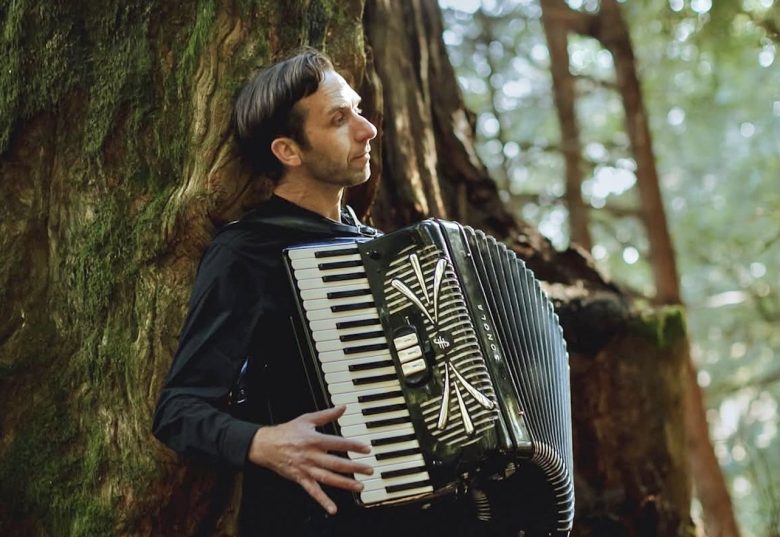

As a composer, player and improviser, Rob Reich possessed a gift for creating music that captured the emotional essence of any particular moment. The Bay Area musician’s unexpected death on Thursday, May 15, at the age of 47, left a vast and disparate constellation of his collaborators united in shock.
The outpouring of grief has spilled across social media via loving tributes, telling anecdotes, and clips of him in action on accordion, piano, glockenspiel, and more.
Reich was an indispensable voice on the Bay Area music scene, playing out multiple times every week, in both prestigious concert halls and dimly lit bars. He collaborated with everyone from the San Francisco Symphony — which featured Reich on accordion playing Nino Rota’s score at a 2022 screening of “The Godfather” — to his two-decade run with guitarist Dave Rickets’ Django Reinhardt-inspired band Gaucho.
According to his longtime partner Steph Solis, Reich went on a solo trip to the Mendocino forest retreat Orr Hot Springs, which he visited a few times a year as “a meditative place of healing.” When he didn’t check out in the morning, staff went to his cabin and found him “seemingly peacefully asleep inside, but unresponsive.” He had already died, she said. No cause of death has been determined.
Finding his voice
Raised on Long Island, Reich displayed a gift for music at a tender age. After one of his older sister’s piano lessons, three-year-old Robbie “sat down and hammered out ‘Mary Had a Little Lamb,’” said his father, Richard Reich. He soon started lessons with the same teacher and, as he got older, it was clear that music was his calling. He stopped piano for a while and played drums and then guitar, joining a rock band, “almost heavy metal,” Richard said.
In 2000, he graduated with a degree in composition from Oberlin Conservatory, where he studied with John Luther Adams and Pauline Oliveros. Then, like so many Oberlin-trained musicians before him, he set out for the Bay Area. Though he initially supported himself teaching piano, he never really took himself seriously as a pianist. It was the accordion that became his primary voice as a player.
“There was always one sitting in a box at my house growing up,” Reich said in a 2015 interview. “It was old and beautiful, and kind of a mystery how it ended up there. I brought it out with me when I moved to Oakland and started playing it as a toy, as a joke.”
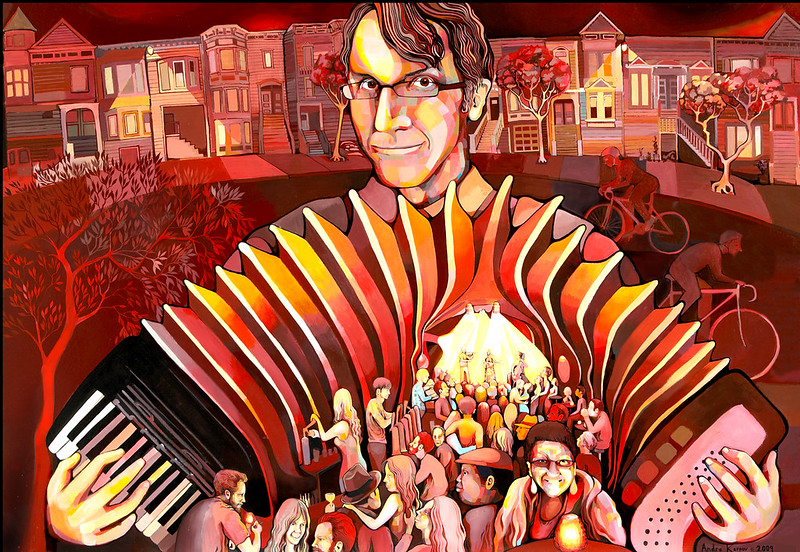
Encouraged by friends to join in free improv sessions, he bought a full-sized accordion “and found opportunities to play,” he said. “I learned some klezmer, and other traditional folk music, and joined some bands. I could make a living playing weddings, so I quit teaching and focused on composing and the accordion.” The Bay Area took note, with Reich featured on a 2015 session of KQED’s Forum about the shift of the instrument’s image from nerdy to cool.
Kaleidoscopic talents
Reich’s work touched many corners of the Bay Area music scene. He was a founding member of Kugelplex, one of many klezmer bands he worked with, and played a key role in the last album by the celebrated chamber improv ensemble Tin Hat, 2012’s “the rain Is a handsome animal (17 songs from the poetry of e. e. cummings)” with violinist/vocalist Carla Kihlstedt, guitarist Mark Orton and clarinetist Ben Goldberg.
He and Goldberg collaborated in several other ensembles, including the rootsy Ben Goldberg School and Reich’s lithe Shadowbox, an ensemble he introduced on an eponymous 2015 CD on Goldberg’s label BAG Productions. His own projects ranged across a wide spectrum, from 1930s swing-oriented “Rob Reich Swings Left” to his long-running duo with bassist Daniel Fabricant.
Portland guitarist Sol Crawford, a longtime friend and the former booker at Amnesia, noted Reich’s dauntingly kaleidoscopic array of pursuits. “At one point, there was the attempt to count the number of simultaneous bands and projects Rob was a part of, and we lost track near two dozen. Not only was he an incredible multi-instrumentalist and inventive composer, his essence was the inspirational quality of “YES” that any collaborator is fortunate to encounter. … His music and life arched over and held a tremendous amount of warmth and joy.”
Reich, a longtime Oakland resident, probably reached his widest audience as the composer and leader of the Circus Bella All-Star Band, the stellar combo that accompanies the Bay Area’s one-ring Circus Bella, which faces its rapidly approaching summer season of free outdoor concerts without his guiding spirit.
“It’s just kind of unthinkable,” said Abigail Munn, whose first move in launching Circus Bella in 2008 was recruiting Reich as house composer and bandleader. “We wept through our first band rehearsal yesterday. I’m feeling my own grief, and the grief of the whole community. He was my artistic partner for so long. He was just prolific.”
Tall, thin, and often preternaturally calm, Reich’s sometimes otherworldly presence made him a natural for the circus. He treasured the opportunity to produce a steady stream of new music for an ever-changing variety of feats and acts, scores that he documented on two albums.
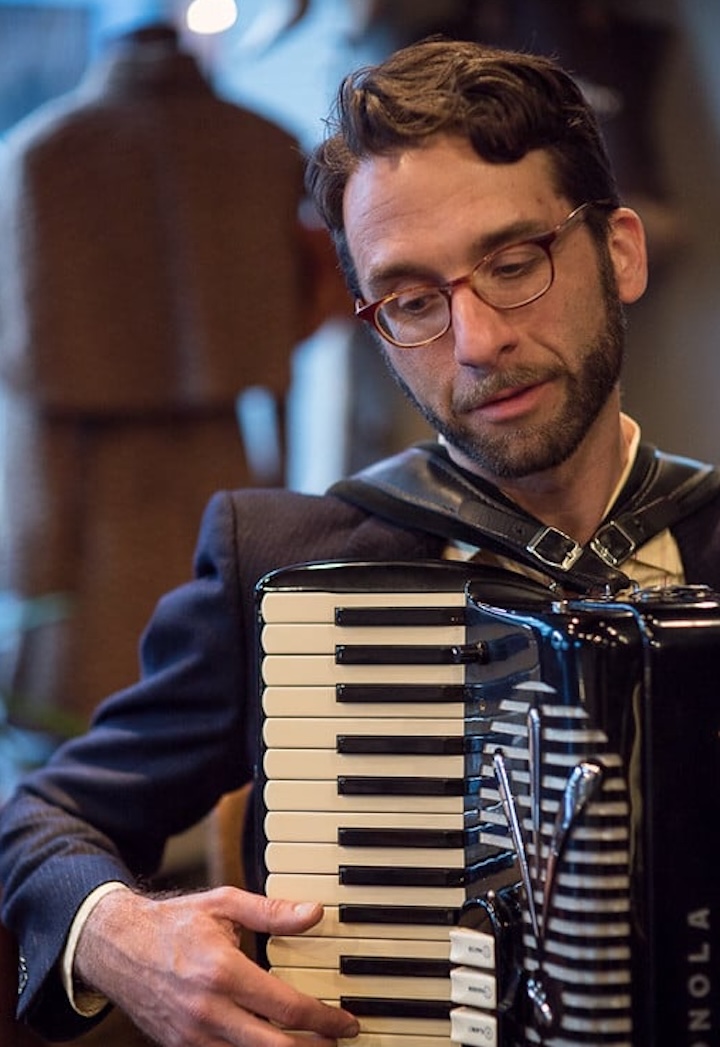
“Sometimes I find myself writing things for the circus I didn’t know I had inside me,” he said in a 2011 interview. “The action calls for it. The scope and range of the music is pretty wide. I definitely get into some sounds and styles that I wouldn’t do otherwise if it didn’t feel right for the act. Even on CD, it’s connected to the performance. Everyone in the circus has a trick. Ours is that we can be chameleons, showcasing all the different styles we can play.”
‘A king empath’
A large part of Reich’s musical life unfolded in the Mission, including recent residencies at Blondie’s Bar with the San Francisco Syncopators, which he co-led with saxophonist Ryan Calloway, and his own combo at the Liberties. He was a fixture at Revolution Café and Amnesia, where he played regularly with Gaucho for some 15 years.
Describing Reich as “a king empath” who “probably thought in music before he translated it into English,” Gaucho guitarist/composer Dave Rickets recalled one of his last musical encounters with him. Reich stopped by at Brenda’s French Soul Food in January without an instrument, “just stopping in to listen. We were conversing as the band was playing, and I gestured to my mandolin. He just sat down, picked it up and tuned it as he joined in and played this Monk solo on top of ‘Lady Be Good.’ He was such an amazing musician, and he loved every role in the group.”
It was at Brenda’s in 2016 that he met his partner for the past decade, Steph Solis, a longtime Mission resident. In a heartfelt Facebook post, she wrote of their first encounter: “I couldn’t help but stare as I ignored my chicken, he was so magnetic,” she said. “Then I caught his eye for a moment and he boldly returned the eye contact as he played, holding a gaze with me playfully for minutes straight. Those bright blue eyes, framed by incredible crow’s feet. It was an instant electric connection, out of the blue. I dropped my number in the tip jar — with a $20.”
Reich is survived by his parents, Richard and Linda Reich; sister, Heidi Reich; 15-year-old daughter, June Price; and partner, Steph Solis. A celebration of his life is planned for early June, with details to be announced soon.
Rob was an incredible inspiration – creative, prolific, playful – I have never met a better musician in my lifetime. I cannot think of a player more worthy of respect and admiration. But he was also just as inspirational on the human front – kind, gentle, funny, encouraging, enthusiastic, supportive. This is a huge loss for the community. He touched so many lives. My heart goes out especially to Steph and his family and all who were close to him. May his brilliant, warm, creative spirit live on in all of us through the music he gave us.
Thanks so much for this tribute. Rob was one of a kind, and an incredible asset to all of us. Kudos for publishing his story. He will be missed.
There is a GoFundMe for Rob’s 15YO daughter’s college fund: https://www.gofundme.com/f/support-june-mabel-prices-bright-future
So many amazing qualities to this man, but above all may be his ear.
His ability to hear and transcribe, in music and perhaps also in life – a sensitive, strong, and non-judgmental awareness of his environment.
A life worth admiring.
Very sorry for this loss.
A peaceful death in a place he loved, we should all be so lucky – though always too soon.