

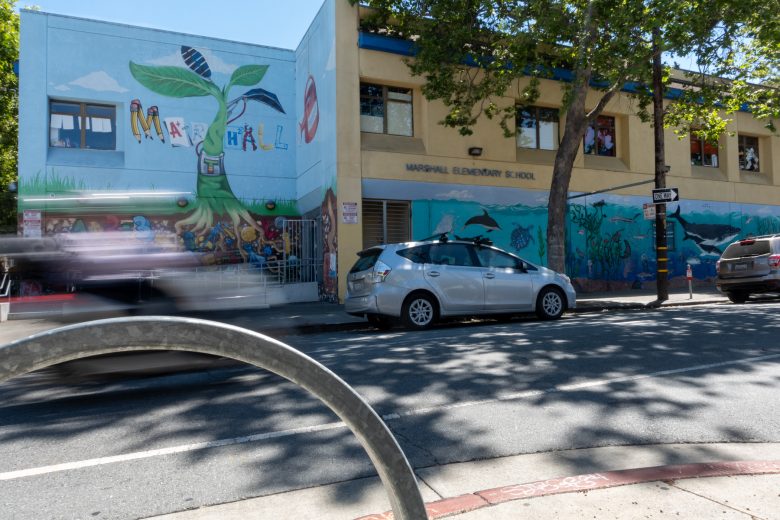
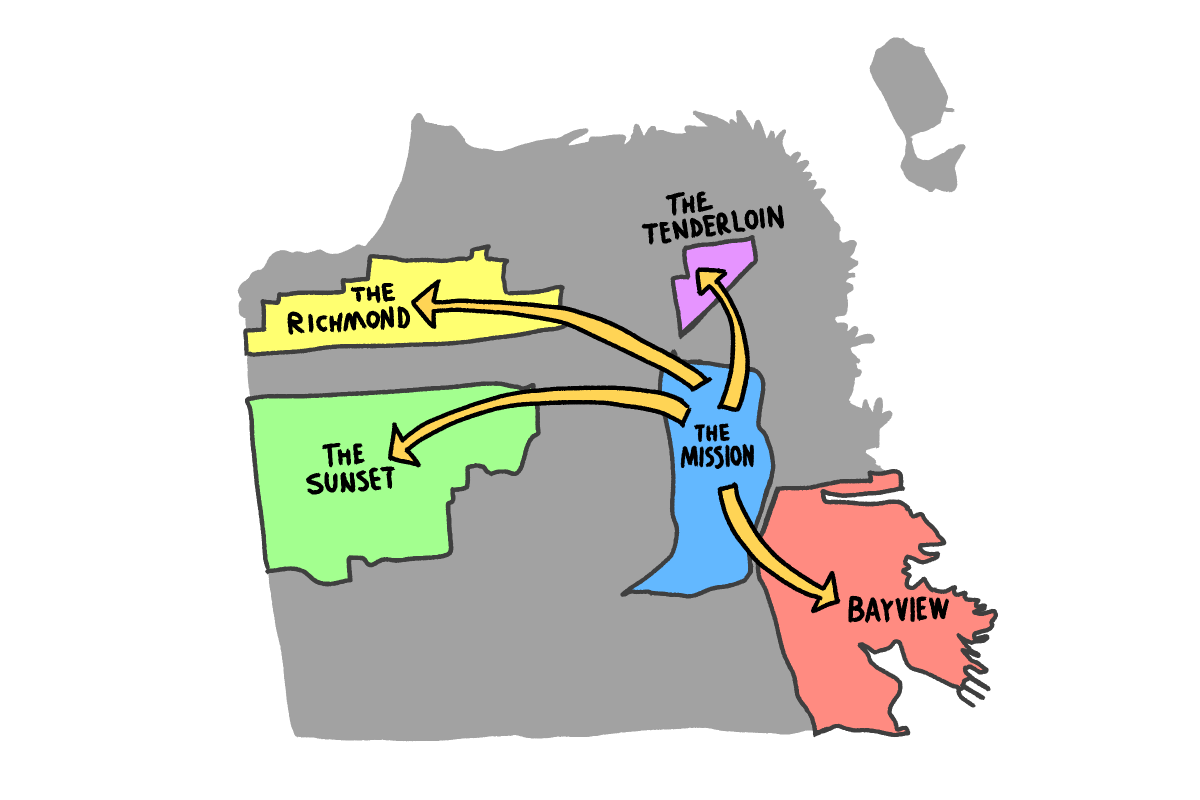
Mission District residents were posited a conundrum at a Thursday night meeting: Should 10 units be eliminated in a 100 percent affordable housing project, or should the units be preserved, but block sunlight for children at nearby Marshall Elementary School?
The community’s vote will be taken over three meetings and tallied at the end of the final gathering.
The changes proposed by Mission Housing and the Mission Economic Development Agency would slash three stories, or 10 units, of affordable housing at the 388-unit “La Maravilla” complex planned at 16th and Mission streets.
The newly proposed alterations are rooted in concerns over one of the project’s buildings blocking sunlight over the playground at Marshall.
A shadow analysis presented at a community meeting on Jan. 15 showed that one of the structures would block 95 percent of the sunlight from the school’s playground during winter recess time. The results created concerns for parents.
“We recognized the effect of the shadows over Marshall’s playground. We know this is important for parents and teachers,” said Dairo Romero, community planning manager at MEDA. “This is an important decision to have to balance. How do we build housing and, at the same time, allow children to develop and grow with everything they need?”
The units that would be slashed are all low-income, available to families making between 30 to 80 percent of the area median income. For a family of four, that would be between $46,750 and $124,700.
“There’s always pushback. This is why we have the housing crisis that we have,” said Sen. Scott Wiener on Friday morning, adding that while he understands the concerns coming from part of the community, the priority should be housing families.
“[The project] is right next to BART, and in the heart of the Mission,” he said. “This is where we should be maximizing.”
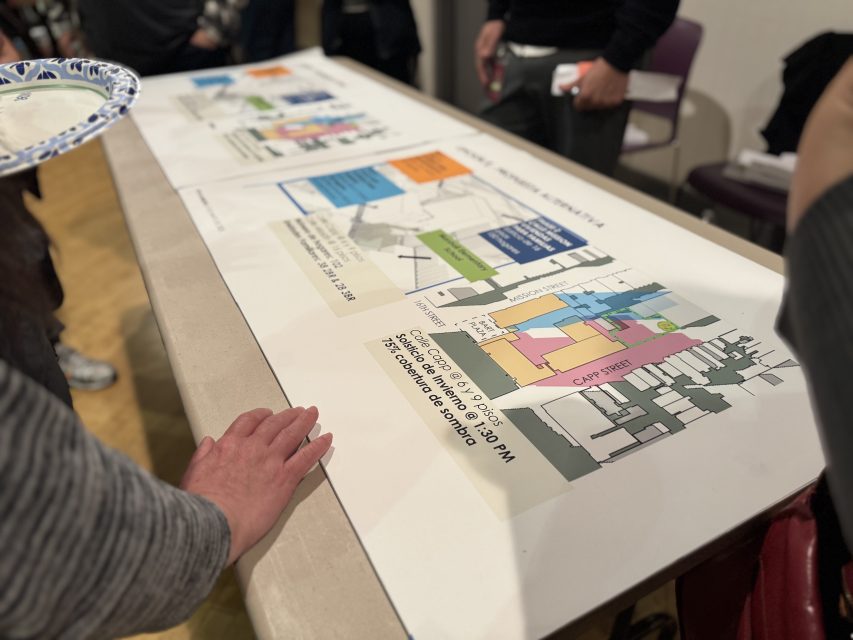
On Thursday night, in front of about 120 attendees at the Women’s Building, developers unveiled their updated version for the affordable housing complex that would reduce the shadow exposure on the playground by 20 percent.
The development is divided into three different structures: A 136-unit building of supportive housing on Mission Street, a 150-unit building for family housing on Capp Street, and a 112-unit building of family housing on 16th Street. The latter is the structure that would shadow the school’s playground, and if the community agrees, it would be reduced to a six stories, rather than a nine.
MEDA’s project manager, Laura Daza, said a peak in shadow-casting comes for about 45 days of the year, with its zenith in December. There is at least 95 percent of shadow exposure on the playground in the original plan, and 75 percent with the revised proposal.
Attendees broke into six groups and discussed further concerns, and asked both developers questions.
“We should think about the greater good, rather than our personal interest,” said a woman who spoke in support of keeping the units.
“This decision should be made by those who are going to be affected the most,” said another woman.
“We will have another meeting at Marshall with parents and staff later this month to hear their concerns,” a MEDA representative said.
Organizers reminded attendees that voting was not necessary today, and that they could take more time if they wanted to think a little more. Many, however, cast ballots even before the end of the meeting. It is unclear how the developers will prevent residents casting votes twice.
Currently, the developers are submitting an application to the state’s Tax Credit Allocation Committee for about $30 million worth of tax credits to complete the financing of the first phase of the project, the 136 units of supportive housing. If the funding is approved, construction could start by the first quarter of next year.
Two more meetings are planned: One for parents and staff of Marshall Elementary will take place May 16, and another for community members will take place June 5 at the Women’s Building.
After the meeting, planning commissioner Gilbert Williams reflected on the decision before the community.
“I think it’s going to be a tough decision for the community to make around the impacts on the school,” said Williams, who said he is not leaning any one way yet because he still needs to see more information.
“I came in late in the process. I feel like I don’t have enough information yet,” he added.
Your kids can get sunshine at the 16th Street BART Plaza.
If you wanted to create a parody about San Francisco, you could pretty much just present this article verbatim. Debating a “shadow analysis” that shows “a peak in shadow-casting com[ing] for about 45 days of the year with its zenith in December” (gosh, you mean when the 3-week periods around when sun is at its lowest point?), and anyone who shows up for a meeting can “vote” on it, apparently as many times as they want. With more “meetings” about it to come. And hundreds of units of 100% affordable housing are thus delayed and delayed.
“’This decision should be made by those who are going to be affected the most,’ said another woman.” Crazy process for a government administrative decision. But okay, then let’s let the families who will be denied housing if this project is reduced, and those waiting for construction to be completed, make the decision.
That’s always the funniest bit. Nobody gets input from the people who would live in those homes whether they’d prefer the homes aren’t built at all.
So the interests of 10 families who might live in the 10 units in question supersede the interests of everyone else?
the needs of the millions of people who would live in SF if we allowed housing construction should supersede the interests of the 800000 people who live here now
There are hundreds of millions who would live in San Francisco at some price. Why do you exclude them you selfish NIMBY?
When the “interests of everyone else” are actually the fabricated concerns of a handful of people about slightly less sunlight in one spot for a bit of the winter, the interests of people wanting a roof over their head absolutely supersedes it.
There are ~62 weekdays during the darkest 12-13 weeks per year, with ~18 holidays, leaving 44 actual school days. Add in rainy/cloudy days and there are likely 20-30 days with actual sunshine. SF has an average UV index of around 1.8-2.7 during this time, and you need a UV index over 3 to produce any meaningful amount of vitamin D. The fact that we are delaying and even thinking about potentially cutting affordable housing in a neighborhood that desperately needs it so kids get some weak sunshine at a time when they’re going to be bundled up in jackets and ski hats anyway is…well, just makes no sense. We’re in a housing crisis.
If this situation were reversed and somehow the new building was actually adding sunlight to the playground these same people would be complaining about increased skin cancer rates for their children to stop new housing.
Cutting 10 units off of hundreds in a trade-off with other legitimate interests in the neighborhood is stopping new housing?
Why is this even up for discussion? This is exactly an example of “too much democracy.” Whoever is in charge needs to put on their big-boy pants and make a decision, knowing they can’t make both sides equally happy — but keeping in mind that schools are closed for a good couple of weeks in December, so what are we really talking about?
We need to stop asking for permission to build homes. Nobody’s answer matters. The answer is yes.
Why not replace the northeast BART plaza with housing instead? That way we still get the much needed housing and the kids can have their sunlight. Plus the sooner that plaza is gone the better.
this is actually a great idea, not sure why its being downvoted… is there anybody out there who loves that plaza?
MEDAS shadow analysis also fails to represent clearly how much sunlight would be blocked additionally for those that live across the street from Marshall elementary along Capp St., the shadow would cast as far as those some living along 15th street. The proposed 16 Stories is taller than anything currently in the Mission. It really IS a bit much.
Sadly these meetings are structured in such a way that there is no way to comment on other aspects of the project- One major issue, very important to the neighborhood is that 120 units 27/7 supportive housing. Our neighborhood is completely saturated with this type of housing as evidenced by this situation found at the BART plazas. We are tired of our neighborhood being considered a containment zone– first the tenderloin, then SOMA, and Now this mission. Enough is enough. Affordable Mission Housing for families first!
So Mission Housing and MEDA unveil a large project plan to the community, and instead of asking “did we get this right?” and “is this what you want?” or “is there anything we are doing wrong?” they proceed from the premise that their proposal elicits affirmative answers to those questions (by acclimation as their intentions are good and pure) and then proceed to constrain the conversation to one that benefits the YIMBY, “do you want to trade units for elementary school playground sun exposure?”
As usual, the convo is being directed to one that posits residents as the obstacle, housing as the solution, and the quality of life for elementary school students, many of whom are migrants, homeless and kids of color as expendable. This would never be tolerated at a school that was mostly Chinese American.
Mission Housing and MEDA need to come back to the residents living around 16th/Mission with a blank slate, give we residents meaningful consideration in contributing to our neighborhood’s future that was absent during the Plaza 16 Coalition process, and work with residents as partners to make the best project possible for the most people. That nonprofits fear residents to this extent impeaches their claims to represent the neighborhood.
I do not recall The Marvel In The Mission including a permanent supportive housing component for substance and psych back in the day when I went to Plaza 16 Coalition meetings and The Marvel was proposed.
This is MEDA and Mission Housing serving its own needs over those of the community. Building affordable housing is the wheelhouse of CCHO’s business models. But in the same way that firms make money not selling razors once, but by selling razor blades over and over, the regular income for CCHO nonprofits arises from services, building maintenance or, more lucratively, substance and psych treatment.
Why do Mission Housing and MEDA fear Mission residents so much? Why don’t we and our new neighbors at 1950 Mission, 490 South Van Ness, Folsom/16th and Folsom/17th deserve special outreach as primary stakeholders who will have to live with what is build day in and day out?
Are non-SF residents allowed to vote in this process? Or will every nonprofiteer nursing at the City teat send their staff and clients to vote their way?
Are only residents near the project allowed to vote? Or will every YIMBY in the region pack subsequent meetings to vote for units over young scholars?
We have no idea because this is a wholly owned public engagement operation of two private corporations, they fear residents as opponents, and thus hold their cards close to the vest. The burdens of illegitimate leadership!
I won’t answer the question for others, but given that vitamin D deficiency is actually a thing, Wiener’s housing above all else is obnoxious. Just because he can rent an electric clam for a suntan or go to a tropical island for his vacation, doesn’t mean kids don’t need sunlight.
There are plenty of places to build, including on toxic dumps. Is that a place he would like to build housing? Would he move to an apartment there.