
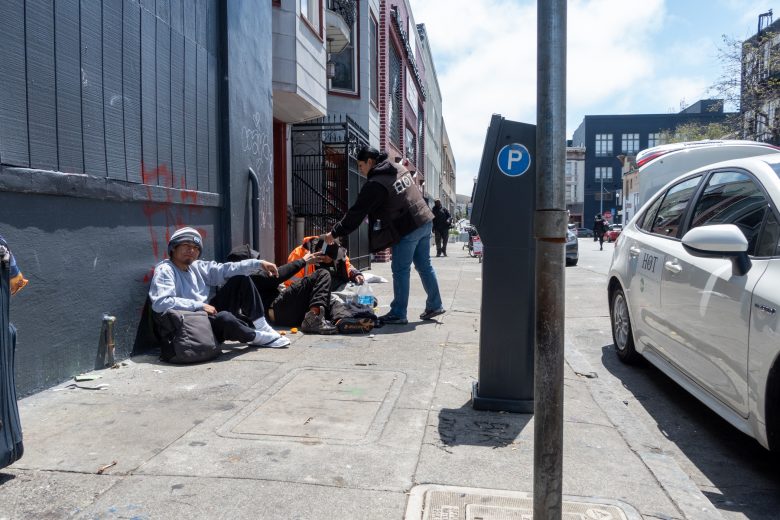

San Francisco has changed its response to drug use and homelessness under Mayor Daniel Lurie’s administration, creating collaborative street teams that work across departments to tackle troublesome behavior.
Now, Lurie wants to know if it’s working.
In a 30-day progress report released Friday, the mayor’s office said it was “refining” the indicators it uses to evaluate the impact of its street teams. These teams, rolled out in March, are led by city staff and police officers who do everything from responding to 311 requests to helping homeless people find shelter.
Right now, the city has preliminary data, like the number of shelter beds set aside for street teams and the connections made by the teams to medical, mental health, or substance use services.
In their first 30 days, the street teams filled between 79 and 98 percent of the shelter beds they were allotted, for instance. They connected 977 people to medical, mental health, or substance use services, and took 447 people “from streets into care indoors.”
But Lurie’s office is requesting more data to show what happens to people after they’re first contacted. The data will be key as the city looks to expand the use of the teams.
“The launch of the Neighborhood Street Teams marks a fundamental shift from previous service silos to an integrated, neighborhood-based, multi-disciplinary model,” read the report.
The city currently has three teams: One in the Mission, one in the Tenderloin, and one roving around the city.
Over the next month, the city will add three more, connected to police districts: A team for Bayview and Ingleside, a “Southern/Central” team covering SoMa up to North Beach, and a Westside team covering the Richmond, Park, and Taraval police districts.
Each is led by the Department of Emergency Management and the San Francisco Police Department. Previously, the city’s response to public drug use and homelessness was mostly siloed by department.
The report comes the day after a board hearing where District 9 Supervisor Jackie Fielder lambasted city officials for failing to explain how they define and measure success in tackling homelessness and public drug use.
“I see genuine efforts to do something different,” Fielder said. “But we have to be able to tell San Franciscans: What are our measures of success?”
Today’s report did not offer a complete answer.
City staff appear happy with the reorganization: “We have observed faster, more flexible responses, as well as stronger coordination leading to successful placements and interventions,” according to the report, put together by two of Lurie’s policy chiefs: Kunal Modi, who oversees health, homelessness and family services, and Paul Yep, who is in charge of public safety.
But there is less data to show what effect that reorganization has had on the people it is meant to help.
The street teams did the following in their first 30 days:
- 79 percent of allocated “congregate beds” — those in traditional shelters in large, shared rooms — were used.
- 95 percent of navigation center beds — similar to congregate shelters but typically have more privacy and more services, and often allow partners to stay together or people to bring in pets — were used.
- 98 percent of “non-congregate beds” — single rooms, generally held for the most high-need people living on the street — were used.
- 70 drug treatment beds were used.
But it’s difficult to make sense of the numbers, and to know whether they show an improvement on past performance, because it’s such a narrow sample of shelters, said one former city official.
Other metrics the administration shared:
- 977 referrals to medical, mental health, substance use services.
- 447 people “brought from streets into care indoors.”
- 22 people used the Journey Home busing program.
What was clear in the report, and from city officials’ public statements, is that the city needs more shelter beds.
“Most days, the available beds that we have to offer are gone before lunchtime,” said Mark Mazza, who manages the Tenderloin streets team in the Department of Emergency Management, at a press conference last week.
Lurie has made cleaning up San Francisco’s streets a top priority. Reorganizing the city’s response is one of the key ways he’s doing that. He has also established a round-the-clock police presence at the 16th Street BART Plaza, and he has solicited private funding to support his efforts.
To that end, last week Lurie announced a $37.5 million fund from donors to help address homelessness and drug use, including building more shelter beds.
But one key frustration with the city’s policy is that it’s unclear whether the Lurie administration is actually moving people off the streets and into housing or treatment, or simply shuffling the unhoused around the city. That’s what Fielder’s questions were hinting at on Thursday.
The city’s efforts to cut down on overt drug use at Civic Center, in SoMa and in the Tenderloin, for example, pushed people to area around 16th and Mission streets, city officials have acknowledged.
The police presence at 16th Street may have cut down on drug use there, but as a consequence, troublesome behavior has spilled over into nearby side streets and alleyways.
How can San Franciscans know, Fielder asked, that people who need help are actually getting help, rather than being shuffled around?
Mary Ellen Carroll, the executive director at the Department of Emergency Management, said finding the right metrics is difficult: “The ultimate sort of measure is how our neighborhoods look and feel to the people that live and work in them. And that is something that we have struggled with; how do you measure that?”
There are two metrics that are already proving troublesome, though.
One is direct exits from homelessness. This is a measurement that combines unhoused people being put in housing with other programs such as busing people out of San Francisco.
There has been about a 35 percent drop in this measure between January and April of this year, compared to the same period in 2024. (Some of this is because of resources; the prior administration happened to have an influx of funding for housing.)
A second metric is drug overdoses. After 14 months of declining overdose deaths, the city’s fatal overdoses are on the rise again. In March 2025, San Francisco reported 65 accidental overdose deaths. That’s up from a low of 37 in October.
“This is about saving lives, restoring dignity, about responding to the reality on our streets,” Fielder said, on Thursday. “Not sweeping it from one block to another.”
We need hard copy data on whether addicts are homeless or not, whether they live in San Francisco or not and whether people want services or to be left alone and what the plan is for the latter, which might apply to the majority of addicts.
If the majority of addicts are neither homeless nor from San Francisco and do not want help, then let’s cut to the chase.
Every morning I wake up. I read this site. I read the Chronicle. I check out r/sanfrancisco.
The first five words out of my mouth are “Thank God Lurie is Mayor.”
Thanks for reporting
Things are dramatically different since Lurie has taken over .
Hard to comprehend what Breed and her administration did with all the money and resources spent on this?
She was a dissapointment and arrogant.
Not effective .
Am hopeful, Mr Lurie will continue to work hard show to help the homeless and illegal drug activity in this city .
The real victims are the citizens who’s concerns have been ignored for years .