

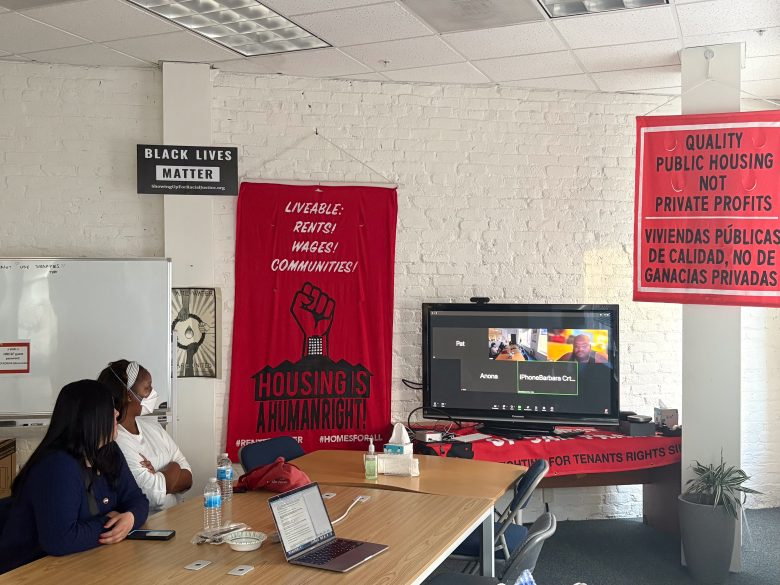

As the city braced Thursday night for the mayor’s budget proposal a couple of tenants from a Fillmore low-income housing complex gathered at 11 Grove St. — just a five-minute walk from City Hall — to strategize how to draw attention to living conditions they have described as “atrocious” and deplorable.
“We were under the radar for so long, people were getting evicted and everything,” said Pat Cochran, an organizer for the tenants at Thomas Paine Square Apartments. “What can we do now to use this momentum?”
Cochran was referring to Mission Local‘s coverage of Thomas Paine Square Apartments, which documented how the tenants feel neglected by Bethel AME Church, their landlord, a historically Black church in the Fillmore.
“What do we do next?” Cochran asked the four tenants who attended the meeting.
Even though they live across from the church, tenants say that there is so little they know about their landlord or the seven-member Board of Directors that oversees the complex.
What they know is that Bobby Sisk, a steward of the church, sits on the board along with the church’s pastor Cecil Williams, who is the board chairman. But reaching them will likely take some city intervention.
In the meantime, they are working on figuring out the names of the seven board members, their roles, and their relationships with one another. The hope is that once noticed, the board will do something about the mold infestation and asbestos. But so far, their May 2023 demands for comprehensive asbestos testing has gone unanswered.
When Mission Local asked if the board planned to meet with tenants, Sisk wrote in an email “This is a board of directors’ matter, and at this time, l have not been authorized to respond to any outside concerns.”
Isaac Santiago, an organizer at Housing Rights Committee, a tenants rights group that has helped the tenants over the years and hosted the Thursday meeting on Grove Street, asked the tenants what they would ask Sisk if they sit down with him.
“Aside from maintenance, one of the things to ask is for a tenant to be on the board again,” Santiago suggested.
The lack of response from the landlord spurred them to ask City Hall for help. The only breakthrough so far was a May 16 meeting at City Hall with Supervisor Bilal Mahmood, who represents the Fillmore. The three tenants were joined by tenants from other problematic apartments across the city.

Anone Lee, a tenant and a resident leader of the Thomas Paine tenant association, was one of the three tenants who attended the meeting with Mahmood and two aides. The supervisor listened to everyone as they shared their stories.
“He seemed like he cared, but he didn’t promise anything,” Lee said. “He didn’t say when the next meeting will be.”
Mahmood’s office confirms that the supervisor is committed to discussing the tenants’ concerns with the Mayor’s office and scheduling a separate meeting between the mayor’s office, his office, and the tenants.
It’s unclear when that meeting will happen or what they can do without involving the project’s landlord. At present, Mayor Daniel Lurie is focused on his first-ever budget proposal that’s presented today at City Hall.
While waiting for the budget season to pass so that they can get attention from City Hall, tenants hope they can get more tenants at the complex to engage in their fight.
Cochran and the tenants acknowledged that it can be draining to “keep up the fight.” Cochran said that so far, only 10 or so tenants are actively organizing under the tenants association — a sharp decline from its prime in mid-2022 when 46 residents signed a formal letter demanding change from the ownership.
Only four tenants attended Thursday’s meeting — a low turnout because the meeting was not taking place on site at the complex but at the Housing Rights Committee office. “We should have dropped the flyers a few days earlier and we only got the texts out on Wednesday [for this meeting],” Cochran said. Tenants are hoping to do more door-to-door outreach to get more tenants actively involved.
Lee has some hope that Supervisor Mahmood will make a difference. “It is time for him to do what he needs to do to help those of us who live in the district,” Lee said on May 19. “Hopefully that will happen, but I don’t know.”
This is one of the big problems with low income housing in general. Residents have no ability to move if the conditions are substandard and so landlords are heavily incentivized to let the buildings decay. Even if the owners want to fix the problems: the cost of any kind of maintenance is prohibitively expensive and what’s coming in from the tenants might not even cover the needed repairs.
If landlords don’t have the means to maintain their properties, they have no business being landlords. Of course, slumlords love to cry poverty, using your argument as a rationale. Others weaponize it to provoke rent-controlled tenants to move out (looking at you, Veritas!).
I mean, that’s kind of what I’m saying. If the city wants there to be low-income housing then the city probably should just run those units themselves instead of trying to get landlords to maintain units at a loss. Slumlords are pretty inevitable in this situation because their tenants CAN’T move out without losing their rent-controlled housing.
I’m curious what you think a landlord should do if they own a rent-controlled property that doesn’t bring enough rent in to cover management + maintenance + taxes, become a charity? I don’t like it when people do things that are selfish, but it seems like it’s in the best interest of anyone who owns a rent controlled property to let it decay: you make the same income either way.
The city ran their own housing and it was …. ATROCIOUS! Corrupt and incompetent. “Four people, including three current and former San Francisco Housing Authority employees, were indicted yesterday on bribery and conspiracy charges following allegations that they sold federal housing vouchers. The federal grand jury indictments come after an eight-month FBI probe into corruption within the housing authority. Two dozen people have been implicated in the scandal”. THIS CITY IS RUN BY PHONIES WHO CLAIM TO CARE, BUT REALLY JUST STEAL ALL THEY CAN !
Typically they just sell the building at a relative ‘loss’… and some big property management company comes in and one-way-or-another evicts everybody and starts over after renovations. At least that’s how it used to be. Then they’re back at the market rate and they start doing as you describe all over again.
I believe you’re right that that’s a common strategy. Let the building fall into disrepair, pressure tenants to move out one way or the other, then fix it up so you can rent at market rate or at least a higher rent-controlled rate.
As far as I can tell, this is an intractable problem with privately owned rent-controlled units, and to a lesser extend privately owned subsidized units.