
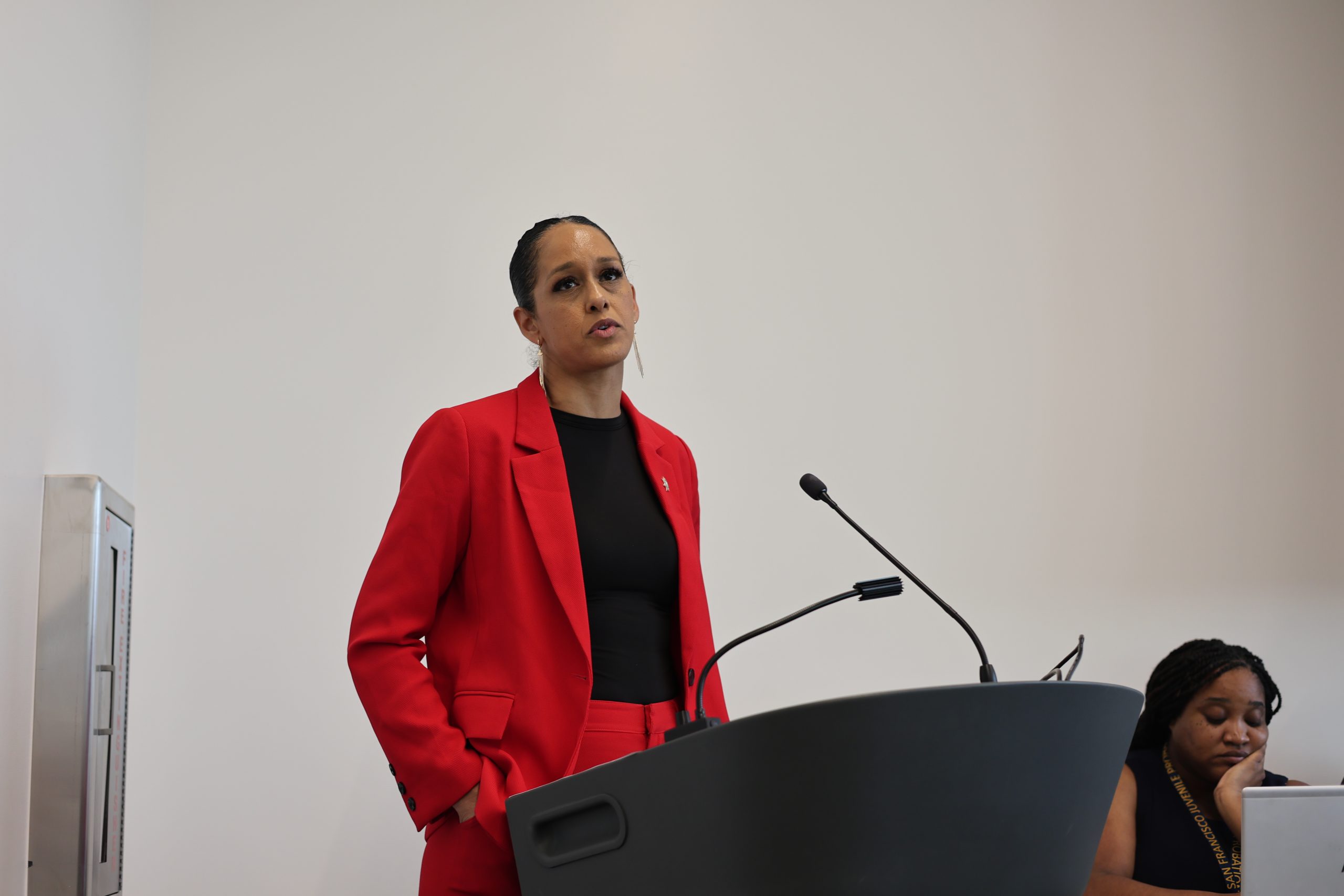

In the face of San Francisco’s $818 million budget shortfall and a directive from Mayor Daniel Lurie for all department heads to devise 15 percent cuts to their budgets, District Attorney Brooke Jenkins said: Absolutely not.
In a hearing Wednesday at the Board of Supervisors Budget Committee, Jenkins asked for a $2.9 million increase in her department’s budget for the 2025-2026 fiscal year. That’s about a 3 percent raise. Under the mayor’s proposed cuts, the DA’s budget would fall by $5.4 million, an $8.3 million difference.
Jenkins needs the funding bump, she said at the hearing, to cover already-negotiated salaries and benefits which, added together, make up 77 percent of the DA’s budget. If she imposed the mayor’s cuts, she added, she would have to lay off 25 prosecutors, a move that, Jenkins said, “would essentially gut our misdemeanor unit and our preliminary hearing unit, as well as three narcotics lawyers.”
“We are a city bogged down in low-level crime,” Jenkins said. If her department is unable to continue with its current pace of prosecutions, “We will see a lack of accountability that moves us backwards in many of the issues we’re working hard to resolve on our streets.”
In the last year, Jenkins has lambasted judges who divert offenders into mental health programs, and has charged more misdemeanor cases than in any year in more than a decade.
Today, a state prosecutor handling misdemeanors in the district attorney’s office has, on average, 186 open cases, Jenkins said. Those handling general felonies have an average of 69. If the cuts went ahead, Jenkins said, “I would have to say, right to all of you and to the mayor’s office, ‘Well, then what should we not prosecute?’”
“You mentioned 186 cases per [assistant district attorney] for misdemeanors,” asked District 4 Supervisor Joel Engardo. “That sounds like a lot, but what does that mean? In the best-case scenario, what would be a caseload?”
Misdemeanor attorneys should have “closer to 100 cases,” Jenkins responded, adding that 186 open cases at once “far exceeded” her caseload when she was a misdemeanor lawyer in the office of then-DA George Gascón. “The workload has to be manageable when you’re talking about someone whose licence can be stripped from them if they make mistakes.”
“We’re a city that has an excessive volume of lower level crime … if we don’t address it, our city will continue to decline.”
DA brooke jenkins
What about that average of 69 felony cases, asked Engardio. Jenkins responded: “They would tell you it’s a lot.” She added when she worked in felonies, the department was “configured differently,” and the number of cases she dealt with was “too much then,” but that 69 cases is more than the public defender’s average of 65.
Others dispute whether those felony numbers really are outliers, or how much can be extrapolated from those numbers at all.
Ryan Khojasteh, a former prosecutor in the district attorney’s office who ran against Jenkins last year, told Mission Local he had closer to 150 felony cases at a time when he worked for former District Attorney Chesa Boudin and, briefly, for Jenkins, when she was first appointed to the role. Jenkins later fired Khojasteh in 2022, as part of a wider staff overhaul.
A prosecutor at another Bay Area district attorney’s office told Mission Local that listed averages don’t tell much about workload. What’s more relevant is “how complex the cases are, how many are active at any given time, or how busy the office is as a whole.”
At the budget hearing, Jenkins argued that cases at the DA’s office are getting more complex, and that it’s taking longer to resolve misdemeanors and felonies. In 2024, she said, it took an average of 574 days for a misdemeanor case to be resolved, up from 184 days in 2014. For felonies, it was 591 days on average, up from 213 in 2014.
San Francisco’s crime rate is at historic lows. Violent crime in 2024 dropped to levels not seen since 1961, and even property crime is falling. Yet many San Franciscans, including some who turned up at Wednesday’s hearing, said they wanted the streets cleaned up, and the district attorney’s office to have the money to do it.
Jenkins echoed their sentiments: “We’re a city that has an excessive volume of lower-level crime, to the point that it has impacted our economy, it has impacted families’ abilities to move about and feel that they’re safe. And if we don’t address it, our city will continue to decline.”
This stance is par for the course for the DA, the public defender, the sheriff, or any elected official, said former city controller Ed Harrington at a Mission Local event Tuesday evening. “There’s no benefit for them to cut their budget. Their staff will hate them.”
Rather than interpreting this as outright defiance, a move like this is “just elected officials doing what elected officials do.”
True to Harrington’s analysis, San Francisco’s elected public defender, Mano Raju, also turned up at today’s hearing, even though the hearing was about the district attorney’s budget. Supervisors questioned him anyway, prompting Jenkins to ask, “Can he have his own hearing?” before ceding the microphone.
Raju’s approach to the subject at hand was to be expected. “We do have a very urgent need for funding,” he said of his own office, in response to questions from Supervisor Shamann Walton.
Why does the public defender need more money? Because it has to defend the additional cases Jenkins is prosecuting: The public defender’s office, Raju said, has seen “a significant increase in arrests and charging.”
It was recently revealed Jenkins is violating the sanctuary city ordinance and turning people over to ICE, and I think that needs to stop before we even consider such a request.
https://indivisiblesf.org/blog/stop-da-from-cooperating-with-ice
Ah, yes, shielding illegal immigrant fentanyl dealers from federal enforcement and deportation. That’s a winning political strategy.
If they’re dealers they go to PRISON _before_ deportation, or do you think they should just be let go and we shouldn’t have our DA follow laws on the books?
(Trumpies don’t think things through, get well soon.)
We have any number of people living on the streets of San Francisco, in tents, in cars, and in campers, with no money, jobs, or prospects, and, we don’t even know who they are when they entered the country, perhaps, without a valid passport or ID, and without applying for or containing a visa, perhaps on the false premise that they are a political asylee. And, what is the proposal? Arrest them if they commit a crime and then turn them loose because we can’t afford to keep them in jail for habitual petty theft, public drunkenness, misdemeanor assault; what is your proposal, “housing first?”
Nice “devil” outfit though, liar. Stylin.
Hunh. The rules and the law just don’t apply to crooked, money grabbing Brooke Jenkins. SFPD exceeds its budget year after year after year. Jenkins and SFPD are among the highest paid in the nation with the most abysmal performance records to boot. Crooked Brooke and money grubbing, overtime abusing cops will bankrupt this city because new Mayor Lurie and new supes let them. Shameful.
We could save some money from getting rid of Jenkins, right?