

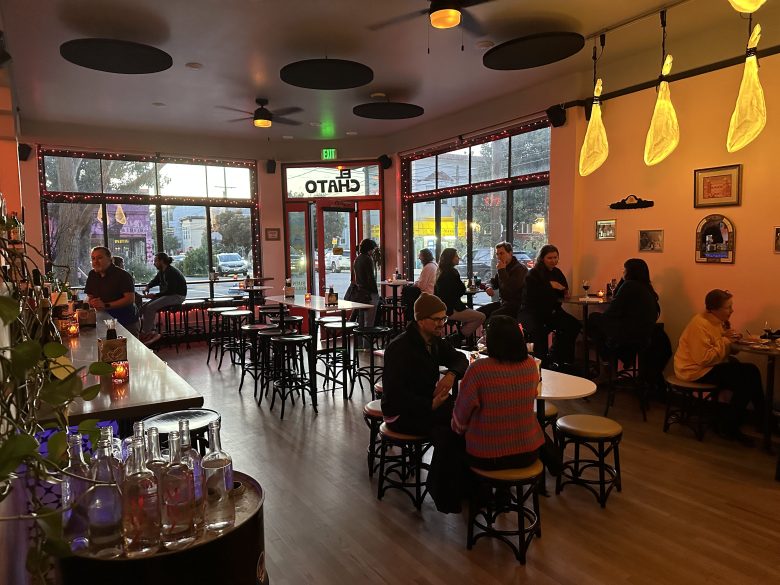

It’s spring in the Mission, and the days are finally stretching their legs. That golden-hour glow, the one that used to be gone before you even left work, is now hitting at a much more respectable time. On the corner of 21st and Bryant streets, El Chato eases into the evening, opening its doors at 4 p.m. but truly coming to life around 5. Inside, the air is warm, the wine is flowing, and the line between regulars and newcomers dissolves as quickly as the first sip.
Nearly three years in, the Spanish-style taberna has become exactly what owners Rafa Sáenz and Erin Rickenbaker promised: A no-nonsense, daily fiesta where every glass of wine is an invitation to let loose and live a little. Or live a lot, especially if you find yourself on the receiving end of a porrón.
Recently, Erin and Rafa were mid-explanation about the art of the porrón, a traditional drinking vessel — narrow neck, wide base, long spout — when a neighborhood regular strolled in, dog in tow, ostensibly just to say hi. Claudia Deveze, an electrical engineer by day, quickly found herself roped into a live demonstration, tilting her head back as a stream of Galician white arced toward her mouth. The porrón, passed around in moments of camaraderie (with the occasional miscalculation), isn’t just a party trick.
“It’s something to share, like a bond,” says Rafa, a Madrid native. “It’s an act of trust.”Away from the heavily-trafficked–and higher rent–Valencia Street, El Chato offers an atmosphere that, as Rafa says, is more tranquilo. The taberna observes the Spanish tradition of the 5 p.m. vermú, a vermouth that is less about chugging and more about stretching out the pleasure of a drink. It’s a slow, social kind of drinking, the kind that pairs best with unhurried conversation, a little something to snack on, and the understanding that there’s no rush to the next round.
Vermú
In the early days of planning El Chato, Erin, an East Bay native and Rafa’s business partner, kept circling back to one question: “Should we put sangría on the menu?” It wasn’t exactly her drink of choice, but she knew it was fun, familiar and, most important, a moneymaker. At Bellota, the Spanish restaurant where she and Rafa first met (and which closed last year), she’d watched tables order pitcher after pitcher, drowning out the wine list she had so carefully curated. Still, the financial upside was compelling.
“One day, I just woke up in the middle of the night and said, ‘We’re not doing this,’” she said. Instead of sangría, she opted for vermouth, sherry, and Madeira, fortified wines that have long played starring roles in Spanish drinking culture.
“The first time someone ordered a bottle of vermouth for the table, I asked, ‘What made you do that?’’” she recalls. The answer: “It was the first thing on the menu.”
And so, the menu now opens with a list of 20 vermouths (two on tap), 14 sherries and three Madeiras, with prices ranging from $9 to $20 for a 3-ounce pour in the short glass known as a “chato,” a nod not only to the vessel but also to the Spanish and Latin American term of endearment, which the owners embraced when naming the bar.
They found an audience willing to give Spanish vermouth a chance. Less bitter than its more medicinally-inclined Italian variety, vermú is defined by its notes of citrus and spices, more obviously made for drinking on its own rather than mixing. “And now, people get to experience something that is Euro culture but distinctly Spanish,” Erin explains. The buffer zone between work and home, the time for an aperitivo before dinner, is vermú hour. It’s time to just hang, share a few bites , whether it’s a tortilla, anchovies or a traditional cheese table, and perhaps check the shelves for options to take home. Or jump directly to wine time.
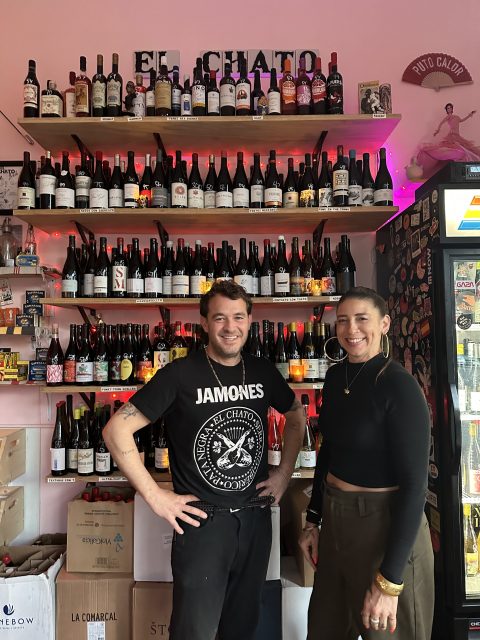
Spanish wines are the backbone here; Erin spent a harvest there, after all. But she refuses to let the list get stuck in Rioja and Ribera del Duero. Instead, she digs into the small producers, the natural winemakers trying new things. Beyond Spain, the selection expands to Eastern Europe and Latin America, grouped in the shelves with cheeky tags such as “rojos con cuerpazo” (“reds with yuge bodies,”) “suavesuavecito,” and “yo perreo sola.”
Erin buys in small batches, which allows customers to sample lean whites, chilled reds, and fizzy pét-nats.
“There’s people that come frequently, and I don’t want them to drink the same thing every time,” she says, a Slovenian sparkling red in hand. She’s happy to enlighten less-sophisticated drinkers. “I hate bars that make you feel weird or embarrassed for knowing nothing about wine.”
While Erin keeps the wine list, Rafa handles the rest: The food, the music, the art (jamón-shaped lights included), and the general “buen rollo.”
Communal spirit, playful chaos
El Chato’s calendar features weekly live music, Flamenco nights and a guest DJ on Sundays. At other times, it is Rafa’s playlist on the speakers, from classic rumbas to Brazilian bossa nova to the catalogue of romantic ballads in Spanish that the whole of Hispanoamérica affectionately calls “music to iron to.”
“Songs that came out when I was a tween and all I wanted to listen to was Guns N’ Roses,” he explains. “Yuri, Camilo Sesto, Juan Luis Guerra; music that is well done.”
The approach is paying off, attracting customers as varied as the vermús.
“When La Doña drops in and tells me she feels at home, when I see the lowrider cholos swapping stories with the Spanish expats over a glass, I think: Yeah, we did something right.”
Nice article! A great place too.