


Nine months into a two-year pilot curfew on certain stores in the Tenderloin, San Francisco police officials said today it has been effective in its goal of reducing street loitering and crime in areas of the neighborhood.
And they want it to keep going: Commander Derrick Lew, speaking today before the Board of Supervisors’ Public Safety and Neighborhood Services Committee, presented a heat map showing a decrease in incidents of crime in the 20-square-block area where the curfew has been in effect for nearly a year.
“My recommendation would be to absolutely keep it going,” Lew said. “Of course, we would like to get to the point where we can lift this type of legislation, but I don’t think we’re there yet.”
No action was taken on the ongoing curfew, and the item was continued to a future, undetermined date, when supervisors may reassess the pilot program.
The curfew, which was adopted last July, imposes a mandatory midnight closing time on many corner stores and smoke shops but does not impact liquor stores. The Tenderloin, which has no full-service grocery store, has a high concentration of small liquor stores, smoke shops, and mini-groceries, many of which were open late into the night. Groups of people would gather at night on the lit street corners, and drug activity and illegal vending often proliferated.
Store owners, meanwhile, have been frustrated with the loss of business after being forced to close their doors early.
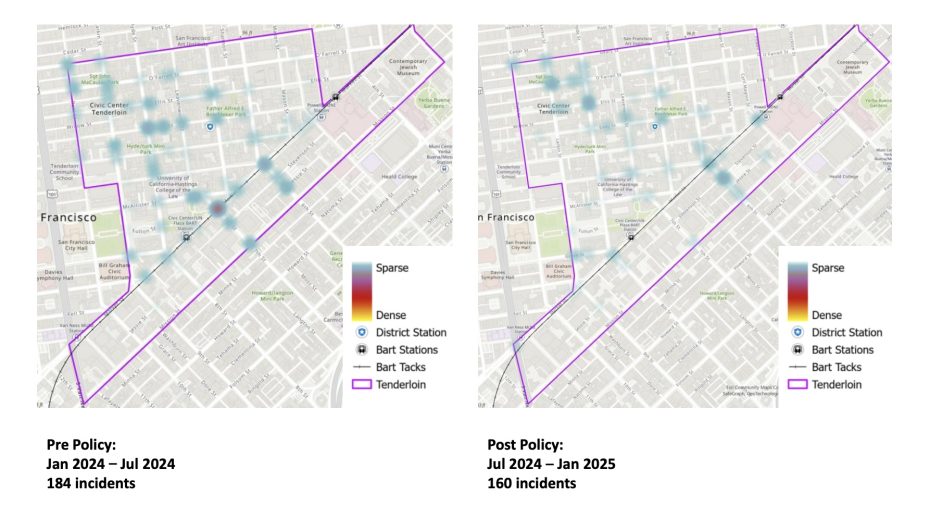
But it may be having a beneficial effect: Assaults and narcotics incidents dropped slightly, and non-fatal shootings decreased from four to one. There was one homicide within the zone, compared to none in the six months before the pilot.
The number of calls for police service through dispatch, however, stayed roughly even in the six months before the pilot began and in the six months after. Overall police service dropped, however, due to a decrease in officer-initiated actions.
In the wider Tenderloin police station boundaries, non-fatal shootings dropped off significantly, while homicides stayed the same and other shootings increased. Other crimes, like assaults and narcotics-related incidents, decreased slightly.
Stores violating the curfew, upon observation by police, are fined up to $1,000 by the Department of Public Health.
Jennifer Callewaert, the assistant director of environmental health at the Department of Public Health, reported that the department has issued eight violations to stores breaking the curfew, and that four of those violations came from a single store.
The supervisors discussed the possibility of expanding the curfew to surrounding areas like Sixth Street, but that would require further police staffing.
About 20 people spoke in support of the curfew and the changes in street conditions. But business owners have also told Mission Local that the rules, which allow liquor stores to continue operating, are unfair and hurt their business.
Sam, an employee at Rainbow Market and Deli on Larkin Street, said the store, which sells fresh food and groceries and has a deli counter, used to be open until 2 a.m. The early closure at midnight caused the store to lose almost 20 percent of its business, he said last month, and people still congregate on the sidewalk outside the store, even when it’s closed.
“We have a lot of people upstairs that have a lot of anxiety and don’t come out during the day,” said the clerk at another store, who declined to give her name and explained that she brings basic food items to the neighborhood. “They can’t do that no more, because we’re not open.”
“In the wider Tenderloin police station boundaries, non-fatal shootings dropped off significantly, while homicides stayed the same and other shootings increased. Other crimes, like assaults and narcotics-related incidents, decreased slightly. ”
If I understand this correctly, the stats within and outside of the zone are not significantly different. How can anyone supportive of the curfew attribute the changes to this policy when the stats changed similarly where the policy wasn’t in effect?
Because copaganda works.
Well look at it objectively, IT IS UNFAIR to the businesses. They didn’t sign up for that when they signed their leases and there’s no legal recourse for them. Criminal elements plague the entirety of downtown all day and all night, but it’s the businesses trying to scrape by and make their commercial rents who are penalized?
If it were some kind of limited emergency measure for a few days while SFPD got its act together for sweep enforcement, maybe that would be acceptable, but just a blanket curfew over a legitimate businesses operation that’s already struggling?
Meanwhile they want to keep BARS open until 4am in the same areas, no less? How is any of this equitable to these legitimate businesses? If they’re individual problem stores that are selling paraphrenalia or facilitating gambling or something, that’s another issue. Is this really the plan, to close businesses down by force anytime a group of drug users nests nearby, rather than actually patrolling and ensuring our streets are safe?
“Stores violating the curfew, upon observation by police, are fined up to $1,000 by the Department of Public Health.”
Well at least the police are doing SOMETHING to earn that paycheck, right?
“This is fines.”
Great points to consider
“but does not impact liquor stores”
Yeah make that make sense.
iirc it’s because state liquor store regulation supersedes the city’s ability to regulate liquor store closing times
No wonder businesses are closing like mad in San Francisco. They won’t punish the vandals, vagrants and drug addicts. But they will punish the business owners… MADNESS !
Liquor stores are not affected by the curfew…
What a sick joke.
Typical San Francisco policy.
Notice that SFPD’s “heat” map does not show the 20-block area where the curfew is in effect. The map they provided includes approximately 60 blocks. Additionally, the map includes areas that are not “the Tenderloin.”
For rhetorical effect or convenience or something, SFPD’s map has colonized/annexed/angeschlossen/Greenlandified nine blocks of SOMA and a chunk of Civic Center. Yes, these boundaries are artificial and permeable, but I wonder if the Contemporary Jewish Museum will start marketing itself as a TL culture/history center, even though its block apparently has no crime whatsoever. Is the new city office building at 11th and Mission “really” in the TL – despite its utter lack of crime according to both the before and after maps? What about the apartments at Mission and South Van Ness? I don’t know how late shows run there, and it is in fact just “TL adjacent” on the maps, but Bill Graham Civic Auditorium seems to cause crime too, so APE might need to adjust their hours at that location.
Because it doesn’t delineate the zone of prohibition, SFPD’s map reveals very little about the curfew’s effect. The map does show, however, that crime has gone up in certain spots – 6th and Stevenson (Supervisor Dorsey’s district, for anyone who still wants to say everything is former Supervisor Preston’s fault) and Fifth and Market (part of which is in Dorsey’s district and the rest of which is in D3), where crime has become more common. In any event, the entire map shows only sparse crime activity in a score or so clusters that are relatively evenly spread across the “larger” Tenderloin.
I don’t grocery shop in the Tenderloin so the curfew doesn’t bother me.
What a necessary thought to have out loud. “Other people exist?”