

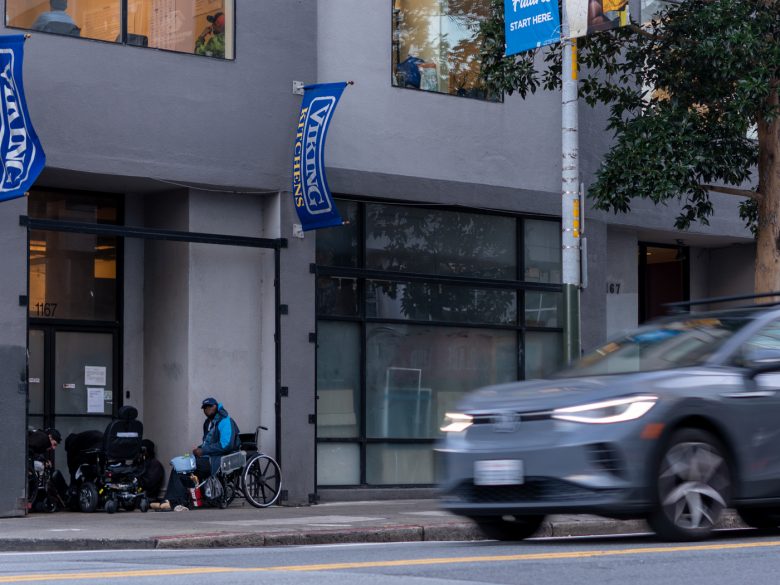

When Theris Coats failed to make it from his San Francisco hospital bed to a sobering center in February, and wound up dead in county jail a few weeks later, his father, like any parent, wanted someone to blame.
Coats, or “TC,” was in the throes of addiction and in a wheelchair with an amputated leg. He was just a few days sober after a stint at St. Francis Hospital. Medical staff, his father said, had released TC and put him, alone, into a taxi headed for San Francisco’s Medical Respite & Sobering Center at Eighth and Mission streets to dry out.
He never made it there. He wound up back on the streets, his family believes, and a few weeks later was arrested on an outstanding petty theft warrant. He was found dead in his jail cell two days later.
But even before his arrest, Coats’ destination was less than ideal. From the outside, the center doesn’t seem like a respite at all.
Walk a block down Mission Street and you’ll typically see groups of drug users and dealers gathered on the corners at most times of the day or night. Walk down Sixth, Seventh, or Eighth streets, and you’ll see the same.
“When I started looking into it … everything pointed to, ‘There’s a breakdown here,’” Coats’ father said. “It’s almost saying: ‘Here, go out there and finish killing yourself.’ To me that’s what it says. It screams that.”
While addiction treatment experts agreed that Coats should have been chaperoned to the respite center, the location isn’t unusual. In the Tenderloin and SoMa, where drugs are ubiquitous, addiction treatment centers, sober facilities, and other treatment options abound. In a 10-block stretch of SoMa, there are well over a dozen facilities to treat or house those with substance-abuse issues, or connect them to treatment.
The medical respite center where Coats was to go has some 75 beds for people trying to stabilize.
The Minna Project, another 75-bed drug-free transitional housing rehabilitation center, sits about two blocks from there, right along Sixth Street, a longtime hotbed of public drug use.
A few blocks away is the Father Alfred Center, at 10th and Folsom streets. The Salvation Army’s Harbor Light Center, which aims to help their residents overcome addiction, is around the corner at Ninth and Harrison streets.
Similar clusters can be found in the Tenderloin: TRP Academy is an abstinence-based treatment at 630 Geary St., on the north end of the Tenderloin. Five blocks away, the GEO Group runs a for-profit halfway house at 111 Taylor St. that prepares its tenants for reintegration out of prison.
And more will open. The city recently announced that a sober independent living transitional housing is coming soon to the Civic Center Motor Inn, at 9th and Harrison.
“It’s a tough call,” said Joe Wilson, the executive director of Hospitality House, when asked about the density of drug treatment services in areas where it can also be quite easy to get drugs. “You want the resource to be sited near where it’s needed most, but where it’s needed most is also near the locus of the activity that the individual is trying to withdraw from.”
The challenge, in choosing the right spot to open a place that offers housing or treatment to people struggling with addiction, he said, requires weighing availability, neighborhood willingness, and distance from its clients. And, not surprisingly, it is the low-income neighborhoods where most of the treatment centers end up.
Keith Humphreys, a Stanford University professor of psychiatry who studies addiction treatment, said treatment centers often end up in lower-income neighborhoods because that’s where rent is the cheapest and residents are the least resistant.
Humphreys called addiction “the most resource-deprived part of medicine.”
As a result, people trying to beat their addictions end up having to do so with drugs just outside the door.
“People who are addicted are often extremely cue-sensitive. Just the sight of someone smoking meth or injecting themselves with fentanyl can trigger really intense urges to use,” Humphreys said. “The fact that we don’t have any sort of recovery-safe corridor makes it harder.”
Others, however, argue that treatment should be located where there are people who need help.
Vitka Eisen of Healthright360, a nonprofit that provides healthcare and substance-use treatment, said some treatment centers are located in neighborhoods like SoMa and the Tenderloin by design. Early-stage addiction services, like drop-in centers, need to be accessible to the target audience.
“A sobering center or a crisis center is likely to be near the place where people are experiencing those crises,” Eisen said. That would explain why the “respite” center that Coats was headed to was only a block from Sixth and Mission.
But, added Eisen, distance can be helpful at other stages, as is the case with Healthright360’s drug-free “residential stepdown” treatment center on Treasure Island. “You walk around on Treasure Island and it is a level of peace. It’s beautiful,” Eisen said. “There’s a lot of benefit for our clients to be out there.”
Paul Harkin, a long-time harm reduction worker, agreed that the “ideal situation” would involve treatment and housing throughout San Francisco.
But, he said, triggers for drug users exist everywhere, and people with substance use disorders often won’t travel far for treatment. That was one of the reasons that treatment centers were placed in the Haight, he said, and why they are in the Tenderloin and SoMa today.
“You’re trying to find affordable housing that keeps people connected to their social services. There’s clinics in the Tenderloin … their case managers are in the Tenderloin,” Harkin said as an example. “So you don’t want to put them in Pacific Heights.”
Some communities also tend to actively oppose treatment centers coming to their neighborhoods. Chinatown successfully fought off a sober living facility proposed there last year by then-Mayor London Breed, in part because Breed sought Chinatown’s votes in her reelection campaign.
The result? “Containment” of treatment centers in certain neighborhoods where services already exist, Harkin said.
The same happens with homeless shelters: This month, Supervisor Shamann Walton spoke out against a new tiny-cabin site that opened in Bayview, where he says there are already plenty of shelters compared to the rest of the city.
“Ask yourself,” Walton wrote on Instagram, in reference to Lurie, “would this oligarch do this in Pac Heights, Lake Merced (where there are dozens of folks living in vehicles), Golden Gate Park Area (where there are dozens of folks who are unhoused).”
As long as services for people addicted to drugs are concentrated near areas of drug use, said Humphreys, that proximity and its potential to spur relapse could be a motivator to clean up open-air drug use.
And, even if services are concentrated in one area, Wilson said, “it doesn’t mean that those communities need to be devoid of other kinds of investments, other kinds of amenities that promote [the] positive.”
Some data about outcomes at the different treatment locations would be really useful.
ML reader marcos has the correct math and a solution.
one only has to hear the roar from the west to understand why the schitty is unable to build dense housing there. or create a new park.
one may also notice nothing has been proposed in the north yet.
equity is only available on first-come first-served basis.
Anything short of involuntary hospitalization in someone who has no intention of ‘drying out’ will fail because everywhere is within arms reach of drugs.
Our city, along with many other American cities, has failed to effectively address drug addiction. San Francisco needs to think outside the box and pursue innovative solutions. The current environment creates too many temptations for individuals struggling with drug addiction. Building treatment centers outside the city will not only give individuals the opportunity to overcome their addiction but also stimulate job growth and provide more employment opportunities in communities that can benefit from this expansion. Unfortunately, if we continue with the current approach, failure is likely to persist.
I mean Medical Respite has also saved and extended a lot of lives and have a bunch of people who are not Nurses or Physiscians who work there busting their ass all day for almost no money to do their part in keeping the city safer but I guess let’s not mention the positive work they do just that it doesn’t seem desirable because of how the outside looks, great journalism Eleni. Also to the dad, maybe if you cared about your unhoused addicted son getting to a safe place from the hospital, go support him, but don’t blame the system because they didn’t chaperone an adult in a taxi, he was not conserved and had the freedom to not go to Respite and clearly he made that choice.
It’s unfortunate that if a comment is critical of the author, they remove it from here. My previous message highlighting the work Medical Respite does has been removed. Let’s see if they remove this and makes me wonder how much of the discourse is being silenced on this platform
Hi Stan —
These comments are approved in real-time and nobody was hovering over a keyboard to approve it at that very moment.
Best,
JE
Thank you for the article .
The drug crisis has a supply and demand problem.
Until the supply is stopped , the addicts will not stop coming and will almost alway return to using.
Also there is no reason that the addiction centers need to be all located where the drugs are still available.
The drug supply , dealers and distribution need to be stopped.
They are horrible and need to be arrested and locked away for life .
The addicts , who go to treatment , must not be around areas where there are drugs .
The game is really getting old .
Massive law enforcement and mandatory involutary treatment , including removing addicts from the streets even if they refuse must begin.
Really sad and tired of seeing the addicts and dealers all day everyday on Lower Polk Street .
Also tired of spending hard earned taxpayer money to support their lifestyle and having to clean up the mess the create everyday on Myrtle between Polk and Larkin.
Have seen dealers kicking addicts to wake them up to get them to buy more drugs
Insanity
San Francisco, for all of the corrupt Democrat warblings about “equity,” is a tale of two cities: the “nice” neighborhoods and the “colony,” where undesirable social problems are contained in the neighborhoods that generate the sales and property taxes used to keep the “nice” neighborhoods “nice.”
The difference between The Mission and D10 is that the Mission nonprofits claim exclusive property rights over the D9 seat while D10 nonprofits are not nearly as Stalinist in their practice. Walton thus had latitude to act on behalf of his constituents while Ronen was reduced to her role as technician securing city funding for the nonprofit mafia.
The math at the Board of Supervisors, 8/3 “nice” districts/colony districts means that this is not going change unless subjects of the colony organize to do direct action bring city government to a halt until the colonial abuse is legislated away.
Were residents to ever get organized to that extent, the city funded Mission poverty nonprofits that function as colonial administrators would receive extra city funding to contain the threat.
Last summer I sensed a change in the force after Mission Cabins came online. We opposed it as a matter of self respect, not wanting to get shat on again having been shat on so many times and did not expect for circumstances to get this bad.
At community meetings with SFPD and former Ronen legislative assistant Santiago Lerma, who had gotten a landing spot from Breed as Ronen was terming out, I stated my observations as the situation was deteriorating.
The response was one of gaslighting. SFPD urged me to join the SFPD after blaming the supervisors, police commission, superior court bench, everyone but the SFPD and SFPOA and turning the blame back to me for truth telling as the lead was flying. During Breed’s last months in office, Lerma told neighbors that this was how it was going to be in our neighborhood moving forward and we’d best learn to deal with it.
When I promised to ensure that any time that the City wanted to move to put in another homeless cabin village in other neighborhoods, given the correlation between the opening Mission Cabins and the tenderlionization of 16th/Mission BART, I would ensure that residents of other neighborhoods were aware of the disaster that Mission Cabins has visited on our corner of the Mission.
I was taken off of mailing lists by city and nonprofit staffers and disinvited from public meetings for saying this.
That’s probably why the Lurie administration kept the D10 project on the DL until they unveiled it as a fait acompli.
None of this changes until the SE side of San Francisco is thoroughly decolonized, the wealth we generate is not offshored to the “nice” neighborhoods, and SE San Francisco are not viewed as an infinite sink for the City’s social problems.