

In November 2022, Mission Local revealed that, in her final week on the job as an assistant district attorney, Brooke Jenkins accessed the confidential “rap sheet” for a case to which she had no connection, and emailed it to a colleague who also had no connection to the case.
Everyone in a DA’s office, down to the interns, knows you can’t do this. You can’t go rummaging through confidential material unrelated to your job on a whim, let alone downloading it and emailing privileged documents to random people inside or outside the office. It’s a firing offense and, more than that, appears on its face to be a clear violation of the California penal code, a misdemeanor.
Yesterday, Michael Barba at the Chronicle reported that the State Bar, after a two-and-a-half year process, has taken the unusual, if not unprecedented, step of sending a sitting prosecutor into a diversionary program following a passel of ethics complaints leveled against the recall figurehead turned DA. The wording used in the State Bar’s March 25 letter was that the ethics complaints against Jenkins would be “best resolved” by “requiring” Jenkins to participate in the diversion program.
Say what you will about the State Bar — and it is unclear how rigorous an investigation it mounted over these past 29-odd months beyond asking Jenkins questions and leaving it at that — but someone over there has a sense of humor. Jenkins, in her two years and change atop the office, has moved drastically away from the diversionary programs championed by her ousted predecessor, Chesa Boudin. Now, to borrow the line from “Pirates of the Caribbean,” she’s in one.
State Bar spokesperson Rick Coca said that the attorneys shunted into the diversion program are, by and large, “those who have not been the subject of prior discipline, who do not have a history including 15 or more complaints within the last five years, and who are the subjects of complaints alleging that they engaged in isolated misconduct with a low risk to public protection.”
Diversion, he continues, “serves many of the purposes of discipline,” in part through “education, direction [and] warning.” Ultimately, the program leads to the “rehabilitating” of the “attorney receiving diversion.”
Yes, rehabilitating. Via diversion. The irony is strong with this one. No doubt about it, someone over there has a transcendent sense of humor.

Whether a rehabilitative diversion program is the best move or Brooke Jenkins deserved something more punitive — being forced to listen to the Kars for Kids jingle on repeat, say — is a debate for the ages.
Let’s do that later. Now, let’s note that the State Bar blew off every ethics complaint against Jenkins except for the one that she couldn’t explain away: improperly accessing the “rap sheet” for Troy McAlister, downloading it and then emailing it to a colleague who also had no business possessing it. That one was memorialized via email, which Mission Local obtained. Willie Brown was as right as he was pithy when he noted that the “e” in “email” stands for “evidence.”
While we’re on the subject of putting regrettable things in writing, the following was Jenkins’ excuse for doing all this, as retold in the State Bar’s letter:
Jenkins claimed that when she emailed the rap sheet, she and [colleague Don] du Bain were sharing their frustrations with Boudin’s leadership, and du Bain mentioned the McAlister matter. Jenkins pulled up his record to familiarize herself with the case. She said that she sent the rap sheet to du Bain’s private email rather than his work account by mistake, surmising that the system must have auto-filled his personal email address when she started typing D-O-N, and she did not realize it.
The first thing to note is that it doesn’t matter whether Jenkins emailed this to du Bain’s private email, his work email or the email he uses to buy things on Craigslist (though it’s an especially bad look to send sensitive materials to a non-work email).
It also wouldn’t matter if Jenkins printed out the rap sheet and skulked out of the office with it or had it sent to du Bain by bike messenger. Neither Jenkins nor du Bain had a professional attachment to the case. It was improper for her to access a rap sheet she had no business possessing and even more so to send it to a second party that also had no business seeing this document. But that happened.
The DA’s office maintains that the rap sheet exchange between Jenkins and du Bain was not a misdemeanor. By mere dint of being an employee of the DA’s office, the DA claims du Bain was “authorized” to read the rap sheet sent to his personal email at 10 p.m. on a Saturday.
A goodly number of legal observers pushed back on that interpretation, deriding it as self-serving and even “ludicrous.” It warrants mentioning that the Department of Justice mandates for the California Law Enforcement Telecommunications System (CLETS) state, unambiguously, that “Information from the CLETS is on a ‘right-to-know’ and ‘need-to-know’ basis.” It also states that “Accessing and/or releasing information from the CLETS for non-law enforcement purposes is prohibited … and is subject to administrative action and/or criminal prosecution.”
It is unclear why either Jenkins or du Bain, neither of whom was involved in the McAlister case, had either a “right to know” or a “need to know” the information in McAlister’s rap sheet, let alone both. It is also unclear how either Jenkins or du Bain’s behavior was consistent with “law-enforcement purposes.”
And, while the State Bar spokesperson praised the “education and direction” that could lead to “rehabilitating” an ethical offender, that’s a curious concept in this particular case. Again, everyone in a DA’s office knows you can’t rampage through CLETS and peek at the rap sheets that have nothing to do with your cases, let alone disseminate them to randos.
Yes, everyone: In order to obtain CLETS privileges, one must pass a test and renew every two years. Interns take this test. So do paralegals. Of course, attorneys do, too. Here’s a photo of such a test, taken on a young prosecutor’s very first day in the office.
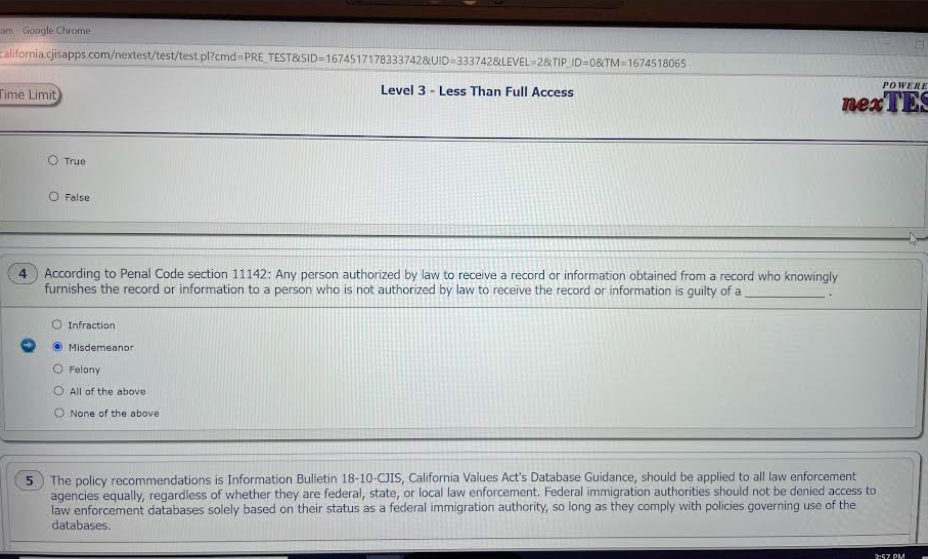
This fledgling DA got it right: It is a misdemeanor to disseminate sensitive materials to people who aren’t entitled to receive them. Again: This is the sort of thing that even non-attorneys in a prosecutor’s office are expected to know on Day One or damn near it.
So, it is very hard not to read Jenkins’ explanation, as recounted in the State Bar letter, as being a tacit admission of breaking the law.
Troy Ramon McAlister was a drug-addicted repeat property-crime felon who drove a stolen car through a SoMa intersection on New Year’s Eve of 2020 while purportedly high on meth, striking and killing 60-year-old Elizabeth Platt and 27-year-old Hanako Abe. The mishandling of his case became Exhibit No. 1 in the recall campaign against DA Chesa Boudin.
And Jenkins and her colleague du Bain were the lead prosecutors of this case in the court of public opinion. But Jenkins assured the State Bar she has no idea how the lengthy and detailed rap sheet she sent du Bain reached the recall campaign for which she served as a figurehead. That wasn’t her. That could have been so many people.
When asked for specifics on the diversion program, as well as by what authority she accessed the rap sheet, downloaded it and disseminated it, Jenkins responded with a statement.
I hold myself to the highest ethical standards possible. I cooperated fully with the State Bar and respect their decision.
Political opponents, who were ardent supporters of Chesa, attempted to weaponize the State Bar’s complaint process. The State Bar conducted a fair, thorough and comprehensive investigation.
Jenkins, for whatever reason, did not refer to Chesa Boudin using his last name. So perhaps the people filing these complaints were ardent supporters of Chesa’s Bistro, a Creole eatery in Chicago. But, assuming it is Boudin we’re talking about here, we can blame him for his fair share of management problems and poor decisions.
But we can’t blame him for improperly pulling up the McAlister rap sheet to “familiarize herself with the case” and then downloading it and sending to a colleague, a clear transgression that Jenkins should have known was deeply wrong on her first day in the DA’s office in 2014.
Jenkins, in her statement, assured the general public that both she and her office “remain focused” on “ensuring those who commit crimes are held accountable.”
You know, you just can’t make stuff like this up. In this city, you don’t need to.
she is an awful person. The fact that she took 100k, lied about it, then admitted it, then released privileged info, got the support of the police union but swore there was no quid-pro-quo about releasing that 3rd-day-on-the-job cop who shot the dude in the back and was arrested by his partner – and then did so as soon as she had a chance (the arresting officer filed suit and then was given a closed settlement and retired)
how many blatant lies do you have to tell to get kicked out? how many crimes do you have to commit to get kicked out? That person is what is wrong with politics in general. You get people with the intention of making things better for others and you get people who will break the law to get power for themselves. It’s clear who is winning that battle
OMG !! Get Rid of Her asap !! I am So Sick of these Hypocrites !!
Engardio came in with her, remember. PRO-RECALL BREED FRAUDS.
One law for us, another for them.
“Jenkins declined to answer questions about what her participation in the diversion program would entail and whether she would enroll in ethics school. It’s also unclear whether her enrollment in the program is mandatory. Jenkins said in a statement that she holds herself to the highest ethical standards possible, cooperated fully with the state bar and respects its decision.”
“Political opponents, who were ardent supporters of Chesa, attempted to weaponize the state bar’s complaint process,” Jenkins said in her statement.
So that’s why you’re being assigned to diversion, because everyone lied? Sure lady.
She obviously learned NOT A THING about the accountability or transparency required for the job. Breed taught her well.
My understanding is that a diversion program is the very lowest criminal penalty. Basically you do a class and the thing goes away, rather like how a traffic citation is quashed if you attend traffic school. No conviction, no RAP sheet, no nothing. Just a toothless reprimand.
Well actually no. Young adult court is about two years worth of intense weekly court appearances, meetings with a case manager, etc. drug court is more intense cause of the regular drug testing, and mental health diversion can take up to 2 years to graduate from. Diversion isn’t like taking that comedy traffic school for 2 hours and $50 or whatever (ok I did that in high school in Florida, probably costs more now). Anyways, diversion for crimes is evidence based and has been to shown to reduce recidivism and cost less than incarceration which furthers the goals of public safety and addresses a persons underlying problems that typically caused them to get into the system to begin with.
This state bar thing with our dirty DA is different cause it’s truly an attempt to sidestep the right decision which would cause a big political wave… she didn’t commit a crime cause of mental illness or poverty or addiction. She did out of greedy ambition. She’s the worst. I wish people would recall her hypocritical unethical behind… (I’m so polite online!)
an online class to boot.
You’re talking about “diversion” in the criminal law context. But that has nothing to do with this situation. JE mixes up these concepts as well. The state bar investigates complaints about attorney misconduct – it need not be criminal behavior but could concern things like substance abuse that impairs an attorney’s judgment or failing to adequately communicate to clients. Anybody can make a complaint to the bar about an attorney, and the bar will investigate. And if the investigation warrants it, the bar will open up a disciplinary proceeding. The state bar’s diversion program is new and applies when the conduct that is alleged (whether proven or not) is not very serious, or when the state bar does not think it will be able to prove the attorney committed misconduct. Notably, the diversion program is not available at all when the conduct that was alleged involves dishonesty, fraud, deceit, or misrepresentation, or if it involved a criminal act that reflects adversely on the attorney’s honesty. After investigating, the bar decided not to open up a disciplinary proceeding with Jenkins, and the diversion agreement necessarily means the bar did not think anything involving dishonesty or a criminal act occurred. It was just a way to wrap up a matter through a mandatory class or something of that nature where the bar concluded nothing more was warranted. Also, the state bar is very strict about attorney discipline – the bar is far lower than is required for criminal prosecution. So if anyone thinks the bar cut some sweetheart deal, that is not how bar investigations work and is flat out wrong.
“ Also, the state bar is very strict about attorney discipline”
The state bar is so bad at attorney discipline that in 2023 they published two separate reports into how openly corrupt the process was. There’s been a lot of supposed reform since then but they get no benefit of the doubt.
https://www.calbar.ca.gov/About-Us/News/FAQ-May-and-Lazar-Reports-on-Handling-of-Girardi-Complaints
Yep that’s right. Out of hundreds maybe thousands of times the courts have found prosecutorial misconduct, the state bar has only disciplined 7 or 8 DAs. Ever.
> “…and the diversion agreement necessarily means the bar did not think anything involving dishonesty or a criminal act occurred.”
You’re connecting a dot that shouldn’t be connected.
Thank god for another lawyer. Too bad people don’t like hearing the truth.
You’re flat out wrong if you think SFBAR is well run and accountable, frankly LOL at you sir.
SFBar? What the clown bullshit is this? It’s a state bar you silly ignorant. It’s not a city bar
L-O-effing-L. Ironic, indeed. And the CA state bar needs to be taken out back of the woodshed for some “counseling.”
One of the most delicious ways I know to unwind after a difficult day is to watch old episodes of the Perry Mason television series.
Justice always triumphs because even Hamilton Berger, the Defense Attorney who strives to wreck every one of Mason’s defenses, always places Truth above making a personal victory.
It is a joy to witness jurisprudence as it should be– placed squarely within the framework of the US Constitution and the rights of all people.
You’ve got it all wrong. Hamilton Burger was the DA, not a defense attorney. Mason was the defense attorney.
Of course! I stand corrected.
I guess im confused about how a rap-sheet is confidential. Is that right? Many states actually have arrest-records as public information and even have a website updated daily (for landlords or employers when reviewing candidates, etc). Im glad we dont do that, but are we really saying two officers of the court cant share a rapsheet in discussion? i guess thats the law, but it seems kind of weird. Maybe im confusing rap-sheet and arrest-record?
It was noticeable when Zelensky used Vance’s first name during the now infamous press hearing. ‘Tell me, what is this diplomacy you speak of, J.D.?’
President Zelensky > Vice President JD Vance, the subordinate (and clown.)
Frankly using first names is more diplomatic than not.
And he’s 100% spot on to question Vance’s defense of Russian interest in diplomatic resolution to a war of invasion that they started a decade+ ago.
You want to ask why he doesn’t wear a suit next, right?
Miss Chesa😞
You clearly have no idea what the word “privileged” means in a legal context.
Kars for Kids jingle on repeat –
You made my day, Joe!
Thanks for the excellent, if somewhat sarcastic, article!
Joe, you’re a top reporter and I trust your viewpoint and insight, but you’re off on this one. You told us numerous times in this article that accessing the rap sheet and sending it on was a misdemeanor. The State Bar thought it was worth putting Ms. Jenkins into diversion, which is both richly ironic and, to my thinking, about the right level of response, but I have a hard time seeing this as criminal. What were she and her colleague going to do with the rap sheet? It seems to me a little professional development, like a case study, is the intent here — where’s the problem? Given her position, she doesn’t have a right to access cases for learning purposes? And what’s with the Chesa’s Bistro comment? That’s just snarky.
Anyway, in your piece, we learn of the alleged crime, name of the alleged criminal and all. I read of someone’s alleged crime in news reports all the time, before they’re convicted, which is more damaging to the accused than two lawyers discussing their case. I think the argument for need-to-know is stronger than the argument for a misdemeanor. The whole recall affair, here and with the school board, was a mess, and this issue strikes me as inconsequential.
ML making mountains out of molehills. Rather have Jenkins any day than Boudin, even if she is not perfect. At least she actually wants to put criminals behind bars. ML always so far to the left it has no understanding of what’s most important. Crime is going down in SF, have you noticed? Or maybe that’s not a priority for you.
“The mishandling of his case became Exhibit No. 1 in the recall campaign against DA Chesa Boudin. ”
And the “fruit” of Chesa Boudin running the DA’s office caused rot. It was a rotten time with a rotten DA (Boudin) and all that happened was rotten.
Jenkins is a better DA and whatever happened while we were getting rid of Boudin I give a pass to.
“Jenkins is a better DA” if you ignore all the ethics violations and LAW violations… absolutely!
Check’s in the mail.
Als, yes, I suspect that the lack of outrage about this incident is in no small part due to the idea that sometimes the end justifies the means. If this is what had to happen to remove the unpopular Chesa from office, then so be it.
I suspect many folks would be very happy if Trump could be removed from office at the cost of such a technical infringement of lawyer protocol.