

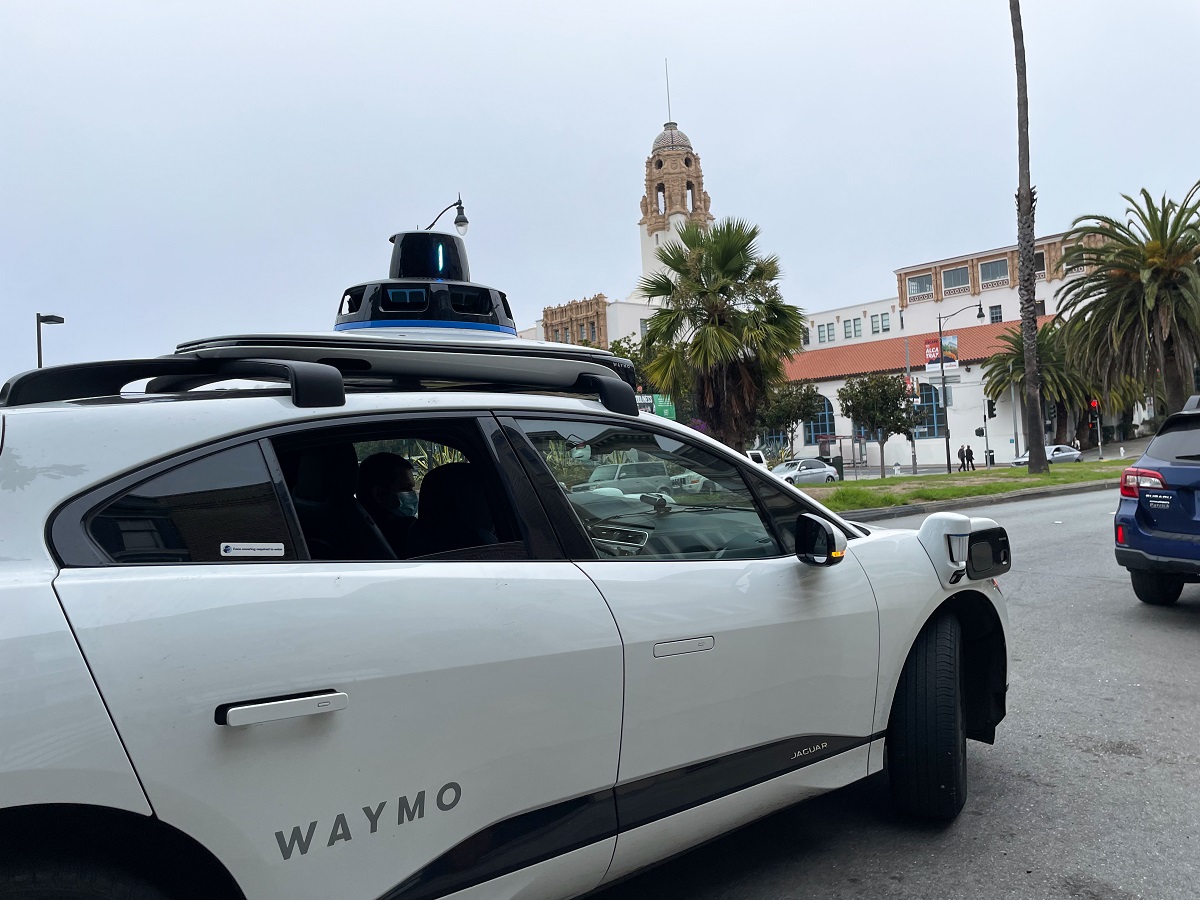
Multiple sources have confirmed that Mayor Daniel Lurie’s administration has struck a deal with Waymo to let the autonomous vehicle company into San Francisco International Airport to “map” its environs for future autonomous use.
The move is a precursor to full service by robo-taxis at SFO, which would allow passengers to hail the driverless cars and be dropped off by them at the Bay Area’s busiest airport, a financial boon for the company and the crown jewel in its Bay Area expansion plan in San Francisco, the Peninsula and the South Bay.
SFO would become the first airport across California where Waymo can operate, but it came at a cost to the company, which agreed to several concessions to obtain the needed permit.
Namely, Waymo will not be allowed to engage in any commercial activity at the airport, and it will share some data with the San Francisco city government. The nature and extent of the data sharing is not yet clear.
“The permit shall prohibit the movement of ‘commercial goods’ by use of an autonomous vehicle on airport property,” reads the language governing Waymo’s use of the airport, according to a copy viewed by Mission Local. “‘Commercial goods’ means any goods, wares, merchandise, or other tangible items requiring transportation for a fee or a commercial purpose. Commercial goods include any items for which a motor carrier permit is required.”
The permit went into effect on March 14 and is valid through April 13, and the airport can extend it then for another 30 days.
The ban on commercial and delivery activity at the airport was a requirement for keeping the Teamsters union from fighting the deal. The union worked last year with state legislators to require vehicles of 10,000 pounds or more to have a driver, but Gov. Gavin Newsom vetoed this legislation. This year, the Teamsters and state legislators are attempting to prevent autonomous vehicles from breaking into the commercial-delivery field.
Doing so would protect thousands of union delivery drivers at outfits like DHL and UPS.
Peter Finn, the secretary-treasurer/principal officer of Teamsters Local 856, praised the administration of Mayor Daniel Lurie and San Francisco airport executives for helping to bring about “commonsense implementation for this technology that takes into account safety and jobs. It’s an example of what we are trying to do on the state level.”
The deal would mark a turning point in a two-year struggle for Waymo, which in early 2024 won the right to pick up and drop off passengers in San Francisco, and last week announced it would do so in several Peninsula cities. It had tried, hitherto unsuccessfully, to break into the airport.
Waymo also operates in Phoenix, Arizona; Los Angeles; and Austin, Texas; and has access to the airport in Phoenix.
Shortly after the publication of this story, the mayor’s office sent out a press release announcing the pact.
“This agreement is another example of how San Francisco is driving innovation while supporting economic recovery,” Lurie said in the release.
“We’re pleased to play a part in showing the world that the future starts here in San Francisco,” added Nicole Gavel, Waymo’s head of business development and strategic partnerships.
Has anyone else noticed Waymos running stop signs?
I’ve seen it twice now in The Mission, but not captured it on video yet.
I saw one doing a California stop at Shotwell on Saturday. Two weeks ago I saw one stop and then do a violent swerve into the oncoming lane on 17th. Luckily there was no one in the opposite lane, but the swerve was weird because there was no visible object that it would have needed to swerve to avoid. Then, it sped it up to make the light, which had turned yellow buy the time it reached the intersection. Just like a human! ;-]
Yes, I know, humans do this all the time, bla bla bla.
wrt to the vaunted safety record:
The total number of robot miles driven is an infinitesimal fraction of the total number of human-helmed miles over the same period, so saying robot cars are safer because they haven’t killed anyone yet in SF is a disingenuous uses of statistics. To get a true measure, you would need to randomly select the same number of human-driven miles over the same period on the same streets at the same times, and compare for accidents.
A large percentage of the robot miles were tallied in the middle of the night, by “gangs” of waymos circling the same humanless routes over many hours. I’ve seen herds of them circling the same empty streets over and over in the middle of the night. What useful data are they collecting at that time that they don’t already have?
But if you see climate change as a social good, have at it, and maybe you can even buy some crypto with your AI agent on your next waymo ride.
Personal data. They are pinging your cell phone, blue tooth, wifi and keeping track of where you are and where you go. And your car’s plates if you have one.
I’ve nearly been hit while crossing the street in the crosswalk a couple of times too. The last time I took Waymo, the car drove very aggressively – felt like an old-school taxi ride with a driver of questionable sobriety – and I vowed to go back to human drivers.
My take is that Waymo’s “driver” is learning, but unfortunately it’s learning from other vehicles it observes on the road, many of whom are driving by humans who do not drive safely. So Waymo is picking up bad habits, or at least that’s how it seems.
To me, adherence to ALL the traffic laws should be a basic requirement for any autonomous vehicle, and that means all of them… from crosswalk laws to speed limits. Double parking too.
Just because humans often break these laws doesn’t mean we should be ok with robotic drivers doing the same thing.
I have the opposite experience and I’ve taken about 30 Waymo rides. My experience is that they come to a full and complete stop at every stop sign and they scrupulously follow the 25 mph speed limit. I actually take an Uber when I’m in a hurry because I know the human drivers will get me there faster by braking the rules.
I see 30 Waymo rides every 2 hours. I’ve seen them cross double-yellow and blow through stop signs. I’ve seen a near miss pedestrian in crosswalk in an electric wheelchair. Your mileage and experience may vary but these things are happening constantly. Also Waymos are slower than humans at decision making generally, but aren’t even aware when they’re breaking the rules – to the point that SFFD and ambulances can’t get them to follow any when absolutely critical. It’s the worst of both worlds and unaccountability is baked in.
the same companies profit from waymo surveillance profit from killing civillians in gaza using AI.
Wow, twice! I wonder how many times you have seen human drivers run stop signs in that time span?
Good to know that the bar for robot cars is that they just have to be slightly better than humans.
And 100% less accountable under Newsom’s PUC.
So how are they going to get to said airport? The 101? The 280/380 interchange? Yikes.
Or, are they just going to clog up the already impossible nightmare of airport traffic, just puttering around learning the place?
Another unmentioned danger of Waymo cars is how aggressively other drivers act around them. SFO is like the Hunger Games on a good day.
No denying that driverless is a way of the future, but the growing pains are not so much fun.
Growing in LA Country and haven taken countless trips to LAX, SFO is like a spa retreat compared to that, even on its worst days. I’ve had nothing but a breeze getting to/ from SFO whether it be by Uber, my own car, or BART.
“No denying that driverless is a way of the future”
The economics don’t scale. And the liability issues…
have only ever seen them driving safely and respectfully in our Neighborhood, which stands out because you often take your life in your hands, stepping into some of the busier intersections. excited to see progress towards SFO being available and good to see San Francisco is true to form trying to ensure no longer term change because it would be inauthentic to embrace the future.
“it would be inauthentic to embrace the future.”
I, for one, welcome our robot overlords.
“because it would be inauthentic to embrace the future.”
What a wonderful excuse for anything at all!
“Struck a deal”… paid enough cash to Lurie’s warchest.
Exactly. When the PUC authorized them in a 3/0 vote you knew the fix was in.