

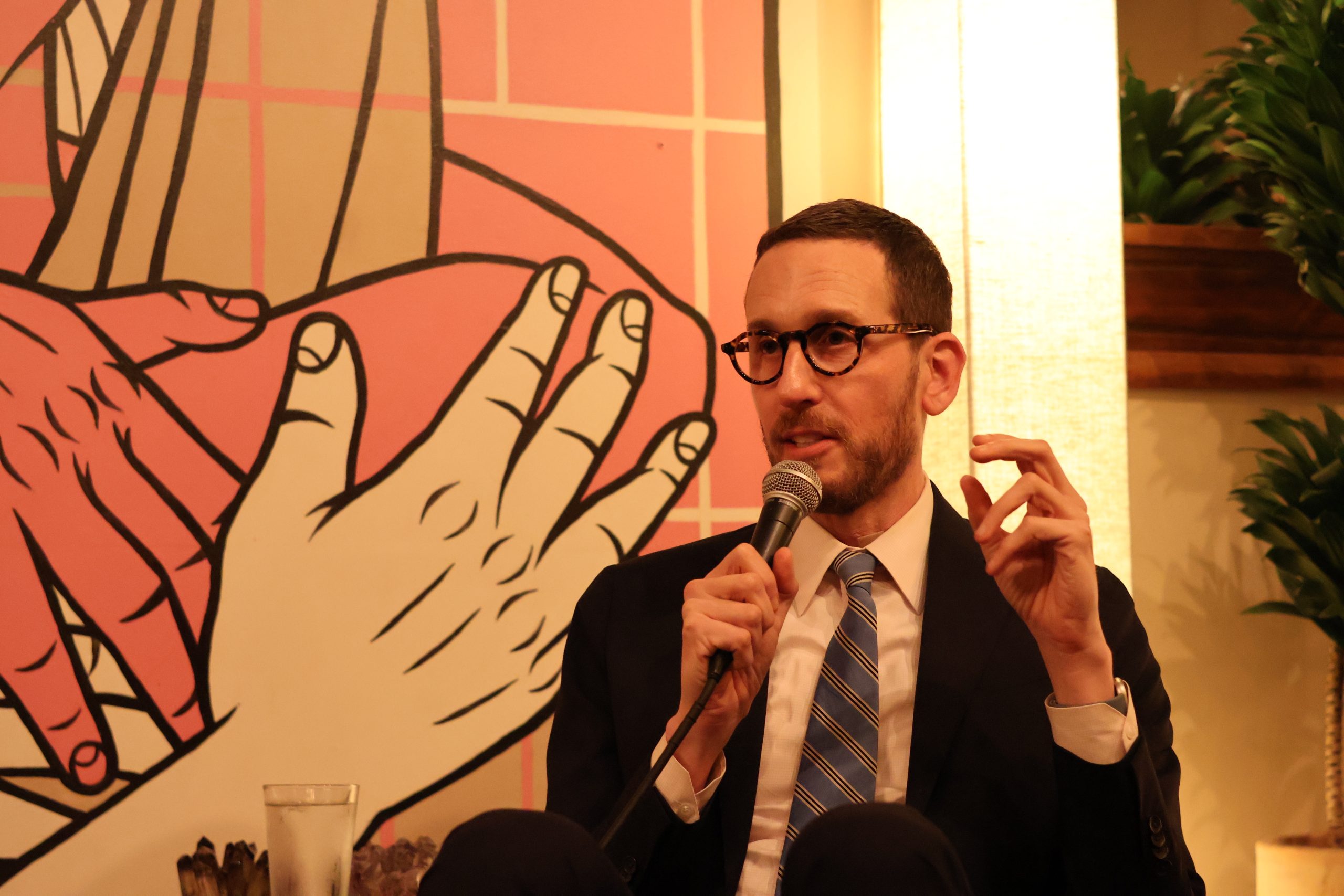

The following is a transcript of a conversation between Joe Eskenazi, Mission Local’s managing editor and columnist, and Scott Wiener, held in front of a packed house in the back room of Manny’s last Tuesday, right after the president’s address to Congress.
The vibe was unabashedly cheerful, earnest and nerdy. Quite likely, no audience has ever been so excited to hear an explanation of what it means to have a state bill held in suspension.
This interview has been lightly edited for readability and clarity.
Joe Eskenazi: Thank you for coming out tonight, Senator.
Scott Wiener: Thank you for having me.
JE: Democratic strategist, James Carville, who — my mother never fails to point out, looks alarmingly like the shrunken apple heads we used to make at school — recently had an op ed in the New York Times. This is a quote from him: As Donald Trump and Elon Musk continue to sow international and national chaos and disorder, he called for Democrats to “embark on the most daring political maneuver in the history of our party: roll over and play dead. Allow the Republicans to crumble beneath their own weight and make the American people miss us.”
Am I correct in assuming that you disagree?
SW: I do disagree. I think we should do everything in our power to accelerate that collapse, because they’re giving us the raw materials. We have to help make it happen and not play dead.
JE: Is this something you talk about with your colleagues? Tell us your playbook here.
SW: We’re very focused in Sacramento on running California, and protecting California from what Trump and Musk and all of them are doing.
They’re going to try to take a wrecking ball to our budget. They made that very clear. The President lies about it, but they’re going to cut Medicaid. 40% of Californians, over 15 million people, get healthcare through Medicaid.
They frame it as “fraud, waste and abuse.” That’s just their entry point to say, “No, we’re not really cutting it. We’re just getting rid of fraud and waste.” And they’re going to cut it.
Same with Social Security. He sort of said it — I was listening to him on the way over — He said tonight, there’s all this fraud in Social Security. They’re looking for ways to cut because they know to fund these mega tax cuts that they want to provide to rich people and corporations, they have to get the money from somewhere, even if people end up eating cat food in a gutter afterward.
They’re going to go after healthcare. SNAP. What we call CalFresh, food stamps. Food for low-income, working class people, and many, many children. We get almost $8 billion a year in K-12 education funding from the federal government. A lot of it pays for special ed, free and reduced lunch. They’re going to go after that. I could go on and on.
All of these things could have huge impacts on California’s budget. I chair the budget committee now, and we’re just trying to prepare for that chaos. They are so chaotic that we don’t know the scale of it, so we’re focused on protecting immigrant communities from mass deportation. We’re focused on protecting trans people, and focused on trying to make California run better, in terms of building more housing, having better transportation, more clean energy, and all the things that; we’re playing defense. We have to run California better, make California all that it can be to show how it’s done as they enter into chaos. We are definitely not wanting to play dead.
JE: You say we have to make California run better. One of the topics that comes up is: “If only San Francisco or California was run better, what attacking points would the Republicans have?” This seems a bit naive to me.
SW: I don’t think it’s the complete solution. There were a lot of reasons why the election went the way it did and and, you know, we focus a lot on around the swing states, but let’s be really clear: You’re running against this guy who’s a felon. Who has been found to have committed sexual battery. Everyone, I think, knows what I’m talking about. It should not have been a close election.
And so we have to ask ourselves: Why was it even close? There are a lot of reasons. But I think it’s important to be able to show the world that the government can work. That government can make people’s lives better. That government can be an active source of good.
But also, if we’re living through these difficult times, I want our blue states and our blue cities to be the most amazing places. Where people can afford to live, and where people can come if they don’t want to be living in places that are less and less hospitable. We need to be a welcoming place. And you can’t be a welcoming place unless people can afford to live there.
JE: I agree. I’m not defending bad government. It just seems that, from the outside, it seems almost like a good cop, bad cop type of attitude with yourself and some of the local politicians. Is there any coordination, or is this just everybody staying in their lane?
SW: You mean, around Trump?
JE: Around Trump. The mayor here doesn’t even say his name.
SW: Oh, that’s not a good cop. That’s — Mayor Lurie just got into office. He came in on a very focused platform about what he was going to do, and he’s and he’s doing that. I don’t criticize him for focusing intensively on the nuts and bolts of running a city. And I’m happy to talk about the evil that’s coming at us from Washington.
JE: So, taking a stroll down memory lane: July will be 10 years since your “Fox News is not real news, and you’re not a real reporter” moment, which is what you said to a minion of Bill O’Reilly while actually closing a door in his face.
Tell us a bit about your ensuing decade as a focal point of very angry and vitriolic people on social media, television and real life.
SW: Yes. It was an interesting moment in time. In 2015, there was a horrific death; a woman, Kate Steinle. There was an undocumented individual who was apparently shooting at the sea lions. A bullet hit her, and she died.
He was prosecuted, as well he should have been. It became this national right-wing thing about, like, “All undocumented immigrants are safety risks and criminals,” and so on.
Fox News came to San Francisco, and was stalking supervisors at their homes, trying to get people on camera to embarrass them. I was in City Hall one afternoon, and it was Jesse Watters. He was a correspondent at the time. I was at my office, and he caught me on the way to the restroom. And so I, I just said, you know, “Fox News is not real, not real news. You’re not a real reporter. I only talk to real reporters.” The reason I did that is because I’m like, “I’ll just ruin their tape so they won’t have anything to run.”
And then, a few days later, I’m sitting in a board of supervisors meeting, and I get a text from one of my staffers saying, Bill O’Reilly just played the clip of you doing that. He called you a pinhead.
So that was my first tidal wave of right-wing death threats, etc. It’s definitely accelerated over the last 10 years, usually related to my work to support LGBTQ people.
It goes in waves. Sometimes it’s a little more quiet. Sometimes it explodes.
If I get mentioned on Fox News in a pejorative way, or if Marjorie Taylor Geen tweets about me or Elon Musk tweets about me. Charlie Kirk or Ted Cruz, they all have their moments where they like to tweet about me. I represent everything they hate, this lefty gay Jewish guy in San Francisco. I check every single box.
I got thousands of death threats. They come in on social media, emails, calls to the office. The poor interns who answer the phone; sometimes we just tell them to stop answering. The SFPD bomb dog has been in my home numerous times. It’s a really cute dog, by the way.
I developed very thick skin coming out of San Francisco politics. Over time, you become sort of numb to it. But I do feel really bad for my staff. It’s just a lot. Sometimes, when I have colleagues who go through periods where they’re getting really gone after, I’m like their therapist.
JE: This dovetails with my next question, which is: “Has this prepared you, perhaps more than most public figures, for this moment?”
SW: Perhaps. I know who the opponents are. I sort of know what drives them. I also think I have really learned the deep corruption that underlies it. People who are pillaging the federal government and trying to pillage this economy, the way you do that is by distracting. Creating scapegoats and people they can hate. Blame it on the trans people. Blame it on the immigrants. Blame it on the Jews; it usually finds its way back there, historically. They just find ways to distract people.
What they’re doing to the economy now: Fueling inflation is going to hurt job creation. They’ll just blame it on other people. That’s how they do it, to hide this kleptocracy that they’re setting up, where the way you do business is supporting and bending the knee to Trump. And if you don’t, then we’re then your company’s at risk, and you have to then pay the piper. For a long time, I didn’t see that.

JE: I’m sure you’ve noticed that heavy tariffs of Canada and Mexico, among other things, are not going to lower the cost of construction. Are they coming after you personally?
SW: Definitely not about me, but it is true that they are trying to collapse the construction workforce with their deportation policy. The construction workforce has always had a lot of immigrants working in it, a lot of people who work super hard and try to come here for the same reasons that my great-great-grandparents came here from Eastern Europe. They were escaping the pogroms, and they came here for opportunity, and they built lives for themselves and for their families.
So yeah, they’re, they’re trying to collapse the construction workforce. They’re going to make materials for building housing more expensive. We already have so many challenges with housing and interest rates. Hopefully those will be coming down, but now they’re creating other challenges. They’re going to make food more expensive. Agricultural workers, farm workers are scared to go to work. They don’t want to send their kids to school.
He’s created this fear because they physically can’t deport the number of people they say they want to deport — 10, 12 million people — but they can create such intense fear that people can’t really function.
JE: Let me continue with the housing. You have done a lot of work to streamline the [state] housing-approval process, and San Francisco has been cajoled into doing the same. But as we just touched upon, housing is still not being built. I’m wondering what else is holding housing back, and what can state or local government do about it?
SW: There are a number of barriers. We used to build a ton of housing, and we stopped, for the most part, about 50 years ago. We accumulated, over a half century, this massive, massive housing shortage, not just in California, but California is definitely the tip of the spear.
There were a few reasons why we downzoned and banned multi-unit construction in a large majority of residentially zoned land. We created endless process, so that even if you comply with the zoning, it might take you 10 years to get your permit. Or maybe you don’t get it at all, or your project gets chopped in half, or we put huge financial obligations on you that make it economically unfeasible.
The construction industry, honestly, did not modernize in the way that it needed to. We also, during the Great Recession, lost a lot of our construction workforce, and it took us about a decade to start climbing back. And then the pandemic hit, and then high interest rates.
We’ve done a lot of good work to force cities to zone for more housing. We have streamlined the process significantly, and we were able to pass a law that is now in effect in San Francisco, eliminating for the most part, discretionary permitting, making everything what we call ministerial, meaning that you set the rules ahead of time. If someone meets the rules, they get their permit in a matter of months, not years, also known as “good government.” We are not all the way there, but we’ve made good progress.
It is still way too expensive to build. That’s partly because of the fees that cities are putting on housing. I’m not opposed to fees on housing but, as of the last time I checked the details a year or two ago, it was almost $200,000 per home or per unit in San Francisco in exactions. Sacramento was $20,000 last time I checked. If you are saying, “On top of building, you have to pay $200,000 per unit,” that’s going to make housing more expensive or just make the project unfeasible.
One area that is totally fixable is the mega projects. I think it’s like 40-50,000 entitled units. Parkmerced, Schlage Lock, the Shipyard, Treasure Island, et cetera. These big projects that total tens of thousands of homes that are approved, but we put such big financial obligations on them. Parkmerced was required to help fund a light-rail line going through it. I’m all for light-rail lines, but that is a government responsibility. They got approved, but the finances don’t work. They all need to be renegotiated. That process started under Mayor Breed, and I’m confident that it will continue. I don’t want to speak for Mayor Lurie, but I would be surprised if it didn’t. It makes sense to renegotiate these projects so that they can actually be built.
JE: Do you believe that the holdup in San Francisco is entirely due to the onerousness of San Francisco, and market forces play no role?
SW: I think that the intense over-regulation of housing and fees and the process et cetera in San Francisco has absolutely played a significant role.
It’s not the only issue. We’ve had high interest rates for the last few years. We under-invest in subsidies, which has been an issue. The federal government withdrew. Until Governor Newsom came, in the state did very little, because our previous governor did not believe in subsidizing housing. Governor Newsom does.
So, we’ve been able to increase our investment, but the investment is not what it used to be. We used to have — we had national rent control after World War II. States started opting out by the late ’40s, early ’50s. The real strong push to reenact rent control, at least in California, started in the ’70s. What happened during that time period? It was in the ’70s that we started to make it impossible to build enough housing. We down-zoned. CEQA was adopted and promptly used to stop new housing. All sorts of new procedures and appeals were instituted. When we build a lot of homes like we did in the ’50s and ’60s, there’s less pressure for rent control. And then’ when you stop building, renters start getting really screwed and priced out. I don’t think that timing was coincidental.
JE: We have the regional housing needs allocation for San Francisco, which is we’re going to have to build 82,000 homes by 2031. This seems unlikely, considering where we are in 2025, and market forces and population of San Francisco. Is 82,000 the number that we should still be working with, or should it be reassessed?
SW: There’s been so much focus on that number. We have a real housing shortage. It’s not just San Francisco. The old housing goals — the city of Beverly Hills got an allocation of three homes, for an eight-year period. Because of the reforms that we did, they now, in the current cycle, have to build 3,000 homes.
San Francisco, a major metropolis, had 27,000 under the last cycle, and now it is 82,000. Yeah, absolutely that’s a lot. I think the city should work very hard to meet it. If we can get all of those mega-projects going and done, that will all count towards that.
We should spend less time hand-wringing over, “Wow, 82,000 seems like a lot” and more energy getting housing moving. The reality is that if San Francisco does not meet the 82,000, what happens is it will continue to be what we call “streamlined,“ meaning all ministerial permit approval, no discretion.
That’s not, to me, a punishment. That’s actually a really good thing. That’s good government, instead of having every single project be a political football. Goals are goals, and sometimes tough goals are a good thing.
JE: Is there anything you could or would do at the statewide level about the cost of labor in San Francisco to boost the production of new housing?
SW: We need to dramatically expand our construction workforce. We need to really ramp up our apprenticeship programs and education. When I was a kid in public high school in suburban New Jersey, we had a regional vocational school, and some kids went to that and some of them did quite well later on with the skills that they had learned there. We got away from that for a long time.
We need to understand that education needs to be super diverse. People are going to be drawn to different things. And construction is an incredibly noble profession. You’re building things that people are going to live in, ride on, get energy from, forever.
We should be ramping up our construction workforce and making sure that it’s not this boom and bust where the construction workforce gets eliminated when there’s a recession. That’s when we should have more government investment in construction, while there’s plenty of workforce available put in the work to build public works, or public housing, what we call social housing now. We need to treat the construction workforce like an always thing, and not just “We’ll hire you when the economic environment is good and interest rates are low, and as soon as things get bad, you can just go somewhere else and figure it out.” That’s what happened during the Great Recession. It just scattered to the four corners of the earth, and it took more than a decade to rebuild to where we had been in terms of construction workforce.
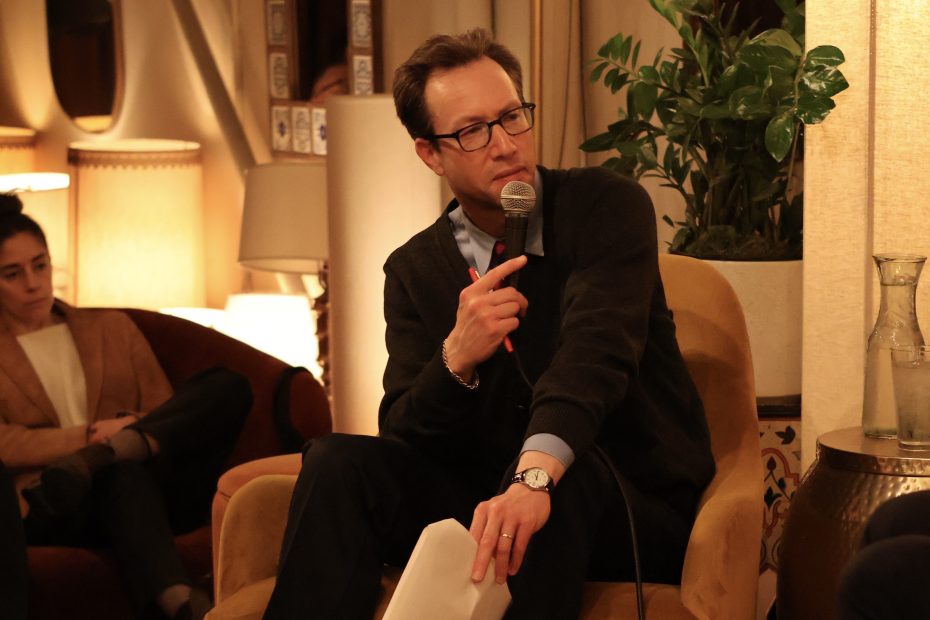
JE: Just down the block from here, at 2588 Mission St., in 2015, Mission Local’s office was in a large mixed-use building. It burned because of faulty wiring; they hired a crook to put in non fire extinguishers. And then it was neglected, and it burned again, and eventually it had to be razed. And at this point, the landlord wants to put in a 10-story building.
I can understand why local control was wrenched away from places like San Francisco, but how could this have been prevented?
SW: I’m not deep in that project. I know there are some concerns, and some of those concerns are well founded. I’m not expressing a view of the project overall, because I don’t know enough about it, but this is one of the reasons why it’s become so hard to build anything here.
What we do is say, “Okay, we have 100 projects; 99 of them are really good, and one stinks. We’re going to make it really, really hard to impossible to build any of them.”
We’ve done that with housing. We have done that with transportation. We get so nervous that someone is going to build something and be irresponsible and not be community minded, so we’re just going to make it hard to build everything in order to be able to say no to that person.
And even though, yeah, it is frustrating when you’re like, “Damn, I wish I could say no to that person.” But then, by changing the rules, which is what we did in the ’70s, we start saying no to a lot of things, because people can always think of reasons to say no. And then we have a housing crisis. And then we have a situation where Texas produces more clean energy than California. We are a bigger state than Texas. We believe that climate change is real. And yet, Texas produces more clean energy than California does.
JE: Moving on to transit, another pet project of yours. Muni is presently facing one heck of a fiscal cliff, and I’m wondering: What can we, as a city and state, do to keep it viable?
SW: Muni, BART, Caltrain, AC, Transit — all the big systems have had operational financing instability for a very long time. Unlike some other parts of the world, we don’t put tax dollars in transit like we should. Countries that are much poorer than the U.S. invest two to three times, as a ratio of GDP, than we do.
Europe or East Asia put significant tax investment in these systems, and give the transit systems land use authority so they can build all sorts of dense housing and retail and office space around the station and generate both riders and revenue for the system. And that’s why the Tokyo subway is $1 for, like, this amazingly frequent service.
Muni, at least it’s part of San Francisco government, so it does get tax investment from the San Francisco General Fund. Caltrain has to beg three counties for their annual contribution. It’s really mortifying. Same with BART; it has a small sales tax, but they’re overly reliant on fares. Before the pandemic, BART was at, like, 70% fare box recovery, which they would brag about. And I would be like, “No, that’s bad. That means that you are so reliant on fares that you keep jacking up your fares and it becomes too expensive. And the SF State student can’t afford to take BART.”
California puts way less operational money into transit than states like Illinois, Pennsylvania, Massachusetts, New York. It was already a problem, and the pandemic poured lighter fluid on it. These systems are recovering, Muni is at almost 80% pre-pandemic. BART’s at 45%.
By the way, I wanted to say for the record: All these numbers about ridership percentage? It’s not ridership. It is number of trips taken in a week. It is not a reduction of riders. If you used to commute five days a week on BART, and now you’re commuting three days a week on BART, that’s a 40% ridership reduction, but the same human being who needs BART to get to work.
When you look at the number of people who are riding in a given period of time, BART is not at 45%. It’s probably more like 70% or 65%. People are still relying on these systems.
I’m so happy that my colleague from across the bay, Jesse Arreguín, was just elected. I was really sad that Nancy Skinner, who represented the East Bay, who was like my mentor in the Senate — she was amazing — termed out. But Jesse Arreguín, who was the mayor of Berkeley, who’s a total transit fanatic like I am — we’ve been partnering on trying to get better state budget support for transit.
It’s going to be hard, but we also are working very hard to have a multi-county revenue measure to fund operations. We’ve had Bay Area Regional revenue measures for transit before, but it’s always been for capital. We’ve never done it for operations. We want to create longer term, sustainable funding.
We wanted to do nine counties, which I tried to do last year. We gave options: It could be a business tax, it could be a parcel tax, but sales tax was probably the most likely. Santa Clara county decided — it was like a political meltdown situation. They really, really didn’t want to be a part of it, which was unfortunate. And so we came back this year, and it’s going to be a three- or four-county measure. If we’re able to succeed, then it would go to the ballot, probably a year from November.
JE: Is this the one where San Francisco is going to pay more than everyone?
SW: Yes.
JE: Because everyone likes that.
SW: Well, no, but the reason that San Francisco will pay more is that we want to put a bunch more money into — there’s no downtown recovery without BART. We need BART not to collapse. And BART is at risk of collapsing.
BART has been doing a lot of things internally to make itself better. I have some colleagues who are the most intense critics of BART who have been saying, “I’ve been riding BART, it’s been great.” They have dramatically increased their deep-cleaning of cars. They’re changing the fare gates to make it much harder to do fare evasion. They’re running shorter trains so that people are closer together, so it’s less sparse, and people feel safer.
There’s more work and more efficiency that can happen. But we’ve got to save BART and we need to put significant funding into Muni, because Muni has a big, big challenge as well. We already see there’s some service reductions that are happening, and I don’t want that to get worse.
JE: Let me ask you this one: Sales tax, we all pay. A payroll tax, the businesses downtown that would be getting their workers delivered to them, would pay. Is there an appetite for that in 2025, to have a payroll tax?
SW: I’m open to having a mix of taxes. Sales taxes are paid by — individuals pay it. Sales tax is also paid by businesses. So a lot of people pay sales taxes. But I would like to see a mix.
The reality is that I think a business tax — it can win, but it’s not winning in a landslide. We don’t have a lot of margin of error. If you induce the business community to start spending and running a big campaign against it, it could lose. That’s the politics that we’re dealing with, and why sales tax is often the default.
San Francisco, and this is going to be shocking to a lot of people, our sales tax is actually significantly lower than most surrounding counties. Alameda County is much higher. Parts of San Mateo County are much higher. There is legitimate concern that more sales tax will potentially push it to, perhaps, over 10% in some areas. Not in San Francisco, but others.
Other revenue sources are challenging. In terms of a parcel tax, to do regional parcel tax and for that to be enough, it would have to be so high that it would be politically infeasible on the ballot. So yeah, if we could do a mix, but I think it’s more likely, most likely, to be a sales tax.
JE: About the push to allow more liquor licenses downtown to get revelers in; that’s the ground floor activated. But what about the empty floors above the ground floors that are not providing any kind of tax revenue? What can we, as a city, and we, as a state, realistically do to try and kickstart the downtown?
SW: So, I authored California’s entertainment zone law, which has been fantastic in San Francisco. Front Street by the Warriors Arena we’re also seeing — I don’t think it’s an entertainment zone yet, but, like, the first Thursdays and Bhangra and Beats, there’s a lot of great stuff happening in the downtown area.
The bill that you’re referencing, actually, the mayor came to me with that idea. They want to have 20 new low-cost liquor licenses for restaurants, not for bars, in the Union Square, Moscone or Yerba Buena area, to try to just get more activation in the buildings or out on the street.
In terms of offices. we’re already seeing some level of recovery. It’s slow and it’s painful, but it’s happening. Some of those office buildings, especially some of the class C office buildings; I’m not a real estate person. I don’t want to insult them or anything. They’re all our children. It’s unclear to me that they’re ever going to recover. There are some that can be converted to housing. I think they’ve done the inventory. There’s a certain subset, and it tends to be the older buildings because of the way the floor plates are. The ones built in the ’50s, ’60s, ’70s, not so much.
JE: Does anybody want to live in the Bank of America building?
SW: Yeah, I don’t think that would be one of the ones. Some of them may need to be replaced. I bet you that every high rise downtown has a fan club. This is San Francisco; there’s probably going to be like a Reddit page for any of those buildings.
If you look at like lower Manhattan, lower Manhattan was like the financial district. In retrospect, why did we think it was a good idea to have a downtown that was only about office 9 to 5, Monday through Friday? That doesn’t make sense. You should have mixed-use neighborhoods.
Lower Manhattan took a long time. Lower Manhattan was converted from office, to office and housing and retail and nightlife, and so on and so forth. I’m sure a bunch of people here have been to lower Manhattan recently. It’s amazing. It’s so vibrant. The financial district can be that, but we have to be willing to make some physical changes there and just to do some things differently.
It’s not going to happen overnight. I wish, I wish I could say, by the time Mayor Lurie ends his first term, it’s all going to be, it’s going to be a gradual thing. These kinds of physical changes take time.
JE: Here in the Mission we’ve got, you seem to be rounding third on the vending bill last year, and Sacramento is an amazing place where things go into a box and they disappear. Can you explain to us what happened there?
SW: I love that Mission Local is so into this bill. I think it’s great. I’m very flattered.
So basically, for anyone who spends time in the Mission — the mission is really exceptional, in terms of the street-vending culture. It’s a really beautiful thing, folks who are selling food or flowers or crafts. Vendors who’ve been here for a long time. They add so much to the neighborhood.
What we’ve seen in recent times is that, in addition to these vendors who play by the rules, is folks who are just selling stolen goods. You’re like, “Hey, that looks like deodorant I got at Walgreens yesterday.”
It does a few things. First, it fuels retail theft. It also creates an atmosphere of intimidation and even violence on the streets, to the point where the Public Works inspectors who enforce those permitting rules were wearing bulletproof vests. It pushes the legit vendors out because they don’t feel safe.
It got so chaotic that Mayor Breed, with the support of Supervisor Ronan — Supervisor Ronan she would agree, if she were here, she’s a super lefty Democrat representing a really progressive community. And she supported the moratorium that the mayor placed on street vending on Mission Street. None of us wanted to see a moratorium on street vending. But had gotten so chaotic and because state law was designed in a way — in 2018 we passed a law that, in retrospect, was way broader than I think any of us anticipated. We have parts of the state where the cops are constantly harassing the street vendors. So we moved enforcement of street vending away from the police to administrative. You can have a permit system and you can administratively enforce it. In San Francisco, it’s Public Works.
That’s, I think, generally, a good idea. But in places like San Francisco, where we embrace street vending, the law was broad enough that the police were unable to even intervene when it was obviously stolen goods, unless you had proof that that person stole the goods.
And so, with the support of a lot of stakeholders in the Mission, we came up with this very focused approach just for San Francisco that would provide a limited role for the police, only in situations where there the city will create a list of commonly stolen goods, and if someone is selling of one of the items on that list on the street without a permit, without proof of payment, then they can be cited by the police. We had a unanimous vote from the Board of Supervisors. Dean Preston. Everyone.
JE: So this was like Candyland. You’re right up at the end, and then you drew the ice cream sandwich, and you’re right back to the beginning?
SW: Yeah.
JE: So, what happened last year?
SW: We could do a separate program just on Scott Weiner’s frustrations with the California legislative process.
This is a state of 40 million people. An unbelievably diverse, complicated state in every single respect. The California legislature is a complicated institution. Thousands of bills get introduced every year. Some live and some don’t live. Some die early, some die late. Some die mysteriously. Some die in very obvious ways. Some get vetoed by the governor.
One of my least favorite aspects of the process is called the appropriations process. In each house, if it’s a housing bill, it goes to the Housing Committee and maybe the Local Government Committee. It’s a very transparent thing. There’s an analysis and then a presentation, and then members vote, and the bill either gets voted out, or gets voted down.
Any bill that has more than a very de minimis fiscal impact gets sent to the Appropriations Committee, and then it gets put into this limbo state called the suspense file. So they all get sent to the suspense file, and it’s like, truly, you’re in limbo. It’s there, and then there’s this one day when something called the suspense dump happens, I really like the term, where either it gets passed out to the floor, or it gets held. And if it gets held, it wasn’t because of a vote, it’s very leadership driven.
There are some times when bills get held for political reasons. Sometimes bills just get held, and there’s no ascertainable reason. And you never get an actual explanation about why your bill was held. Sometimes you sort of know. Sometimes you don’t know, or it’s just, like, you know they were eliminating a certain number of bills. It’s designed also to reduce costs, so you don’t have bills with huge costs just going right to the floor without being vetted. And so every year, every single year, in both the Senate Appropriations Committee and the Assembly Appropriations Committee, I lose some bills that get held, as does every member of the legislature.
And so this bill, which I introduced, I started it in the Assembly, and it was, like, flying through, and then it just got held in this committee. And I’ve been asked many times, why? Why? The answer is: I don’t know. It just did, along with several other bills that I had. Speakers didn’t have so do that. I have no idea.
JE: Speaker [Robert] Rivas didn’t have anything to do with that?
SW: I don’t know. I reintroduced it a month or so ago.
JE: Do you have any idea if it will happen again?
SW: I can’t. I can never predict the future in the legislative process. What I do know is that we have very broad support in San Francisco. We have support in the community, in the Mission. Alot of community organizations, including, once again, the street vendors, are supporting it.
The mayor is sponsoring it. I’ve done everything I can to lay groundwork with the committees so that it moves forward. I cannot guarantee that it will pass, but we definitely have a path to get it passed.
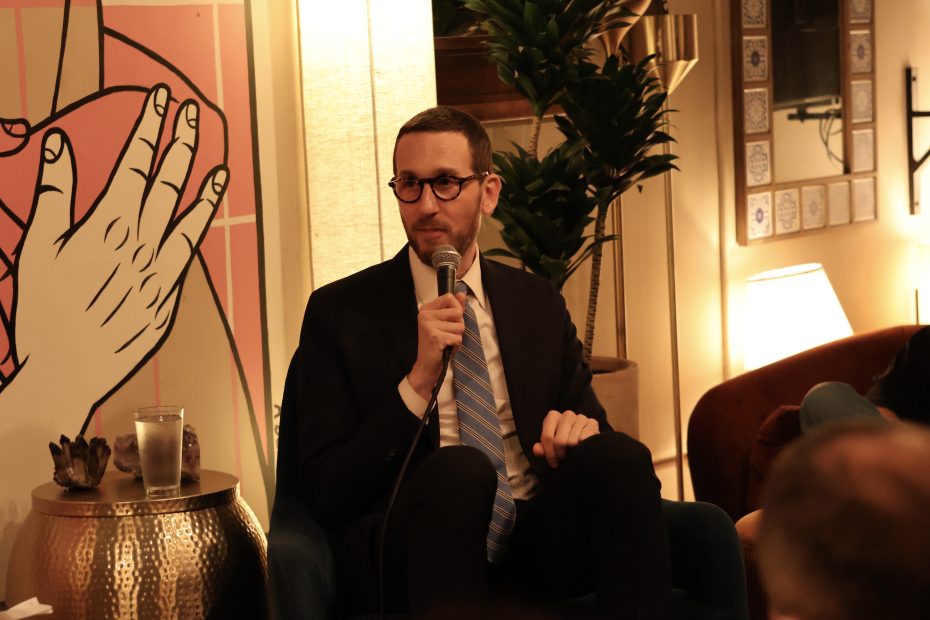
JE: Let me move to some of the questions. This one says, “Hi, Scott and Joe. When will I be able to take a train to Los Angeles?”
SW: Well, to the question that we said at the beginning, where you said it was naive, I think the solution is getting blue states to govern better.
JE: And I think if we were the best governed state, they would still find reasons to hate us.
SW: They would. That’s what I’m saying. You know, it’s really tragic that we’ve allowed the right wing to hijack the narrative about high-speed rail. The trains to nowhere, as if San Francisco, Fresno and LA and San Jose were nowhere. Losing sight of the fact that right now, to get from the Bay Area to LA, it takes twice as long by train as by car.
We do not have a true statewide rail system in California, and we should have one. It has been really hard starting it out in the Central Valley, I understand why the Governor made that decision. I think, in retrospect, we should have started out in the Bay Area. We have all the tracks laid already that are now electrified.
I think people thought it would be easier. It wasn’t. You have a lot of Republican officials out there who obstructed it every step of the way. It was just obstruction, obstruction, obstruction. We need to turn that around.
I have a bill. It’s not the only issue, but one of the problems is that high-speed rail has to get so many permits from cities, from counties, from special districts. They have to get permission from PG&E or there could be a Comcast wire that’s hanging that needs to just be buried underground, like a simple thing. If Comcast doesn’t respond, sometimes high-speed rail has had to demobilize contractors because they have to build a bridge over a little gully, and there’s a wire there that needs to be buried, and they can’t get a response from a utility or from a telecom, and so they literally have to demobilize their contract.
If you think about those kinds of delays, and how they pile on one another in terms of timelines and costs — we have a bill that will put a shot clock on those kinds of utility and local government issues. They still have their process, but they can’t just ignore it and delay it. Just one piece of the puzzle.
I think we need to get this done. There are people who want to abandon the project. I don’t agree with that. I think California should show that we can do it.
JE: What can states or coalitions of states do to take over federal functions under threat?
SW: We can actually do a lot if we coordinate well. We’ve done it in some areas — when California did cap and trade, we coordinated with some other states and parts of Canada.
California is perfectly positioned to do it because of our size. We’re the fifth largest economy. We were going to be fourth, but then Germany picked up their game. That’s the reason that they want to get rid of our ability to set our own automobile fuel standards, which we’ve had for many years; when we do it, that drives the whole national market. If you get California, New York and Illinois and, like, Oregon and Washington, you’re really going to drive things. They’ll try to preempt us. But consumer protection, having a stable financial system, all sorts of sorts of areas we can legislate at the state level. If we can get a group of states to just cut and paste each other and adopt the same rules, we can really, really drive things.
JE: A similar question here. “If Trump/Musk make more cuts to the NIH, can the state step in to support the UCs with research funding? Asking as a newly accepted PhD trainee to UCSF.”
SW: You and I are mind melded, because I’ve been thinking of exactly this. On Sunday, I was on the phone with the chancellor of UCSF, just, I’m trying to get my head around the full scale. It’s not just NIH and CDC, it’s NOAA. They’re like, going on to the National Weather Service. And then the National Science Foundation.
I mean, and when you look at California’s success, Silicon Valley would not exist without the UCs and Stanford. Research universities producing talent and incubating these research institutions, They have been part of the absolute rock foundation of California’s success.
And so, when we see these institutions being threatened with these cuts by this administration that claims to be pro-innovation while slashing actual scientific innovation, what they mean by innovation is that the tech people who support Trump can get rich, and then they’ll go after the ones who don’t.
So yes, I think that the state should step in. It makes a lot of sense. We can’t do everything that the federal government is doing, but we should be stepping in to try to support scientific research in California. That could actually accelerate California’s role as a global leader in science, scientific innovation.
The other thing that we need — we created this program called Cal RX, to try to create generic drugs, to try to drive down the cost. Already CalRX has purchased naloxone, which is driving down the cost. They want to produce insulin; that is taking way longer than anyone thought. But we need to step that up.
I’m really worried that we may not have a flu vaccine, flu shot and Covid shot this year. You may have seen they cancelled the advisory committee meeting for the flu shot, where they start looking at the different strains. If they keep doing that, we’re just not gonna have a flu shot this year. I want to find ways for us to start getting flu shots and vaccines into the country. And we might have to use some guerrilla tactics to do that, which I’m cool with.
People shouldn’t have to travel to Canada — hopefully it won’t be a war with Canada — but go to Canada or somewhere else to get vaccinated. I would love to find ways for California to empower people to get vaccinated here, even if Mr. Kennedy is doing his ridiculousness.
JE: This is the last question: “With a $16 billion budget, why do we need a sales tax for transit? Why isn’t transit a priority that can be funded with existing revenue?”
SW: Well, when you say $16 billion, you’re talking about the city. When I was on the Board of Supervisors, I authored a charter amendment, that the voters passed, that put more of the San Francisco general fund money into Muni. I would love to see more of that.
So, I do support that. And I support it from the state general fund. We were able to get a billion dollars in the state budget a year ago to provide operational support. Had we not obtained that billion dollars, 400 million, of which went to the Bay Area, we would have already seen these massive service cuts. And so that’s why we’re trying to do it again.
If we could just get a $1 to $2 billion line item in the state budget for transit operations, a lot of these issues would be significantly better. The challenge we have with transit is it doesn’t have the same level of power players advocating for the money as others. It’s not a criticism. We have amazing transit advocates. But in terms of power players, we’re finally getting more labor unions engaged, and SEIU is prioritizing transit funding this year, But still, transit doesn’t pack the same political punch.
Part of it is that statewide, when you get outside of places like the Bay Area and parts of LA, not as many people are riding transit, and the people who are riding transit tend to be very low income, and they’re just trying to get by. They’re not the ones who are the power players in the capital. So I’m looking at all the options. Yes to the city, yes to the state, but we need to have a real strong baseline of regional support. That’s why we’re doing this ballot measure.
JE: Well, I want to appreciate everybody for coming out here. Scott, I am serious. We can go over the amazing black box appropriations committee of Sacramento, which makes even less sense now that you’ve explained it to us. Thank you.
I would be remiss if I didn’t recommend donating to Mission Local, where we squander your money on things like food and heat. Thank you again for coming out on a Tuesday.
Question for Senator Weiner: How long will it take to build so much new housing that housing costs drop, and good numbers of middle and working class San Franciscans can afford to live in the city again? And what’s the interim plan?
It will never drop. The demand will always far outpace new construction and HE KNOWS THAT so every single time he’s promising it’s for low incomes he is lying to your face – and realizes that – so realize it also. It’s impossible for any amount of market rate construction to EVER bring down rents and housing costs in San Francisco. YIMBY is implicitly a manufactured slogan-acronym invented by developers to grow fake grassroot support for their crusade to enrich themselves by sidestepping regulations and public scrutiny of developer motives. When they stripped expedited, “streamlined” ADU’s of any rent control requirements or low income renter requirements, all of it, and are now stripping office conversion space of same, all of it, that really tells you who they care about and who they don’t.
Fact check:
The undocumented immigrant who was charged with the murder of Kate Steinle, Jose Ines Garcia Zarate, 45, “was acquitted of murder and involuntary manslaughter charges, as well as assault with a deadly weapon… Prosecutors had argued Garcia Zarate intentionally shot Steinle, 32, with a Sig Sauer .40-caliber handgun as she and her father walked on San Francisco’s Pier 14. But Garcia Zarate’s defense attorney said the shooting was accidental and the bullet ricocheted off the ground and traveled about 80 feet before hitting Steinle.” He found the gun wrapped in a cloth on the pier and it went off. source: CNN I think it is important in this political climate not to contribute to demonizing homeless people or refugees/immigrants, documented or otherwise with false narratives.
Fact check: guns like the Sig Sauer handgun in question don’t just “go off” on their own. Zarate was handling it at the time. Obviously he pulled the trigger. He was acquitted in a City court. The Feds took on the case and he has since been deported.
Fact check your fact check: Sig Sauer is well known for accidental discharge, SFPD/LAPD/NYPD records confirm this. The jury of San Franciscans voted to acquit because the defense conclusively proved that Zarate obviously did not pull the trigger (video evidence supported this). Rightfully acquitted in City court, the Feds got Zarate on “possession of a firearm” because he had touched it for a second before dropping it and the ricochet unfortunately hit Steinle. The Feds did not take on the case of murder as you suggest.
Feel free to educate yourself more on the Sig Sauer on this link, officer:
https://themattgonzalezreader.com/2017/07/11/juan-francisco-lopez-sanchez-2/
Important film by Jeff Adachi on this case:
https://www.ricochetfilm.com/
One of my life’s great adventure,
I’m a groupie for a long line of great (in my mind) people over the last 80 years and one is Joe Eskenazi’s work over the last quarter century or so and that of Matt Gonzalez a bit before that.
I drove the entire Mexican border in preparation for watching the Zarate/Trump/Gonzlez trial/show for Trump’s hate of immigrants …
5,000 miles in 18 days and stayed with Matt’s parents in the legendary (think ‘Last Picture Show’) town of McAllen, Texas.
20 year old Mercedes with no AC in hundred degree stretches for days when I only could drive after Sundown … 160 mph on speedometer and I had to goose it to 120 once to … got over 20 mpg.
I went to every day of trial and Trump is the reason Zarate spent an extra few years in prison while innocent cause Trump ‘requested’ it while considering Federal Court judges for possible elevation to the Supreme Court.
The peasant, Zarate got caught up as a symbol …
go Niners !!
h.
Wiener’s support for Prop M (whilst claiming to support for Prop L, which could not succeed if beaten by Prop M!) is what he really thinks of transit.
$25 million a year for Muni, gone because Wiener didn’t want Waymo riders to pay a little more to support public transit.
@21five – By that measure, Tim Redmond’s support for Prop M is what he really thinks of transit. 48 Hills endorsed both L and M as well. The League of Pissed-Off Voters, to their credit, warned people about the poison pill in M but didn’t actively oppose it. They went with a “strategic no endorsement.”
It would have been much, much better for our progressive slates to have strongly opposed Prop M.
Prop M had some “good governance” merit, but the poison pill was unacceptable. At least, to anyone who really supports transit.
Joe and Scott and Daniel and Jackie,
Great interview, Joe and what happened to the audio option which was appreciated by this oldster ?
Scott’s a wonderfully brilliant read and top mouthpiece/operative for the State’s developers and Manny should balance the subject presentation by having Eskenazi interview Zelda Bronstein who is every bit the Senator’s intellectual equal and subject area expert.
I’ve learned to concentrate on changing what I can see out my window and that has been getting rid of trash and abandoned furniture and human waste mostly around the Armory and dog crap on 14th from Guerrero to Mission both sides of street and I’ve outfitted a trash can on a small suitcase dolly topped with a teddy bear and sunflower and kitty litter and steel brushes and cardboard pieces of various sizes for disposables when I pick up broken glass and vomit and … you get the idea.
So, the largest blot out my triple bay window facing east was the 600 plus feet of base scaffolding around the Julian and 14th Street base of the Armory.
What finally got the stuff moved was action from the City’s Planning Department which charged the owners (AJ Partners outta Chicago and Tennessee) 2k for the confirmed complaint and 1k daily fine after 2 weeks.
That, and a kick in the seat of the pants from Mayor Lurie as candidate whose Tipping Point outfit was having a Swells donors concert with limos and gowns and me and the dog watching from across the street with Skippy.
One huge improvement Lurie’s people made for their crowd was to haul in some fancy trailer sized rest rooms (City has 3 dozen of them) and I’ve had couple of 311 #’s active with DPW to put one permanently in front of the Armory and remove the horrid plastic shell thing on the 14th street side.
Anyway, Daniel did his thing and together we cleared just over 600 feet of sidewalk on Julian and 14th which is a natural place to paint in some numbered Vendor spaces against the building plus another 379 feet on Mission.
We know this will work because there has been a highly successful Flea Market (La Pigulita?) in the parking lot on South side of Armory for at least 20 years on weekends.
Supervisor Ronan tried to extend the Vendor community spaces behind the Armory but the scaffolding was still there and she closed the street and parking which made a war.
Now, there is space for vendors there and as Fisherman’s Wharf vending has shown, the vendors themselves will keep out the crooks if the vendors have specific spaces numbered and assigned for them.
Hey, my view up and down 14th is great now and my dog and I spend two hours every morning keeping the sidewalks around the West and North side of the building daily.
Mr. Mayor, give us a toilet in front of the Armory like the one Tipping Point put there.
We don’t need attendants in tuxedos.
go Niners !!
h.
I don’t care if the attendants wear tuxedos or not, but the attendants need to keep handing you towels until you pay them to stop.
James Carville’s “rope-a-dope” strategy– advising the Democratic Party to “roll over and play dead” and let the Trump administration crumble under its own hubris– just might work… so long as we forget that it was the decades-long prostration of the party that was key to bringing Trump and his MAGA-fascists into power.
Just a thought. Why does someone who was born in raised wealthy on the east coast and educated at Harvard believe he speaks for working class people who were born and raised in the Bay Area? I can answer my own question. Scott Weiner believes that we’re all too stupid to make our own decisions. I personally don’t think that writing a law a week makes you a better community representative. It makes you an arrogant know it all. Stop worrying about what Trump will do and take care of the problems that affect your constituents on a daily basis. I can guarantee you Weiner has no chance of moving on to Washington. The Pelosis will see to that thank God
> Why does someone who was born in raised wealthy on the east coast and educated at Harvard believe he speaks for working class people who were born and raised in the Bay Area?
Ooh, I know this one! Because he was elected. That’s how our representative democracy works. We elect people to advocate on our behalf.
He was elected based on lies he told, then proceeded to turn his back on the constituency he had made promises to. Yes, true. That’s why he’s not fit for even his current office, lest of all anything beyond.
🚇 I appreciated Sup. Wiener putting Muni funding for new development, but it’s clearly not enough. There’s new housing opening up soon near me (730 Stanyan) at the same time as a cut in Muni lines that would serve this location. That’s messed up. I also appreciated Sen. Wiener trying to get public transit funding from the state, but not the process that lets it languish in committee.
It’s a huge problem that transit funding always has to go begging and suffers from cutbacks from time to time. Also a huge problem that nobody would dream of doing this for unsustainable and damaging automobile transportation. The former is kept unreliable and the latter just keeps chugging along. We need to reverse that.
Before 2008, the State of California granted nine figures, almost $200m if memory serves, in operations subsidy to Muni. Wiener has been unable to replace that which was cut.
Zionist genocide accomplice has yet to mention the 50,000 civilians murdered for land theft and that government’s hand-in-glove ethnic cleansing with Trump support. Why give Wiener a pass on genocide support?
Don’t hold your breath. Wiener rolled out the greatest atrocity hits album days after October 7th. He failed to see the incompatibility here:
“Hamas must be entirely eliminated as a political and military force. I urge Israel, in these operations, to protect as many innocent Gazan civilians as possible and minimize casualties.”
https://scott-wiener.medium.com/a-few-words-on-the-disaster-in-israel-5166765d6e4c
Now he’s rolling out the newly minted ‘Trump is Neville Chamberlain’ trope.
Proxy warriors are eager to fight ’til the last dead Ukrainian.
https://www.instagram.com/scott_wiener/p/DGwTiOTSqmG/?img_index=1
War in Gaza ✅️
War in Ukraine ✅️
I’d hesitante to at all seem to compare incomparable situations in Palestine vs. Ukraine even as the underlying political point is duly observed. Of course I won’t hold my breath either. Wiener’s blinders are powerful and well resourced. I wouldn’t want him commanding a furniture dolly.
Yet the Palestine/Ukraine objectives are comparable: diplomatic negotiations to achieve land rights, human rights, and lasting peace. Americans shouldn’t delude themselves, the US has unnecessarily prolonged both wars.
Let us never negotiate out of fear. But let us never fear to negotiate. –JFK, 1961
The Tokyo Subway is not “a dollar per ride”! Fares start at 180 yen, but they skyrocket from there. The line is also private now, joining the other rail companies. Transit is not cheap in Japan, and bus service in smaller cities is sparse and ends early. The Tokyo Subway itself, which is actually an amalgamation of private railways, grinds to a halt at midnight.
There are a large number of people within a very small area with very little green space. Housing, equivalent to even the low standards we find in aging Victorian flats in San Francisco, would be very expensive to rent. Instead, people rent tiny rooms with shared bath.
Is that the city that Scott Wiener wants to live in?
Scott Wiener’s developer sellouts have taken the wrecking ball to our governance.
I voted for him the first time he ran when he promised to shake up BART. We’ll that was his first broken promise. He turned out to be the typical promise the world and produce nothing. I absolutely regret voting for this snake oil saleman.
The LGBT/AIPAC mob will ensure he will never be held to account for his lies.
@SD – “LGBT/APIAC mob” is a new one, better contact conspiracy theory central so they can run with it.
The Bay Area, the State and the Democratic Party would all be so much better off if Scott Wiener had never been an office holder. Talk about a divisive individual…
Chock full of developer money and pretends to be for the people. His true calling is lobbyist for special interest groups.
> “And so we have to ask ourselves: Why was it even close?”
There is far too little daylight between the donor class indebted warmongering ‘we’ĺl give you an extra dinner scrap’ Democrats and same same except further to the right idpol ‘we’ll eat that extra scrap’ Republicans. Wiener is certainly no exception. He’s the epitome of neoliberalism, and there’s every indication he supports a neoconservative world view. Dems have come to think we should cheer them on for being center-right instead of far-right.
“I represent everything they hate — this lefty gay Jewish guy in San Francisco. I check every single box. ”
Wiener decries fake news from Fox News and in the next breath the neoliberal developer shill comes to Manny’s and promulgates this disinformation.