

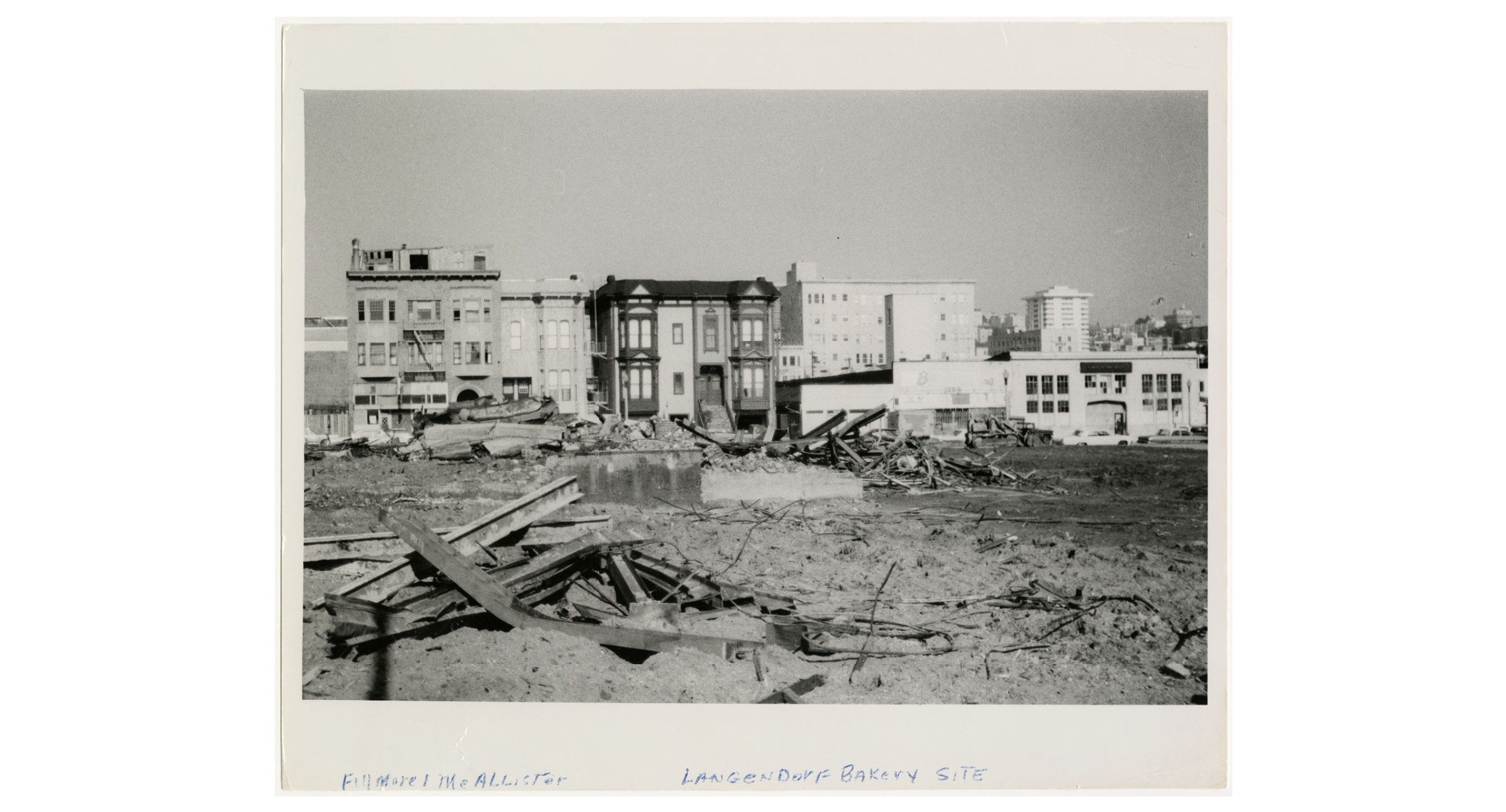

Lynette Mackey’s family was displaced from their two homes in the Fillmore in 1975, when she was a teenager. The homes were seized by eminent domain, and her family was paid $28,000 for both of them. More than 18 people were displaced from those two homes.
If they’d been able to keep those homes, they would have had not only their appreciation in value, but stable housing and income for generations of her family.
Instead, Mackey has a “certificate of preference.” It’s not a house. But it’s not nothing.
The certificates let families affected by the redevelopment of the 1950s and ‘60s jump ahead of others on waiting lists for housing units in the city — below-market units for sale and rent.
The city estimates that 5,893 mostly Black households were displaced by the San Francisco Redevelopment Agency half a century ago. An estimated 50,000 living descendants of those families were thought to be eligible for certificates in 2023. And that’s only in the Western Addition and Hunters Point.
But those certificates rarely house any of the beneficiaries, according to city records and those familiar with the program. Very few eligible recipients actually receive a certificate. Those familiar with the certificate of preference process said the program struggles to track people down, connect them to certificates, and help them apply for housing.
Even when they succeed, the available housing options are often still unaffordable for many who are eligible.
In the 10 years between 2014 and 2024, just 250 certificate holders were housed in San Francisco. The city could not confirm how many certificates it has issued since the 1960s, when the program began, but reports state some 7,000 certificates had been issued as of 2023, and about 1,500 had been used.
Last year, another 319 certificates were issued.
“It’s pathetic, honestly, the number of people [housed] versus the number of people who were displaced … it just makes you want to cry,” said Cathy Davis, who runs the Bayview Hunters Point Multipurpose Senior Services, a property of the Office of Community Investment and Infrastructure, the successor to the Redevelopment Agency. “The longer time goes by, the more the memory of all this goes away.”
Davis’ organization has seen some success in doing outreach to help certificate holders navigate a process she calls “cumbersome.”
Even though her organization has been the most effective at doing the necessary outreach to get certificate holders housed — more than 100 since 2010 — Davis is disappointed the numbers are so low. She said the city needs to prioritize and focus on those who were displaced if it wants to have a real effect.
“If you really want to redress the issue that happened when all these people were systematically removed,” Davis said, “you have to expand the way you find them. You have to focus on that to make sure that it happens.”
Despite a decades-old mandate to replace housing lost or razed during redevelopment, the Office of Community Investment and Infrastructure had only built 9,239 of its anticipated 27,776 units by June 2024. Fewer than 3,000 of those are considered affordable housing. The rest are market rate.
Since 2020, only four certificate holders have been housed in one of these properties.
The Mayor’s Office of Housing and Community Development also funds housing built by nonprofits, but few certificate holders enter those developments either; just 79 since 2020. Descendants of displaced people, who make up the majority of the tens of thousands of people eligible for certificates, are not eligible for these developments.
“There are very few Black people in San Francisco celebrating the certificate of preference program today,” said James Taylor, a political science professor at the University of San Francisco. “They are kind of the last vestige of the humiliation … of being Black in San Francisco.”
The process, Taylor said, is like looking through a store window to “see what’s inside … but you can’t go in.”
The city has made efforts to track down those eligible for certificates in recent years, even contracting with a private-investigations firm to locate dispersed former residents and their descendants. And legislation passed in 2023 is helping to finance more affordable housing in the city, particularly to fulfill the replacement housing obligation to reconstruct lost homes that was never met.
Given preference, not priority
Even certificate of preference holders have to qualify for available housing options. Getting into most available affordable housing in San Francisco requires down payments, approved loans, and dealing with an ultra-competitive environment where thousands of people are jockeying for a tiny supply of housing.
Many familiar with the certificate program said these obstacles often end up deterring the often low-income, mostly Black applicants. Fred Blackwell, head of the San Francisco Foundation and the former head of the Redevelopment Agency, said requirements should be eased for certificate holders.
“Given what those folks have gone through, once they actually do get to the front of the line, the attitude of the bureaucracy [should be], ‘We’re going to need to do everything that we can do to get these families in,’” he said.
Mackey, whose family was displaced from the Fillmore in 1975, now works as an investigator for the city, sifting through incomplete redevelopment records and tracking down residents and their descendants to connect them to certificates.
“It’s not easy to get somebody that’s homeless — let’s just say that — and give them a certificate and say, ‘Here, go get your apartment,’” Mackey said. “It doesn’t work like that.”
Mackey said the certificates would be more useful if they came with a housing voucher, or had monetary value to make up for losses families suffered during redevelopment.
“The houses that you’re building right now, the rent’s $3,800, so I get a certificate that [gives] me a priority,” said Mackey, who ended up housed elsewhere in the Fillmore. “But the problem is still there: Can I afford this unit versus what I owned?”
Just getting certificates into the hands of those eligible in the first place is difficult. Tracking people down, despite efforts the city has made, remains difficult.
And many of those displaced decades ago have simply moved on, living in California cities like Antioch or Pittsburg. Uprooting their lives to move back to San Francisco is a difficult ask.
“Once you are displaced, you put down roots somewhere else,” said Blackwell, adding that he is “not always convinced” that victims of redevelopment “even want to come back” to San Francisco. “While I think it, in theory, is attractive to people to come back, in practice, there’s a lot that has to go into that.”
Mackey, for example, has no plans to use her certificate because she’s 65 years old and has no desire for a big change. Instead, she is helping her children use theirs.
But it does not make up for the harm, she said, not by a longshot.
“I’m not complete, but it’s something,” Mackey said. “It works for those that need a house right now. If I needed it, it would be perfect. But it’s something. It doesn’t make me whole, though.”
Meanwhile…….Urban Renewal Round 2 has unfolded with the closure of the Fillmore Safeway. D5 communities in the Fillmore, Japantown, Western Addition, Cathedral Hill and the Tenderloin are now living in a food desert. New D5 Supervisor Bilal Mahmood refers folks to Booker T’s food pantry, which already had a waitlist and was overwhelmed when Mahmood began telling folks to sign up. Folks are also being told to hop on a shuttle to do their shopping. Old folks don’t hop. Repeated requests to Mahmood for a public hearing with the actual stake holders Safeway, Align Real Estate and venture capital firm Cerberus have been rebuffed. Why? Why are meetings with Safeway “confidential”? Is the new D5 supervisor too busy posting videos of press conferences and police raids in Lincoln Park (where only 1 person out of +80 will be charged by DA)) ? Meanwhile, D5 seniors and working families suffer without a full service grocery store, pharmacy and banking branch.
Sorry. I meant Jefferson Park, not Lincoln.
This is why the YIMBY lies bear rotten fruit. They don’t care about low income housing or keeping rents affordable, it’s all a developer giveaway. Wiener, Breed, Mandelman, Engardio, they all know the scam and are on board with lying to make developer self-enrichment and gentrification sound politically acceptable and necessary by pretending it’s all about helping poor people – in reality it’s all about getting money into their campaigns for reelection.
I am grateful for this succinct look into the terrible fallout of this racist redevelopment program, and the City’s frustrating and frustrated efforts to redress it. Finding the victims of redevelopment, and their heirs who qualify for certificates of preference is one major challenge; after finding them, offering them a certificate to uproot themselves where they resettled for a one bedroom apartment at $3800 a month, to come back to the city that stole their property, seems hardly an adequate remedy. I agree it is a well-intentioned effort – but it needs to be part of a larger reparations program to make sense. And as long as the City allows the market to determine the price of “ affordable housing“, those families who are invited back are unlikely to ever be able to afford to live here.
Yes ! Give them all 5 million dollars and let them buy a luxury home (is there any other kind) for only a dollar (It would be racist to make them actually spend that 5 million on something worthwhile) in San Francisco!
This article is a rehash of a prior article. If the family received $18,000, 50 years ago, it would have been incumbent upon them to buy alternate property. The article fails to mention whether or not that was the case. If the, presumably, grandparents decided, for whatever reason, that they’d rather put the money to some other use than to buy another home, then that is what is commonly known as a lost opportunity. It’s similar to someone saying that they could have bought stock in Apple, or Microsoft, 20 years ago; that, and a slice of bread won’t make a sandwich.
Let’s be honest .. SF residents deported all Blacks to the East Bay . Look at Oakland and Antioch …. SF residents are pretty racist inside … just look at the results and not what the racist and homophobic progressives say. BLM
Seek a noggin doctor.
Do you have copies of the “deportation” orders?