

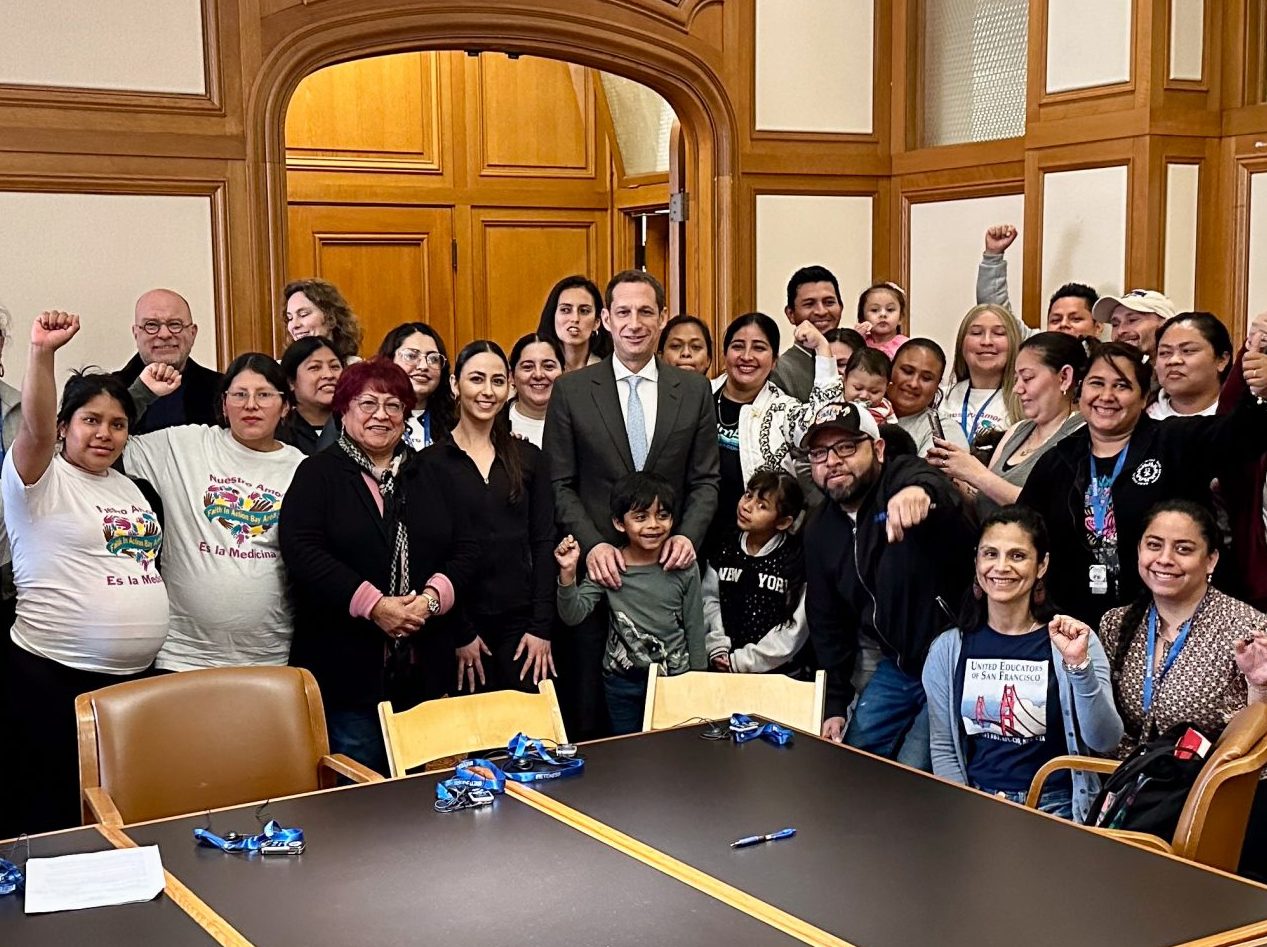

On Feb. 28, Emily Liotta received a notice that she, her husband, and their three children needed to leave their room in San Francisco’s Salvation Army Harbor House homeless shelter in the next 12 days.
Liotta felt confused. Two days earlier, she says Mayor Daniel Lurie told her that as long as she and her family were making “positive progress” towards getting permanent housing, they would not end up back on the streets.
None of it registered with Liotta’s case manager at Harbor House: “There’s nothing we can do,” Liotta recalls shelter staff telling her. “These are orders from above us. You’re being evicted.”
She will lose her place on March 12.
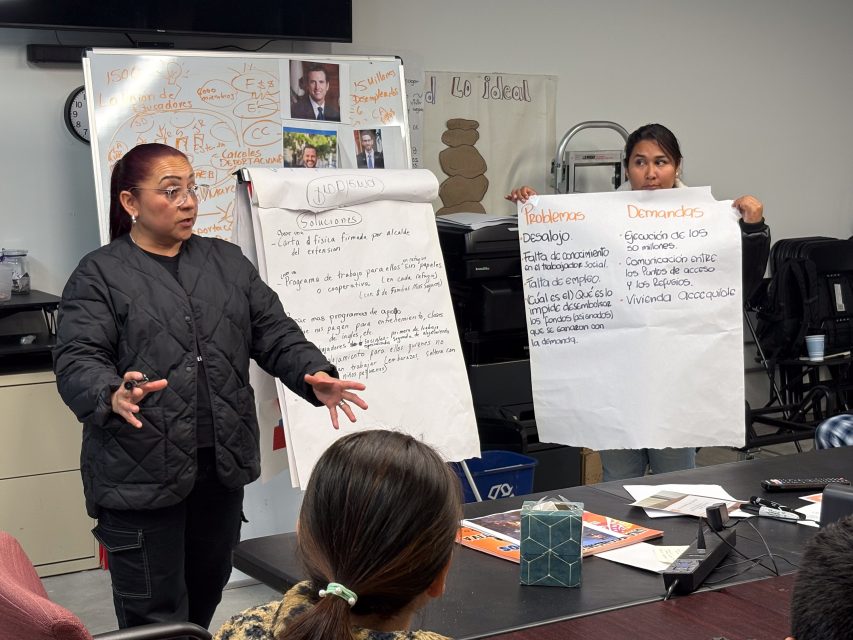
Even getting the meeting with Lurie had felt like a victory. Liotta and about two dozen other homeless families were among the first casualties of a return to a pre-pandemic policy, one that limits family stays at city-contracted shelters to a maximum of 90 days, with an automatic 30-day extension.
When the families received notices to vacate in January, saying they needed to find new places to live by early February, they marched to Lurie’s office, pleaded for help, and enlisted Supervisor Connie Chan as an ally at a press conference a few weeks later.
Kunal Modi, the mayor’s policy chief on health, homelessness, and family services, heard of the homeless families’ plight and visited the 16th and Mission streets office of Faith in Action Bay Area, a nonprofit helping families organize and advocate, according to Matt Alexander, the group’s communications director. Alexander said Modi then brokered the Feb. 26 meeting with Lurie in Room 200.
“In the meeting, I felt very satisfied, because he really listened to us, and he answered our questions and he really gave us hope,” Liotta said about Lurie. “But it’s one thing what he says, and another thing what they actually tell us in the shelters.”
Violeta Roman, a community organizer with Faith in Action Bay Area present at the meeting, remembers the assurances given by the mayor’s office clearly.
“They promised that families will not be evicted as long as they are working with their case managers,” Roman recalled. “They said the eviction policies will not affect the families as long as they are making ‘positive progress.’”
That is not what the city says now. Emily Cohen, a spokesperson for the Department of Homelessness and Supportive Housing, noted in a statement that the decision is up to the shelters. If a homeless family needs more time, she wrote, case managers can authorize a 30-day extension.
The department also noted that, on top of the automatic 30-day extension, families can get two more 30-day extensions, stretching their total stay to 180 days, before they are asked to leave the shelter.
“The intent of the policy is to ensure that shelter is used as an emergency resource that focuses on connecting families to long-term housing options to resolve their crisis as quickly as possible,” read the statement. “Every family’s case is unique, and each family’s extension requests will be addressed on an individual basis based on the criteria outlined in the policy.”
“The mayor’s office supports the policy that the Department of Homelessness and Supportive Housing put back in place,” Lurie’s team wrote in a response. As for the families who are puzzled by contradictory messages from their shelters and their mayor, Lurie’s team referred them to the homeless department.
Supervisor Jackie Fielder, who attended the meeting with Lurie, said it was “unacceptable” for families to be evicted while they are trying to “prove positive progress” to the city. “It’s completely unfair and terrifying for those families.”
“Everything is on the table for me: Legislation, another meeting, more internal conversation — this is just unacceptable,” she added.
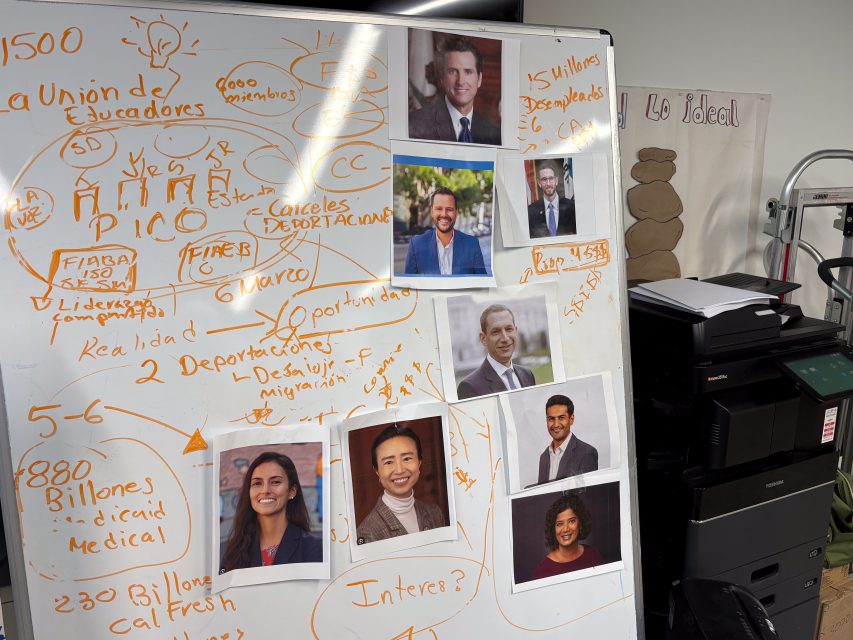
In retrospect, Liotta and other families recalled, the conversation with Lurie lacked specificity, up to and including what Lurie and Modi meant by “positive progress.”
During a debrief on the morning of March 4, families who attended the meeting recalled some examples laid out by Modi. They had to accept any housing subsidy offered to them, check in with social workers or case managers, and attend meetings organized by shelters. But they were never told to whom they should report this “positive progress” to, or how to track their attainment of it.
But they did work toward those goals anyway. Maria Zavala, a 37-year-old mother of three children also living in Harbor House, attended shelter meetings, but recalled that many of them were only held in English. As a monolingual Spanish speaker, Zavela left with little clue what had happened.
Liotta said she applied for a rental subsidy from Compass Access Point, a city service provider, in January. She was told to join a waitlist and check back in April, by which time she and her family would have been back to living on the street.
Zavala, for her part, always had her doubts. She left the meeting feeling as though no real solutions had been proposed. She, like many others, have been told they will receive no more extensions and must move out in March or April.
“They said ‘it’s the absolute last extension we’re giving you,’” Zavala said. “’And we’re not giving you any more.’”
Interviews with families were conducted in Spanish with translation by Matt Alexander.
I would rather we house San Franciscans who were “displaced” by urban renewal than these people who showed up here and now expect housing. Per the Mission Local article :”Lynette Mackey’s family was displaced from their two homes in the Fillmore in 1975, when she was a teenager. The homes were seized by eminent domain,”
Yes, we need to establish a pecking order and that means someone ends up at the bottom.
I think some important facts are missing here. I believe a lot of these folks are probably immigrants who came here without any sort of housing or jobs. How is that sustainable and why should they get resources that should go to folks who are locals and need help just as much? I would feel a lot more outrage if these folks grew up in San Francisco or were true locals who needed our help.
They did get a reprieve. Instead of being told to leave immediately after staying longer than the rules allow, they were given extra time, which has now elapsed. Is the city supposed to pay to house them in a putatively temporary shelter forever?
They got a previous reprieve. They knew that was running out, which was the point of the meeting — just last week — with Lurie.
Then Lurie apparently didn’t have the guts to tell them to their faces that that was going to be the end. Instead he made promises that he did nothing to keep.
Lurie and his administration are no different than previous mayors and staff – Supervisors Fielder and Chan also fell for it, not seeking more specificity from the Mayor in that meeting because they didn’t want to risk their new relationship with the new figurehead.
San Francisco spends about $1.1B per year on homeless.
That’s about $140,000 per homeless individual, or almost $12,000 per month.
Just housing them would cost less. It’s what they do in Nordic countries.
Hi John —
It’s not accurate to simply divide the homeless budget by the point-in-time count or whatever other tally of homeless you have and come up with a dollar amount per homeless person. The homeless budget is, plurality if not majority, spent on housing for the formerly homeless who have been moved off the street. I can’t say it’s similar to Nordic programs, but, yes, this money *is* largely going to housing.
Housing is expensive and the number of homeless + formerly homeless is also not small.
Yours,
JE
I wish these city workers and non-profits would put all of this time and energy into people who are longtime residents instead of spending countless resources on people who just got here with “demands.’ This is part of why I just don’t bother donating to a lot of these organizations. I see them fighting for people who just got here and want a 4th extension to live for free while veterans are sleeping on the sidewalks and suffering on 6th Street. I doubt many SF residents want to keep paying for these people, including the mayor.
When people seek government support it should be as a last resort and never viewed as a long term solution but as a very temporary emergency measure. If such housing is provided for 60 days, with several 30 day extensions, then a positive outcome is measured by finding housing within the generously allotted period of time. A negative outcome is the failure to find housing and continued dependency, despite the potential for homelessness, as a result. That is a known problem when you offer someone free housing, as temporary emergency support, and they insist on holding on to it for as long as they like. That is one reason why relatives, even family members, may not open the door to someone they know who is experiencing homelessness; because they might refuse to leave. That is what is known as being taken for a fool, when your kindness is taken for weakness. It requires firmness, resolution, and determination, to hold people accountable to an agreement.
Do you know if 1) these families are here legally?
2) they had jobs in San Francisco prior to losing their housing, or instead they came here without a job or a place to stay?
These things matter, whether you write about them or not.
Hell of a lot of assumptions there Terry. Would you be so judgmental if they were white? Besides, what difference does it make? Does someone not deserve to have shelter if they weren’t able to make it through the increasingly restrictive, draconian and bureaucratic US Visa process? Also, you try finding a job when you don’t have a permanent address and see how easy it is.
You should try being more compassionate and empathetic to the fortunate in our society. Maybe direct some of your critique towards the millionaires and billionaires in San Francisco actively colluding to keep rent artificially inflated while simultaneously automating industries and campaigning to keep from providing benefits to workers.
“Does someone not deserve to have shelter if they weren’t able to make it through the increasingly restrictive, draconian and bureaucratic US Visa process?”
No. The answer to your question of, “Should we give free housing indefinitely to people who snuck across the border illegally,” the answer is NO.
Lurie is just continuing to reveal himself to be SF’s Donald Trump. A billionaire who didn’t earn a dime and willing to lie and cheat for just a little more power.
Trump had more charisma. Dumb but has charisma. He cracks me up!
When senior/disabled Americans are left in the street to die why would these people believe they are entitled to better treatment than United States citizens?
They just got here and have DEMANDS? That’s funny. I think I’m going to move to Tiburon tomorrow and carry around a list of my demands. On second thought, maybe Alexander and Jackie can invite some room-sharing and couch surfing at their homes? Why not right.