

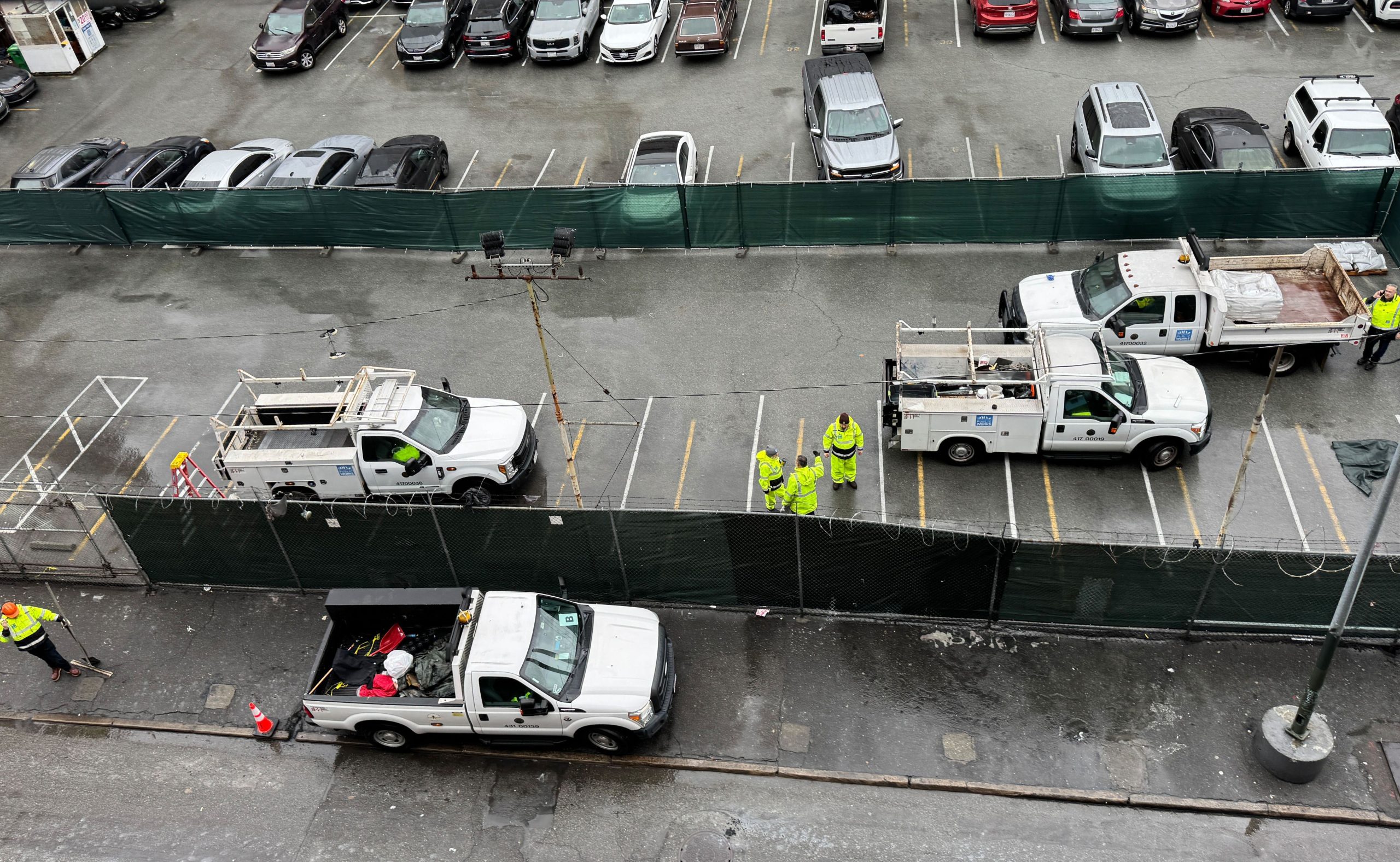

Hours after the Board of Supervisors voted to give Mayor Daniel Lurie expanded powers to mitigate the city’s drug, mental health and homelessness crises, San Francisco police held a town hall to address part of their contribution to the effort: A parking lot.
Specifically, a parking lot at 469 Stevenson St., a stone’s throw away from the notoriously chaotic Sixth Street corridor, which Lurie has focused on as an early priority for his administration.
Police hope to operate 469 Stevenson as a hub for directing drug users to services and offering to bus them out of San Francisco, or putting them in jail. The site was the subject of an infamous fight in 2021, when the Board of Supervisors temporarily blocked hundreds of housing units there, which led the state to investigate the city’s housing laws.
The city is “keeping the expectation really low” as it tries “doing something different,” San Francisco Assistant Police Chief David Lazar said Tuesday evening; the concept was “thrown together starting about a week ago,” added Southern Station Captain Luke Martin.
But, Lazar said, “If the model works, we can copy and paste it.”
Plans for how the temporary law enforcement and treatment center will function are not yet concrete. Members of the public, Lazar added, are encouraged to think of it as a “fluid project” without the “bureaucracy” of city projects that take months to roll out.
One goal, officers said, is to create a site for police to more conveniently process arrests, which could increase time spent patrolling. Currently, officers have to drive to the police station at Seventh and Bryant streets to fill out booking paperwork before going out on patrol again.
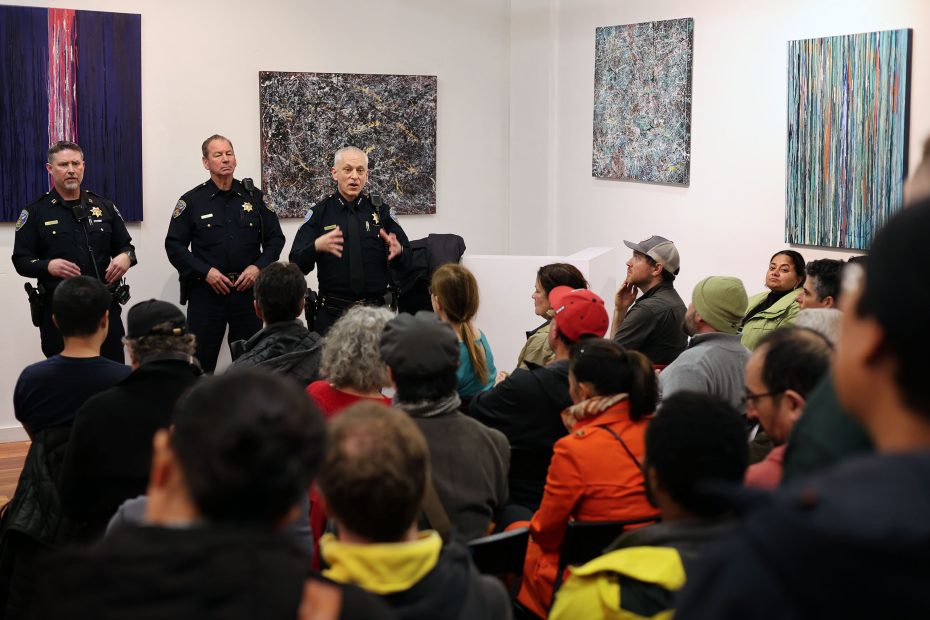
A “transportation area” will have sheriff’s wagons ready to shuttle suspects to county jail. While attempts to ramp up arrests last year led to dangerous levels of overcrowding at the jail, Lazar said he was “not really concerned about overcrowding” at the moment.
He was unsure of the jail’s capacity for intervention, but said police would continue taking people there regardless: “I don’t know how exactly the sheriffs will [do], but that’s not going to stop us from doing what we need to do.”
Although the operation is expected to begin in the coming days, Lazar said after that police do not yet have design drawings for the space. As of press time, a third of the parking lot has been cordoned off with wire fences. Neighbors noted that one of them toppled over in the day’s storm.
Officers stressed the value of the center beyond law enforcement. Current plans are to run it in partnership with agencies like the Department of Public Health and Department of Emergency Management, but no specific roles have been assigned yet.
For example, Lazar said, drug users could come to the lot to seek treatment voluntarily, or to be bused out of the city through the Journey Home program.
“If we arrest somebody [and] bring them to jail, maybe there’s an opportunity for them to meet someone from public health,” Lazar said. “But where we’ve got to get better is really connecting public health to them, and having that touch every single time we touch them.”
“We’ve received no communication so far,” said Wesley Saver, an advocate from the nonprofit HealthRIGHT 360, during the meeting. “You’re more than welcome to join us,” Lazar responded.
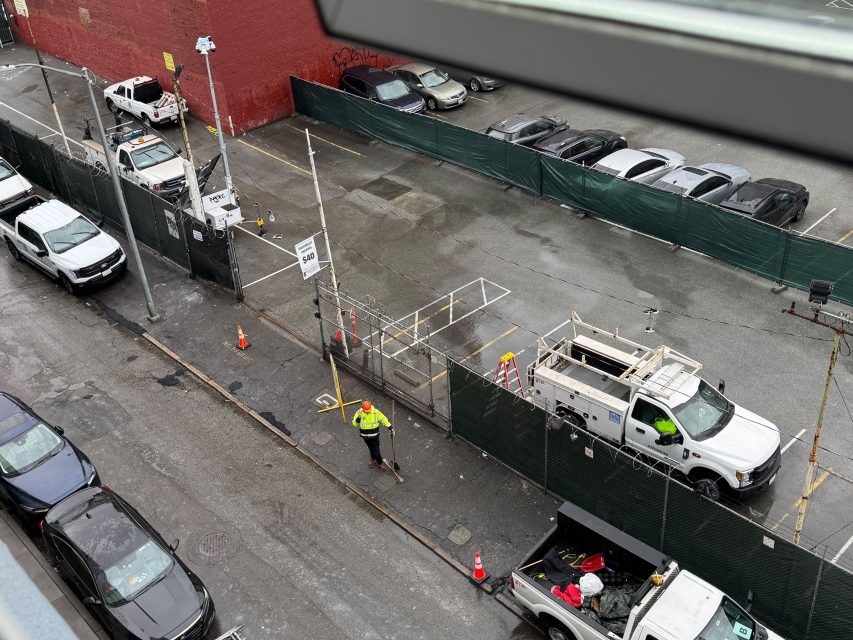
The town-hall meeting was attended by some 50 community members who packed into the Little Raven Gallery at 1015 Howard St. until the space was humid and slick with footprints from the rain. Several thanked the police for their increased presence. Others raised questions without easy answers.
Had Lazar considered the fact that the lot has, as one neighbor put it, “zero infrastructure;” no outlets, electricity or plumbing?
According to city records, the lot is owned by BUILD, a local developer that has been working on constructing an apartment building on the site for several years. Plans for a complex were greenlit by the Planning Commission in April of 2023, but in July of 2024, Muhlis Tur, general manager of North Beach parking, filed a request to operate the site as a parking lot for another five years.
A generator and flood lights could be brought in, Lazar told Mission Local. “You know what we might do, because of the weather,” he suggested, “is put up some temporary little pop tents with the four legs, that you see at, like, a street fair.”
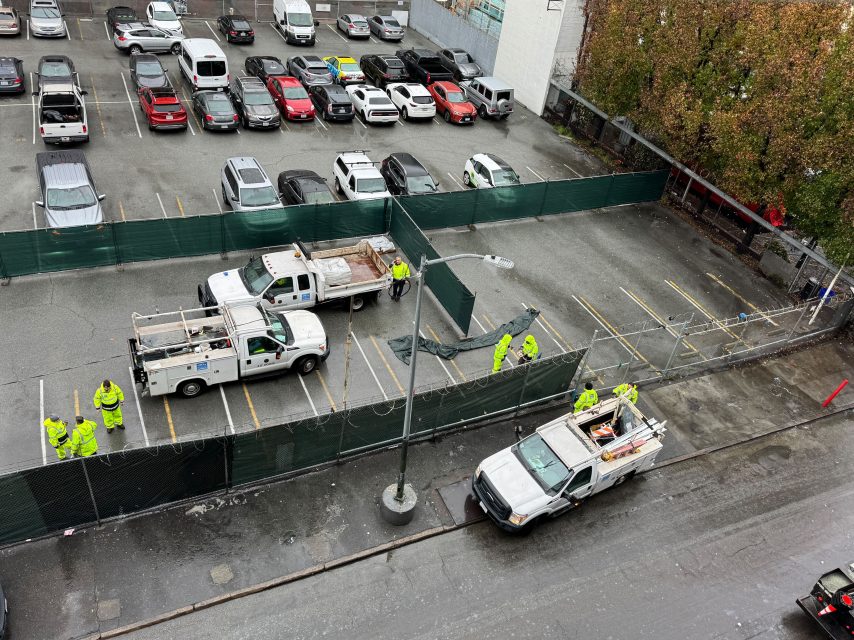
Would all the first-responder vehicles create traffic? They’d enter the lot via a separate entrance, Lazar responded.
Would police presence at the lot push the area’s drug market to other streets? Lazar noted that “this model is to try to avoid displacement” by connecting people to services where they are.
Would addicts in the area be likely to wander in and seek help at a location that was being co-managed by a police force? This, Lazar indicated, would be an ongoing conversation.
“Building a relationship with a police officer is not one of the best ideas,” said Cherie Davis, the lead program manager of Hospitality House’s Sixth Street location. Getting people to seek help, Davis added, comes from long relationships with vulnerable members of the community, who are unlikely to turn to law enforcement for support.
“And then they say they want to put this divider up to hide themselves, but [they] are there for you,” said Davis, in reference to the security fence. “I don’t know how that works.”
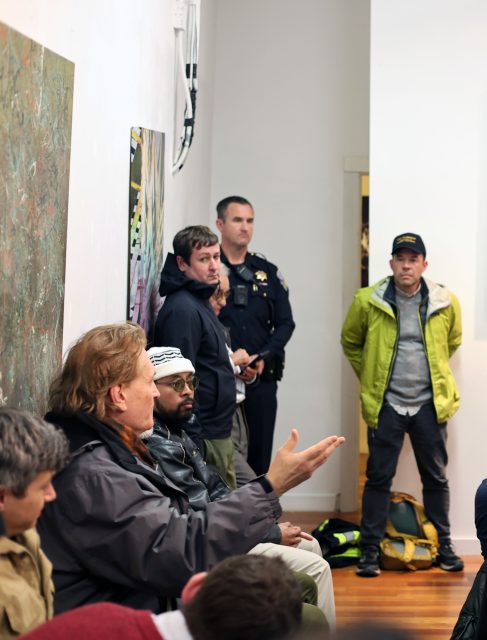
It’s the “same old, same old,” said Mark Sackett, founder of The Box SF, a nearby event space. “It’s not thought-out.”
How will the SFPD determine if the experiment is working? If neighbors are feeling better about the streets’ conditions, users are taking advantage of the services, and 911 calls are down, Lazar said the city would consider the project a success.
Is there a specific data set that authorities will be using to determine what services are needed? That, responded Lazar, is a “great idea.” In the meantime, he said, the SFPD was open to feedback, and would hold another town hall in 30 days. At that point, Lazar said, the city may decide to shut “the whole thing down because it doesn’t work for whatever reason.”
“But we at least have to start and try. That’s what our new mayor is about.”
Finally!
Efficency .
Process everyone .
Law enforcement and services centralized .
Lawlessness is lawlessness .
If arrests are necessary then that can be done .Persons can be evaulated for treatment and help.
Clean this mess up.
Enough of those who continue to allow the harm to continue by allowing the drug scene to go on.
Good. I’m tired of the city contorting itself to serve the interests of junkies who come here to use fentanyl and shoplift.
Get them out of here. If we want to put the city back on track, that’s the first step.
The drug tourists and dealers have to go. All in favor of this plan.
You can see why fascists got in charge based on the upvotes of comments. People are incredibly dumb and blame the less fortunate for systematic issues causing symptoms like drug use and crime. Maybe if we didn’t have a housing issue in the first place there wouldn’t be as much of a drug and crime issue. But no, they think oppressing the homeless will help.
Perfect. A place but no plan. Money but no plan. Is there an intercity bus stop nearby, or will a bus be needed to take them there (somewhere)? Stay tuned. It sounds like a kind of outdoor warehouse where homeless mentally ill drug addicted progressives can be housed. No light, no outlets, no bathrooms, and no plan for them. Nice bit about the community fair tents. Of course no one knows how much this will cost, or where the money coming from. No problem since there’s no plan. Maybe President Musk will provide some crypto to cover startup cost
“drug users, could come to the lot to seek treatment voluntarily”
Well you didn’t tell us we had geniuses in charge, wow.
Didn’t the City already try a fenced-in outdoor area with tents to get people using drugs off the streets? (At UN Plaza, remember?)
Why did that one close? Not enough treatment beds available and too many neighbor complaints, if I remember correctly.
Would anyone need to be forced into treatment if it was as easy to get as drugs?
We should try that sometime and see what happens.
The illusion of safety and justice. It’s just streamlining the punishment of the poor.
So we should just cede our public thoroughfares to illegal drug users and dealers indefinitely?
Absolutely! It’s just treating a narrow symptom. They just want to put a pot under the leak to “catch the criminals” rather than fix the leak that allowed people to slip through the cracks in the first place. The assumption is that these folks who are stuck in this hell are somehow different than you or I.