

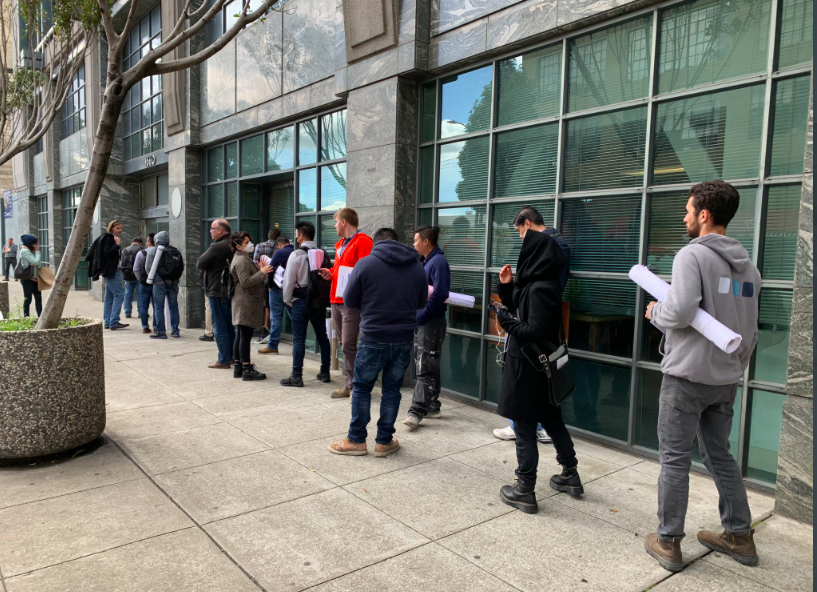

Four years ago, we reported on a man cracking under the burden of the Kafkaesque nightmare that is San Francisco’s permitting system and having a loud, public breakdown at the 49 South Van Ness Ave. permit center.
He screamed to anyone who would listen that he could not navigate the Department of Building Inspection’s byzantine requirements, that he could not land the in-person meetings necessary to obtain permits, and that he could not move his projects forward. Rather than cheat the system “like everyone else,” he threatened suicide. He further threatened to walk up the block to City Hall and kill himself in front of the mayor.
While many people have struggled with permitting in San Francisco, this man was a permit expediter. Obtaining permits was his job and raison d’être, and even he couldn’t handle it.
Authorities intervened and, thankfully, he was saved. He is, we’re told, doing much better.
But the permitting system in this city really isn’t.
We have a new mayor now, Daniel Lurie. God willing, he won’t be getting visits like this from this man or anyone else. On the campaign trail, Lurie heard more than his fair share of horror stories from small businesspeople who waited months and spent thousands of dollars for what should have been simple permits, or residents whose remodeling plans were transformed by the city into a Eugene Ionesco play.
Permitting in San Francisco feels a bit like “Gilligan’s Island.” What ought to be a three-hour tour ends up getting you marooned for God knows how long. So, earlier this month, the mayor announced an initiative called “PermitSF” to streamline, centralize and de-Gilligan permitting in San Francisco.
Make no mistake: It’s good that the mayor is prioritizing this. It’s good that this is happening. It’s good that an intervention is being staged against the city’s Department of Building Inspection — and not just DBI, but other permit-granting agencies as well, including Public Works. It’s good that Lurie appears to be emphasizing the needs of residents and small businesspeople rather than merely knocking down political walls for major developers to entitle projects that won’t be built for 10 years.
So, it’s good. But it won’t be cheap. And it won’t be fast. No matter what the press release says.
But at this point, you may be wondering: Isn’t permit reform something the last mayor promised? And the one before that? And others, going back to the times when unpermitted spittoons were an issue? Well, it’s true. And now we’re doing it again, although this mayor, unlike all the others, does not have a vested interest in the status quo.
You also may be wondering: Can San Francisco accomplish the bullet-pointed goals set forth for “PermitSF” in the aggressive 100-day or one-year timelines laid out by Lurie? Some of them seem eminently doable: Extending the hours at the permit center shouldn’t require a papal bull; coming up with legislation is something legislators can do.
But can San Francisco “create a consolidated permit application and allow for any permit to be filed online” in just one year? Supporters of PermitSF don’t foresee it. People involved in PermitSF don’t foresee it.
But that doesn’t mean this is a bad or misbegotten process. Permit reform, too, is not a three-hour tour. Even if the major goals take more time, there is so much else that could be done in relatively short order to make permitting better and make it customer-focused instead of bureaucracy-focused (or corruption-focused, as it was for too many years).
And, perhaps, the city could start by doing less.

We’ve joked before that putting a garden gnome in your yard requires a permit and removing one requires completing a historic preservation survey. That’s a joke: But restaurateurs having to provide de-facto architectural drawings of where their sidewalk seating would go; that’s not a joke. Nor are fees calculated based on the square footage, which can come out to thousands and thousands of dollars a year.
Fees like this are always described as cost recovery, and it’s a San Francisco special to create more bureaucracy so as to recover more costs. So maybe it’s time to stop doing that. Maybe part of streamlining the permitting process is to stop requiring so many permits.
It shouldn’t require encroachment permits and thousands of dollars and months and months of waiting and a set of schematics — and the possible involvement of paid fixers — to put up some sidewalk tables and chairs. The Golden Gate Restaurant Association’s Laurie Thomas notes that San Francisco is already an outlier in subjecting its businesses to these requirements. So, maybe we can just stop doing that. It is less and less justifiable to mandate businesses and residents to partake in burdensome and onerous procedures for the privilege of living and working in San Francisco. We may never be able to make it easy for people, but we shouldn’t go out of our way to make it hard.
While we’re at it: Did you know that anyone hoping to do some trenching, excavation, sidewalk replacement or curb replacement may be subject to fees of thousands or even tens of thousands of dollars before they obtain street-use and mapping permits? At issue: “Monuments” in the public right-of-way.
When you read “monument,” you may envision Coit Tower or Abe Lincoln sitting in front of City Hall and the like. But the monuments in question are tiny, sand-dollar-sized survey markers, coin-sized metal placements or even scratches on the pavement akin to hobo hieroglyphics.

Survey markers are protected under state law. But is it necessary to charge a bar hoping to put in a parklet thousands and thousands of extra dollars over this? That’s the sort of thing one hopes the folks tackling PermitSF will look into, even if they can’t “create a consolidated permit application and allow for any permit to be filed online” in just one year.
Which they all but certainly won’t.

In 2010, the crime labs San Franciscans saw on TV cop shows featured 3-D holograms. San Francisco’s real-life crime lab, however, featured a technician snorting the evidence and feral cats. Real life can disappoint you that way. Which brings us back to permit reform.
San Francisco’s building inspectors are working off an operating system so old that, if it were a person, it could buy beer. It’s old enough it wouldn’t even get carded. A building inspector cannot look at his or her phone and see what electrical inspectors or plumbing inspectors on the same property are up to, let alone health inspectors or fire inspectors.
“I can’t say, ‘Oh, you didn’t pass plumbing,’” says one. “Everyone has different systems. I have to go and read it on a job card. I have to read somebody’s handwriting.”
San Francisco tried to update its system when it entered into a pact with government software company Accela in 2011. In 2019, the city withdrew from the pact with nothing to show for it but a small fortune spent and countless squandered worker hours. San Francisco demanded millions of dollars from the company for its “failed” system. Building Department officials, however, clearly also sabotaged the project from within; increased reliability, transparency and efficiency would have ruined their profitable little cottage industry.
Setting up a proper, overarching system would require taking the time to draw up the necessary specs, find the right company, enter into a pact, and for that company to get to work, unimpeded by saboteurs. All of this costs money, and neither time nor money are in great supply these days. In fact, millions of dollars earmarked toward permit reform in San Francisco hails from a federal Housing and Urban Development grant. If the feds renege and yank that money away, the city will certainly continue moving forward. But a couple million here, a couple million there, and soon you’re talking about real money.
If you’re looking for silver linings, it seems less and less likely that department higher-ups kneecapping an expensive system meant to improve the customer experience would be tolerated these days. But that did happen and the city did get into a legal firefight with the software company. That may make it harder to find the next company willing to work with us.
All in all, it remains a bit galling that our grand new plan, which is all but certainly overpromising, is for San Franciscans to receive the level of customer service that residents in other, less expensive cities already enjoy.
So, the goals of PermitSF aren’t wild. It’s good the city is moving forward, but it’s unfortunate we spent so long moving backward. In a year’s time, it’s hard to envision the mayor’s lofty goals being met.
But if things are better — if things are improving — it’s hard to envision the people of San Francisco holding it against him. In other words: We’ll permit it.
No records management system built and maintained in good faith, be it based on index cards or cloud computing, would allow changing or deleting inspection records in retrospect as has been practice at DBI. A technocratic angle that putting a modern system in place and things will be fine is backwards so long a culture of corruption, nepotism, cronyism and rent seeking remains. The bad apples will find a way regardless.
Exactly. “Reform” doesn’t mean a lot unless you independently audit the result.
My concern is that SF is going to, in it’s usual manner, demand some sort of bespoke system to manage the permitting system as opposed to adapting an existing system used elsewhere. We seem to fall into this trap every time, adding cost and time to these projects if not torpedoing them entirely (see: public restrooms, school payroll systems, and custom, networked garbage cans).
Yes that seems likely. The correct approach would be to find the city does the best at the permitting process, buy their software system and adapt SF’s permit system to the new software. Usually that would be considered a backward approach but given that both SF’ system and process need upgrading, it would actually work.
And qui bono from bespoke regulation? We know who.
If the city just allowed people to operate they way it does, we’d collectively save millions of hours every year …
City wants to move a farmer’s market? Off it goes, into the street across from the plaza. Block it off with barricades and add a street mural? No problem … done. SFTMA refuses to allow street murals or a modicum of protective barricades on other streets, but they are exempt from their own rules.
Put up a fence? No problem. Especially if that fence privatizes public space. The recently installed fence in front of Arsicault Bakery on McAllister has given them a section of public right of way for private use. Or at least it seems to be private use. I haven’t tried sitting there on one of the Fermob bistro chairs that are ubiquitous on public-private spaces in Civic Center and the Tenderloin.
Park in front of a fire hydrant, in a “daylighting” pedestrian safety zone, on the sidewalk, or in a white zone? No problem. If your car has an exempt plate.
Broken sidewalk/trip hazards? All good in front of public buildings ….
“Park in front of a fire hydrant, in a “daylighting” pedestrian safety zone, on the sidewalk, or in a white zone? No problem. If your car has an exempt plate.”
= Not a fact, but interesting pseudo-anecdote? Daylighting zones aren’t being enforced yet for starters, sidewalk parking is a complaint-based enforcement for which there are no plates that affect the ordinance, and white zones are for passenger loading but require the scant MTA enforcers to notice and enforce that provision which is decidedly down on their priority list, yet no plate affects that either. Unless you meant diplomatic plates, (and including Federal plates), those tickets still are written when enforcement is available and pointed to it.
This is in no way a defense of MTA, just how it actually is.
Joe, you missed one of the biggest issues: Planning. There is no talk by the mayor to change the status quo of Planning.
We have a very detailed planning code. If you submit a building permit application that complies with all the planning code, you would assume that the planning department would be OK with it. Any change to the building envelope triggers neighborhood notification to all property owners within 150 feet and registered neighborhood groups. Neighbors can contest any application to the Planning Commission, the Board of Appeals and the Board of Supervisors at no cost to the neighbor. Frequently the decisionmakers will rely on alleged impacts on sunlight, air, and views (no matter how spurious), despite Planning stating that those are not a valid basis to reject an application. No other city in the country allows neighbors to stop projects like this that comply with the Planning Code. It begs the question: why have a Planning Code at all, it complying with it does nothing for your project?
I was going to say something about planning also, good for you.
I don’t think it’s accurate that you need an encroachment permit for cafe outdoor seating. Isn’t there a permit specific for “cafe tables and chairs”? I thought encroachment permits are for things you’re permanently installing in the sidewalk like a small fence or storage box.
I’ve worked in several cities around the bay area and the real difference that I’ve seen that takes the most time my far is incompetent contractors. In other cities they have lists of approved contractors who will get the projects through without a hitch. The thing that takes the absolute longest in permit approval and costs people the most heartache and money is incompetent contractors who don’t know how to read comments or even their own specifications on the plans sets. I’ve seen plan sets go through 15 revisions because the architect didn’t read the comments on the first round. I’ve had many a plan set where my comment for 4 rounds in a row is “see previous comments”.
When I worked as a consultant in Mountain View, I had to get screened before they would allow me to submit reports to the City. That would help a lot of projects make sure their contractors will actually follow the codes we have set forth to make our city safety and more sustainable
fwiw, pretty sure the reason the city charges cost recovery for permits is a statewide ballot measure that made cost recovery a fee and anything else a tax (which requires a super majority vote).
The City should also drastically lower or drop the fees for permits. Quickly and cheaply processing permits creates economic activity that benefits the City far more than modest permit revenue. And, doesn’t seem likely that people would abuse the process — who files for a kitchen remodel permit just for fun?
The current dysfunction within the planning department stems from an overly close relationship between the leadership of the current planning team, chief of staff and land use attorneys. These attorneys have a vested interest in prolonging the entitlement process, as it allows them to accrue substantial fees from applicants. This dynamic creates a system where these attorneys support the careers of permitting division staff who contribute to and foster these delays, thus generating more billable hours. This is a mutually beneficial arrangement which adversely impacts the needs and best interests of the public and average citizen. To improve efficiency and serve the public interest, it is crucial to foster a culture of problem-solving and innovative thinking within the planning department, prioritizing solutions over catering to specific land use interests. This unquestionably necessitatea a reevaluation of leadership within the permitting division to ensure impartiality, equity and diversity. Time to daylight these improprieties. Rachael, are you listening?
Joe,
You sure do good work.
It would behoove Mayor Lurie to set aside a full morning or afternoon with just you and Rich Hillis to get a comprehensive overview or the Last Twenty Years of San Francisco construction.
Hillis has basically been one of the major Project Developers for the City over that time and you’ve soared over them like a vulture flying from perches at a variety of unworthy publications.
Hell, throw in Peskin and Harvey Rose and Greg Wagner.
None of these guys will bs you.
And, whomever yelled: “Tell em you’ll do it in 100 days !!” ?
Bad advice.
You be the one who realizes he has 8 years left in that building and the first to have an approaching wave of AI algorithms that will easily ferret out just who’s making the roadblocks and why and y’all outta be listening to its opinions.
lol
Go Nines !!
h.
This is a planning problem. If you want to replace your windows you can pull an over the counter building permit for around $500 bucks. Planning will charge you $1600 dollars just to approve the process. Building ( Electrical and Plumbing) inspectors don’t write the codes they enforce them. If they stray from the rules they’re likely to wind up on this website watching their careers go up in smoke. No matter how sympathetic they are to the customer’s plight. It’s not their fault the computer system is antiquated.
Large developers cannot avoid the permit process. But small developers, contractors and building owners can. I recall our bathroom remodel from a few years ago and during the design and estimate phase the contractor asked me: “Do you want permits?”. The implication was clear – that I could save money by not bothering and a blind eye would be turned. No hefty fees and no pesky inspections.
And as you say the fees can be high – I think it was over $2,000 for my kitchen remodel. But there is another reason to duck getting permits. And that is that some part of the value of the work gets added to your Prop 13 tax basis. So not only do you pay the permit fee but your property tax bill can go up by several hundred dollars a year, or more.
Tom —
It says a lot that we punish people who play by the rules. When you make following the rules so expensive and so onerous that you dive away people *and* reward the scofflaws — you’ve failed. How many people properly obtain permits to get a spot for their moving van — and how many people just double-park? It’s stuff like this, times a million.
Yours,
JE
20% discount if the homeowner doesn’t want a permit. 20% add-on if the homeowner wants to help.
The planning part is the worst. They are completely ignorant of what is actually historical, and view their jobs as just mucking up the system so that everyone has to hire an expert or expeditor. I am still not decided if it’s just incompetence, or if they get kickbacks. Some evidence in criminal cases it may be the later.
Firing half the staff and requiring those remaining to do quicker reviews, or be fired, would help a lot.
Make them pick their battles, not try to gum up everything.