

Man, I do miss Wilderness Exchange. Rather than spending a fortune on chic new camping equipment, you could buy second-hand gear, ranging from like-new to humorously antiquated “Swiss Family Robinson”-era stuff. You could even buy the second-hand pocket knives seized at the airports.
It was, in its way, a magical place. But it didn’t sell magical equipment. Too bad for San Francisco: We need magical equipment. All too often, this city attempts to address its most intractable problems … with a tent. As we noted back in 2023: “Too many disturbingly impromptu city plans seem to start with someone saying, ‘Hey! Let’s get a tent! A big tent!’”
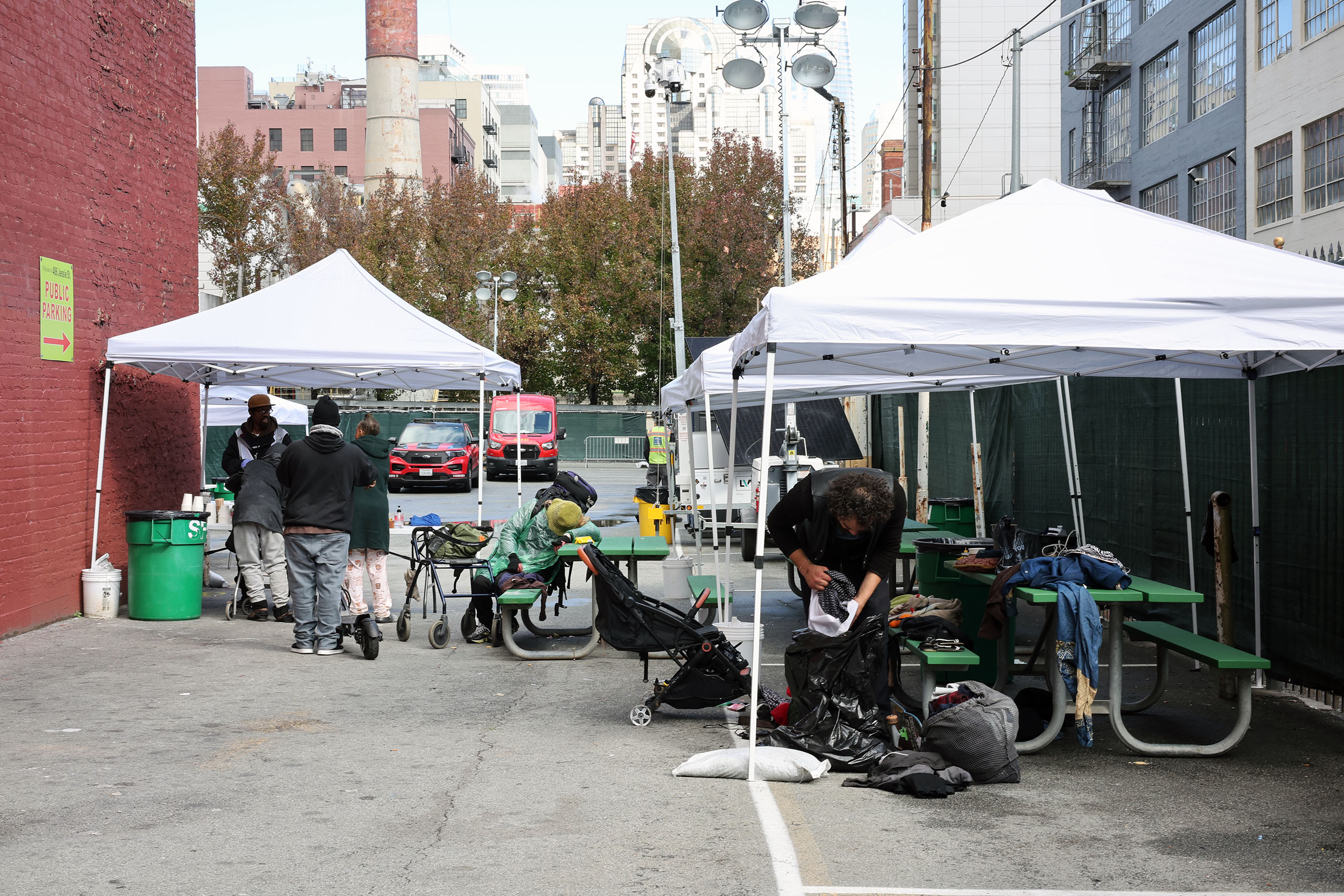
By late last week, a number of tents had sprouted in the fenced-off area of a former Nordstrom parking lot at Sixth and Jesse streets in SoMa, stumbling distance from one of the city’s most notorious drug bazaars. Neighbors told us that both fences and tents had been blowing over in the wind. This city is just a sucker for symbolism.
And that goes for the overall site, too: The parking lot where, in headier times, San Francisco officials argued that a massive housing development would serve as a gentrification bomb is now being converted into a one-stop shop to arrest the city’s most down-and-out drug users or coerce them into treatment or a bus out of town.
No, there isn’t a big tent, but, instead, a series of “little pop tents with the four legs, that you see at, like, a street fair.” Let no one say that San Francisco cannot evolve and adapt in its thinking and approach.
Last week, San Francisco Police Department officials addressed community members living and working in the city’s put-upon Sixth Street corridor. It was a remarkable meeting: It is difficult to simultaneously offer so few details and so many contradictions.
City officials we spoke with had been led to believe this would be “a public-safety tent” in which cops would merely expedite the onerous procedure of booking and processing arrested drug-users. They were surprised to hear the police say that the “triage center” would also be a place for treatment referrals or the “Journey Home” program to bus homeless drug users elsewhere. Similarly, SFPD-announced co-management roles at the site for the Department of Emergency Management and Department of Public Health also came as a surprise to many in city government, who had been led to believe this was a police affair.
This level of amorphousness and evident lack of intergovernmental communication doesn’t bode well. That’d be the case if the city was trying to build a playground, let alone tackle decades-long problems in San Francisco’s most desperate neighborhood. Cracking down on public drug use and offering people the choice of a bus ticket, treatment or a trip to San Francisco’s increasingly crowded and chaotic jails is not cutting-edge material. It’s ostensibly what we were already doing. It’s the “round up the usual suspects” of municipal policy.
But now, there are tents.

Separate and apart from whether it’s good and efficacious policy, let’s assume that San Francisco wants to speed up arresting and processing people doing drugs in public. The logistics and paperwork required to deal with a single person smoking fentanyl on the stoop can pull officers off the street for hours (That’s why, a decade ago, cops told me they simply took away drugs and crushed users’ drug paraphernalia; they called this “The San Francisco Way”).
But if your goal is to speed up arrests, the tent site at Sixth and Jesse streets might be useful. Adam Smith could tell you a bit about the expediency of separation of labor; dropping off suspects at a processing site akin to a factory line would allow cops to head back out and do more work.
But at last week’s community meeting, police announced the site would be doing more. It’d be doing everything, in fact. Arrests! Treatment! Busing! On Friday, they were pouring free cups of coffee.
This, too, is a San Francisco tic: In an attempt to do everything, the city makes it difficult to do anything. We too often strive to put everything in one place, without having proven we can do one thing well.
But, more fundamentally, are get-tough solutions for fentanyl users helpful? That depends on what the goal is. This study, from public-health researchers at Yale University and the University of Colorado, found that get-tough solutions lead to massive spikes in both incarcerations and overdose deaths. It’s not hard to find studies like this.
But only if you care. Or look. Or care to look. So, it’s understandable why this city and so many of its exhausted inhabitants are pushing the jail-or-treatment line. San Franciscans have lost patience with drug-induced street disorder: Last year, 58 percent of voters approved a measure to drug-screen welfare recipients, the milder version of a policy endorsed by former MAGA Rep. Matt Gaetz.
San Franciscans are clearly fed up with visible chaos and misery. So are the folks who choose where to hold conventions. And street conditions and the ongoing failure of downtown retail continue to be catnip for national and international media. The city is ready to tell drug-using street dwellers to “shape up or ship out;” this is, literally, the deal being offered to someone weighing jail or a bus ticket.
Is the city’s approach useful for getting people out of sight and off the street, thereby improving the curb appeal of Sixth Street? It’s a possibility. Will it reduce addictions and save lives? If you follow the science, that’s more doubtful: See here, here, here, here, here, here, here, here and here.
Meanwhile, what manner of treatment will be offered? And what, exactly, does “accepting treatment” entail? If a drug user chooses treatment to avoid arrest and attends a session or two — or none — then what? What kind of follow-up and monitoring will there be? Or do cops simply say “that person accepted treatment” and check a box?
But San Francisco isn’t running a science experiment here. And there’s more than one way to gauge “success.”
When asked if the concepts of a plan that police espoused to Sixth Street denizens about the “triage site” could work, Dr. Daniel Ciccarone, a University of California, San Francisco addiction specialist, said they could. But that depends on what your desired outcome is.
“Is it fewer civilian complaints about public drug-use? You might be successful. Is it a lower number of people in San Francisco who are some combination of homeless plus drug-using because you’ve bused them out of town? You might be successful there, too,” says the doctor.
“But if you’re asking me as a public health advocate: It’s a disaster.”
San Francisco, like so many cities, arrested scads of drug users in decades past. “With some outcomes, you do see short-term benefits,” says Ciccarone. “Visibility, crime issues; those may go down. As far as reducing overdoses and saving lives, you can’t find that study.”
And there is no chance of real success if city agencies don’t work cooperatively and stay on the same page. “But that,” Ciccarone says with a laugh, “is a bit of a pipe dream.”

Do the liberal European enclaves touted by San Francisco progressives arrest the hell out of folks using drugs in public? You bet they do. But they also have robust treatment options and supervised consumption sites that a drug user in a public space would have willfully spurned.
We don’t have those here. There is nowhere near enough treatment for drug users who desire it, let alone for those who don’t. Yes, there are slots in outpatient programs where people can get medications like buprenorphine. But then they’re back out on Sixth Street, and surrounded by lunacy and temptation. Inpatient facilities are in demand, and nearly full.
As for the Journey Home busing program, Mission Local reported last year that a number of the guardrails in earlier homeless-busing programs have been eliminated. A key component of the Homeward Bound program, which moved more than 11,000 homeless people out of town between January 2005 and June 2023, was checking to ensure that friends or family would be receiving a homeless person when he or she stepped off the bus.
We’re not doing that anymore. City officials told us that they have made the program “low-barrier,” so someone in the midst of a drug crisis can have an epiphany and be bundled onto a bus within relatively short order.
To reiterate: We are making it easier for someone with no resources and in withdrawal to get on a bus and be sent to a place where they may have no connections and nobody is looking out for them.

SoMa workers and residents who attended last week’s meeting with the cops certainly hope for the best. But they expect the worst.
Mark Sackett, a SoMa event space owner and entrepreneur, said he voted for Daniel Lurie and is grateful that the mayor and the police are turning their attention to the neighborhood. But he likened the approach so far to “kicking an ant hill.” Joe Wilson, a formerly homeless man who is now the executive director of homeless services nonprofit Hospitality House, said that “efforts like this are largely focused on what the neighborhood looks like, rather than permanent solutions, so they’re bound to fail.”
But the situation on Sixth Street, always dire, has devolved. Something must be done. And this is definitely something.
“I’ve been in the neighborhood for 38 years, and I ain’t never seen anything like this. This has got to be a movie. It cannot be real,” says Del Seymour, a former drug dealer and addict who now leads the jobs training nonprofit Code Tenderloin. “It is so far out of the realm of normalcy. I can’t take it no more. People are killing themselves and we are letting them do that. What kind of folks are we? We can’t let them do that no more, and I am willing to try anything right now. Anything.”
And this is definitely anything.
Sixth Street has, for generations, evaded solutions, and has been the most distressed corridor in San Francisco. For Lurie to stake his early reputation on cleaning it up could be a nigh-insurmountable challenge.
San Francisco’s crime rates are at near-historic lows. But residents have voted as if the city is undergoing a 1970s-era crime wave, in large part because of disorder, chaos and overt misery on the streets. So it will be interesting to see if deftly applied statistics, even accurate statistics, convince people that things are improving on Sixth Street, where disorder, chaos and overt misery are generational conditions.
Because, in the end, there is no magical tent. Only magical thinking.
Additional reporting by Abigail Vân Neely.
3 articles in less than a week from Mission Local on this site near 6th Street. I didn’t comment on the prior articles, but the snarky tone of this one is just too much. This has been one of the worst blocks in the city for many decades. The triage site has been open for 3 days! Let’s give it some time before we prejudge the outcome. At least this administration is actually trying something after inheriting the chaos and neglect that the family (Brown, Newsom, Lee, and Breed) left behind.
I completely agree, Greg. We haven’t been doing what is described above by Eskenazi here for years; in fact, we’ve been doing quite the opposite. We’ve allowed dealers to dominate our streets, flooding them with cheap fentanyl. We then handed out tents, enabling people to occupy the sidewalks and use drugs undisturbed. On top of that, we didn’t give the police the freedom to move those tents or arrest individuals openly using drugs right in front of our homes, families, and children. The status quo is not only a colossal failure for neighborhoods and the people who live in them, it’s deadly for those who are doing the drugs. In fact, with dealers being arrested, encampments being cleared, and public drug use no longer tolerated, there has been a 23% decrease in drug overdose deaths in 2024 compared to 2023.
I’m also frustrated by the ongoing fallacy that crime is down. Perhaps property and violent crime rates are lower, but that’s not the reality for people on 6th Street or at Jullien and 16th, or even my neighborhood on 26th and Shotwell where the sheer amount of low level crime such as vandalism, drug use, human feces, reckless driving, fencing, etc. make daily life intolerable. The real crime here is the failure of politicians who have allowed our streets to deteriorate for so long, making them nearly unlivable for people just trying to run a business, hold down a job, and raise a family.
I commend Lurie for taking his promise seriously and working to finally set the city right after years of destructive mismanagement by previous administrations, along with the nonprofits and others who supported their failed strategies.
After 20 years of the problem getting worse, and with our having built a bunch of low income housing in the neighborhood , my sympathy is 110% with those trying to actually build lives in the neighborhood.
If you polled the non-drug addicts, my guess is that a bus ticket back to wherever they were from is the last of the things they want to happen to them.
Look I’m sorry people fell onto drug addiction, but that does not give them rights to be in San Fransisco and impacting others lives.
“worst blocks in the city for many decades”. Let’s remember how a few years ago, SFMTA insisted on widening the sidewalks, predictably compounding the challenges.
It’s not prejudice. Joe is just pointing out the futility of this approach because we have seen it several times over many years. The point is that a tent with a bunch of cops who keep doing the same thing they’ve been doing for years barely changes anything on the surface. Trying the same thing over and over won’t produce different results. It should be obvious by now!
These problems require an honest, serious, science-based approach. The city doesn’t have the facilities, the people to run them, or the money to pay for all that (and possibly the people with the will to do it). Until the city, state, and federal governments actually work on solving the root of the misery on our streets, band-aid solutions will only move the chaos from one spot to another.
I, personally, am tired of the stupid tent approach because it has become permanent instead of temporary.
That area clearly needs an emergency approach now. I just hope this time is temporary and better solutions will come in the next months/years… fingers crossed.
“Let’s give it some time before we prejudge the outcome.” Ok, then what? There’s not going to be some independent fact analysis of the # of people “saved” from their addictions, at best we get a vague # of people put on buses – to what end? We have no idea. Problem = elsewhere, photo-op, speeches, someone gets a 1/4 million dollar salary for a non-profit to organize the “endeavor” of putting up tents and having basic homeless services there… it’s so basic and yet we gold plate it and then pretend it’s some kind of miracle that we got this far? I mean kudos to Lurie for the basics, but..
Go ahead, mock the people trying to make this city better.
What’s your idea, then?
How is this idea that different from what already was tried. How effective independently is this. How are we tracking the data. How are we auditing the tracking we do. How much does it cost. Questions and skepticism are not mockery, but you’re right that we all trivialize the seriousness of the questions we are effectively deciding if with nothing but a 4 year vote, individually. What more can we do, individually, to make this more effective and more accountable – that’s my question. I’m not running for mayor, I’m just a guy watching the shit go down and trying to keep a middle view of why it is this way. If Lurie had a cape we’d have seen him flying around already.
“But then they’re back out on Sixth Street, and surrounded by lunacy and temptation.”
Do you think that cleaning up Sixth St. and getting rid of the drug dealers and active users will reduce the “lunacy and temptation” for the people trying to get clean?
I think it’s worth a shot, personally. The other question — whether cleaning things up will make it less likely for the new people to fall victim to the same levels of addiction — never seems to get asked or answered.
I might be missing something but I think only one of the nine links you include about involuntary treatment is an actual study—the rest are articles. The study in the International Journal of Drug Policy reviewed other studies and did not conclude that involuntary treatment does not work. The results seemed mixed. It says this:
“Three studies (33%) reported no significant impacts of compulsory treatment compared with control interventions. Two studies (22%) found equivocal results but did not compare against a control condition. Two studies (22%) observed negative impacts of compulsory treatment on criminal recidivism. Two studies (22%) observed positive impacts of compulsory inpatient treatment on criminal recidivism and drug use.”
Why only focus on 6th street? I mean, I get that’s where they’re putting the cop tents, but have you been on Wiese or Julian between 14th and 16th streets recently? It’s a disaster/drug carnival. This is all push-down-pop-up theatre. They push people from one area to another and nothing really changes. I’m sure there are other areas similarly being abused. We need safe consumption sites, rehabilitation for those who want it, and to stop relying on punishments that have never worked. Prohibition is only good for making all the problems worse.
Perhaps they can push these folks out of town entirely. That would cause immediate positive changes for San Francisco, and likely the addicts as well once they make their way somewhere less grim for them than Midmarket.
Could his latest initiative again fail/fizzle out/not live up to what’s been hoped for? Sure. Though, from the looks of it, this time it’s happening on a shoestring budget. (For cost reference, just look at the tiny houses in the Mission or that failed RV park at Candlestick). So at least they’re not sinking millions into the endeavor.
The question is WHY DOES an RV parking lot “fail” or have to cost millions to operate, when it’s literally not that big of a deal? A: Because SF makes everything a federal case big deal instead of just doing what is necessary, 1.7 Million dollar public restrooms and ADA-compliant (but leaking) 2Billion dollar subways that nobody uses, and cops getting paid 2x salaries + pension all at once and they never even get out of the car to write a ticket. It’s not that hard to give people a place to go park an RV and live their lives for a while. We make it hard, as SF pretends to be a “world-class” city but can’t do small town basic s.
The BoS simply waved Walton’s cost proposal for the Candlestick RV park through. No cost breakdown or competitive bidding that I noticed.
So if you were the non-profit (Urban Alchemy if memory serves me right) that got the funding – this thing wasn’t a failure at all.
That’s the question, per cost and verifiable figures, WAS it a failure or a success? We the Joe Public have NO IDEA! And we trust the Breeds, Jenkinses and Singers to tell us how it is? Please.
It’s about time the city did something about Sixth Street, and honestly, this is at least a step in the right direction.
You mention “liberal European enclaves touted by San Francisco progressives” but don’t note that these places lack the hideous rates of (generational) inequality for which the USA is the weird stand-out among the rich-world countries. Treatment is more likely to be accepted – and more likely to work – when people have lives worth going back to. So don’t leave out poverty as a very common piece of the USA’s drug-use puzzle?
Plenty of countries with high inequality that don’t have the USA’s issues. In fact, plenty of states in the USA with worse inequality but no crackheads regularly taking a dump on your doorstep.
There is a supply and demand problem with drugs .
“A rat will keep eating poison until it dies “
Both law enforcement and services are needed .
Trying to run a drug addiction center , mental health clinic and homeless shelter on every corner doesn’t work.
I applaud this effort .
The progressives enabled an impaired person to come to a taxpayer site to take more drugs .
That is insanity and cruel.
Ethically , medically and legally wrong to take drugs ,
The dealers should be arrested and no mercy shown . The progressives would probably encourage the dealers to take the drugs found on them.
The addicts are impaired; however , they need to understand it is illegal to take drugs . If they can find them they can find and take methadone .
Zero drug tolerance .
See a nytimes article about the success for treatment in prisons. Very good news.
Why the local taxpayers have to foot the bill to take card of addicts who come from allnover in wrong ,
Treatment , jail or leave.
It is time to show SF has zero tolerance for this .
The majority need to have their concerns addressed .
Unfortunately, no matter what is done with addicts , the success rate is low . Most die.
It is time to follow the un model
And put these persons in tents away from the neighborhoods . UN refugee camps . They may live there for a couplr years but need to get cleaned up sober and take responsibility for themselves .
I look forward to this Lurie plan and tents coming to the Tenderloin and Lower polk street area soon .
Hanging out all day and doing drugs on the street harms themselves and all.
This papers tone appears to think that is ok.
The addicts are selfish . They have no right to destroy this city and others lives .
At some point, San Francisco needs to focus more on its residents’ needs for clean, safe streets than it does on playing social worker. We cannot rehabilitate 30% of the country’s homeless and drug addicted. Already our city has spent billions trying to “save” people who tell us over and over again that they don’t want to be saved.
The article notes that “we are making it easier for someone with no resources and in withdrawal to get on a bus and be sent to a place where they may have no connections and nobody is looking out for them.” Yet many of our street people come to SF with no resources, no plans, no jobs, and no connections. They come for the money, the drugs, the free resources, and they expect SF to take care of them. If they refuse to help themselves, it’s not unreasonable to send them back to their homes.
As for the tents – Better a few large white tents in a central location offering solutions than the blocks of homeless tents pitched in our neighborhoods.
Here are some rough stats: SF budgeted $846 million to try to help homeless people in 2024. And we counted about 8,300 people who were unhoused last year, some of those with drug, alcohol, and mental health issues. That’s about $100k per person…just for 2024. I don’t know what we can do to better help people but perhaps there’s enough money washing around.
Hi Scott —
Assessing cost per homeless person is a lot more complicated than dividing the budget by the number of homeless people in the biannual count. The biggest chunk of homeless spending is on housing — which helps the people you don’t see. These costs continue even after someone is housed.
There’s a lot of money being spent and surely not all of it is well-spent. But it’s more informative to look at the homeless budget as also comprising a housing budget.
Best,
JE
No one who want to discuss “housing the homeless” @$100K/person should be listened to until they have been to Asia (hong Kong, Singapore in particular, but also Korean and Japan) where their is a lot of public housing, but the units are 100-400 sq feet.
We are trying to provide middle class housing on the public $$$ and not only is it not so long the problem, but it is not surpassingly destroying any consensus to address the issue.
A large building, with small units, some with two or three small bedrooms for families, and drug sniffing dogs at the entrance would do a lot of fix the housing problem…
Do you actually know anyone in low income housing? There are definitely 100-400 sq ft units in Soma / Tenderloin
that is simply not true though and how about we have a dog sniff you every time you come home? What a disgusting suggestion.
You have to operate within the framework of local law. We can’t all emulate, er, Singapore 1:1.
I get the impression many do not want to spend anything, but just make these folks go away.Disappear from their sight.
what about those housed who arent allowed to ise indoors, so they stand, lay around in front of my house on Julian Ave. SROs on every corner and Gubbio handing out cofe and snacks that gets dumped all over our block. Its not hard to see how much of a failure the soft of drug addicts approach has been. If you dont live precisely on one of the really bad streets, you cannot comprehend how humiliating and depressi g it is live live amoungst the carnage and filth.
No one forced you to live there as I assume you can afford market rate.
People doing the fentanyl droop everywhere from 7th Street to 5th, Folsom to Geary is not sustainable. It’s also not productive for them or society at large. Tripping over drugged out people every 100 feet is bad for the greater good. This is a positive step towards making our city habitable for the rest of us.
The ‘street fair’ analogy was amusing and apropos. Seems the City Folks want to make it seem ‘lighthearted’ and casual. I’d argue that is partially how we got here in the first place.
There was a time when doing drugs was looked on a warning/no-go for folks but it seems the open dialogue has shifted towards the doing them safely side. Not just for addicts but for yet-to-be addicts who might have avoided opiates in the past but not so much anymore.
Why has the Peninsula not developed the same drug issues? They don’t put up with it and undoubtedly they push those folks along to SF or other permissive areas. While the bus idea is a bad idea (detoxing on a bus…. what a joy for other riders) the idea of sending folks out to other locales not as inundated (thus more available resources) is attractive.
However, if folks don’t want to quit it won’t matter if you force them into Rehab. And folks don’t want to quit if they feel no hope after they stop the things anesthetizing them from their circumstances.
Re: “Why has the Peninsula not developed the same drug issues?”
Asking questions can ‘seem’ to invoke an obvious answer.
The ‘Magical Thinking’ is what we’ve been doing for too many years. We tried to solve everything with talk and it has been a failure. Commands must be given and if there is disobedience overwhelming force needs to be used. No More Talk, Action.
Perceptive column as usual, Joe. When you mentioned liberal European cities and how they combine law enforcement with robust treatment and safe consumption sites, I immediately thought of Zurich and its successful Four Pillars approach. Thanks to former supe Dean Preston, who commissioned the below report, we have a blueprint for what Four Pillars would look like here. We just need to do it.
https://sfbos.org/sites/default/files/BLA.Zurich_4_Pillars.111924.a.pdf
In addition. Addiction is a 24/7/365 occupation.
This mans what ever they do, it needs to be a 24/7/365 operation.
What reports like this elide is how cities like Zurich treat regular crime, not drug crime. Try to clear out an Aldi’s shelf and pawn your proceeds outside Hauptbahnhof and report back how generous your pretrial release conditions are.
Either you’re arresting someone or your not. Prolonged detainment without arrest is unConstitutional. The first thing they do when you hit the jail is take a pic and prints. Then jail staff (sheriff’s department) does intake work and then they stick you in a holding cell for post-arrest observation and determination. They can’t do any of that there. They aren’t expediting arrest there.
So the question remains: how are they getting folks into the lot? It’s not realistic they are saying ‘come with me or you’ll be arrested.’ That’s a lawsuit.
Presumably, they want people to enter voluntarily. Adam Guidry is there getting a free a coffee, browsing the bazaar. Kids know where to go for paid travel. It’s not an arrest center. There are no sheriff’s department staff there with mainframe computers.
How the city enables open air drug dealing and use. Allowing liquor stores and junk food shops to exist in the TL is deliberate. Stores selling liquor, Brillo pads, glass pipes, aluminum foil, single cigarettes, lighters, rolling paper. These items sell more than the junk food.
All drug dealers and users buy these items. The city depends on the sales of these items and therefore can not honestly eliminate the symptoms of its addiction.
What uncompassionate drivel most of these comments are. The Orange Musk and his ilk along with generations of underinvestment into healthcare and housing and a media and politicians that demonizes (certain) substance users (I mean Newsom is a substance abuser & look at him) and unhoused folks all the time seem to have created an unthinking, cruel public that cares more for the aesthetics of streets than actual care and compassion for people.
This entire playbook (lock em up or bus em out) has been the only playbook that I have ever seen the city do for the last 28 years I’ve lived here. The ONE time we opened a safe consumption site it was immediately demonized by all media and even the politician that opened the site. So it closed even though the strategies were starting to work (although still not adequately funded).
At this point comments on articles like this are not just pointless (including this one), they are contributing to an increasingly cruel vitriol directed at poor people. This isn’t good for society. Nor will it help the larger, systemic, root problem of growing inequities and disparities that are fueled by the rich / 1% gobbling up all the money and who play ransom with politicians to extort their will onto the people: jail as solution to all problems so as to increase the population stripped of their rights and sold into slave wages for the 1%’s profits.
bravo!
Bulldog Answer,
Decriminalize drugs.
This takes the cops and dealers out of the Triangle and has worked around the World with only Jailers and Prosecutors refusing to agree.
Arresting and imprisoning people is big business and Empire Builders in cop shops and jails and prisons are lobbying like hell to lock up more and more.
Decriminalize now and that includes the Sex Trade and Casinos.
Music is already legal and that covers why I came here 40 years ago …
Sex, Drugs and Rock and Roll
That shit was hella fun.
Go Niners !!
h.
Bulldog Answer, Decriminalize drugs. This takes the cops and dealers out of the Triangle and has worked around the World with only Jailers and Prosecutors refusing to agree. Arresting and imprisoning people is big business and Empire Builders in cop shops and jails and prisons are lobbying like hell to lock up more and more. Decriminalize now and that includes the Sex Trade and Casinos. Music is already legal and that covers why I came here 40 years ago … Sex, Drugs and Rock and Roll That shit was hella fun. Go Niners !! h. 0 0 votes. Sign in to vote
Reply
I keep trying to miniaturize my views …
It turns out trafficking drugs is big business too, and if you think the CEO of Walgreens is up to some nefarious stuff let me tell you about the goings on of a certain man named Joaquín Guzman.