

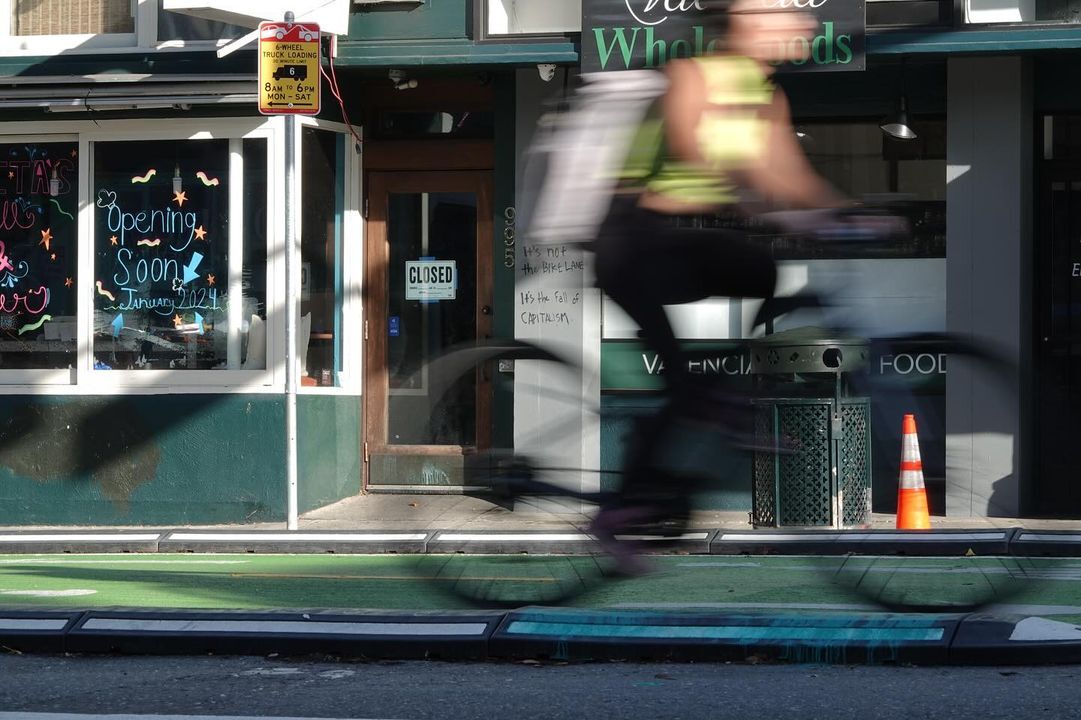
The Valencia Street bikeway will move from center to curbside after a unanimous decision by the San Francisco Board of Supervisors today.
Construction of the side-running bikeway will begin in early February, and will take two to three months to complete, depending on weather conditions, the San Francisco Municipal Transportation Agency confirmed.
The construction schedule has been delayed from its original plan to begin in early January, an outcome that’s not ideal for most merchants along the commercial corridor, who had hoped to avoid pushing new bikeway’s construction into spring or summer, the busier shopping seasons.
The Board of Supervisors hearing today considered an appeal filed by VAMANOS, or the Valencia Association of Merchants, Artists, Neighbors, and Organizations, that challenged the California Environmental Quality Act (CEQA) exemption granted for the Valencia curbside bikeway project.
The appeal was filed in December, approximately a month after the plan for the new curbside bikeway was unanimously approved by the San Francisco Municipal Transportation Agency’s board.
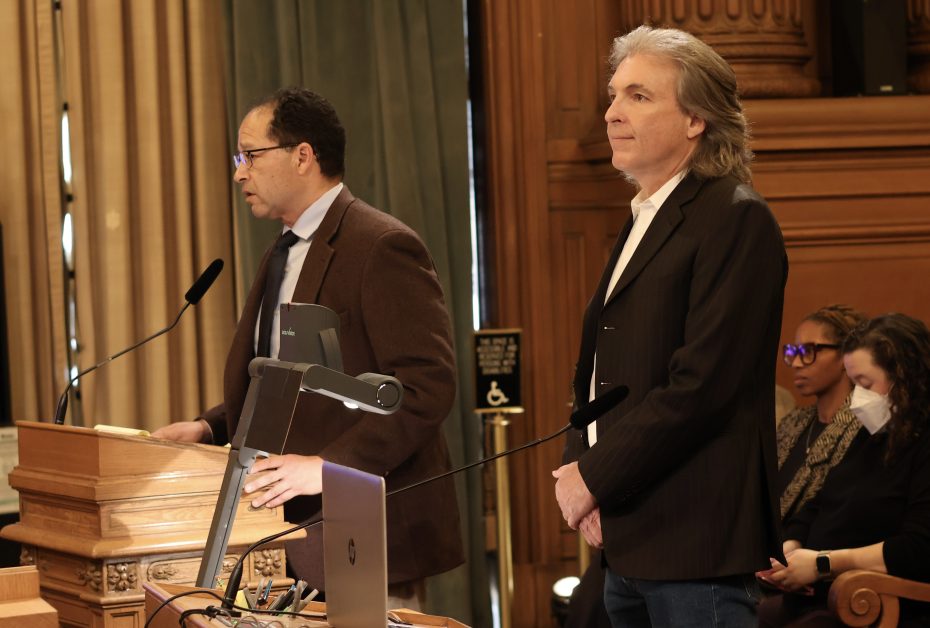
In other words, the Board’s decision is less about whether the new bikeway is a good idea, and more about whether appealing it is appropriate. “The question before us today is not to consider the merits of the proposed bikeway product itself,” said Supervisor Jackie Fielder, whose district, District 9, includes the eight blocks of hotly contested bike lanes. Instead, it “is a very narrow question of whether the MTA-proposed, curbside-protected bike lane project falls under the statutory exemption determined under state law.”
Fielder’s conclusion, she added, was that the SFMTA’s proposal was sound by the definitions and criteria set forth in section 21080.25 of California’s Public Resources Code, which exempts from CEQA certain bicycle facilities and pedestrian facilities that meet specified criteria, said Fielder.
The appellants, or VAMANOS, maintain in their appeal that the new bikeway project fails to address legal, environmental and community considerations required by CEQA.
The Planning Department, which issued a statutory CEQA exemption for the new Valencia curbside bikeway project in November, disagrees. Because the new bikeway project costs less than $50 million, is being carried out by a local agency that is also the lead agency of the project, is not demolishing affordable housing, and is implementing pedestrian or bicycle facilities that improve safety, it is exempt from CEQA. The mid-Valencia curbside protected bikeway project satisfies all of the requirements to be exempt, according to the Planning Department.
In fact, said Jennifer McKellar, senior environmental planner of the Planning Department, the purpose of creating the statutory exemption to CEQA in the first place was “to promote sustainable transportation,” like bike commuting.
“I’m going to confess that,” said Supervisor Matt Dorsey, “few things in my career in this building have irritated me more than watching California’s preeminent environmental protection law, CEQA, weaponized against environmental priorities.”
The hearing today, he added, “it seems to me this is what the legislature sought to address.”
All supervisors present voted to affirm the statutory exemption granted to the new bikeway, and in opposition to the appeal.
VAMANOS, a nascent group founded in mid-2024, identifies itself as “being more militant” than the Valencia Corridor Merchants Association, the main merchants association on the street since the early 2000s, according to VAMANOS’ attorney, Julio Ramos.
VAMANOS has about 12 active members, according to Ramos. This includes representatives from Wrap & Roll, Santora Apt. & Bldg. Supplies, Sidewalk Juice, Valencia Whole Foods, Amado’s, and Jay’s Cheesesteak, according to a list shared in December by David Quinby, owner of Amado’s and an active member of VAMANOS.
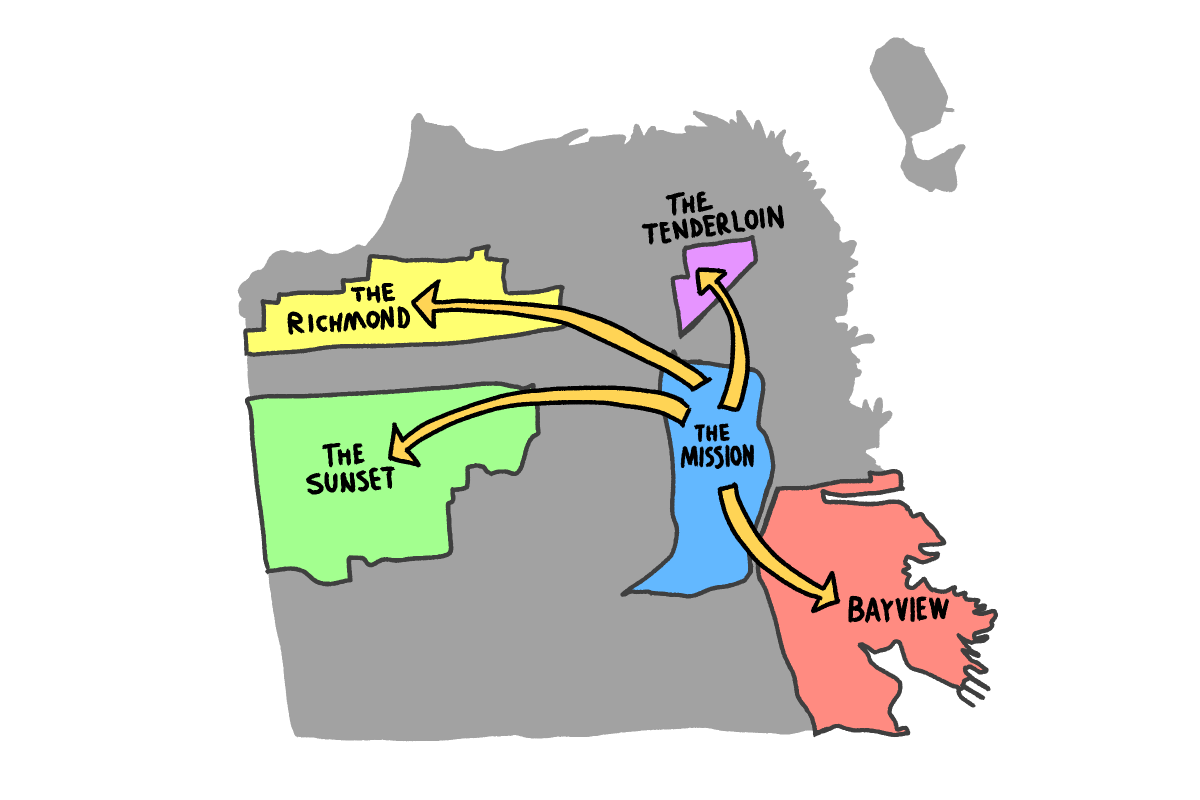
Valencia Street is an ideal location for bikeways compared to adjacent streets, adds Paul Stanis, the SFMTA project manager of Valencia Bikeway Project. The streets to the west of Valencia Street, Guerrero and Dolores streets, are very hilly and car-focused. Streets to the east, such as Mission Street or South Van Ness Avenue, see heavy bus traffic. Smaller side streets do not necessarily connect the southern neighborhoods to Market Street.
The burbside bikeway will be protected, which will eliminate more parking spaces. But, said Stanis, Valencia Street is among the 12 percent of city streets that, together, account for the majority of severe and fatal collisions. Every month, about two cyclists are struck by vehicles on the entire Valencia corridor, according to Stanis.
After receiving mixed feedback on the center-running bikeway pilot project, which was favored by most cyclists but loathed by merchants, the SFMTA conducted extensive outreach and community engagement through 2024 before finalizing the new design.
Despite being unanimously approved by the SFMTA board, the new design was the result of a compromise. It’s the end product of efforts to balance safety, mobility and economic vitality, said Stanis. Valencia Street serves so many different needs that it’s difficult for bikeway design to satisfy everyone. Decision-makers as well as many community members accepted it with the hopes of moving on from the prolonged battle.
That wish, however, was shattered in December, when VAMANOS filed the appeal.
Today’s decision was preceded by a two-hour-long hearing before the full Board of Supervisors. The Planning Department and the SFMTA weighed in, and supporters and opponents of the appeal lined up to make public comments. Opponents outnumbered supporters by at least two to one. Both sides mostly expressed their frustrations with the whole bikeway discussion.
At the end, Quinby tried to put a more positive spin on the bikeway discussion, which had been prolonged by a month. Filing the appeal, he said, “was the only way to get [people] together and talk … I’m so glad we came together to speak on this.”
It appears to me that the people who wanted more parking complained about the center bike lane. This resulted in the side, curb protected bike lane being approved which removes more parking.
If Valencia was a one way street, there would be ample room for parking, bike lanes, and parklets. It’s not clear why making the drivable space narrower (to make room for more parking and modes), isn’t up for discussion.
It’s “not clear” why the bicycle lane can’t be one way then either.
Constricting the drivable space in 2008 when urbanists insisted that sidewalks be widened is what also constrained the options for street configuration moving forward.
I’ll be sorry to see Valencia’s center bike lane go. Having it along the curb means that cyclists will again have to dodge cars making right turns and now avoid pedestrians passing from parked cars and Ubers to the sidewalk. Everything is a compromise I guess.
As a traditional bicyclist living in the area, they aren’t many of us non-motorized riders left out there. The average rate of speed of the various E-devices using the ‘Bike Lane’ is much higher than it used to be. ‘Bike lanes’ have been so taken over by devices that prefer to Share The Road with cars like we used to. The fighting will be more between electric scooters delivering crap to WFH ppl and bikes than between bikes and cars. I think both of those user groups hate the scooters equally.
And you can bet that those 80# delivery e-bikes will just park their rigs adjacent to the curb to run into restaurants to pick up a delivery.
I’m confused what VAMANOS wants. Delaying construction means the loathed center bike lane will stay up for longer? Confused about what they want.
I think they are confused as well, their website described them as an “anti-gentrification group”. Who are they selling $10 juice to?
Haha!
It’s not clear what it is that Vamanos wants in regard to the bike lane?
They pretty clearly don’t want any sort of accommodation for bicycle traffic, period, which is why further efforts to negotiate/compromise were pointless.
Why do bicycle advocates lie?
No more so than rich, entitled white people poisoning the air and killing pedestrians in their death mobiles.
Here’s the SFMTA report showing the impact of the center bike lane go here: https://www.sfmta.com/media/41378/download?inline
Here’s part of the summary:
Furthermore, the findings continue to indicate that the pilot design is an improvement over the pre-pilot conditions. Aspects like vehicle blockage of the bikeway, which was a significant traffic safety concern in pre-pilot conditions, were drastically less frequent during the pilot. Other concerns, such as vehicle dooring or vehicle encroachment of the bikeway, were also less frequent after pilot implementation. Essentially, the pilot has reduced or almost eliminated all mid-block conflicts for people on bikes. Overall, the pilot has made the biking experience safer and more predictable. Other aspects of the pilot design, such as the curb management plan, also showed success at reducing unsafe vehicle loading behavior, such as double-parking. However, even with these positives from the pilot design, a new conflict arose from the pilot: vehicles making illegal left or U-turns at the intersection. These illegal movements are the main cause for bike-related collisions in the current pilot conditions.
Seems like people forgot this:
“Yesterday at 1:30 p.m., Huang was crossing the crosswalk at 18th and Valencia streets when an alleged ride-hail driver in a car heading westward turned left and struck him. An eyewitness at Yellow Moto Pizzeria said Huang “clearly had the right of way,” but the driver “didn’t yield.” Though police and paramedics arrived soon after and transported him to the hospital, Huang appeared very much “in pain,” the eyewitness said.”
Quote straight out of ML. The current design made a 80 year old man attempt to walk 40 feet across a busy street where he had no protection no safety island, to get killed. The design of the center lanes never accounted for people who do not walk fast, like Mr. Huang. This was the second MTA designed situation where a fatality occurred. City incurs liability.
And if there was a curbside bicycle lane, 8 foot parking lane, even 10 foot traffic lane, Mr Huang would had only had to traverse 20 feet with the bicycle lane and parking lane as protection.
LOL, so many comments. No one will ever be happy here; it seems even trivial now. When constructed, the people called it a “Meat grinder” .good one..a staggering number of people got killed on that lane…not..Then we had the merchants blaming the lane for decrease in business; that was a good one as well. Now more whining. At least during construction, we won’t have the morons’ bikers using the lane as a racetrack…To resume, typical reactions all over, that is why SF is getting behind on a lot of things because locally we have a lot of Nobel prize winners, more than billionaires, who always are for everything that is against something and against everything that is for something else.
How does the government know that running a bike lane adjacent to a heavily pedestrianized sidewalk, in an often “vibrant” neighborhood commercial district, between parked cars that have doors and occupants coming and going, will make cyclists and pedestrians safer?
Who evaluated the trade offs? Where is that study?
“between parked cars that have doors and occupants coming and going, will make cyclists and pedestrians safer?”
Not only that, but my understanding is that this bike lane will weave in, out, and around the restaurant parklets.
I also anticipate that at busy times pedestrians will choose to walk along the bike lane, rendering it unfit for purpose.
Not unlike bicyclists on sidewalks or in lanes running stop signs. Yes the problem with “lanes” of all types is that people don’t always follow the rules, and some abuse that. What’s the solution? Enforcement of the rules, not more rules with no enforcement or stupid painted curbs with nothing behind it. If 100% follow the rules, the rules work.
Every article about the VAMANOS group (this is now the third in Mission Local) needs to mention that Amado’s has been closed since November of 2023. VAMANOS is clearly an organization that is acting in bad faith.
Cherrypicking 1 item to say the larger group is acting in bad faith = bad faith.
“Is everyone happy now?” asks the author. ‘Sounds as if no one is happy. First, if two cyclists every month are struck by vehicles, Valencia and other heavily commercial streets are the wrong places for bike lanes. Second, e bikes can (and do) achieve speeds of 40 mph. That kind of velocity can do considerable damage, especially when the cyclists jump stop signs or aren’t looking out for themselves. They will not be happy to have to cooperate with pedestrians and parklets that will share the proposed bike lane. Third, SFMTA cannot live within its rich budget. It now is begging citizens for money and proposing a parcel tax on homeowners to close its predicted budget gap. Meanwhile, it continues with bike lanes on Valencia and other streets to appease the small percentage of people who bike. The Bike Coalition already is complaining that its Biking and Rolling Plan is not sufficient; it wants one that is “more robust.”
The Valencia bike lane is not worth spending millions of more dollars, especially when it hurts local merchants and people who do business with them. It’s astounding that cyclists will accept only Valencia – no other street will do. And it’s infuriating that the city caters to them at the expense of local small businesses.
“The Valencia bike lane is not worth spending millions of more dollars, especially when it hurts local merchants and people who do business with them.
Except that we cyclists are frequent consumers of those businesses.
This is misinformation. E-bikes that achieve speeds of 40 mph (without help from gravity) aren’t e-bikes – they’re electric motorcycles, they require a motorcycle license, and they’re already illegal to ride in the bike lane.
Class 1 pedal assist bikes, which disengage the motor at speeds over 20 mph, are legal and no more dangerous than normal bikes (which can easily achieve that same speed).
‘Not sure that anyone is enforcing a speed limit – many bikes exceed 20mph. Also, it’s illegal to jump stop signs/red lights and ride without lights/reflectors, but some cyclists still do it and “assume” that drivers will see them. The truth is that city biking is hazardous. When you defy the laws of velocity and gravity, someone invariably will get hurt. That’s true with most activities.
Wrong. They’re e-bikes until the law catches up.
All e-bikes are heavier and faster than regular bikes making them more dangerous, not “the same” obviously. There’s no law that enforces bicycle speeds on the street, regular bicycles can achieve 40+ just fine.
Wrong, wrong, wrong you all are, of course. California Vehicle Code, Section 21209, along with Sections 231 and 312.5. Look it up. No motor vehicles on the bike lane except Class 1/2 electric bikes, which cap out at 20 mph. Everyone whining about the protected bike lane kept going on about how cars parking in the bike lane didn’t require new infrastructure, it was “just about enforcement”. Now somehow enforcement is supposed to be impossible?
And if you can get 40 mph, or even 30 mph, on Valencia – even the slightly downhill parts – with a regular non-electric bike, post a video and prove it, Lance Armstrong.
A regular cyclist does not get to 30 or even 40 mph on the downhill part of Valencia between 22d and 18th because the lights are timed for 13mph which means cyclists need to slow down on the downhill segments in order to not stop at the next red.
E-mopeds can speed up to the red light, stop and get back to speed at will because the motor does all of the work and there is no need to conserve momentum.
You don’t bicycle in bike lanes very often, do you? You can spout out industry classifications all you want, but if there is no enforcement, then regular cyclists must contend with heavier and faster e-bikes in a constrained space engineered to be safe for human powered mobility.
Does anyone expect or want SFPD enforcing the law at that granularity? Motorized two wheeled vehicles belong in traffic lanes along with other motorized vehicles.
Campers,
The notices are now taped heavily to utility poles from my corner at 14th and Valencia as far as I can see South with my nakid eye.
I also got added to the Roster of SF Street adopters and given a February 10th window to pick up 250 orange bags !!
Coincidence ?
I think not.
Now back to our story.
I got tired of digging around behind Manny’s theatre curtains and feeling guilty for using so many bags so now I’ll have my own official supply. I asked for extra pickers and litter too.
Getting rid of the Center Bike Lane makes cleaning at those intersections much safer because the narrow car lanes are more dangerous to the hundreds of volunteers who clean in the Valencia Corridor weekly.
And, once again like Parcel #36, the block of Valencia from 15th to 14th is left out of this plan as it was the previous one.
Any cyclist coming past 4 Barrel Coffee headed North hits a final 50 yards to 14th with zero markings at all.
DPW just did a stellar job putting a new surface on the road under my triple bay window doing a scheduled 3 days work in 2 days and that’s a tough job and about a dozen of them worked like a Keefer dance troupe tearing away and hauling the old decayed and pitted long long block from Guerrero down to Valencia. I did a 15 minute video of them at work up close and it should be on sfbulldogblog.com sometime tomorrow afternoon or so I promised the crew who were great and the equipment is about as macho as you can get and the driver of the largest piece of gear, a huge asphalt truck is a woman and not the only one in the crew don’t you love SF.
This whole area around the Armory is getting cleaner all the time.
Pardon me, my mind’s in the gutter and on 3 dozen storm drains.
Go Niners !
h.
“ implementing pedestrian or bicycle facilities that improve safety”
Pretty sure SFMTA made the same claim about the current bikeway pilot. Hopefully their latest plan will be less likely to kill cyclists.
Their plan is to make talking points. Vision Zero = the amount of money left over from millions in surpluses that they’ve wasted, year after year to no benefit.
I guess it’s back to dodging the Ubers that swerve into the bike lane and slam on the brakes. Wear your helmets, riders!
Yep. Sucks!
When a vehicle swerves to the right in a two lane road, one lane each direction, then the safe response is to not hit the brakes, but to take advantage of the opening they’ve created in the lane by slowing down and go around them on the left and merge back into the bike lane.
” Every month, about two cyclists are struck by vehicles on the entire Valencia corridor ” – and there’s conveniently no data on fault as they blow through stop signs and red lights equally, swerve right in front to avoid double parked delivery vans, or anything useful or pragmatically important. Just the #, which in fact is about par for any city street seeing that much vehicle and bicycle traffic. “Vision Zero” was always a lie based on a false premise that became a false promise, deliberately and shamelessly promising to become true “any day now” – and yet? The numbers went up and were indeed the highest ever, after their millions spent and specially crafted laws to avoid the usual oversight. Lobbyism won, pedestrians and businesses and commuters all lost. Where does it end? Whenever the proposals cross into territory protected by deep “City Family” political interests, like the bike lane into Chinatown that was instantly scuttled when a significant voting bloc pushed back on it. I guess safety was less important than votes in that instance? Of course they couch it in “listening to the community” which they absolutely refuse to do, unless it’s that privileged constituency.
I wish I could post pictures of a bicycle collision I heard, luckily no one was hurt seriously but the father had abrasions on his hand and the toddler was crying. I think it was Engine 7 who just happened to be driving by helped until the ambulance got there. I believe the police took a report or documented something. Happened in a Saturday morning six months ago, look it up.
And that changes what about the reality of life in any US city? Or the reality of wasted millions and millions by SFMTA experimenting instead of doing the basics first? Cycling is not a risk free activity even when the riders are sober, not speeding, paying attention, properly illuminated and in the right part of the road. Having a few people injured on major thoroughfares is reality. Having a couple killed in a year in a city with minimal traffic enforcement and a lot of clueless people on phones is a reality. “Vision Zero” = zero vision, just graft and throwing money at a problem that cannot be solved that way with curb paint and bollard thinking.
Look – the center bike lane was a mistake – but now it’s there, the damage to our small businesses has already happened (and most of it was actually due to the chaos and disruption to the street during its construction – now that it is finished and operational, it actually does little to interfere with businesses) – and so tearing it is a terrible idea! Please, can someone stop this before it a) wastes another ton of scarce taxpayer funds and b) causes untold further damage to businesses disrupted by construction. Jackie Fielder, can you please help stop this? My bike has been my main form of transport for over 30 years and really, I couldn’t care less which option we have – but I am terrified of more construction doing even more damage to our precious small businesses in my neighborhood!
The center running bikeway was most certainly NOT favored by most cyclists as the reporter incorrectly states. Every cyclist who went more than a couple of blocks had to deal with the unsafe intersections where it transitioned to side running. Any cyclist who wanted to go to a shop had to awkwardly stop at the intersection and wait at the side of the bike lane with cars whizzing by on one side, bikes on the other, just to get to the sidewalk. It added multiple confusing additional light stages and longer wait times for crossing. It was a ridiculous design from the beginning. Just because the Bicycle Coalitionwent along with it (SFMTA gave zero other options and the Bicycle coalition — wrongly — figured it was better than nothing) does not mean they had agreement from their members. The center running bikeway was a wasteful experiment rammed down everyone’s throats by SFMTA. Good riddance to that experiment. What a waste.
if you read the analysis of the project, it’s been measurably safer for bikers and a success in pretty much every metric (it’s failure is area of public perception)
As a regular cyclist along Valencia, I was anti-the center running bike lane, pre-implementation, but have enjoyed it much more than I thought. It feels safer than dodging the double parked uber eats/door dash drivers. Alas for compromises.
Does anyone know what will happen to the outdoor seating parklets of some restaurants?
The most “intelligent “group
The right wing SF Board of Directors votes unanimously to spend more money to make the streets more dangerous and prioritize cars over bikes.