
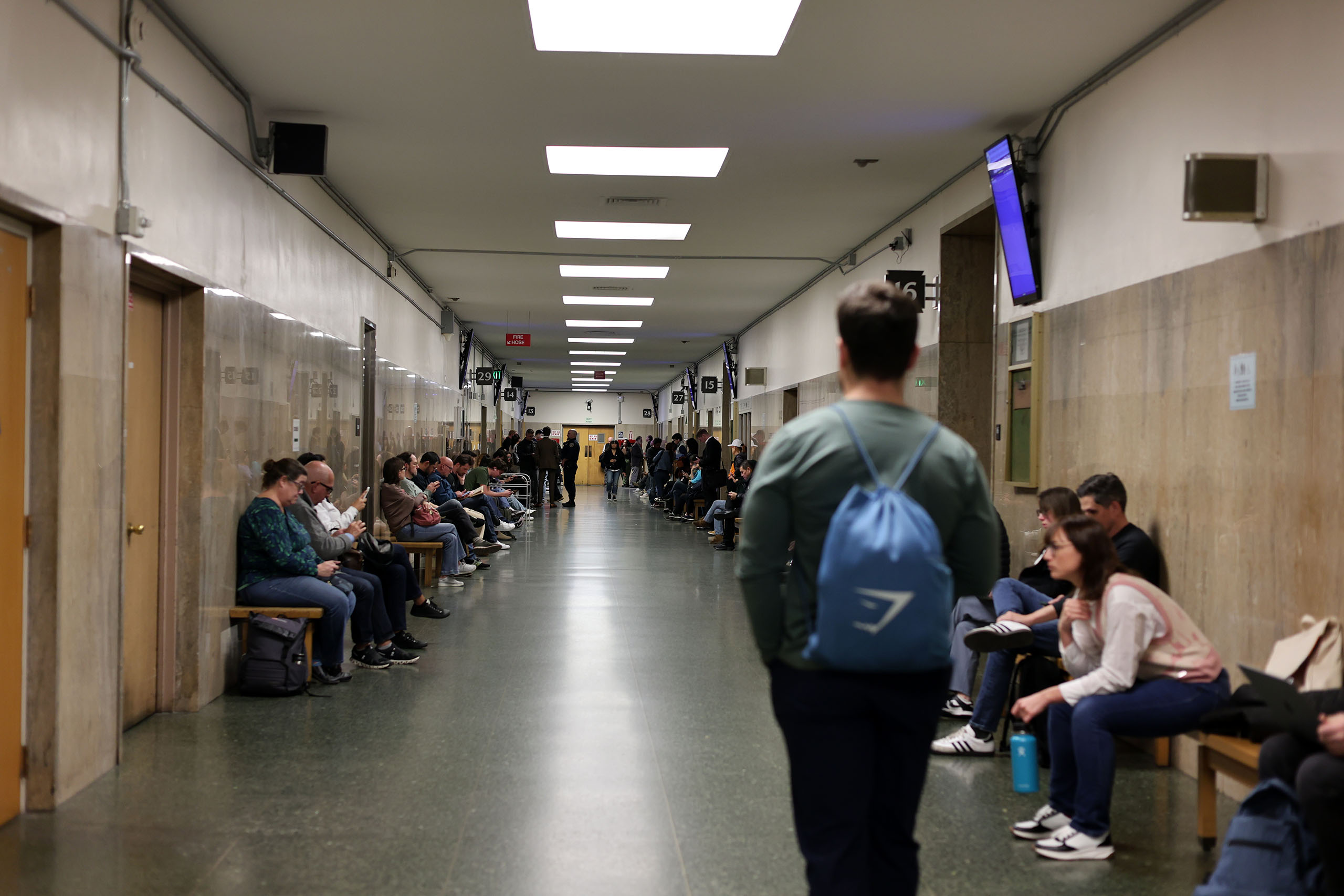

A typical day in court is not exciting. There is lots of scheduling, and there is even more waiting: For a case to be called, for a homeless defendant without a cell phone to show up, for jury duty to end.
“So much waiting,” a public defender laughed on a recent Thursday.
To a spectator dropping in, each day’s small losses and victories, like an overruled objection or a pretrial release, might seem trivial.
But within the aging courtrooms increasingly resembling a set from a 1980s buddy-cop movie, mothers, teenagers, and men in orange sweatshirts at San Francisco’s Hall of Justice wait for decisions that will change their lives. Judges and lawyers, meanwhile, wait to see their work make a difference.
Mission Local spent a day chatting with public defenders, prosecutors, police officers and family members at 850 Bryant St., a grey behemoth of a building next to Highway 80. It is the city’s central justice facility, housing the San Francisco Superior Court and the police headquarters.
Most adult criminal cases prosecuted by San Francisco authorities pass through its halls.
On Jan. 16, it was a pretty regular day, most agreed; maybe even quieter than normal. I was told I should have come for the Bob Lee murder trial.
Still, people there found moments worth waiting for, like congratulations from a judge, thanks from a client, or a fleeting glimpse of a loved one before the sheriff’s deputy escorted them away.
‘He’s innocent. Why is he still there?‘
Security takes up most of the lobby. Guards nonchalantly cycle the grey bins piled in the entranceway through a metal detector each time someone arrives. Legal professionals in matching pantsuits move briskly. Non-regulars, meanwhile, have to take a moment to pat around in their pockets.
Most of the interior paint job is a nondescript shade of khaki, and a row of rectangular fluorescent lights cast a white beam down the hallway floors of cafeteria-style green linoleum.
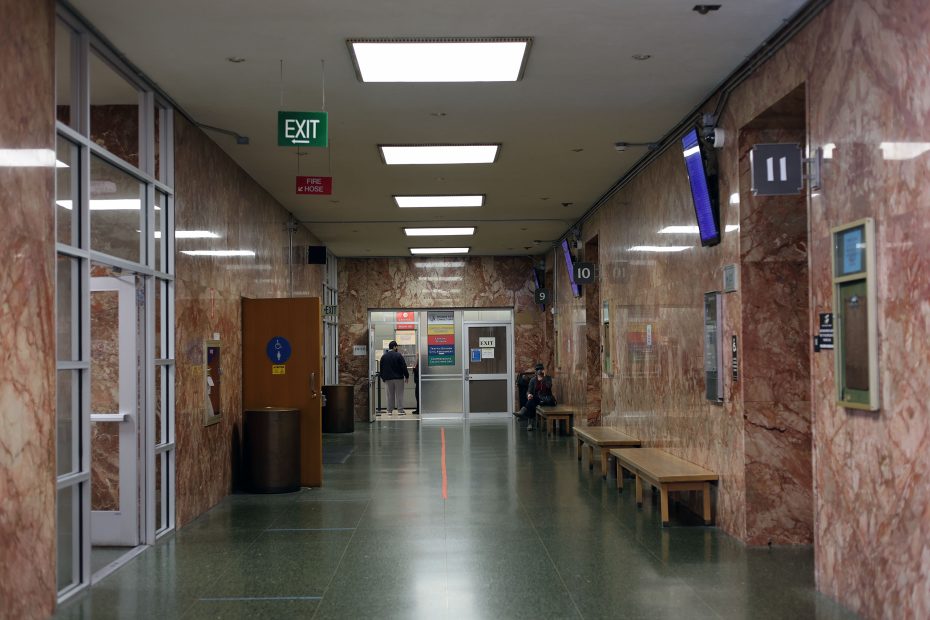
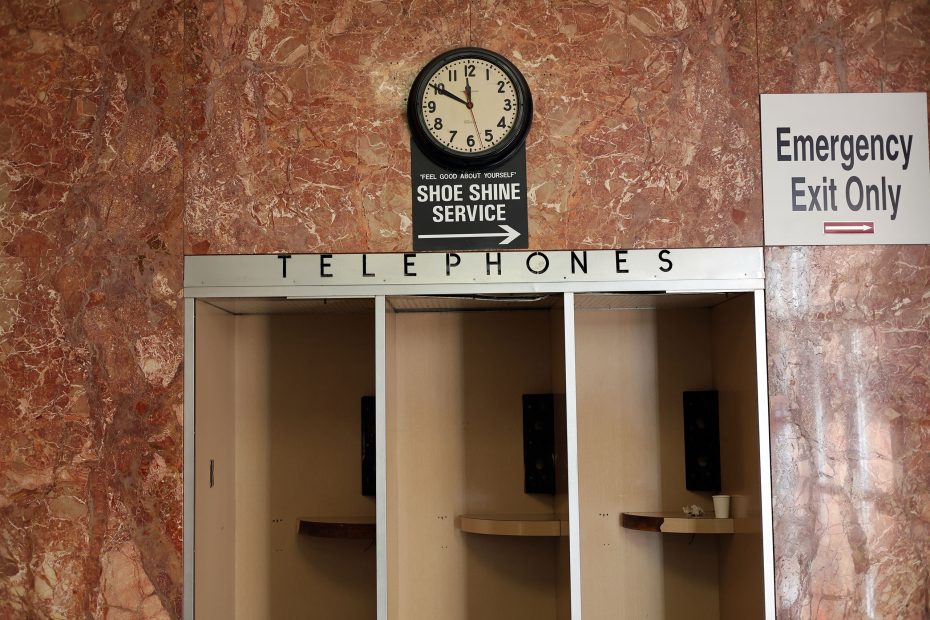
At one end of the pink marble hallway on the ground floor are three empty cubicles — the pay phones are long gone — and a dusty sign advertising a shoe-shine service.
“Feel good about yourself,” the sign says. The shoe shiner is nowhere to be found.
The place is “pretty chill” most of the time, a veteran clerk said, but even decades of experience doesn’t mean they’ve seen it all.
All kinds pass through here. Sometimes people with appointments “seem to not be all there,” mentally, when they step up to the clerk window. But, still, “they surprise you.” Sometimes people come just to hang out and wind up “nodded out,” slouched on the long wooden benches, which look like they belong in a one-room schoolhouse.
San Francisco’s courthouse is more “old-fashioned” than what you’d find in most other cities, and “not exactly seismically sound,” one worker told me through a plexiglass partition.
That’s an understatement. Rodents and asbestos plague 850 Bryant St., which was supposed to be abandoned in 2019. The roof is failing. The paint has lead in it.
Judges, police and the incarcerated have all been swept up in the building’s “cascading sewage problem,” as Joe Eskenazi put it. Human feces have been known to trickle down from the jails on the top floors to the courtrooms below. Ever-grinding “muffin monsters” were installed in the plumbing lines to eviscerate whatever foreign objects inmates flushed down the toilet.
Leaving the hallway and stepping into one of the courtrooms on either side, it takes a moment for one’s eyes to adjust to the room’s overwhelming ochre hue. The seats, partitions, and vinyl paneling are all the same warm wood tone. Inside, it could be any time of day; like a casino, there are no windows and no clocks visible to the public.
Casual conversation is exchanged between lawyers. A woman in a black pencil skirt tells a colleague about a homicide case.
“It’s good,” she says. “Well, not good, but meaningful.”
In the audience, however, the only sounds come from toddlers who can no longer sit still.
Visitors can watch hearings from the rows of wooden high-school-auditorium-style seats at the back of each courtroom (a handful, though, are broken, according to the notes taped to them). Cell-phone use, photos, recording, talking and eating are all forbidden.
On this day, a handful of family members were scattered at the back of Department Nine for preliminary hearings: A middle-aged Latinx couple and two women wearing baby Bjorns, one of whom also had two toddlers in tow. The presiding judge announced that she and the families had “been together all morning.”
“¿Cuántos tienes?” an attorney whispered to one of the mothers, stopping on her way to the stand to lean over on stiletto heels.
During a recess, a public defender explained the significance of a preliminary hearing to the couple: There would likely be DNA, video and photographic evidence against their son, who had been brought in on a drug charge.
“He’s innocent; why is he still there?” the husband, who, for reasons known only to him, wore black plastic gloves, asked as he paced in front of the courtroom’s double doors. “The judge says he’s a danger,” the white-haired public defender sighed. “This is the best I can do.”
When the session resumed, the prosecution called its first witness: A plainclothes police officer working out of Mission Station who said he has participated in hundreds, if not thousands, of narcotics investigations.
The officer identified two defendants who had been brought in. One, he said, was a tall and slender Black man “wearing an orange sweatshirt.” The other, he said, was a shorter, stockier Hispanic man “in an orange sweatshirt, as well.”
For the entirety of the officer’s testimony about the co-defendants’ alleged drug deal, the tall man remained turned to stare directly at the audience. One of the babies began to cry.
‘Brakes or no brakes, you have to show up’
More young mothers and middle-aged parents waited in the hallway for the afternoon arraignments. One woman asked if I was a lawyer; she was looking for someone to represent her boyfriend.
Inside the courtroom, the chains around the defendant’s wrists jingled as he gave his girlfriend a small wave. When the judge released him before his trial on the condition that he attend drug treatment, she murmured “Yes!” and jumped up, blowing a kiss.
“This is your chance,” the judge told the defendant. “I hope you take it.”
Many judges seem to spend their days waiting to see someone make progress, no matter how incremental.
The questions they ask are mostly clarifying. When defendants do answer, it is usually in monosyllables: “Okay” or “Thanks.”
“You’ve done a great job. Let’s just get you back on track,” said mental health court presiding Judge Charles Crompton to a man wearing a weathered tweed jacket over a hoodie. He advised another man, a graduate of a rehabilitation program at Baker Places, to keep reaching out. “Transition can be difficult.”
At 2 p.m., the docket outside Crompton’s courtroom still displayed a long list of names. What they really need, a public defender told me in the hallway, is a second mental health court.
The docket outside Judge Bruce Chan’s young-adult court was equally long. Inside, 13 teenagers, all kids of color, sat silently, waiting for their appearances before the judge.
When I stepped in, the room was stiff with tension. A teenager had just turned his back to Chan and made a “rude gesture,” unknown to me, that left the judge “so surprised, I didn’t know what to do.”
“I want you to succeed, but success means more than just being here,” Chan told the teen.
In the following youth check-ins, Chan would repeat, again and again, the importance of demonstrating initiative.
One young woman didn’t make her last court appointment because, she said, her phone wasn’t working. Another failed to make progress because, they said, they had to take their cat to the vet and their car to the shop.
“Cat or no cat … brakes or no brakes,” Chan said, “You have to show up.”
Finally, a teenager who had been doing well, according to his advocates, took the stand. He told the court he would like to be a Muni driver someday.
Chan delivered his advice with typical pragmatism — the young man would have to stand out to pursue a competitive career — but his voice had softened.
‘Something right every day’
By late afternoon, empty coffee cups littered the vacant phone booths and lay scattered on the benches. Attorneys exchanged stories of the day’s little dramas: A client who spoke over the judge, a defendant who asked to represent himself and then argued that he was incompetent.
Things move more slowly under District Attorney Brooke Jenkins — the “lock ‘em up DA” — and negotiations sometimes feel like they are always “all or nothing,” a veteran public defender confided.
Still, despite occasional bureaucratic “childishness” and the unavoidable tedium of scheduling and waiting, many advocates have returned to work in the Hall of Justice every day for decades.
As one deputy district attorney said, it’s an “opportunity to do something right every day.”
Thank you AbigailVan Neely and Mission Local for this visceral snapshot of a day at the Hall of Justice. The piece is striking in that it illustrates how, for better or worse, our system of democratic justice occurs. Reckonings. Frustration. Patience. Compassion. Brutality. Humanity, with all its imperfections, on display.
SFPD headquarters and their Southern Station left 850 Bryant in 2015 and the county jail left in 2020. The courts will remain in the building (which has been deemed seismically unsafe for years – in addition to inadequate maintenance) until the Superior Courts of California designate a new site.
OK Jen but then how do the defendants who do not make bail or OR get to the court? Are they bussed in en masse from the burbs?
Usually the central lockup and the courts are in physical proximity, for obvious reasons.
CJ 4 closed in 2020. But CJ 2, which is next door to 850 Bryant at 425 7th Street is still open. CJ 3 is in San Bruno.
There is still a jail next to the HOJ. The jail inside the HOJ was on the very top floor…that one has been closed. Also, while one of SFPD’s stations moved out of the HOJ awhile ago, as soon as the DA’s office moved out SFPD moved a lot of their staff back into the HOJ. That building is a disaster and a danger to the public and the people who work there. It’s not just asbestos and lead…the building will 100% fall down in the next earthquake. It was not built with earthquake safety in mind.
Yes, they’re transported from other jails, including one just up the block.
Defendants currently in custody come from the jail around the corner on 7th St or (the majority) are bussed in from the SF jail in San Bruno.
If you’re at 7th St jail, it’s colloquially 850 Bryant.
my last HOJ caper, jury trial. The PD makes up a story, some guy in the hall admitted to the crime and disappears into the crowd. PD says hold it, I got something for you, judge. Now the judge has to appoint a private defense attorney which cost more money. That private attorney was trying to fight for his defendant, like he’s suppose to, but making up all kinda stories, hoping one will stick with one of the jurors. After a 3 day trial, guilty. It was the JA regime.
“Things move more slowly under District Attorney Brooke Jenkins — the “lock ‘em up DA” — and negotiations sometimes feel like they are always “all or nothing,” a veteran public defender confided. ”
Say, did any of your journalists consider asking the DA’s office to respond to this anonymous quote?
Do they still teach fairness in journalism schools?