



Some 30 percent of San Francisco nonprofits monitored and funded by the city are not adhering to required fiscal rules, according to a Jan. 13 report from the Board of Supervisors Budget and Legislative Analyst.
The lack of compliance does not mean the city’s nonprofits are derelict in their duties. It does, however, raise eyebrows at a time when such contracts are under scrutiny following a series of scandals under Mayor London Breed’s administration.
Mayor Daniel Lurie, in announcing anti-fentanyl ordinances, has called for a suspension of competitive bidding rules and Board of Supervisors approval of contracting, which could result in even less oversight.
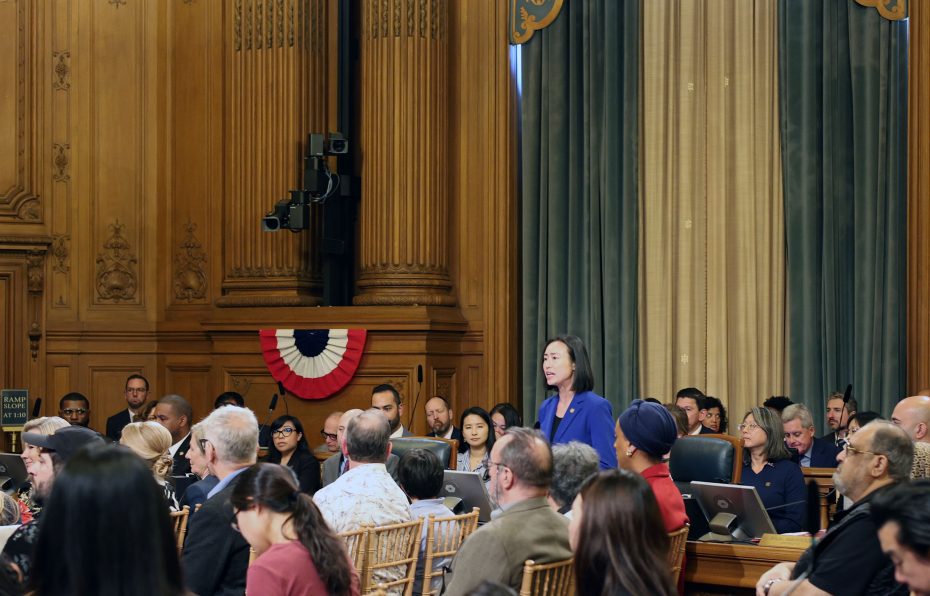
Connie Chan, the Board of Supervisors’ budget chair, who requested this Budget Analyst report last spring and released a first draft in June, said she would work to bring nonprofits in line with the city’s standards.
“We want more organizations in compliance, not just with the city controller’s office through the auditing process, but also making sure that they are in good standing with the state attorney general,” she said.
Former city controller Ed Harrington said the city can train nonprofits to file more timely financial statements, for instance, “as opposed to cutting them off.”
“Let’s face it; the nonprofits you’re working with are the backbone of how we do mental health, substance abuse, and other programs in the city and, for many communities, there aren’t a lot of choices for who might do that work.”
San Francisco spent approximately $1.5 billion to contract services with community-based organizations in the last fiscal year. These organizations, the report noted, “provide essential health, behavioral health, homeless, and other services.”
Most partner with the Department of Homelessness and Supportive Housing, Department of Public Health, and the Human Services Agency. They include nonprofits like Catholic Charities, the Native American Health Center, and Jewish Family Services, which help provide shelter and medical access.
One-third of the approximately 200 organizations monitored for healthy fiscal practices by the Citywide Nonprofit Monitoring Program — 61 of 199 — were found to be non-conforming with city standards, according to its annual audit.
Among the most frequent issues: Incomplete or late audited financial statements, even from organizations that are accomplishing their paid tasks.
The Jan. 13 report cautions that “insufficient financial practices can result in the closing of community-based programs that otherwise had satisfactory performance.”
Two such instances are described. The Jo Ruffin residential treatment program and the Grove Street House crisis residential treatment center had successfully provided service, but were closed due to the “financial insolvency” of their operator, Baker Places, in 2021. Baker Places was later promoted from “red flag” status to “elevated concern” status the following year, according to the report.
In another case, the homeless nonprofit Providence Foundation, in May 2024, was debarred from seeking new contracts over allegations of falsified invoices.
Seven of the 81 community-based organizations reviewed for the report — selected because they each received “high dollar contracts” of over $10 million to deal with the “most urgent issues on our streets,” Chan said — were found to have been out of compliance for the last two fiscal years. All, however, continued to receive city funding.
“There are not that many organizations” that can provide the services done by the city-contracted organizations, Chan said.
Moving forward, Chan said she hopes the mayor will be “more hands-on about conducting in-person inspections and audits.” The Board of Supervisors, she added, can work to identify fiscal compliance issues earlier.

Report outlines possible dept. mergers, city vacancies
The Jan. 13 report also addressed vacant city-funded positions and potential department mergers.
More than $8 million in salary and benefit costs went unspent as approximately 35 percent of the city-funded positions created in the last fiscal year remained vacant. Most of these vacant positions were in the Department of Public Health, which employs the largest number of staff.
Former controller Harrington was unsurprised by these numbers: The city’s application process is lengthy, and there is an “assumption that a certain number of positions will always be vacant in the city.” Salary savings are often put towards overtime pay, as is common in the police department, or pushed into the following year’s budget.
Finally, the Budget and Legislative Analyst’s office prepared a list of departments that could potentially be restructured. Their eight merger suggestions include combining police, fire, and emergency management into a unified Department of Public Safety, and combining the juvenile and adult probation departments.
Chan described these proposals as a “blueprint” for minimizing administrative costs, rather than a means of cutting services and programming. Ultimately, she said, the board will consider the report as it discusses measures to “reduce wasteful spending and increase efficiency in city government.”
The Jan. 13 report proposes eight possibilities for departments that could be merged:
- Health Service System and Human Resources Department
- Adult Probation and Juvenile Probation Departments
- Planning and Building Inspection Departments
- Department of Children, Youth and Their Families and Department of Early Childhood
- Police, Fire, and Emergency Management into a unified Department of Public Safety
- Department of the Environment and Public Works
- Human Rights Commission and Department on the Status of Women
- Department of Police Accountability, Sheriff’s Department of Accountability, and Office of Inspector General
We need for the City to estimate the population in need of the services the City pays the nonprofits to provide and for the nonprofits to prove how many people they serve so that we can get a handle on the percentage of need met by this outsourced approach.
What effect would it have to cut off the 30% of nonprofits who do not comply with accounting reporting standards and redistribute the funds to the 70% who operate properly?
It’s made pretty clear in the article: for a lot of these nonprofits, the actual work they’re doing would stop getting done. A former city controller — so it was his job to oversee all the city’s accounting and spending — said that for many of these, there aren’t other organizations you could just replace them with.
I like his recommendation of training. The actual work the city hires them for is often very far removed from accounting, so it’s no surprise if some of them are less on top of that aspect. The solution is to help them figure the accounting out.
So you’re telling me that in order for us to get this work done move efficiently, we need to accept thhat there will be separate administrative supports for these orgs instead of leveraging city efficiencies of scale, we need to pay non-unionized nonprofit workers less than city workers with flimsy benefits, and that we forgo any direct lines of accountability in how tax dollars are spent by these orgs?
Then I would ask what are the other 70% of the non-profits doing? Could they not perform the important work that the “30%” are? And if none of the 70% that might continue to receive funding could not – what the H are they doing?
My issue is we have too many individual non-profits funded, too much over head, and if we dropped 30% of the operations that are not capable of managing the admin side of required reporting would we end up better off?
I worked a non profit, I felt they did so much for community on bare bones $! Outstanding classes, productions, kids programs. The teachers did not get a lot $$$, vs the productions they produced!
Hire kids out of high school to do the stats the city wants, $20/hour, they’d be happy as the non profit directs racks in $200k plus.
Facts speak for themselves
The nonprofits have demontrated time and time again to be problems .
If taxpayer monies are mismanaged and continue to lost to nonprofits , we are to blame as well for continuing to allow the grift to go on.
Anyone who receives taxpayer monies and and doesnt comply should be sent to jail and must repay the taxpayers back.
There maybe some ethical and decent ones but none inSF .
There is no incentive for them to fix the issues as they would be out of jobs .
Hopefully , the Mayor and BOS, will finally act and stop this .
They are as bad as the corporations .
The freehand outs need to stop.
This city has been gamed for too long.
Every nonprofit should be required to allow all taxpayers to get their info and respond to taxpayers
Now nonprofits dont even return calls or emails .
They only send emails to ask for more money .
What a shame , taking the money and not even addressing the issues .
Review every single one in an open meeting where taxpayers ask the nonprofit questions and they must answer under oath .
Close them down
Not derelict? yes they are..the non profit is a business, people at the top get good salaries..over 90 000 $ a year…no more homeless or drug addicts? no jobs for them…so what is the incentive to fix problems? .we should put someone in charge of checking those groups, and check the real work those organisations are doing and the results..guess what? we know the answer…we have already probably wasted millions of $..in any private company there will be some people fired and budget cuts.
Alternatively, could say vast majority were in compliance, and Supervisor Chan is diligently examining the non-complying organizations. This seems like good news generally, pending results of the audit.