


Mission Local is holding intro interviews with incoming and incumbent supervisors, including Shamann Walton, Chyanne Chen, Jackie Fielder, Joel Engardio, Danny Sauter, and Stephen Sherill. You can read those interviews as they are published here.
Mission Local also held exit interviews with elected officials leaving office after the Nov. 5, 2024 election: London Breed, Aaron Peskin, Hillary Ronen, Ahsha Safaí and Dean Preston.
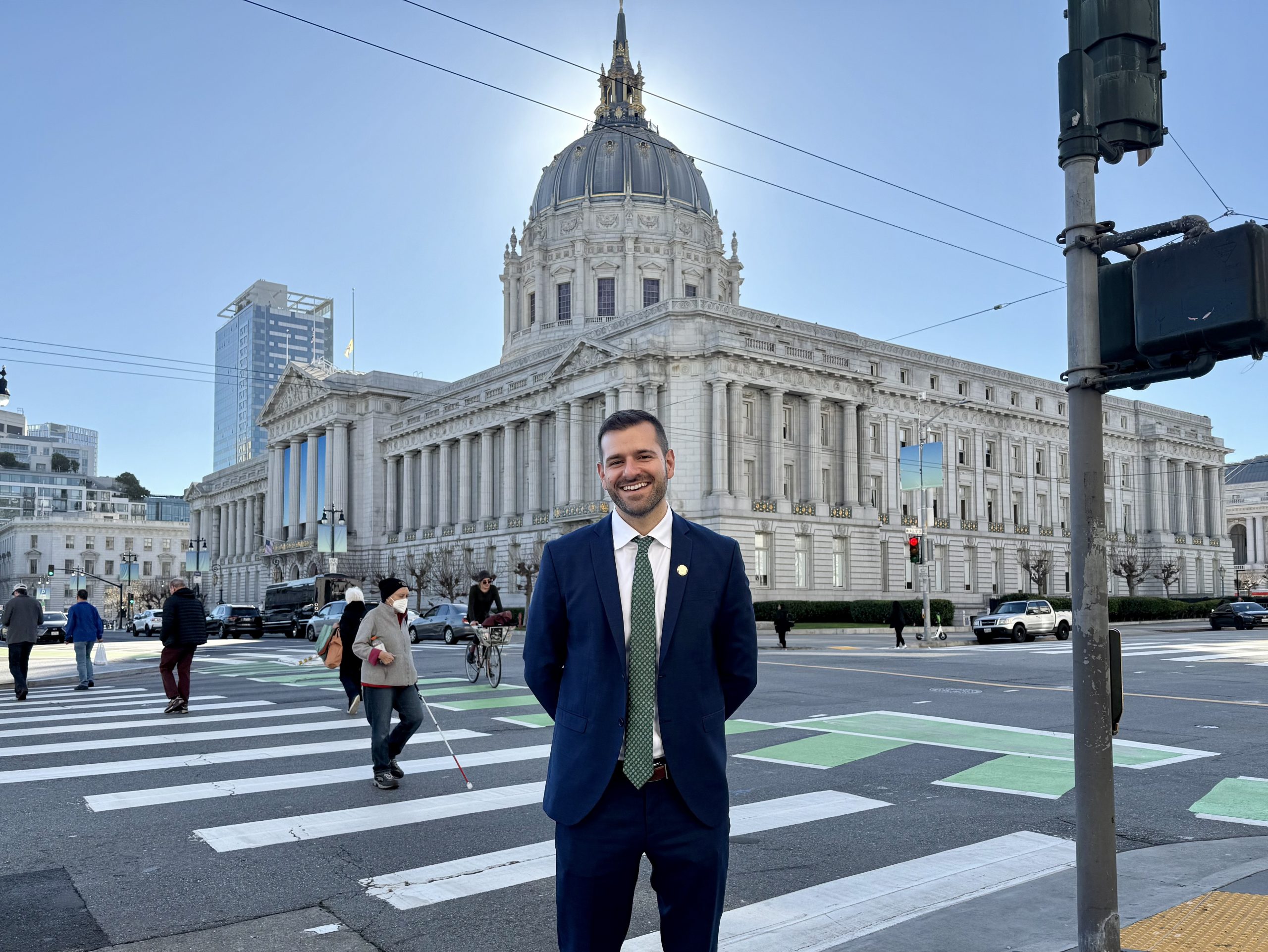
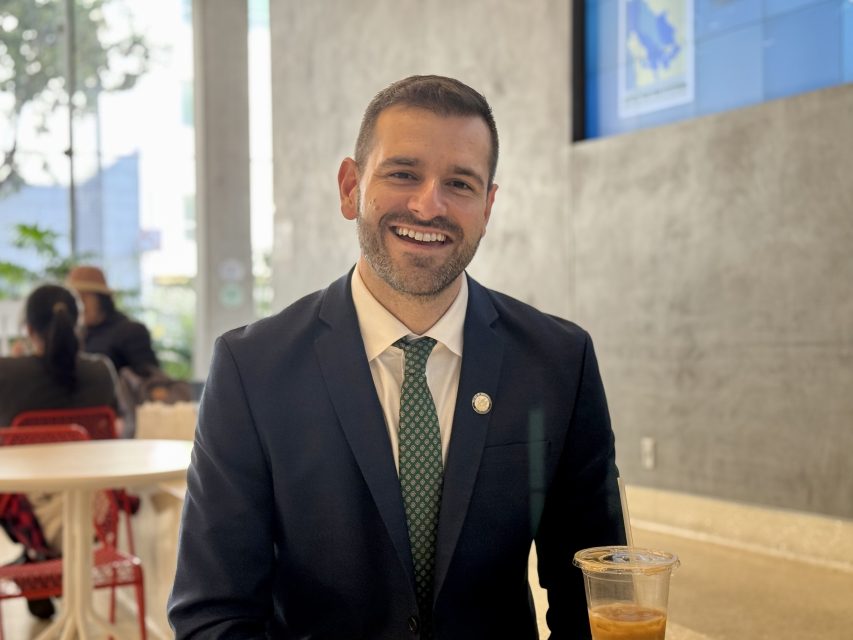
Danny Sauter, a City Hall newcomer, has big dreams for filling in District 3’s empty storefronts, converting empty office space into housing, and making sure the Lunar New Year parade goes off without a hitch. But he also can’t stop thinking about trash cans.
The nascent supervisor, now tasked with the needs of a dozen neighborhoods, has a tough act to follow. The last supervisor before him, Aaron Peskin, was re-elected four times.
Sauter will also be a new parent in the spring. He talked with Mission Local about what it’s like to be a freshly minted supervisor, excited about the future and trying to stay that way.
The conversation has been edited and shortened for clarity and readability.
Mission Local: How is it moving into the new office? Whose office are you taking?
Danny Sauter: I’m taking over supervisor Melgar’s old office. [Note: Melgar is now in Catherine Stefani’s old office.] Supervisor Melgar left us a Chinese New Year symbol on the wall for good luck and good vibes and energy. There’s a million things to set up, but everyone at City Hall has been amazing. People are coming in and out all day to help us set up our email, and help us get into this system, and put this piece of furniture there.
ML: People are optimistic about the city as well as D3. However, the window is short, as you said, and people want to see changes ASAP.
DS: A lot of that comes from the sea change in San Francisco: The mayor, the five new supervisors. People see it as an opportunity.
There’s an expiration to that. There’s a window of time where we have the benefit of the doubt. We’ve got to make the best of that. I am hopeful. The unanimous board president vote yesterday; that was a strong showing of unity.
ML: How did you decide who to vote for?
DS: I talked to all of the people that were interested in running. For me, it was important to have someone experienced. Particularly within the last few days, it became clear that Rafi had the best path in terms of getting the votes.
ML: Speaking of that “window to make changes as soon as possible,” what’s your plan to make that happen?
DS: The plan is to put forward legislation that speaks to things we talked about in the campaign. We campaigned on filling empty storefronts — putting forward legislation to reduce barriers for small businesses. Particularly, removing restrictions specific to District 3.
District 3 is, I would argue, the most difficult place in San Francisco to start a new small business. It has the highest burden of conditional-use authorizations. Over these last 20 years, I would say the approach to small businesses in District 3 is to put in new rules. We’re going to reexamine all of those.
There’s some that still make sense. I don’t intend to modify anything related to formula retail. But I do intend to look at things like flexible-use retail, making it easier to do a split of a storefront or to do a merger of a storefront. We have really large retail spaces in Union Square and Fisherman’s Wharf. It’s the smaller spaces that are doing well. We need to figure out how to make those spaces smaller and more feasible.
We have very highly anticipated openings in District 3 that I’ve been involved in from a community perspective. But now in office, I want to get across the finish line. That includes Grocery Outlet in the old Safeway space on the cusp of North Beach and Fisherman’s Wharf in North Point Center. We have a similar situation on Polk Street with the old Lombardi Sports, trying to get that turned into a Fitness SF.
Cleaner streets: I have people messaging me literally every day about this trash can on Larkin Street that was removed. At the moment, the two constituent requests I get the most are related to safety and trash cans. No one understands how trash cans are decided to be put in one place or moved to another. We are going to call a hearing on that. The number, the location, how they’re removed, when they’re removed, why they’re removed; it seems to be a game of whack-a-mole. DPW, in general, is good at responding, but I would like us to be more proactive and less reactive.
We are going to be heavily engaged on the city’s rezoning. Some of the early drafts of that plan were more west-side focused. I do expect it to expand further into District 3. There’s a lot of underutilized space as you look at the north part of District 3 into Fisherman’s Wharf.
The same about downtown. The path to adding housing there is not necessarily new construction, but conversion. We have work to do to implement the state bill that Phil Ting put forward around downtown office conversions.
Then as we move to Lower Nob Hill, our promise in the campaign was making sure that the shelters and homelessness services there were more effective. We’re going to be meeting with leadership at all of the shelters that have opened there. Particularly we’ve heard concerns around the TAY (Transitional Aged Youth) navigation center on Post. The neighbors have been understanding and patient. But they deserve and expect that when a new shelter opens, it should improve the neighborhood. It should not bring down the neighborhood. So, that’s my commitment.
Then, on a more exciting note, our promise and our hope for Lower Nob Hill has been more open space. I’ve already met with Rec and Parks, and we’ve started to identify where that money would come from, and looking at a few specific sites.
ML: Are we talking about next year? The next six months?
DS: That’s all six months. I’m not promising that it will all be completed, but I expect to make meaningful progress.
ML: What are your thoughts on work-life balance? Many of your colleagues are attending several events every night. You and Chelsey are expecting a baby very soon. You have a lot on your plate.
DS: My wife and I are expecting a baby girl in the spring, I’m very excited about that. It’s a challenge. We’re going to navigate it. I’ve been told it hasn’t happened where there’s been a new parent in City Hall since Michela Alioto-Pier was in office.
So there’s just questions around, like, if I wanted to take a few weeks off after the birth, how would I do that? If I want a period where I’m able to join a board meeting remotely, how can that be facilitated? No one has had to think about these questions for almost two decades.
ML: What’s the most urgent task you need to figure out right now?
DS: One of the most urgent tasks is making sure that the Chinese New Year parade (Feb. 15) is successful, safe, and enjoyable. That’s important this year, in particular, because we have the NBA All-Star Game (Feb. 16) on the same weekend as the parade.
There are concerns from the parade organizers, from the community, to ensure that this parade has the same resources that it would have in any other year, that our police, our fire, our emergency management, our MTA, DPW are not stretched too thin that weekend. The parade brings out hundreds of thousands of people. It takes the entire city to make sure it runs successfully.
That is exactly why one of the first things I’m doing while in office, is calling these agencies together to ensure that they have the right plan. I think they will. But it’s urgent, because it’s so near.
ML: Mayor Daniel Lurie defines his agenda as “common sense;” a balance between sticking to San Francisco’s liberal values and making changes happen. Similarly, Bilal Mahmood suggested “practical progressivism.” What’s your catchphrase?
DS: I guess I need to work on my catchphrase. Our new board president spoke to this exact same theme yesterday. He talked about a city that works, and social justice, and how one thrives on the other.
The way I think about it — again, I don’t have my catchphrase — it’s about tangible results in District 3, about the things that the government can deliver to make life a little bit better and a little bit brighter each day.
We’re going to be swamped with a lot of internal City Hall matters for the next few months, as I’m new and catching up. But I hope that, quickly after that, we can spend more time in the district. We just need to remind ourselves that, the things we’re talking about — are they actually going to impact everyday people and everyday people’s experience in San Francisco? Or are they obscure matters?
San Francisco wants safety, but they demand an accountable police force. We’ve kind of settled in that balance. We’re in the backdrop of record-low homicides, and nearly every category of crime declining in the last few years.
But there’s still that element of disorder that people see and fear. I don’t want to discount that. We’re going to need a number of months without something major happening in Union Square or downtown for people to rebuild that confidence in their brain around safety.
ML: What kind of District 3 do you want to see in four or eight years? A lot of the community leaders I talked to are expecting you to be there for eight years.
DS: If we were to be able to have the chance to serve for eight years, we could accomplish a lot. But I’m not counting on that. We’re not planning that way. It’s about the progress we can make in increments of six months, all the way up to four years.
District 3 is the most important part of San Francisco, because we’re the face of San Francisco to tourists and office workers. It is ripe with opportunities. Union Square is not working. Fisherman’s Wharf is not working. Downtown’s not working. There needs to be an entire reinvention of those areas. All three are in crisis, and those are in my district. Those are the economic engines of San Francisco. There are not many voters or constituents that live in those three parts, but that doesn’t mean that we’re going to spend any less time there.
It’s not my role to come up with the most exciting new retail concept, or the most exciting new tourist attraction. But it is my job to create a climate where those operators and those individuals see San Francisco — specifically, District 3 — as a place that would be friendly to them. San Francisco, and District 3 in particular, kind of had a reputation of being harder to do business in. “Be careful, you really have to get a lot of approval” and “You have to get on the right side of political people.” I don’t intend to operate that way.
ML: How, in the coming months and years, will you differentiate yourself from your predecessor Aaron Peskin? How will the people of District 3 feel the difference?
DS: I reached out to Supervisor Peskin right after the election. I said, “Hey, I’d love to meet with you and your staff to do a transition.” All of his staff, all my staff, we met for a few hours and went over how he’s run his office, some of the outstanding constituent issues. It was a really good handoff.
Supervisor Peskin and I have differences in policy, but there’s more similarities than people imagine. We both started as supervisors around the same age. He was 35. I’m 36. He came up as the president of his neighborhood association. I came up as the president of my neighborhood association. [Note: Peskin is a former president of the Telegraph Hill Dwellers; Sauter a former president of North Beach Neighbors.] We both live in North Beach. He has always seen District 3 as a set of neighborhoods and respected the individuality of each of them. I think of District 3 as a collection of neighborhoods as well. He was active and visible around the district. I want to do that as well.
Some things I do anticipate changing. We want to spend more time, or more equal time, in every single neighborhood. I think there was always a knock on the office of District 3 just being North Beach and Chinatown. I love Chinatown, I love North Beach, But there’s a real need in other parts.
I’ve had a lot of people actually ask me, “Will you hold court at Caffe Trieste like he did?” So many people have asked me about it. We’re setting up on Fridays to have regular office hours, but to have them each week in a cafe in a different part of the district. We can be at A Cup Of Joy on Sutter in Lower Nob Hill one week and then we could be at Fueling Station Cafe on Polk Street in Russian Hill the next week, and just rotate. It’s this idea of having a district office, but there’s never funding for that. We can have this next best thing. We’ll have that on our newsletter.
ML: What policies or practices of your predecessor do you not plan to change?
DS: I will be respectful of history. Peskin shared how he was very involved in constituent issues. I intend to do that as well. There’s some supervisors that, I’ve learned, never touch constituent issues. They never check the constituent email. They just designate a staff person to do all that. It’s very important for me to have a pulse of constituent issues.
We’re going to have staff that works on solving issues and problems, but I’ll be heavily involved in that. In particular, in the beginning, because it just gives you a really good sense of what’s actually happening in the district. The day after the election, I got many emails about this noise issue, or this issue in the park, or this issue on the street.
The last couple months, we haven’t had any city resources, but we’ve been trying to solve things on our own time. People notice that. I’ll meet people in the district that I’ve never met before, but I’ll shake their hand and they’ll say, “Oh, we’ve been emailing you, and you actually email back.”
People are shocked. People shouldn’t be shocked. I see that as my responsibility. I can’t commit to responding to your email in two hours. But if someone takes the time to write in, they deserve me to write back.
ML: What do you think about the recall against Supervisor Joe Engardio?
DS: I don’t support the recall. I understand real concerns about how Prop. K was done. But I believe that the bar for recall should be high. It should be in line with negligence to an office, misconduct to an office. He’s nowhere close to that. He’s delivered a lot of good for his district. I will be there with him against this recall. It’s not a good use of anyone’s time.
ML: You have been attacked for your closeness with Scott Wiener. Is this fair?
DS: I was very proud to have Senator Wiener endorse our campaign. He’s doing fantastic work at the state level. I’m going to work closely with him. But it’s a mistake to characterize my approach or my campaign as a simple extension of him. My perspective is deeply shaped by the time I’ve spent organizing with neighbors.
He is an incredibly popular politician for good reason. He leads on efforts. Because of that, he becomes a lightning rod and becomes someone who attracts a lot of criticism.
ML: How’s the progress on the 1,500 trash cans you promised during the campaign? [Note: Currently, San Francisco Public Works takes care of about 3,500 trash cans across the city.]
DS: In my first meeting with Mayor Lurie, a week after the election, we sat down and talked about a number of priorities. I told him that I made a promise to deliver trash cans. He said, “Let’s work together and get it done.”
We are, at the moment, scheduling a meeting with DPW to talk about priorities. However we need to get it done, we’ll pursue it. I’m not going to get them overnight, but people want cleaner streets. Trash bins are part of that.
Alongside that, mechanical street sweeping is missing from most of the district. I know every single local neighborhood trash cleanup coordinator, and all of them share this desire. We’ve built a relationship that will come in handy when we need to go to the city and get some of these improvements.
The city has made mistakes by trying to go down this route of having everything be custom-designed. We’ve seen the cost and the delays related to that. There’s not a path forward of the number of trash cans we need, if they’re all many thousands of dollars each.
ML: Are we talking about delivering some of those trash cans in the next four years?
DS: Yes, some of them.
ML: What do you think is a more practical number of trash cans to be delivered during the next four years?
DS: I don’t know yet.
ML: Who are your models in San Francisco local politics? And why?
DS: Malia Cohen. I’ve only engaged with her a little bit, but I’m just so impressed every time I meet her and hear from her. David Chiu obviously has so much wisdom to impart on me, because he represented District 3 really well during his term.
I’m excited to learn alongside a lot of people. I really am. The campaign was exhausting, but at the end, I loved San Francisco more than I did at the beginning. Talking to everyone along the way, you just pick up all these stories, and ideas, and hopes and just get reminded why we’re very lucky to be here.
There will be moments of frustration. There will be moments where my naïveté wears down, or is a liability. But I want to keep that optimism as well. The best way to do that is just keep talking to normal people. Get outside City Hall. Keep reminding yourself why this work matters.
Gavin Newsom had many trash cans removed and made the comment “local businesses need to step up”. It was never about local businesses. San Francisco is a walking city. People buy food and drink and walk to enjoy the beauty of the city. Trash receptacles are needed so trash can be disposed of while walking. This applies to both residents and tourists. At one point in the early 00’s it seemed there were trash cans on every block but those days are long gone. Now, we have the added challenge of dog feces. Everyone has a dog, and they deposit the feces bags in the few trash cans left, or just drop them wherever they think no one will notice. The waste issue is a big one, a real annoyance for residents, and a huge black eye for SF. Imagine being on vacation and going to throw away a sandwich wrapper and being met with a trash can overflowing with dog feces in little baggies. Mmm, breathe in all the pro-environmental, anti-greenhouse-gas-air SF is allegedly known for. Welcome to hypocrisy.
His urgent priority is the Chinese New Year parade. Seriously. I’m already done.
In case Supervisor Sauter is unaware of the reason DPW removed many of the public trash receptacles, here it is: Public trash receptacles are seen as an excuse for illegal dumping, a BIG problem in the city. People see a trashbin and assume it’s OK to dump their old mattress and other junk at the site because “the city will come by to empty the trash bin, so why not just dump my crap there? It’s far more common than you might think. In Japan there are essentially no public trash receptacles because people just don’t litter. THey have enough social consciousness to take their trash with them by always having a trash bag with them. SF, sadly, is notorious for oblivious residents who think dumping their household crap next to a trash bin is OK. So it’s a tradeoff: we want trashbins for ensure that people have a place to dump their litter, but we also don’t want them to use that site as a dump.
Was recently walking around Washington Square the other night. Each of the garbage cans along Stockton or Union was surrounded by a mountain of used Tony’s Pizza boxes.
Please, if you add trash cans in the Mission, educate people how to use them! Seems obvious, but people are oblivious. Also, crack down on all the illegal dumping that winds up as bags of festering garbage next to city trash cans. And while you’re at it, target heavily used garbage cans and schedule extra pick ups for those.
The city has a nasty habit of fining homeowners if trash is dumped out front of their property. I got a citation for that a few years ago.
The city appears to just assume that the homeowner would dump trash outside his own house. That makes zero sense but of course it is very easy thing for the city to do, rather than the hard work of investigating who really dumped the trash..
I fought the ticket and won. But it does highlight a problem that the city could fix easily if it had a mind to.
This is funny to me because the two times I’ve witnessed illegal dumping firsthand, it was people dragging huge bags of garbage out to the corner late at night, from homes facing Lafayette Park. Idk if they owned or rented but their furtive glances said they knew they weren’t supposed to do it.
Fpastine,
Young people and cheapo businesses are the worst.
The young haven’t changed their attitudes on trash since Arlo Guthrie got a hit song out of mocking dumping the garbage from Alice’s Restaurant down a ravine next to a country road then mocking the locals for objecting.
Trash guys will tell you that first trash in a new Public can will be not from foot traffic but from businesses trying to lighten their load.
Thing about getting any trash or furnishings and the like down to the area around Public receptacles is that there is room for a trash truck to glide in and glide out.
Get with the Mayor on the Lottery idea, Danny.
The pipes, the pipes are callin’.
Go Warriors !!
h.
I really like that Danny Sauter says Ï have to work on my catch phrase.” Clearly this is a person who doesn’t bother to even think in catch phrases. Nice profile of our new Supe. I’m so glad we have him.
He has to work on his basic knowledge of the city and prioritizing better.
I think there is an omission. More recently than Michela Alioto-Pier, Ross Mirkarimi’s first child was born when he was the District 5 supervisor.
perhaps we should think about getting buildings like the burned out hulk on Union and Columbus replaced? Maybe we should think about implementing the empty-storefront penalties that we all voted to enact but is never enforced? Maybe we should think about ways to get garbage picked up that is obviously not tourists dropping trash, but homeless people making nests for the night and local residents who toss out piles of trash on the street corners?
There are like a billion issues that are far more important than the parade or getting trashbins. Honestly. I have high hopes for the guy, but compared to everyone else running, I feel like we elected a child.
Supervisor,
Ask the Mayor what he thinks of SF having a yearly Million Dollar Trash Lottery.
We’ve spoken about the matter and he was positive.
Where you need the help in keeping the City really clean is in the middle of the blocks kinda thing where people leave garbage from their cars or put out furniture next door to their neighbor’s house or dump their coffee cups or beer can right where they empty them.
That’s where volunteers shine.
They all get together like ducks and 0ut the stuff next to the same can and the DPW truck is there to pick it up before some raving lunatic comes and empties it all back out all over the place.
However, if you work alone like me and my dog, you can end up with full bags and you know if you just sit them by a City can and then phone 311 that it can take days and someone could be along in minutes to go thru them for cans.
So, you muscle up and cram the entire full orange bag into the corner City container a little at a time.
That’s not going to be possible with the new fangled Breed Boondoggles.
We gotta follow the dictum of Elon Musk and don’t put in parts that aren’t needed or as grandpa put it …
“Keep it simple, stupid.”
Million Dollars Tax Free first prize.
100 second place winners get $10,000 each tax free.
Stairs of City Hall
July 4th
Pick up trash for an hour and get a ticket.
go Niners !!
h.