


Mission Local is holding intro interviews with incoming and incumbent supervisors, including Shamann Walton, Chyanne Chen, Jackie Fielder, Joel Engardio, Danny Sauter, and Stephen Sherill. You can read those interviews as they are published here.
Mission Local also held exit interviews with elected officials leaving office after the Nov. 5, 2024 election: London Breed, Aaron Peskin, Hillary Ronen, Ahsha Safaí and Dean Preston.
In December 2024, Mayor London Breed named Stephen Sherrill District 2 supervisor, to serve out the term of Catherine Stefani, who was elected to the California Assembly in November.
Sherrill is a former senior advisor to New York City mayor Michael Bloomberg and, most recently, the director of the Mayor’s Office of Innovation in San Francisco (a role that was funded by Bloomberg Philanthropies).
He now represents the city’s northern neighborhoods of the Marina, Pacific Heights, Cow Hollow, and Presidio Heights, some of San Francisco’s richest areas.
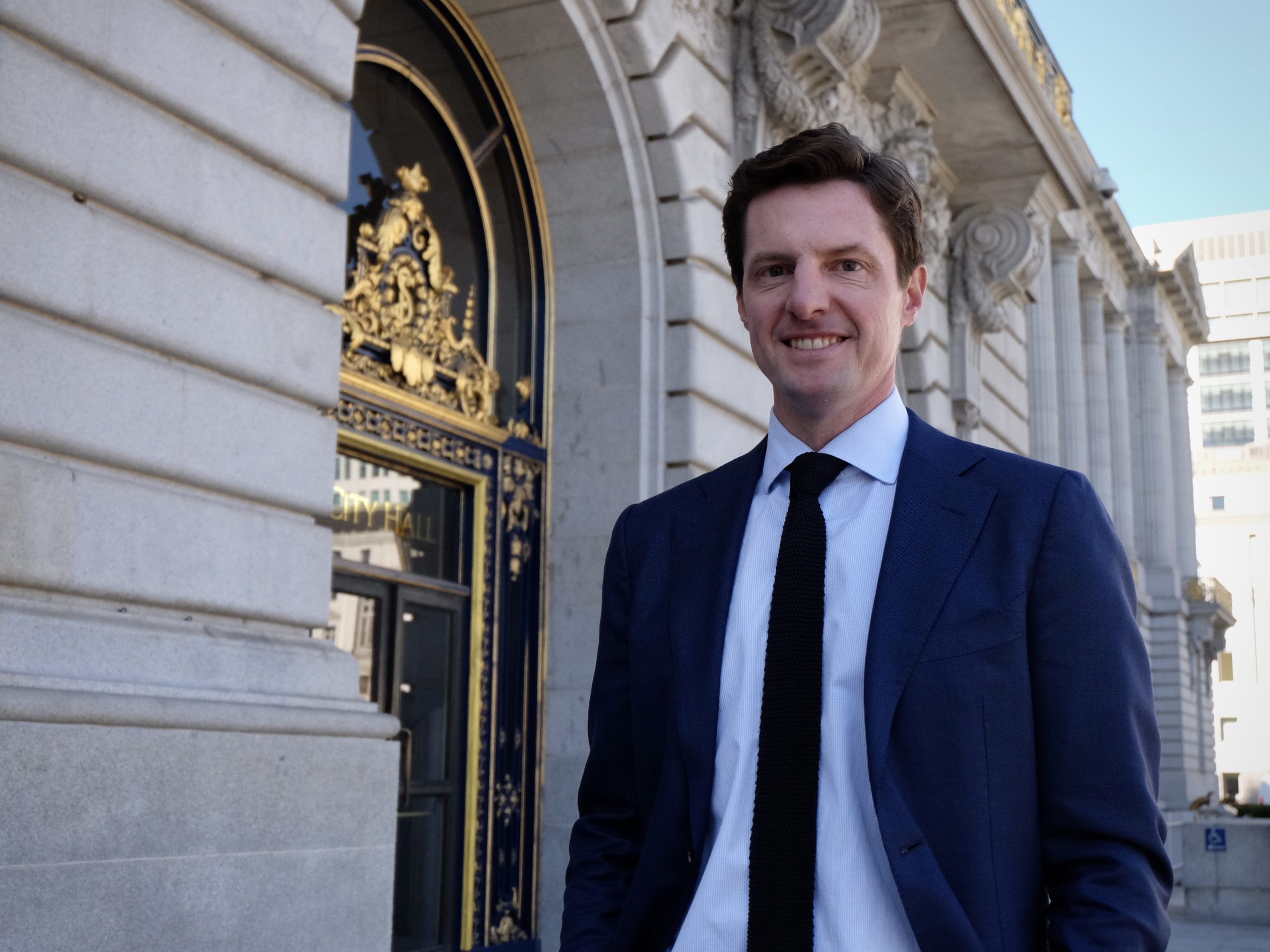
On Wednesday, Stephen Sherrill sat down with Mission Local in his City Hall office, where the walls were still bare, and talked about his appointment, his past work at City Hall and his priorities as the District 2 supervisor.
The interview has been edited for clarity and readability.
Mission Local: A month into your new job, how are you feeling?
Stephen Sherrill: It’s been a lot of fun. There’s so much momentum and excitement in this city. There are so many people who are incredibly invested and excited about the future. I don’t want to understate how much work there is to do, but we just have such a huge opportunity ahead of us.
ML: What are you most excited about?
SS: Someone the other day asked me the biggest difference between being in the mayor’s office and here. Even though my work in the Office of Innovation was very grounded in stakeholder engagement, it was working with a lot of city departments. We did a big data-integration project with Homelessness and Supportive Housing, the Department of Public Health and the fire department and the Department of Emergency Management, so I talked to a lot of internal government stakeholders and worked with a lot of unhoused individuals.
Here, I get to talk to so many more people, constituents, residents, and that is so much fun to me, diving into the things that they’re facing and their challenges.
ML: What are your constituents saying?
SS: I’m very lucky that my predecessor, Catherine Stefani, now in the State Assembly, has been incredibly generous in helping me get settled. I’m really lucky that two members of her team, Mick Del Rosario and Lorenzo Rosas, have stayed on working with me.
We have been able to continue the work on a few things. We were at a planting at the Richardson Triangle, which is a small area in between where Lombard begins to wind its way toward the Golden Gate Bridge and the Presidio. Just continuing to get those plants in the ground. Really important.
Working on ongoing issues, like the redevelopment of the harbor and the marina, digging in some flooding issues on Marina Boulevard and Marina Green, working with the merchants associations. I just really credit Assemblymember Stefani for the foundation she set.
There is momentum building. People, in many ways, focus a lot on the challenges, and the challenges are huge. But if we can continue to build off of the momentum of the last four years, post-Covid, we have a huge opportunity ahead of us.
ML: What are you going to do in the first six months you are in office?
SS: My priority is, first and foremost, public safety. Supporting small businesses is my second priority. Responding to residents and working with them to not only react to their needs, but also to proactively address them. We need to make it easier to be in San Francisco.
Whether you’re looking to raise a family, whether you’re looking to stay here, grow here, start a business here, keep a business here. Investing in making it easier to be in San Francisco, to really thrive in San Francisco, is incredibly important to me.
We’re going to have a hearing on “First Year Free.” [The city program to waive certain city fees for small businesses.] That’s been a really successful program to fill vacant storefronts. It’s not funded for next year, so I want to highlight the success of that program, and then continue working on not only how do we fill vacant storefronts, but how we keep storefronts from being vacant in the first place. [In the 2023 tax year, out of 3,208 parcels citywide potentially subject to empty storefront tax, only 101 were reported as vacant. Out of 259 potential parcels in District 2, only six were reported as vacant, according to the San Francisco Treasurer-Tax Collector. The data is an imperfect tally of the city’s vacant storefronts, as not all property owners have reported the vacancy.]
Responding to the day-to-day neighborhood issues is going to be a huge focus. For example, there are some individuals who are struggling in some of the alleys just here off Van Ness, and some of the property owners are working with DEM and DPH to get those people into shelter and care. When people talk about public safety, it really is both macro level, but also micro.
ML: These sound like priorities for your entire term. My question was, for the first six months, what are some more immediate things that you would do?
SS: Oh, those are immediate things. We have a budget process over the next six months. Those are absolutely immediate things.
We can also look at the closure of two Walgreens in my district, of the 12 Walgreens around the city. I’m already in contact with both property owners, and I’ve been extremely happy with how enthusiastic they are about continuing to invest in the community. One has said to me, “we might be able to host a grocery store here.” Working on those specific sites is going to be a hugely important thing to do. I’m already working with the neighborhood associations in both the Marina and Cow Hollow, and talking to Cathedral Hill neighbors about that later this week. Those are some of the really critical things we need to get to work on. I think that those are absolutely six-month priorities.
ML: Public safety is your top priority. District 2 is one of the safer districts in the city overall. What is that one street or neighborhood that has the most public-safety concerns?
SS: When I look at public safety in the city as a whole and District 2, I don’t think the concerns of District 2 are particularly different. Obviously, each neighborhood has its own individual concerns, but people in San Francisco want to feel safe walking down the street. Merchants want to feel as if they can do business without fear of getting broken into. Tourists. Conventions. All of these things lend to each other.
As we invest in making individual streets and neighborhoods safer, it compounds upon itself, and it makes our business communities begin to thrive. Our religious communities, our nonprofit communities continue to thrive.
With public safety, it’s not just about statistics. [In 2024, the Northern Station had a total of 5,678 crimes, twice as much as the neighboring Richmond station. The Northern station, however, covers neighborhoods beyond District 2, including Japantown, Western Addition and Hayes Valley. It also saw decreases in all crimes, compared to 2023.] It’s about making sure that our streets are clean, that everyone is excited to be in San Francisco.
ML: When it comes to small businesses, for example, the First Year Free program, how does the city have the money for it?
SS: I think a question I might ask is, ‘how do we not have the money for it?’ Vacant storefronts cost the city money. Vibrant economic activity generates money. It generates interest. It generates excitement. That is what makes San Francisco exciting. Tech, yes. Incredibly important. Downtown, incredibly important. But one of the reasons people want to live here is because they want to walk down Fillmore Street or Union Street or Chestnut Street and get a great meal and do some shopping. Maybe at night, they’re going to go out to a bar. So the question I would ask is, ‘how do we not have the money to do these things?’
ML: But the reality is, the city doesn’t have that money, right? For you as a legislator, how would you prioritize in terms of what to cut and what to keep?
SS: My budget priorities start, first and foremost, with public safety, and then with investing in the programs that help our small businesses thrive. One thing that Assemblymember Stefani championed is her support of the Office of Victim and Witness Rights.[San Francisco voters passed a 2022 ballot measure to create this office. After two years, it just opened.] There was an article the other day about a victim of domestic violence who wasn’t able to access the support that she needed. It is critical for us to continue to invest in these at-risk populations.
It is critical for us to fully staff our police department and continue to support community ambassador programs that improve public safety. Those things are absolutely critical because one, it’s the right thing to do. Also, it’s not only just about enforcement, it’s also about recovery. Investing in our recovery community is this flywheel of benefits where when our streets are safer, more people want to live here, more people are coming for conferences, more tourists are coming, generating that tax revenue.
So when we look at budget priorities, when it’s supporting and investing in public safety, protecting critical at-risk communities, fully staffing our police department and investing in things that help our small businesses thrive; yes, there are costs to that. But they also are generating revenue for the city. We need to be looking at this holistically, and thinking long-term about how we’re going to revitalize the city’s economy, and making investments that will do that.
ML: You mentioned all the work that Supervisor Stefani has done. How will you differentiate yourself from her? Or will you?
SS: She’s set an example for me — and I know this isn’t really your question — but she was incredibly responsive to the needs of the community, and that’s something that I believe is absolutely the right thing to do.
I talk a lot about community-generated policy, which some people may not quite understand. When we meet with as many members of the community as possible, whether it’s at bigger town halls, smaller meet-and-greets, or just being in the coffee shop and striking up a conversation next to you — that is where the ideas for effective government come from.
This is really following in her lead; being the district’s voice to government, and not government’s voice to residents. I’m sure, stylistically, there will be things that differentiate, but really, I think so highly of her as a leader.
ML: What are your positions on the city’s upzoning plan, including increasing the height limits on Lombard Street, and what will you do about the pushback from residents?
SS: The first thing to do is make sure that the communities that I am talking to understand and feel heard. We’ve already started deep conversations with them.
I want to, productively, interact with city departments, helping them be more proactive in their engagement with the community. For instance, the Planning Department has a full list of the very active community associations and organizations in the city; making sure city departments have that list, so they know who can we interface with to understand the problems, and not just tell them what the solutions are going to be.
My No. 1 role is helping city departments engage with residents to understand where the challenges are. When it comes to zoning, we’re going to be working closely with city planning. I don’t know what those new final maps are going to look like, but at the end of the day, the city has a housing element that demands certain things. [San Francisco needs to build 82,000 housing units by 2031, of which 46,000 are affordable, mandated by the Housing Element.]
I think the loss of local control through the builder’s remedy [The builder’s remedy allows developers to bypass local zoning restrictions. The city avoided that by passing the Housing Element last year.] would be really bad, really bad. Working with residents to understand the potential options is absolutely critical.
ML: Other new supervisors on the board have spent the last year campaigning and making promises. You didn’t get the chance to make those promises. What is your promise to District 2 residents?
SS: Oh, they’re gonna see me, and I’m gonna be listening to them. We’re going to be doing a lot of events in the district: Public safety town halls, merchant walks, community leader roundtable.
I am going to be out there. I am going to be listening to them. Hey, you’re a District 2 resident. You want to have me over to your living room and talk to your neighbors? I will be there. Print that open invite. Seriously.
If we don’t expand the number of voices who are speaking, we’re never going to really be able to solve the city’s challenges.
ML: You don’t have a long history in District 2, and community leaders don’t really know you. There are people who say you “haven’t done any of the work” for this job. What’s your response to that?
SS: I’m very lucky that I’ve lived in three neighborhoods in District 2 over the last 10 years. I’m never leaving District 2. Oh my God, I don’t think we’re ever going to leave the five-block radius we’re in.
The promise I will make to the residents is that they’re going to see me. They’re going to hear me. And I hope that most of them are going to meet me.
ML: Have you met with Mayor Daniel Lurie to discuss the needs of District 2?
SS: We’ve had some really good conversations. So far, they’ve been focused on public safety. That’s a priority that we share. We’ve also talked about downtown revitalization.
I’m really excited to be working with Ned Segal, who I think really highly of. He comes from a great family too, really a family of leaders here in San Francisco. I’ve known Kunal Modi for a while, who I think is one of the more thoughtful people around homelessness in the city.
ML: Were there points of disagreements in those conversations?
SS: So far, we’ve kept our conversations to things we’re actively working on together. The thing with Mayor Lurie is that I know, and I think he knows: When there are points of disagreement, we’re going to be able to have frank conversations. Really respectful ones. He and I share a deep desire for San Francisco to keep rising, and that works through partnership.
ML: Walk me through the behind-the-scenes of your appointment. How did you become the District 2 supervisor? What were the conversations with Mayor Breed, with other stakeholders? Who interviewed you?
SS: She put an enormous amount of thought into this, as evidenced by the time it took to make the appointment.The conversations were wide-ranging. She based it on her experience, and she also based it on advice.
She just so deeply, deeply cares about the city. We share our deepest core values. In all the conversations that we had, we talked policy, we talked values, we talked goals for the city. She’s an incredibly generous person with the way that she’s offered advice and guidance to me throughout that process.
For her, it was very important to have somebody who was going to be a strong advocate for the needs of District 2. She has deep relationships in the district that maybe people don’t always quite understand.
She also knew that the Board of Supervisors can’t just be 11 people representing individual districts, but 11 people representing the city as a whole.
ML: How many times have you had those conversations with Mayor Breed?
SS: More than three, less than 10? I honestly can’t quite remember. She was thorough, and she was also talking to a lot of people. She also was — by the way — mayor, all at the same time.
ML: You mentioned there were some personal values that you both share. What are those values?
SS: We both really love our families. We’ve also talked about disagreeing with people that we love and still loving them. We both feel that the government needs to be a weapon to invest in underserved communities, and make sure that people are succeeding and thriving. We both believe that it’s important to support people who want to build the future, who want to thrive here, who want to start a family, start a business. The idea of making it easier to be in San Francisco. Affordability is a huge part of that. Keeping our communities safe is a huge part of that.
We talked a lot about supporting the recovery community. That’s something personally very important to her, for reasons I think we all know. I have a lot of friends who are members of the recovery community.
ML: What was that project you worked on in the Office of Innovation?
SS: We worked on a project we called ASTRID, the All Street Teams Integrated Dataset.
The city’s coordinated street response system spans across four departments and nine teams. Those nine teams have been working together for a while, and they were able to share data about individual clients through case conferencing. But because they didn’t have shared data sets, it was impossible to understand how the system was working as a whole and to understand which approaches might best serve clients going forward.
There were traditional legal reasons, data-privacy reasons, why these departments had all built siloed data sets. But those laws had changed. So we were able to implement a new legal framework here in San Francisco called the Homeless Multidisciplinary Team that basically said, if you are an organization working on getting unhoused individuals into shelter, treatment and housing, you can share data.
ML: There were articles written from a number of outlets that tie together Mayor Breed, Michael Bloomberg and yourself. Do you feel this played a role in you getting this position? [Mission Local’s managing editor Joe Eskenazi wrote, “There is nothing yet provably wrong here, today’s appointment carries the whiff of transactionality. It will be more than a mere whiff if Breed assumes a future role under the aegis of Bloomberg.”]
SS: Mayor Breed has proven, time and time again, with everything she’s sacrificed to be a public servant, that is not how she thinks about these decisions.
I worked really hard in her Office of Innovation. We produced something that I don’t think has ever been done in California before. We were the first organization to implement a legal framework and combine these datasets on really struggling individuals across four departments. The clients being served by the Street Overdose Response Team are also probably the clients being served by the homeless outreach team. The Venn diagram is huge.
This worked because the departments and the people on the ground were super bought in. I think the idea that the government should be implementing solutions top down, and just telling workers what to do, is very shortsighted. So for us, it was going out and sitting in tents interviewing people. I don’t know how many other supervisors have sat in tents interviewing people, but you learn more by being on the ground.
Mayor Breed’s support was critical to that work. I have a deep amount of respect for her putting us into the hornet’s nest. There are easier things she could have asked the innovation team to do that she probably may have gotten more benefits from, but she said, “I think this is important.”
ML: So the answer to that question is no?
SS: I just think that’s not how she makes decisions.
ML: Working in the Mayor’s Office of Innovation is a very different job than a district supervisor. What do you think you bring to the job? What would make you a good supervisor for District 2?
SS: The way that we worked in the Mayor’s Office of Innovation is the way that you see a lot of private companies work. It’s something that tech has talked about. An author named Jennifer Pahlka wrote a book called “Recoding America” that I think should be a must-read for public servants.
But the idea that we need to work closely with stakeholders at every step along the way, that we need to approach with a listening mind, with a beginner’s learning mind, is incredibly, incredibly important. I don’t think you can listen enough. You need to listen, and then you need to synthesize, and you need to begin to create solutions to address those problems and then produce results. It’s not just about listening. You have to produce results.
But that background of understanding, listening to find the problems, synthesizing the problems, co-creating solutions with residents, is very much the same. It’s on a slightly different scale, but I’m just taking that approach of listening first, working with community leaders, experts, generating the policy that results in the action and really driving towards solutions.
ML: What do you have to learn on the job?
SS: I’ve been very lucky in how generous people are in offering advice and guidance. There will always be something to learn, and if any elected official thinks that they’ve learned everything, that’s the day they start to fail. For me, it’s about daily learning and relearning about what are the issues, what are the concerns.
ML: What is your vision for District 2?
SS: This gets back to why my policy priorities are my policy priorities. Thinking about public safety first and foremost, being a neighborhood where families are starting and staying and thriving.
When we go down to the Marina Green with our kids, I look at so many other young families, and I know that a lot of them are looking across the bay to Marin, wondering when they’re going to have to move to Marin. So I want people not to look across the bay. I want them looking back at the Marina and Cow Hollow or other parts of the city, too, and staying and growing their families here. I want the businesses started here in the district to stay here.
Looking forward, there are significant infrastructure challenges. We have the redevelopment of the harbor, making sure that we are ready to address climate change and sea level rise, and dealing with things like the Marina green flooding. We just have some of the most beautiful parts of the city, and make sure that they are there not only now to enjoy, but also in the long term. And a lot of those long-term investments need to start now.
I appreciate the fact-checking that ML does in these interviews. But if the data at hand seem to say there are only 101 vacant storefronts in the city, surely that points to a problem with the data, right? I think there are at least a dozen vacant storefronts just in the places I walk past regularly — there must be hundreds at least in the whole city.
I don’t know if the missing vacancies just aren’t in parcels that are subject to the tax, or if they don’t count as vacant for the purposes of the tax, or if the landlords have failed to report them (and so pay the tax), or what. But I’m just counting places that, to a person passing on the street, are clearly storefronts and are not currently being used — they’re vacant.
If Sherrill is hearing from constituents that empty storefronts are a problem, it’s a total non sequitur to say “well, actually there are very few properties paying the empty-storefronts tax”. That just means the tax isn’t covering the problem! The complaint was about empty storefronts, not about too much tax revenue.
My understanding is that you can only claim a tax loss on a vacant property if you are actively marketing it. So if you are just leaving it vacant because the rents suck or you don’t want the hassle or the only applicants are low quality, then you do not get a tax break.
That might also explain why your anecdotal numbers differ from his numbers. The formula retal ban (where it applies) is also a factor of course.
There’s still capital loss and depreciation if they’re a business and as landlords they are a business.
Longtime (30+ yrs) D2 resident here. I see lots of non-answers, cheerleading, and avoiding any specifics. So he will fit right in with D2’s history of useless supervisors: eg, Newsom (an appointee), Alioto-Pier (an appointee), Stefani (an appointee), now Sherrill (ANOTHER appointee). Mom-and-apple-pie platitudes like “public safety!” and “yay small business!” instead of vision. (PS: Interesting how many MAYORAL APPOINTEES D2 has had over the past few decades, no?)
The Breedwashing is a little obsequious and farcical. Repeating “public safety” over and over sure makes me feel safer too as he sidesteps budget cut questions. Oh the plantings at Lombard triangle, so, so important. All that talk about “results” – what was the result? Yeah, Breed got voted out because the results SUCKED. But keep washing that dirty laundry for Bloomberg, whatever.
*(By the way, the “builder’s remedy” that he rightly calls out as being really, really bad? It’s Scott Wiener’s baby. Remember that and attribute the really, really bad idea with the lawmaker that rammed it through for his developer $ constituency. That’s the Breed constituency. It’s not the people on the ground who matter, it’s the $.)
Very good questions. Public safety is hilarious coming from an appointed Supervisor with some of wealthiest zip codes in the nation.
It’s laughable.
Jeremy Infusino District 2 resident