
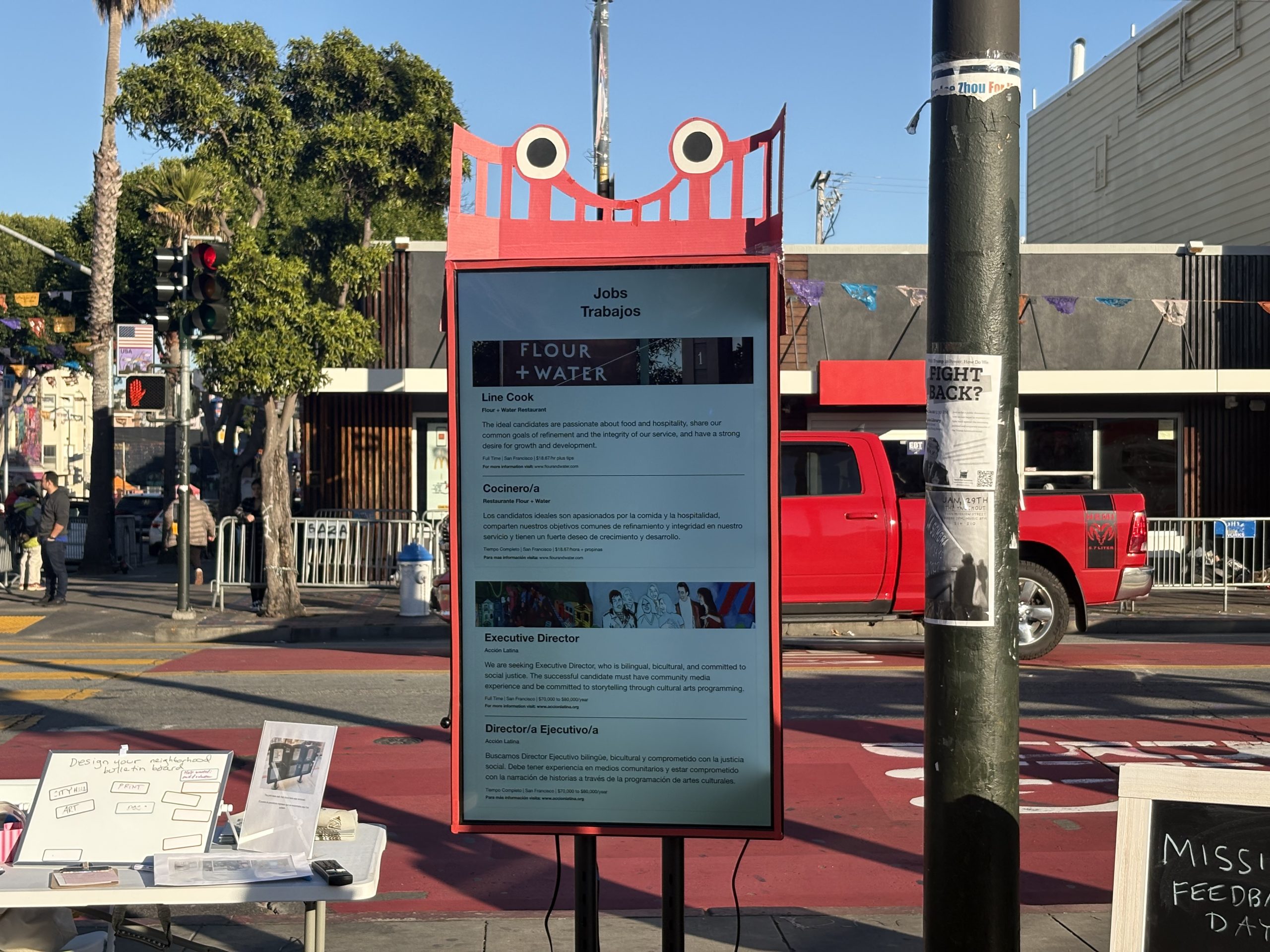

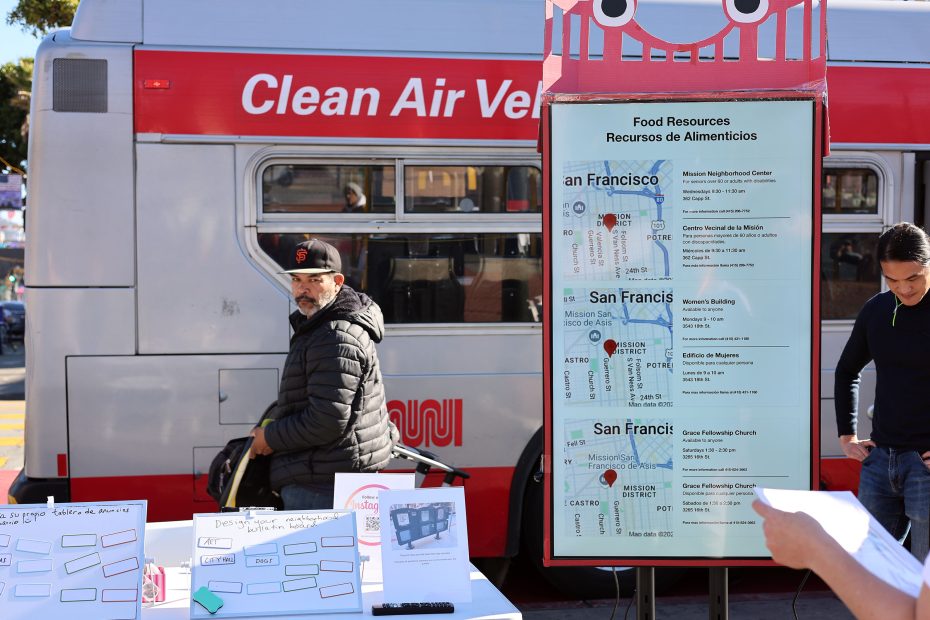
On Thursday afternoon, passersby stopped to look at a new, albeit temporary, addition to the 24th Street BART plaza: A vertical TV screen, adorned with a cardboard Golden Gate Bridge sporting googly eyes.
The purpose? To reimagine what could be in the space formerly taken by public news racks.
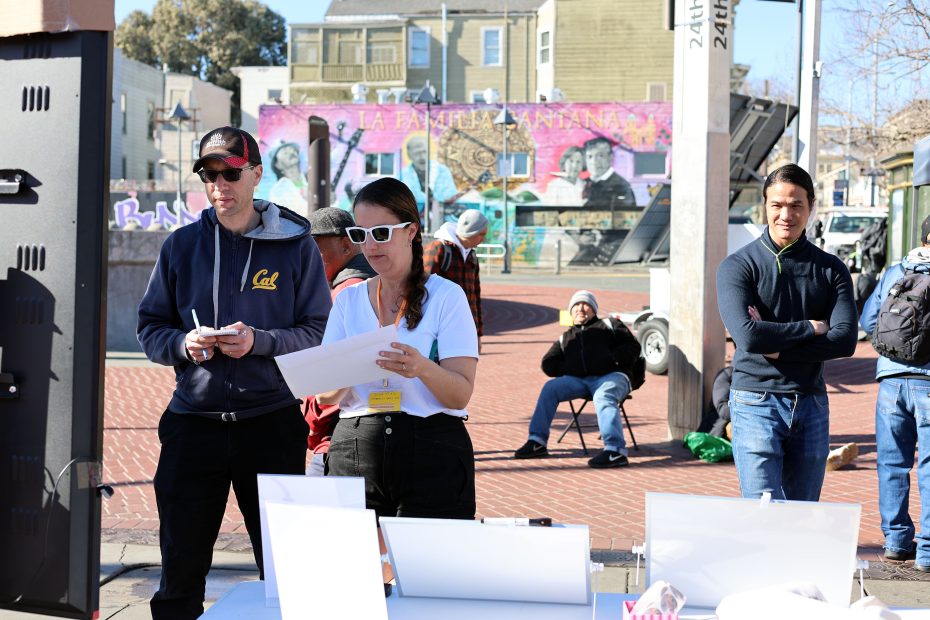
Julia Gitis, founder of the Community News Lab, a nonprofit working to modernize print newsracks into digital kiosks, spent Thursday afternoon soliciting feedback from passersby on what information they would hope to see on a digital news board.
“Empleo,” one person wrote on a whiteboard provided to crowdsource ideas. “Trabajo,” someone added. Overwhelmingly, those interviewed requested information about job postings and events around the neighborhood. Most who approached the popup spoke Spanish, and many requested information about jobs in construction, painting and housekeeping.
Other suggestions were similarly practical. “It would be good to see local volunteer opportunities, or organizations that need help,” said Rex Lu. One of the test slides on the test screen was a list of nearby food banks.
A few suggested information about BART and Muni arrival times, a feature of digital notice boards elsewhere, like in New York City, where the kiosks show nearby subway arrivals. “We’re not getting many BART commuters!” Gitis said, looking around at the plaza.
“I’d like to see any news about health,” said Edward Pulido, in Spanish. Or anything about art, he added. “I like art.”
Gitis hopes the kiosks — which would be sturdy, permanent structures, like similar ones in Berkeley, Oakland or New York — will be designed in partnership with local artists. That, she hopes, will make them more beautiful and bespoke, but also mitigate the risk of vandalism.
On Thursday, Gitis’ prototype kiosk featured information about the local artist Rebeca Abidaíl Flores, who brought along one of her works, a watermelon paleta (an ice pop) to the stand. “Local artists will be a differentiator,” said Gitis. “Every other city’s kiosks look like metal boxes with ads on them.”
Digital-news kiosks in other cities are occasionally vandalized, said Gitis. But the revenue from posting advertisements more than makes up for the cost of repairs, she adds. What differentiates the Community News Lab’s project is not only the input from community organizations and artists — Mission Local, El Tecolote and Calle 24 all participated in the event — but its nonprofit model.
Comparable kiosks elsewhere are run by for-profit companies, like the advertisement boards at Muni bus stops, which are run by Clear Channel. In contrast, the news kiosks would be unique to San Francisco, with local news and local ads.
Clear Channel’s physical news racks might be gone, but not everyone who stopped by was ready to abandon print media. Many expressed a fondness for El Tecolote, a local print newspaper that has been distributed for free in the neighborhood since 1970. Gitis is toying with the idea of adding space to the kiosks for physical copies.
This is the seventh of these sessions that Gitis has held across the city, and she has more planned ahead while she works on getting permits and funding. “It’s going to continue to evolve,” she said. “I want to continue having these conversations.”
Additional reporting by Joe Eskenazi.
In a time of deficits, how much was spent on this already?
Do we really need more tasteless “art” and more ads?
Hi George —
This is not a government project so it is not relevant to a government deficit.
Yours,
JE
I suppose this is a story about manufacturing consent around enriching yet another “non-profit” (albeit an imaginative and altruistic one) seeking to fill a void in our increasingly deteriorating society.
No public transportation? No problem! Uber! Lyft! Scooters! E-bikes! Waymos!
A financial district in the dumpster? Turn it into an entertainment hot spot for people to party, eat, and unload cash!
Homeless encampments? Blight? No problem! Invite some artists to cover it with acrylic paint and scenes of paradise! Welcome to Behlen Country! Instant garden city!
There is always plenty of profit for the insiders creating and manufacturing all this crap, and what better way to make it attractive to the simple-minded than by attaching “googly eyes”?
Isn’t it high time to go beyond “reimagining” San Francisco? With a bit more intelligent imagination?
I would like to see a city that works for everyone. A city does not have to disguise its beauty and imagination by making every niche of it “pay”. And of course– a city that is not divided as it is by its absolutely obscene levels of wealth and poverty.