

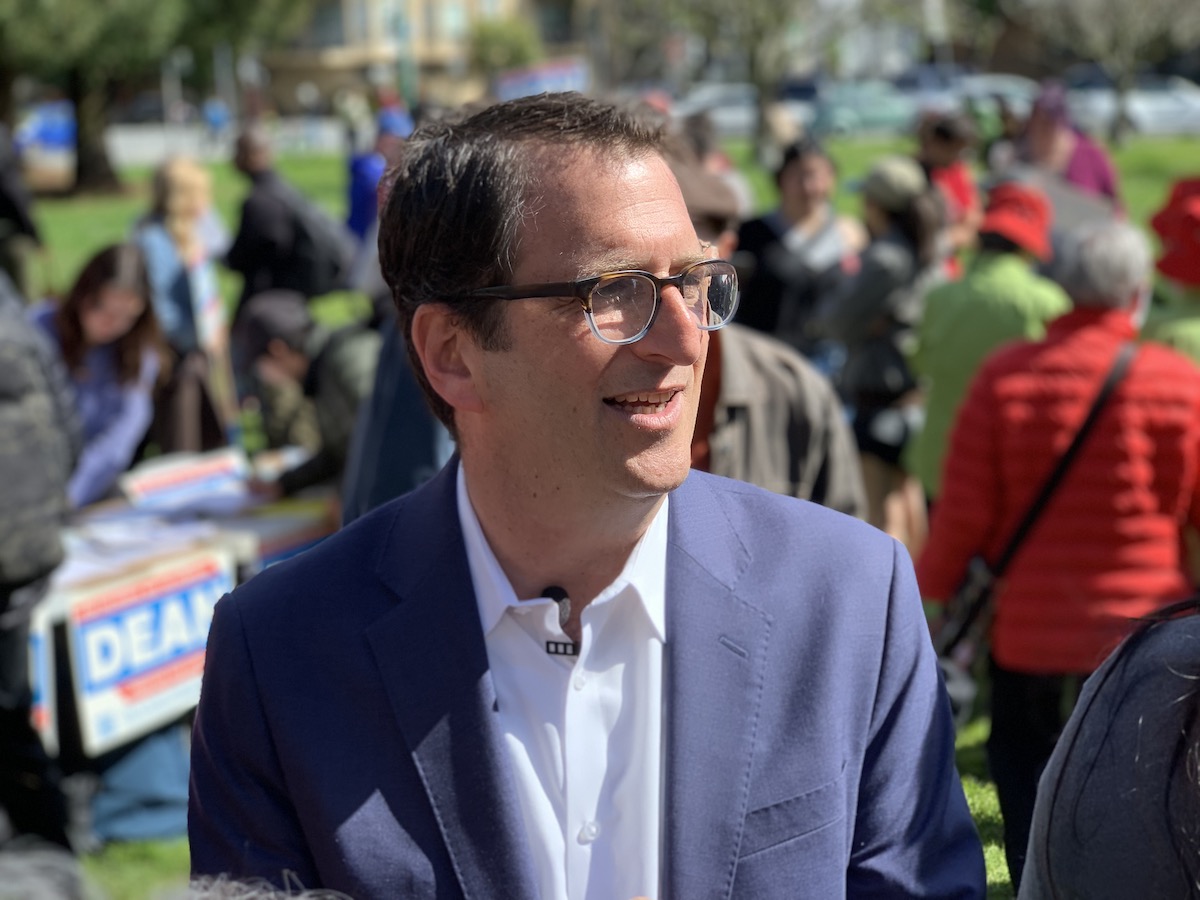

Mission Local is holding exit interviews with elected officials leaving office after the Nov. 5, 2024 election: London Breed, Aaron Peskin, Hillary Ronen, Ahsha Safaí and Dean Preston. You can read our other interviews as they are published here.
Just about five years to the day of his swearing into office, last month Dean Preston attended his final Board of Supervisors meeting as the leader of San Francisco’s District 5, which spans from the eastern end of Golden Gate Park through Haight-Ashbury, Japantown and the Western Addition, the Lower Haight and Hayes Valley, and most of the Tenderloin.
Come Jan. 8, Preston will pass his seat on to Supervisor-elect Bilal Mahmood.
While on holiday with his family in Humboldt County, Preston reflected on his years in office, what he sees as the major issues facing the district and the city, and what is up next.
This interview has been edited for length, and some parts have been resequenced for clarity.
Eleni Balakrishnan: How are you feeling about your five years as supervisor?
Dean Preston: I feel very good about what we were able to do in a five-year term, both the community-led work and the work coming out of our office. I took office with three months exactly before the pandemic shut down the city, so I think, certainly for the first couple years of my term in office, the pandemic and our response to it really defined a lot of the work.
When I was elected, it was a special election. I was the first democratic socialist elected in 40 years in San Francisco. We had a lot of big goals, and felt very much like we had a mandate to fight for working-class people, to stop evictions, to tax billionaires. And we did a lot of that. And we actually were able, especially during our first few years, to achieve some pretty major things, particularly around housing and homelessness which, as I look back, are among the areas where we had the biggest impact in office.
Our office had a lot of positive impact on the city for working-class people and delivering for people who are usually shut out of the political system and ignored in the halls of power. And I think that we used our office and our time in office to really deliver constituent service and legislate for low-income and working-class people in San Francisco.
EB: What were some of your biggest or major accomplishments that you’re most proud of?
DP: I will say that, in reflecting on five years in office, the list is very long. We were an extremely busy office, and had some pretty huge wins along the way for the people of San Francisco.
When the pandemic hit a few months after I was in office, there was a very real question of whether the health crisis would become a mass eviction crisis. That’s what was top of mind for a lot of people in San Francisco.
And so, our office really took the lead in making sure the right to counsel, which I wrote and which was implemented fully under my watch in office. We passed over a dozen eviction bans, constantly adjusting with the changes in state law and federal support, but we effectively banned evictions during the pandemic. And we launched the biggest local rent relief program, not just in California or San Francisco history, but in U.S. history. We’ve seen, more recently through city reports, the extent of the impact of those measures: The rent relief program alone saved 20,000 people from losing their homes or being in huge debt for the rest of their lives, and that’s just through that one program.
So our anti-eviction work is definitely one of the things that our office did that I think had the biggest impact, and really showed, in the middle of a global pandemic and a terrible time, how our city and our society could approach evictions differently, could actually take eviction off the table, and tax billionaires to fund the rent people couldn’t pay.
We showed a model during the pandemic of how to make eviction a last resort, instead of such a common tool in our society, in ways that were really transformative and that I hope we can replicate as a city and as a nation in the future.
Our office also did a tremendous amount of work and accomplished a lot in terms of housing people who are unhoused, of holding the line against the criminalization of homeless people, and moving folks into dignified shelter or permanent housing. And so we piloted the shelter-in-place program by launching the Oasis hotel in District 5, as really the first shelter-in-place hotel before there was a shelter-in-place program.
During the first weeks of the pandemic, we privately did a GoFundMe, raised the money to rent out the Oasis Inn at a time when a lot of people were saying, including city officials, head of HSA, other people in the administration saying, ‘Well, you can’t move people who are homeless into a hotel, because they’ll trash the hotel.’
And we said, that’s ridiculous, you can absolutely move people who are homeless into hotels, and all these hotels were sitting empty. We showed proof of concept by moving all the families who were staying in a congregate and unhealthy [shelter] setting, right next to each other in a basement of a church, over to private rooms at the Oasis. And we also moved all the women who were staying at the Bethel A.M.E. shelter, also in a congregate setting, into private rooms.
We privately fundraised because there was no city program at the time, we demonstrated that this was an effective model, and worked closely with the hotel owner. And then, along with other progressive colleagues, we pushed for and championed the shelter-in-place hotel program and the legislation that called for the city to acquire thousands of rooms. We did not get all the rooms we were pushing for, but we did get thousands of rooms as a result of that legislative advocacy, along with a group of five of us who really led that work on the board, championing the practice of moving folks from homelessness into private rooms.
Then we also led efforts at the board to push the administration to fill vacant permanent supportive-housing units. We did legislation that got significant media attention on that issue, and successfully got the HSH to fill over 30 percent of the vacant units. At the time, there were over a thousand vacant permanent supportive-housing units. Pushing for filling vacant permanent supportive-housing units resulted in the pilot of the Street-to-Home program which, instead of going through endless waits, people were actually moved from the streets directly into permanent supportive housing units.
You couple all that with anti-eviction work that I was talking about earlier, that’s the pipeline of homelessness, right? If you don’t address the pipeline to the streets, which is evictions, you’ll have a never-ending flow of people who are homeless in San Francisco.
Other areas of major accomplishments that I would flag: We did a tremendous amount of transportation work, so fighting to save bus lines, blocking fare increases for Muni for five years, championing Slow Streets and car-free spaces across the district and across the city, and securing $25 million for street and traffic safety for the Western Addition and for the Tenderloin.
Our affordable-housing work, getting on track to creating affordable housing in San Francisco is definitely one of the major accomplishments of our office. So the DMV site in particular, where we convinced the state to build 372 units of affordable housing. The 730 Stanyan site, which is nearing completion now, will provide 160 units of affordable housing. Those are just two sites; we had a couple thousand units now in the pipeline for over 14 sites in our district, and huge budget wins, like the $112 million affordable housing win. We took some big steps toward really building out the affordable housing infrastructure of District 5 and providing the funding to really scale up affordable housing in San Francisco.
Last thing, our success at taxing billionaires through Prop. I in particular is certainly part of what created the hostility and led to a lot of the attacks from the billionaire class. But it’s also raised hundreds of millions of dollars already for the city.
We had five major ballot measures that we did for my office, all of which passed, you know. Prop. I led to over $300 million dollars of money for rent relief and affordable housing, and it’s still bringing in, projected, about $100 million a year or more. Then we did Prop. H [to change election years], which is probably the single biggest reason we have a new mayor.
EB: That anti-eviction work was pretty widely supported, right?
DP: Very much so.
EB: Was there any struggle or resistance in getting those through?
DP: Well, there was a lot of struggle to get those things through coming from the industry. The real estate industry opposed the right to counsel on the ballot. The landlord groups, the Realtors opposed it. The mayor tried to slash funding for the right-to-counsel program, and I had to fight to save it in three different budget cycles and to increase it. The rent relief program was funded by half the proceeds from Prop. I in 2020, we were outspent by a huge margin by the industry and by conservative and moderate politicians. We had to fight in the budget process to win the rent relief funds. We got a $32 million allocation in 2021 for rent relief.
So each of those was a big fight.
The eviction bans were not. I was very encouraged that, during the pandemic, our legislation to ban evictions only had one dissenting vote; it was a 10-1 vote [with District 2 Supervisor Catherine Stefani opposed]. And then, when it came back around for future votes, it was actually unanimous.
Most parts of that work to really dismantle the eviction machine during Covid was over the objections and lobbying of the industry.
EB: What were some of your biggest challenges in doing all of this work? Did any of those end up costing you the election?
DP: The biggest challenge is disinformation and money in politics, which are closely related, and just a sort of toxic culture of more conservative interests that put progressive politicians and progressive movements on the defensive a lot.
The public sees the disinformation and political ads and things like that, but what they don’t see is just the tremendous amount of time and energy that it takes to be rebutting this nonsense on a daily basis. When you have PACs like GrowSF and others who literally just have full-time staff trolling you every day, taking everything you do out of context, and then they have literally billionaire-owned media outlets to have reporters who are on full-time beats, just there to attack progressive politicians.
A lot of it’s nonsense, but it’s time-consuming. It is a barrier. And I do think part of the strategy is to win races, but I think part of the strategy of these billionaires is also just to suck up all the time of progressive movements and progressive politicians that are getting things done. You get the work done despite that, but it certainly is a huge barrier. That was the biggest obstacle, just the amount of money. You do a common-sense thing like try to tax mega-wealthy people, and obviously, they have an incentive to invest a lot of money in trying to beat back those kinds of taxes.
What we showed in 2020, right in the middle of a pandemic, was that the people of San Francisco were ready to fund things like eviction prevention and housing people by taxing billionaires.
And I think that that was a wake-up call for a lot of folks with way too much money in San Francisco.
EB: Have you found any effective strategies to fight the disinformation?
DP: We shouldn’t underestimate our ability to overcome it. And it may sound strange coming from me, having recently lost an election in the face of a lot of this disinformation. But if you look at my five years in office and working really very closely with progressive movements in San Francisco, and championing the causes of low-income and working-class people, we were incredibly successful in almost all of our efforts. I mean, we passed over 100 pieces of legislation. We called the question on a lot of these things that more neoliberal Democrats and others may claim to stand for, and we made people vote on it. And when the question was called on, almost everything we put forward, we won.
Every major ballot measure that we introduced as a movement, and during my time in office, won. Almost every piece of legislation — I can count on one hand the number of legislative efforts that we were not able to successfully get through, or we got through and they faced a veto, or the mayor refused to spend the money. But those are very few.
So I think we have to do two things at the same time. One, take the disinformation and the money and politics really seriously and have a much more effective way of rebutting it in San Francisco. And it’s not just the San Francisco problem, it’s a national problem. But we have to, people on the left, have a much better way of addressing and rebutting disinformation.
We also have to not shy away from progressive policies that center low-income and working-class people in San Francisco, because I think that that still is what the people of San Francisco want. And I think that the voting patterns on ballot measures and on issues show that, and I think our time in office shows that. If you ask the people in San Francisco or supervisors whether we should be evicting people, taxing the rich, housing homeless people, right. The answer, again and again, has been, basically, yes to progressive solutions.
EB: Do you know what that looks like, or have advice for your colleagues moving forward on rebutting disinformation?
DP: We start at a disadvantage where the United States Supreme Court has, through the Citizens United decision, unleashed unlimited corporate spending and super PACs on the American people. And San Francisco, for all the talk often of exceptionalism, is no different in terms of the role of money in politics, and the extent to which billionaires will invest in making sure they’re not taxed, and making sure that our society criminalizes and punishes people who are poor, instead of caring for them and helping them.
So we start with that reality, where there’s no piece of legislation that would be upheld in the courts that can just get all this money out of politics. So, to some extent, we’re stuck with a bunch of billionaires and conservative interests that want a very different city, and are willing to invest a huge amount of money in trying to control local politics.
I don’t think, locally or nationally, anyone on any part of the left has really figured out how to rebut disinformation. I think that’s why we have Donald Trump as the president. But I think certainly, just locally, I think there are things we can do. The first is not to underestimate it. And I think that it’s always a struggle whether to address ridiculous disinformation or just think it will go away if you don’t add fuel to it by rebutting it.
Over time, I’ve become more of a believer in rebutting disinformation early on. I just have not seen that disinformation runs its course. I think that the tools available to disseminate it have only gotten more sophisticated, and if folks have the money to spread disinformation, they can and they will. More so based on my time in office, I counsel people to address it early on.
Among the things I want to work on after being in office is really looking at our communications landscape and how we, as progressives, do a better job of exposing and rebutting disinformation. I think that there are a lot of people who are doing that individually in San Francisco, some of whom have pretty big following, but there’s been a lack of coordination to really get out counter-messages when we’re faced with billionaire-funded disinformation.
EB: What do you think happened with your campaign for supervisor that allowed Bilal Mahmood to come out ahead of you?
DP: First off, I think it is not a big shift to the right in the district. I think some folks have kind of surmised, ‘Oh, has the district changed?’ And I think that the election results show that the candidates who ran on conservative messaging got a collective 20 percent of the vote, which tracks; that is what one would expect in District 5 in San Francisco, that probably about 20 percent of folks actually want conservative solutions as opposed to progressive solutions.
I think with our recent race I think it was a combination: Bilal’s platform, to the extent he had one, was all progressive. I mean, it was all the stuff we were doing. So I think it was a combination of having these PACs do disinformation campaigns vilifying me and our office, combined with — even though he’s funded by these same groups — having him run on progressive messaging. Now, we’ll see what he does with that in office.
I would say, some of the disinformation and the really toxic attacks really are long-standing. I’ve been sparring with the real-estate industry for many years, and I think, as I’ve gained a platform and the ability to legislate and do ballot measures, those attacks have escalated. So, some of this didn’t just happen in the three to six months before an election. It’s kind of these absurd [claims], like claiming that someone who’s spent 25 years fighting for affordable housing is anti-housing.
A lot of people dismiss this stuff as being kind of ridiculous. What our election shows, as a lot of folks around the country have learned, even stuff that seems kind of ridiculous on its face, if it’s backed by a lot of money and nonstop targeting of voters, can get some traction.
EB: Were you surprised by the outcome? Do you feel like it was primarily this targeting, or do you think that residents felt like City Hall or your leadership specifically wasn’t working for them?
DP: We took very seriously the threat of the huge amount of money coming in against us and the level of disinformation. I mean, we were cautiously optimistic because we, of the people we were able to talk to at the doors, got a lot of positive responses from constituents. But it’s a presidential election year; a lot of people vote who aren’t as tuned in on all the local issues, and who are just getting bombarded with negative ads constantly.
So it was disappointing that that won the day in the end, but it’s not like it came out of nowhere. We were very aware of a multi-year effort to just smear our office. When we were able to talk to people, they generally supported what we were doing.
Obviously, our opponent, at some point, did some polling and realized the stuff we were doing was popular, because he just started running on the same stuff, without naming us as the ones doing it. And that just happened, over and over again. I guess that was maybe politically smart as a calculation, but it kind of belittles the truth in politics.
EB: It did seem to work.
DP: There are certainly some folks who don’t support more progressive solutions to issues facing the city. But what is clear, not just from the 2019, 2020 elections, the ballot measures, is in District 5, people still want these kinds of solutions. It’s an overwhelmingly tenant district. They don’t want displacement, they don’t want evictions; they want affordable housing.
The list of things that we were doing had overwhelming support in the district. So much so that to win, Bilal had to campaign on all those very things.
I think the bigger challenge for democratic socialists, for progressives in San Francisco, is rebutting the disinformation and getting the word out about how the things we’re doing work. We were the only county in the state of California where the number of homeless people — in the middle of a pandemic, with all the shelters closing — the number of people who are unhoused dropped. But you wouldn’t hear that on Fox News.
Some of the progressive solutions — housing homeless people, stopping evictions, taxing billionaires to fund affordable housing — these things were absolutely working, and were popular in San Francisco. There’s been a multi-year project to try to make those things unpopular and declare them failures: that first gets traction in a national conservative media beating up on San Francisco, and then is unfortunately echoed by local more conservative politicians in San Francisco. So that has been a pattern, but it doesn’t it doesn’t change the fact that the underlying solutions are there, and when we use them, we make progress.
But those of us who are advancing those solutions have work to do, in terms of rebutting the attempts to attack progressive solutions and those who champion them.
EB: So what would you do differently with regard to the election, or during your time in office? Do you have any regrets, any missed opportunities?
DP: Well, I don’t want to repeat myself. I would rebut billionaire-funded disinformation much more aggressively and much earlier.
That is — that is probably the biggest regret. Now, that’s easier said than done, because we have a staff of four and I think we were the most responsive office to constituent issues and one of the most accomplished, in terms of our legislative work. So, it’s not like there’s a lot of capacity to spend rebutting disinformation.
But there’s a role for allies and for the progressive movement in San Francisco to be much more involved in rebutting disinformation and smears and attacks on progressive movements and on progressive leaders. Looking back, I would have tried to convene more conversations early on with allies, with partners, with folks who are pushing for solutions that benefit low-income and working-class people in San Francisco, to put more on their radar the need to respond. The problem is, people have their hands full, groups representing low-income people have been completely slammed, and their capacity is limited.
If I had to do it over again, going back years, I would probably, from the moment I took office, the first time those kind of attacks came, or just completely absurd things about us — instead of dismissing it, I would have made a more proactive effort to convene the stakeholders that benefit from these policies and figure out how to more effectively push back. But easier said than done.
EB: Do you regret leaving Twitter?
DP: Oh, no, no, no, I don’t. I left Twitter in October ‘23. I don’t regret that at all. Yeah, I’m very, very glad I left Twitter and am enjoying establishing a little bit of a following over on Bluesky, which has been a nice replacement.
EB: I’m jealous.
DP: Get out. Get out while you can. Once [Elon] Musk called for me to be jailed, and he must have fired all the people who were doing any kind of moderation. It used to be that if I would get a death threat or something like that, I could report it and the person would be banned or suspended. But once Musk took over, all that changed, and literally every time you’d make a report, within 48 hours, you get the same message back saying, ‘We’ve reviewed it and there’s no problem.’
People asked — because I had 25,000 or so followers at the time — how I could leave the platform, and it just became pretty clear it wasn’t really a safe place to be.
EB: What are District 5’s needs moving forward that you hope the new supervisor will prioritize?
DP: This remains an over-three-quarters tenant district. And the fear of displacement and the desperate need for greater housing affordability and stability remain top issues in District 5. These are neighborhoods where that fear of displacement, particularly in the Fillmore, where the need to protect existing residents from gentrification and eviction, I hope remains a high priority for anyone in the District 5 office.
There are many, many projects that we have been busy finishing up before leaving office, and we’ll be providing a memo to the incoming supervisor on things that are still outstanding.
Making sure that this community in the Fillmore continues to have a full-service grocery store in the Safeway lot is a huge priority. We were able to hold off the closure through our time in office, but I hope that the next supervisor makes that a priority, as well as activating the Fillmore Heritage Center. There are a number of really key initiatives we were working on in the Fillmore that I hope will be a priority for the office going forward.
With the Tenderloin redistricted into District 5, the ongoing need for a real plan around drug policy in San Francisco is pressing. I’ve been a vocal supporter of safe-consumption sites and of implementing our overdose-prevention plan and of adopting the version of the four pillars plan that Zurich has successfully used, in San Francisco. All those plans have as a cornerstone some version of safe consumption sites.
My successor has said on the campaign trail he supports safe-consumption sites, but we had a mayor who was originally for them and then later was opposed to them.
That is a huge issue facing the district, both getting safe-consumption sites, but also just having an actual comprehensive plan for addressing drug overdoses, drug dealing related street conditions. It’s been incredibly frustrating to try to advocate actual, real solutions in the face of an administration that’s been focused just on kind of the next day’s media cycle, and seeming tough when it comes to drug policy, instead of effective.
There’s lots of other individual project-level stuff, like moving affordable housing forward on Parcel K and on other affordable housing sites. We’ve been leading efforts with community leaders to try to get a full-service grocery store in the Tenderloin, and that remains a very high and significant need.
It’s an amazing district of incredible neighborhoods and also a lot of need. So the District 5 office is, whoever’s in there, is a busy office, when compared to some other parts of the city.
EB: What do you think of the idea that San Francisco is “back on track” these days, that crime or other conditions are improving, and that ramping up law enforcement or other strategies are the reason?
DP: I think what we’ve been doing is a mix. We’ve been doing some good things and some bad things. The good things — the lowering barriers to treatment, some of the night mobile outreach and the immediacy of prescriptions for medication-assisted treatments and others — there are actual positive things that have been happening and have definitely had an impact.
The problem is, to really get this crisis under control, you actually need a comprehensive plan. We have nothing even approaching that in San Francisco. There’s not even been an effort by the outgoing mayor to just convene the different stakeholders around a table and come up with a plan.
This is why we released our 4Pillars4Success report (PDF). We spent a year working with Zurich officials; they had a very similar problem there, and they came up with their four pillars plan.
And what I would emphasize is, it’s not like there’s one perfect plan, right? But you have to have a single plan. You have to have a single plan that police, public health, homeless services, everyone is on board for, so you’re all rowing in the same direction.
What we have now is certain effective interventions happening, but then you have a policing strategy that’s just reminiscent of the war on drugs, arresting drug users, that’s done absolutely nothing but ruin lives. Anyone on the public-health side of things knows that what we’re doing in the law-enforcement side is counterproductive. And so you got to get everyone at the table. That includes people you disagree with. I hope this mayor will do that.
So it’s not that nothing we’re doing is making progress. There are absolutely initiatives that have saved lives and improved things. Community ambassadors are a great example of something that’s made a big difference on street conditions in areas of high drug use and dealing. But it’s been done unevenly, without a plan, and so some blocks don’t have ambassadors, and those are worse. And the blocks that do have ambassadors are better.
What’s been missing on issue after issue, in the last handful of years from the administration, has been bringing everyone together and creating effective plans, even if it’s not everyone’s perfect plan.
It’s instead been an administration that will only talk to its friends, and and we’ve paid a price for that and, at least in words, Lurie, our incoming mayor, has promised to operate differently. I hope he does.
EB: Can you tell us about what’s next for you? Are you going to stay involved in politics? Or go back to lawyering?
DP: Well, I’m not going anywhere. I’ve been in the city 30 years, most of that in District 5, and I’m raising my family here, so I will enjoy a little more time with my wife and kids in the short term.
I will continue, as I’ve been doing for 25 years, to advocate for housing as a human right. I was a housing advocate for 20 years before I was in public office [for] five years in City Hall, so I’ll continue that advocacy from outside, instead of from inside of government.
But I’m also very interested in what role I can play in helping to combat disinformation in San Francisco and [am] really committed to promoting progressive media in the city. Combating disinformation, I see as a real key to addressing extreme wealth inequality and racism.
To me, the efforts are very much connected. The effort to fight for a more equitable and sustainable city is very much connected to making sure that we get out the truth about how progressive solutions actually work to solve issues in San Francisco.
EB: You mentioned how you hope that with the new mayor, there’ll be more collaborative effort toward a coherent plan. You had a bit of a contentious relationship with Mayor Breed. Why do you think that was, and how do you think that can be avoided between the board members and the new mayor?
DP: Well, it was certainly disappointing that the mayor would not kind of overcome political differences to work with us. We tried to work with her, and she was not interested in partnering on much. That stems from, I ran against her in 2016, when she was going to run uncontested for reelection. And then I defeated her hand-picked successor.
She just obviously made a decision to try to undermine our office, instead of working with us. It’s disappointing. It didn’t stop us from achieving a lot, legislatively, and we were still able to do most of the work we wanted to do, but it was just unfortunate at a more symbolic level. The mayor wouldn’t show up at an event if we were in an event, like, it was just very petty, and just does a disservice to the residents of the district who want to see their elected leaders, even if they disagree on things, showing up to honor people together and doing those kinds of things.
From my limited interactions with Lurie, I don’t think that is his style, I found that he’s reaching out to everyone. Whatever policy disagreements there might be down the road, I do hope that the way this mayor treated the District 5 office is not something that any office experiences. It’s just unnecessary, and sort of beneath everyone who’s in politics, to sort of treat each other in that way.
We did plenty of work with her administration and her hand-picked people to get things done in the district, but generally speaking, it was incredibly rare to have moments where the mayor was interested in collaborating with our office.
It’s just an unfortunate way to govern, in my opinion. And, in part, was part of her downfall as well, because I don’t think it was limited to us. I think you saw this when Safaí ran against her; all of a sudden, the administration was trying to undermine everything they were doing. There was just a sense in dealing with that administration that people who were loyal were rewarded, and people who were viewed as in opposition to policies were to be punished.
It’s just no way to operate in office, certainly not my style. I worked very closely with people who had attacked me in the most vicious ways during my campaign, and as soon as I took office, I had them in and we were working together, and you saw folks endorsing me in my most recent run who were 100 percent opposed to me before.
EB: Like who?
DP: Just in the Fillmore alone, so many community leaders who endorsed us, who had previously endorsed our predecessor. People who ran against me.
It’s not just because of our work for the community, it’s also because we worked with them, whether we agreed with them or not on a particular issue, and whether they had supported or opposed us in a particular race.
That was not the style of the outgoing mayor. If you were viewed as not politically supportive of her, there was a sense that there was a price to be paid for that. That does a disservice to the people of San Francisco. Whatever happens in political races, once you’re in office, you’ve got to get over it and serve everyone.
EB: Is there anything else you want to reflect on from your time as supervisor?
DP: The community ambassador work, that’s one success of the city during Covid, especially the [Office of Civic Engagement and Immigrant Affairs] program, which I’m so impressed with. It’s the city’s only in-house ambassador program.
Often, conversations about public safety focus so much on police funding, and don’t focus on all the violence prevention and other intervention work we do. We’ve come a long way in actually viewing community ambassadors as part of a public-safety approach, and it was a really high priority for our office early on. We led the first budget increase for the OCEIA ambassador program and brought the ambassadors to District 5 for the first time ever.
I just hope that, as we continue to have this conversation, as a city, on appropriate levels of police funding, that we’re also investing in the city’s program for community ambassadors.
They’re the ones in the yellow-and-black jackets. They have a level of transparency and accountability that really stands out; they’re like the gold standard of ambassadors. We led efforts in [the Government Audit & Oversight Committee] to hold oversight hearings on the community ambassador programs, and there’s certainly a need to better coordinate it all and look at how we fund it.
My longer-term vision would be a huge expansion of the ambassador program, a city program, leaning into that. Not just by contracting out, but by growing a professionalized group of ambassadors as part of the city.
EB: So expanding OCEIA ambassadors over, say, the [contracted] Urban Alchemy ambassadors?
DP: I’ve generally taken the ‘both/and’ approach, because I think having ambassadors is really important. But long term, yes. I’m a democratic socialist; to the extent you can run good city programs instead of contracting them out, and unionize city workers, [that’s] the way to go.
More broadly, one other thing that doesn’t tend to get as much attention, but that I’m really proud of in our work, has been — I’ve been chair of [the Government Audit & Oversight Committee] for four years. We have led so much oversight work, we’ve done legislation, hearings and audits that have led to important policy changes, and over time will result in significant savings and corruption prevention in the city.
Most recently, we released a PUC audit that the [Budget and Legislative Analyst Reports] did, before that, the police audit, which I hope will factor into some of the budget discussions this year. It’s been a major body of our work.
Anti-corruption and good government work doesn’t tend to get as much attention. It only gets attention when things are going wrong, which is fine, but that was in four years chairing that committee; definitely some work that I’m proud of, that I think made a big difference for the city.
Preston says this: “a lot of people were saying, … ‘Well, you can’t move people who are homeless into a hotel, because they’ll trash the hotel.’
And we said, that’s ridiculous, you can absolutely move people who are homeless into hotels …”
I’m disappointed that his implication wasn’t fact-checked. According to the SF Standard, ” Nine of those hotels have made claims for damages, with settlements totaling roughly $44.5 million. ”
https://sfstandard.com/2023/06/13/san-francisco-downtown-hotel-gets-20m-damage-settlement-from-covid-shelter-program/
Was it better than letting them die on the streets? Yes, of course. But don’t insinuate that there weren’t hotels that were completely trashed afterward.
The fact that his answer to “what do you regret doing” is basically “I regret not yelling louder about how evil my opponents are” is pretty on-brand.
I agree with Preston on more than a few issues, but he seems incapable of evolving, changing, or absorbing other perspectives on anything, ever. It’s disappointing.
Yes, it is stunning that Dean doesn’t think that he ever did anything wrong. And that he only lost because other people are evil.
At least he now has plenty of time to reflect on that.
Dean Preston literally has the power of being correct on his side. What is he supposed to be “evolving” on? His opposition spread ludicrous lies about him. That’s the unvarnished truth. It does need editing or ‘compromise’.
Yes, of course, my mistake. Dean has never once made a political decision or calculation that was wrong, ever. Every single decision he’s made has been flawless and perfectly representative of the unified will of The People, the real residents of SF, against The Powerful, and anytime any segment of his district’s electorate disapproves or disagrees – even a majority of them, perhaps! – it is only ever because those residents were either dumb brainwashed sheep, or not really The People anyways. Ever thus it shall be.
STARK CONTRAST:
London Breed: I. I. I. Me. Me. Me.
Dean Preston: We. We.We. Us.Us. Us. WE. US.
Dean is a fighter for working class people all around the city, not just in District 5. I genuinely cannot imagine what additional damage the pandemic would have done if it wasn’t for his eviction ban. I hope his light burns even brighter as he enters this next chapter of his advocacy.
As a lifelong resident of District 5, I shared many of Dean’s values on paper. My support for Dean ended when his office did not return phone calls or emails when I contacted them about public safety and programs to support my family’s small business (COVID-19 and after). He did not seem interested in hearing our concerns about living and being a small business in his district. I could not vote for someone I felt had no interest in issues affecting my family and my family’s ability to stay in San Francisco. Once again, it felt like my “local” representative was more interested in his national reputation than in serving his district.
First off – thank you Eleni for this longform article. I wouldnt have known half of the things Dean Preston’s office was affiliated with if not for this piece
I loved reading…
– about the right to counsel he got passed
– about how he helped lower the rate of homelessness during the pandemic
– how he pushed the city to fill vacant permanent supportive housing units (why they were not being filled when they had capacity we will never know….)
– how we was chair of the Government Audit and Oversight committee for five years! I had no idea
– about the Fillmore Heritage Center (I will be following this project myself for sure)
Now, I really disliked reading about the disinformation piece. It is very real – disinformation. I do believe that “GrowSF” nonprofit is super insidious – posing as a progressive org publishing voter guides. I am ELATED to hear that Gary Tan is out of SF…… FYI The Phoenix Project does some great reporting on SF politics and that is where I learned about the nature of GrowSF…
I remember seeing Bilal and his team in the Fillmore last summer. They were doing this press conference declaring racism a “public health epidemic…” It was big talk, and while I agreed with what he was saying, I hope it wasn’t just big talk to get elected and that we see programs in place walking the walk.
It is awful to hear that many of Dean Preston’s wins in office were co-opted by Bilal, and now I am getting a bad vibe from him, but we still have to hold him accountable to the people…
As for the claim that the hotel program did not work because homeless trashed the hotels. I believe in the bigger picture that people became housed. Anyone can file a lawsuit, and that doesnt make what theyre saying true exactly. However, it is sad to hear hotels had so much damages…allegedly
As a real live, long-term District 5 resident who uses his name on this site, I am going to miss having Dean Preston as my Supervisor. I volunteered on four of his campaigns – he lost two and won two – and this one was pretty close, in terms of him getting the most first-place votes (not that I think we should get rid of ranked choice voting, since nobody wants to deliver soggy literature in a December runoff.) I think he has been very effective as a legislator (which after all is the primary job of the Board of Supervisors.)
I do think that more needs to be done to fact-check the people who are gentrifying San Francisco politics. For instance, has any member of the press asked who is going to be running Bilal Mahmood’s supposed “Climate Nonprofit” while he’s sitting on the Board of Supervisors?
Dean was a great supervisor, and it’s disappointing to see him go. I hope the city will take to heart his recommendations on adopting the 4Pillars approach to reduce drug overdoses in SF.
Straight from the horse’s mouth: “…People in the administration saying, ‘Well, you can’t move people who are homeless into a hotel, because they’ll trash the hotel.’ And we said, that’s ridiculous…” And then? They trashed the hotels. And then? The hotel owners (read: incredibly wealthy corporations) sued the city for billions of dollars in damages. And then? Taxpayers such as myself are left to foot the bill! (And by the way, Preston owns a multimillion dollar home, and his wife’s “trust” owns several more million dollar properties…These are *facts*, not misinformation). Sorry, but I wish Preston would be forced to sell his real estate and stock holdings to pay for the damages he caused, and let us poor working-class taxpayers off the hook!
So long Dean.
He did not listen to D5 constituents, and we’re far too focused on ideology than basic stuff. That’s why people voted him out. What a sigh of relief he’s gone.
Also it’s so ironic that he’s all about housing, (to get vote to stay in office) yet doesn’t personally house anyone in SF, and makes his family makes money from RE outside SF.
Relieved in D5.
Dean was one of the best supervisors this city has ever had. His defeat was part of a nationwide reactionary collaboration between oligarchs and the democratic party to absorb and then diffuse the popular progressive movement that was building in the previous ten years or so. They had to gerrymander District 5, and then spend TONS of money, over years to slander and run astro-turf candidats against him.
But none of that can change the fact that the prescription of the left is CORRECT. The billionaires can distract, obscure, and propagandize all they want. They have no solutions to affordable housing, inequality, etc. because they profit and therefore seek to perpetuate the conditions that case them.
Ah yes, of course, it is all a vast deep-state, right-wing conspiracy! How could we have missed that? 🙂
Dean’s utter lack of self-awareness is matched only by yours.
My guy, Tom. Capitalism is the conspiracy. Money in politics is the conspiracy. But they’re actually called SYSTEMS. read about it.
Thanks for the interview
Dean maybe a good Tenants Right Advocate but ignored the hardworking taxpayers who live in his former district.
Homeless and addicts are congregated here .
Why?
Because of the drug access .
He never showed interest in job training , or relocation so persons could get back on their feet .
There is no reason to house all those in need in the Tenderloin.
Lower Polk Street neighborhood was destroyed under his watch and he did nothing.
Never did one thing to help the disabled community and ADA.
I suggest he go live in a socialist country, like N Korea and China since he is a democratic socialist.
The enabling and free handouts to addicts is beyond stupid and is harmful.
Law enforcement , arrests and temp shelter with requirements and a timelimit are necessary.
Taxpayers who work hard should not be suppporting addicts and homeless who refuse to get their act together
He has ruined our neighborhood .
Glad he is done.
There’s that disinformation that Dean was talking about.
Like Jimmy Carter, History and time along with Carter’s and Preston’s actual records and accomplishments will prove that both were honest, ethical, honorable and dedicated servants of The People. As San Francisco’s former Mayor Art Agnos said: “Dean Preston is the only elected office holder who says the exact same thing inside of City Hall as he does outside of City Hall. The Dean haters are unhinged toxic and scary wind bags like Elon Musk and Garry “die slow” Tan and Techbros like Steven Buss and Todd David. History will reveal that Preston was a policy wonk, a mensch and an extraordinary human being who was dedicated to public service.
I was a little kid when Carter was president and you presumably were not, but I don’t get the accolades. Carter implemented regressive tax policies and paved the way for Reaganomics; plus he oversaw the ultimately catastrophic 1979 Camp David Accords, which gave Israel cash and carte blanche to run roughshod while Egypt stood down.
Here’s a couple NY Times articles from the time which highlight Carter’s paring of capital gains and bribing of Egypt:
https://www.nytimes.com/1978/11/09/archives/highlights-of-the-tax-law-signed-by-president-carter-individual.html
https://www.nytimes.com/1979/03/15/archives/carter-is-said-to-put-new-us-aid-for-israel-and-egypt-at-4-billion.html
The article about tax changes is an interesting time capsule, thanks. But it says exactly the opposite of what you took from it:
> The rationale of the Senate Finance Committee in sponsoring a general reduction in the capital gains tax — which the Carter Administration opposed — was that it would encourage risk‐taking and capital formation.
So Carter’s administration was against the reduction in taxes on capital gains. Ultimately Congress makes the law — the president has some influence, but very often doesn’t get his way. Especially so with taxes and the budget.
The same tax law also expanded the earned-income tax credit and made it permanent. To this day that’s one of the major features making our tax code more progressive.
Down with Socialism. It doesn’t work and is a threat to our constitution.