

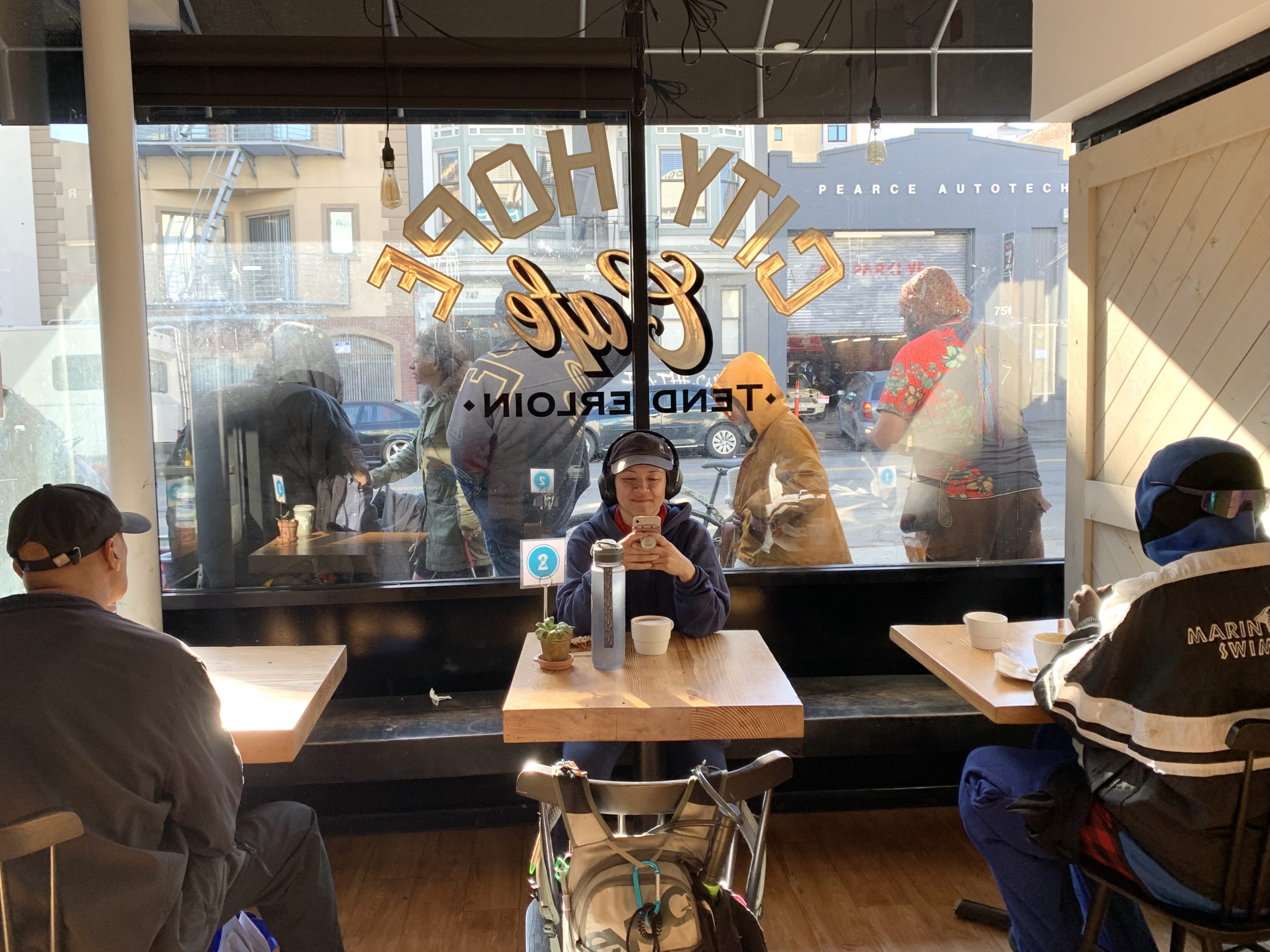

“When I wear a backpack, people treat me a lot different,” says Orlando Blancarte, savoring his last sip of coffee amid the hum of clinking mugs and hiss of the espresso machine on Tuesday morning. “Boom: You’re homeless and you’re bad.”
That’s part of why he keeps coming to this spot tucked between a derelict hotel and an auto body shop in the Tenderloin, even when there’s a queue to get inside. At City Hope Cafe, everyone is treated with “radical hospitality,” and a large piece of artwork on the back wall reminds guests: “You done good.”
It doesn’t hurt that baristas make lattes with top-shelf coffee beans. For free.
City Hope Cafe is only open for two hours a day, three days a week. But this oasis of normalcy kept Blancarte positive when he was homeless, struggling with addiction, and living at a shelter, he says. Here, he made friends and found a community that helped him navigate his way through the shelter system and into an SRO hotel room.
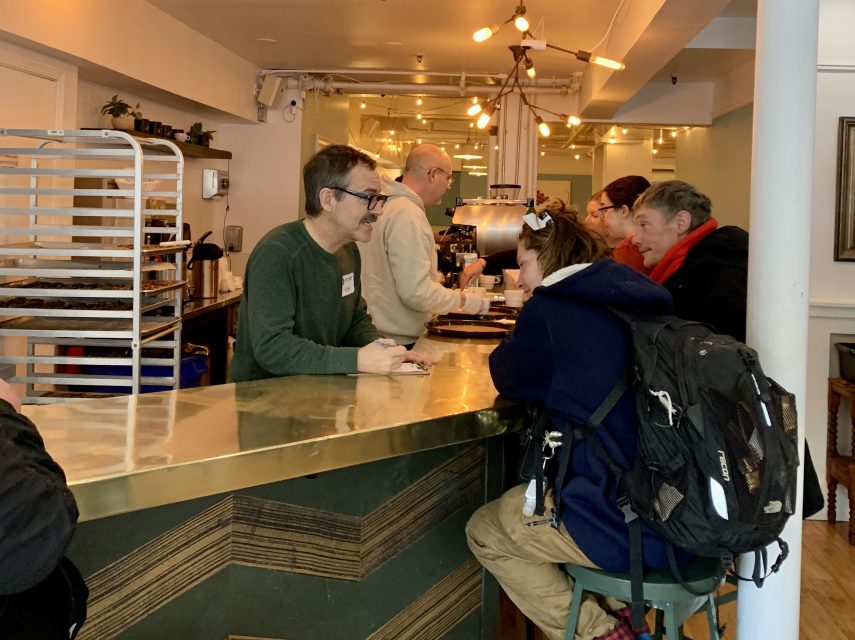
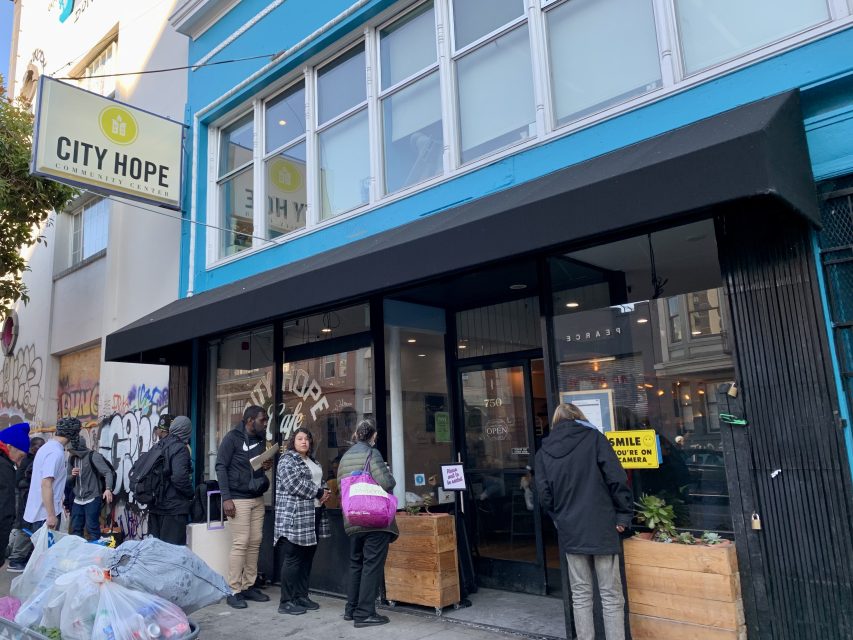
As if on cue, a woman walks in the front door and hugs Blancarte: “It’s been a long time!” she says. Behind the bar, baristas continue pouring milk and pulling shots of espresso. Outside, people shed garbage bags full of recycling and large suitcases with their belongings — large items aren’t permitted in the cafe — and get in the short line.
Respect and routine are a big part of the cafe’s mission that Rev. Paul Trudeau, the founder of the City Hope nonprofit, opened in 2020. As guests first step in, a host takes down their name, greets them, and leads them to a table, a sequence of events many who dine out take for granted. Staff and volunteers try to say each guest’s name about five times throughout their visit, says Trudeau.
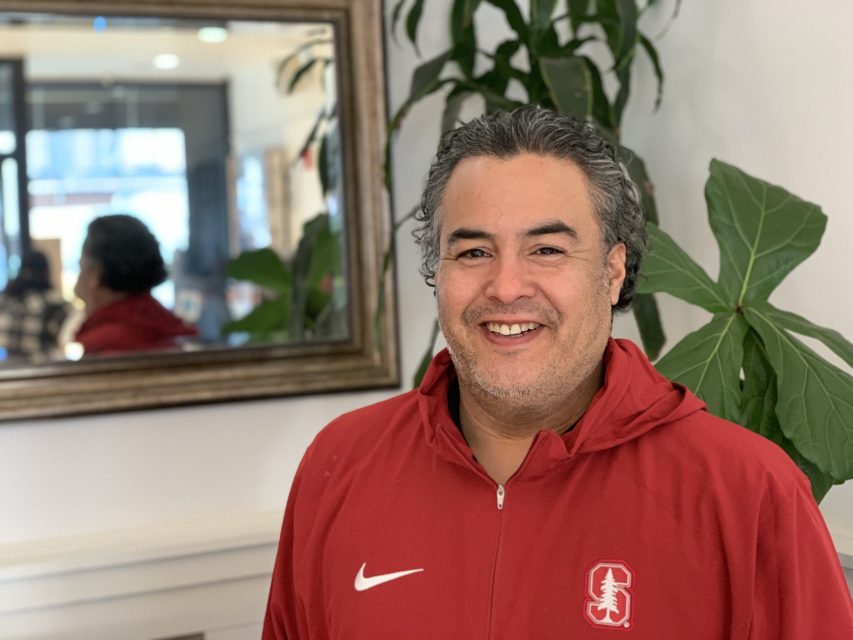
After years of doing community outreach work through his own ministry, Trudeau raised money to launch a community center in 2015, then took out a second lease for a small sober-living SRO hotel in 2016. When the Southern restaurant below the community center closed during the pandemic, Trudeau took the leap and began renting the ground-floor space for the cafe.
Though the church fiscally sponsored City Hope’s programs until 2020, Trudeau said they are now interfaith, with no religious bent. The organization is privately funded, drawing some $2 million mostly from individual donors, plus occasional grants or foundations. City Hope is among a small handful of privately funded nonprofits in the Tenderloin that supplement an often disjointed array of government-sponsored efforts to support the neighborhood. For now, Trudeau hasn’t received any city or government funding, but he’s grateful that this means he hasn’t had to sacrifice his vision.
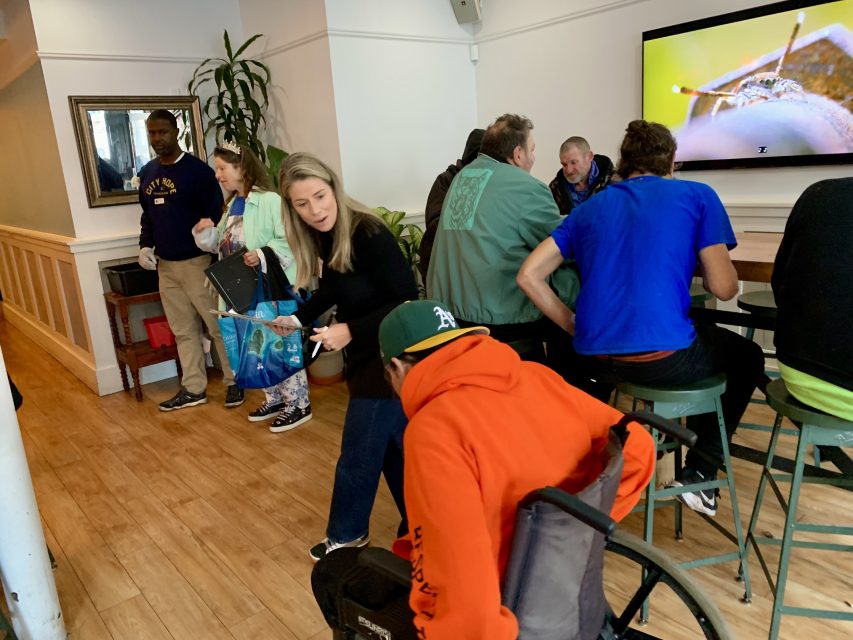
Nearly 14,000 people visited the cafe last year, according to City Hope’s latest annual report. Trudeau said the limited hours keep people excited in a neighborhood where many are mired in a fog of substance use or simply struggling to get by. In addition to the cafe, there’s a revolving calendar of other City Hope programs like trivia, karaoke nights, or dinner and a movie.
“A very common thing in the Tenderloin is, ‘What day is it?’ is the question, not what time it is,” Trudeau said. “When we can give people a grounding layer of something to expect or look forward to, it helps with everybody’s mental health.”
As one woman leaves, leaning on her walker, she calls out “goodbye!” to workers and fellow guests. Across the room, one hears frequent “Nice to meet you!”s from servers learning guests’ names.
In-kind donations abound. Coffee is donated by local coffee roasters like The Coffee Movement and Linea Caffe. Just last week, Verve Coffee Roasters gave a few thousand dollars’ worth of coffee, said Paige MacLaren, City Hope’s program manager and finance coordinator. MacLaren also hosts free barista training for those who want to get into the coffee industry.
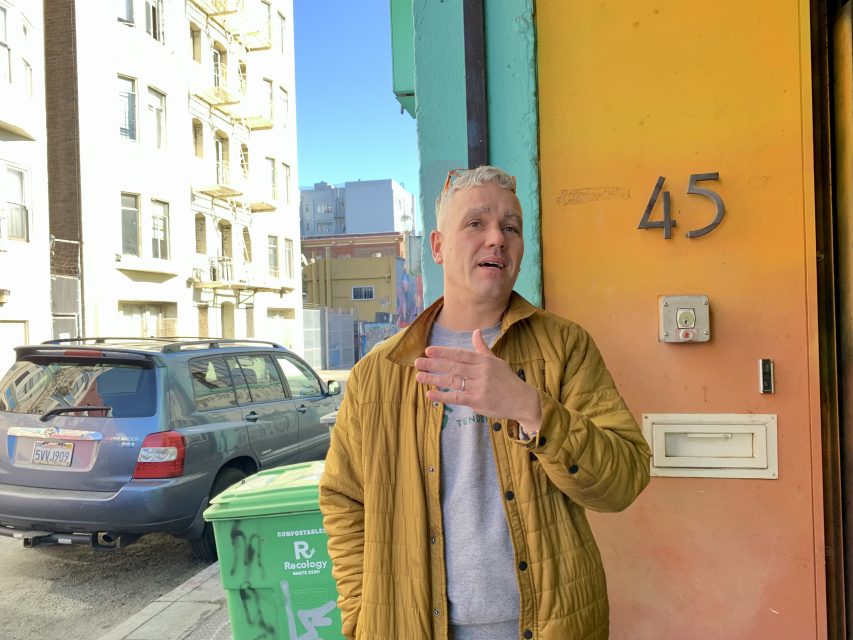
Another part of the mission is to encourage volunteerism and bring into the same room community members who might never otherwise interact, Trudeau said. The cafe is staffed mostly by volunteers serving and working behind the bar: Children as young as 9 can participate, and residents of City Hope’s small sober-living SRO also come in to give back. On Tuesday morning, when this reporter was at the cafe, Liz Farrell, a consultant and the wife of former supervisor, interim mayor and mayoral candidate Mark Farrell, was there greeting guests and taking orders.
Trudeau points to a slip of paper with a visitor’s order, with their name at the top and a checklist for the different menu offerings below. He thinks of it as a “script” for volunteers to get past any “internal bias toward their unhoused neighbors.” The Tenderloin is often treated as San Francisco’s containment zone for much of its homeless population, and is home to a high concentration of the city’s shelters, SRO hotels, and social services.
City Hope also encourages anyone to visit for a coffee, regardless of their financial or housing situation. At a glance across the bustling cafe that seats 80, it’s unclear how much of the clientele is or isn’t stably housed; that’s likely part of the point. Anyone can walk in and grab a table, a coffee, and a pastry.
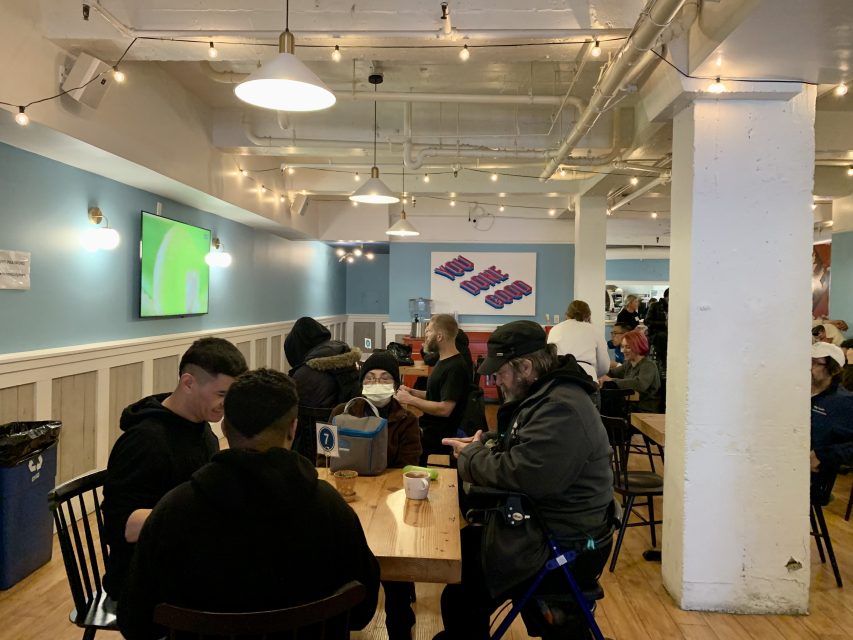
Robin Neil, sitting with a friend at a diner table, said she has a job and her own housing, but she is a regular at the cafe and other City Hope programs. “I’m not ‘too good’ for anything,” Neil shrugs. Most people, she recognizes, are “just one thing away from losing it all.”
Trudeau said the vision for the cafe and City Hope’s other programs was born of the shortcomings he observed while working with people at the county jail or Laguna Honda Hospital, with frequent recidivism and relapse.
“We drop the ball on people when they start to succeed, too soon,” Trudeau said. “We’re putting a Band-Aid on it when it really needs to have a cast, like a longer heal.”
The cafe offers an opportunity for fun and connection in a setting that’s drastically different from the dingy or fluorescent-lit rooms where many social services are hosted. The approach is clearly a hit among residents; on Tuesday, there’s a line outside nearly the entire time the cafe is open.
Shaurice Butler, 38, said she comes in whenever the cafe is open, from where she sleeps “pillar to post” across town in Bayview. She slowly sips a hot chocolate between bites of French toast.
“It’s not like a shelter … It looks different. The vibe is different,” Butler says, looking around as servers run orders to wood-top tables. “You feel like you’re at home. You’re warm and [it’s] welcoming.”
Even the man sitting with Butler, who is passed out with his head on his arms on the table, is accepted here.
Trudeau said the staff keeps an eye out; if someone appears high, the host might seat them closer to the door, near security, and servers will check that the few who fall asleep aren’t a fall risk.
But on Tuesday, nearly all the guests are alert, enjoying their morning coffees and pastries, catching up with friends and acquaintances before many head off to work.
Elisa Linarez Salami said she recently learned about the cafe from a friend, and gushed about all the programs and the kindness she’s found. She stays at a homeless shelter nearby.
“They always find a way to have people feel like they’re in a sense of community and normalized, despite their destitute situation,” Linarez Salami said. “Instead of making them feel like outcasts.”
Thank you for writing and publishing this article. Keep hope alive!
Of note, the pastries at City Hope Cafe are made by James Beard Award semifinalist Michelle Polzine, whose 20th Century Cafe I greatly miss. Folks deserve the dignity of high-quality food; this place feeds souls as well as bellies. Ran into her in Golden Gate Park the other day and was so pleased to hear she’s still loving this volunteer work.
Having been homeless and knowing first hand how next-to-impossible it can be to simply sit and drink a good cup of coffee, undisturbed, I want to cheer these do-gooders.
Sadly that is too difficult for me, and not because I’ve never drunk a latte.
Being penniless and homeless in America is not a game. It is life and death, where one seldom has a moment to do anything more than hustle to make it to the next day.
I have had my full share and more of people offering “freebies”– often accompanied with genuine smiles and proffers of hope and encouragement. But trust me, nothing is free.
For these people, forgive me, I have little more than contempt.
I once read that the greatest sin of all is contempt, and I agree.
“Good” people will kill you for that.
Me thinks you truncated a quote often attributed to Herbert Spencer, which never mentions or assumes the existence of sin: ‘There is a principle which is a bar against all information, which is proof against all arguments, and which cannot fail to keep a man in everlasting ignorance—that principle is contempt prior to investigation.’ Or were you being ironic? Regardless, I imagine the folks at City Hope Cafe would care not the slightest about your contempt for them and would happily welcome you in for a cup of joe, a bite to eat, and a smile, as if you were their biggest fan.
Even assuming it’s true that ‘nothing comes for free,’ what came your way there would most certainly be low cost at best. Hell, I’d be happy to pay the difference between free and low cost to join you there sometime. I could help you investigate your contempt for people you’ve never actually met, and you could help yourself to another danish. Thoughts?