

The San Francisco Planning Commission voted unanimously on Thursday to endorse the Mission Action Plan 2030, an updated version of the city’s existing plan to fight displacement in one of the neighborhoods hardest hit by gentrification.
The plan, said Miriam Chion, the director of community equity at the planning department, “becomes the compass for city strategies, program legislation and investments.”
The new plan largely maintains the city’s current priorities for the Mission: “Secure funding at all levels” to build affordable housing, strengthen tenant protections for “vulnerable Mission Latino residents,” protect businesses and nonprofits in the area, and “preserve and promote cultural resources” across the neighborhood.
But, in a nod to changing post-pandemic conditions along the Mission’s commercial corridors, it adds new priorities to “enhance cleanliness along Mission Street and 24th Street” with community ambassadors, maintenance, and using public spaces. It also proposes to “support both street vendors and storefront businesses” by working more closely with the city.
Unpermitted street vending exploded along Mission Street after the pandemic, particularly at the 16th Street and 24th Street BART plazas. Longtime stalls and other permitted vendors, meanwhile, have faced an uphill battle returning to the street.
The plan does not have any legislative power, but it serves mostly as a list of recommendations from the community to the Planning Department. Once approved, the city agency commits to make decisions and investments in the neighborhood that align with the Mission Action Plan.
Supporters say that, while the plan only secures support from the Planning Department, they hope it serves as an incentive for other city agencies when they make decisions that impact the Mission community, too.
While the plan does prioritize street conditions, it largely focuses on the systemic displacement issues that have long faced one of San Francisco’s most popular neighborhoods for newcomers. The Mission, the city noted, has “doubled its number of unsheltered” homeless people between 2017 and 2022, and averaged a 2 percent loss of Latinx residents in the past decade. In the year 2000, the Mission population was 50 percent Latino, by 2022, that number had declined to 32 percent.
The loss of Latinx residents in the Mission occurred while San Francisco’s overall Latinx population went from 14 percent in 2000 to 16 percent in 2022, indicating Latinx residents are being displaced from the Mission in particular. “The goal,” the report read, “is to reverse this trend.”
The report did note marked improvements. The production of affordable housing in the Mission “more than doubled” over the past decade, compared to the prior one. The Mission’s sales tax revenue in 2023 was almost at pre-pandemic levels, even as the city’s overall rate was 13 percent lower than in 2019. Vacancy rates of 4 percent in the Mission are less than half the citywide rate.
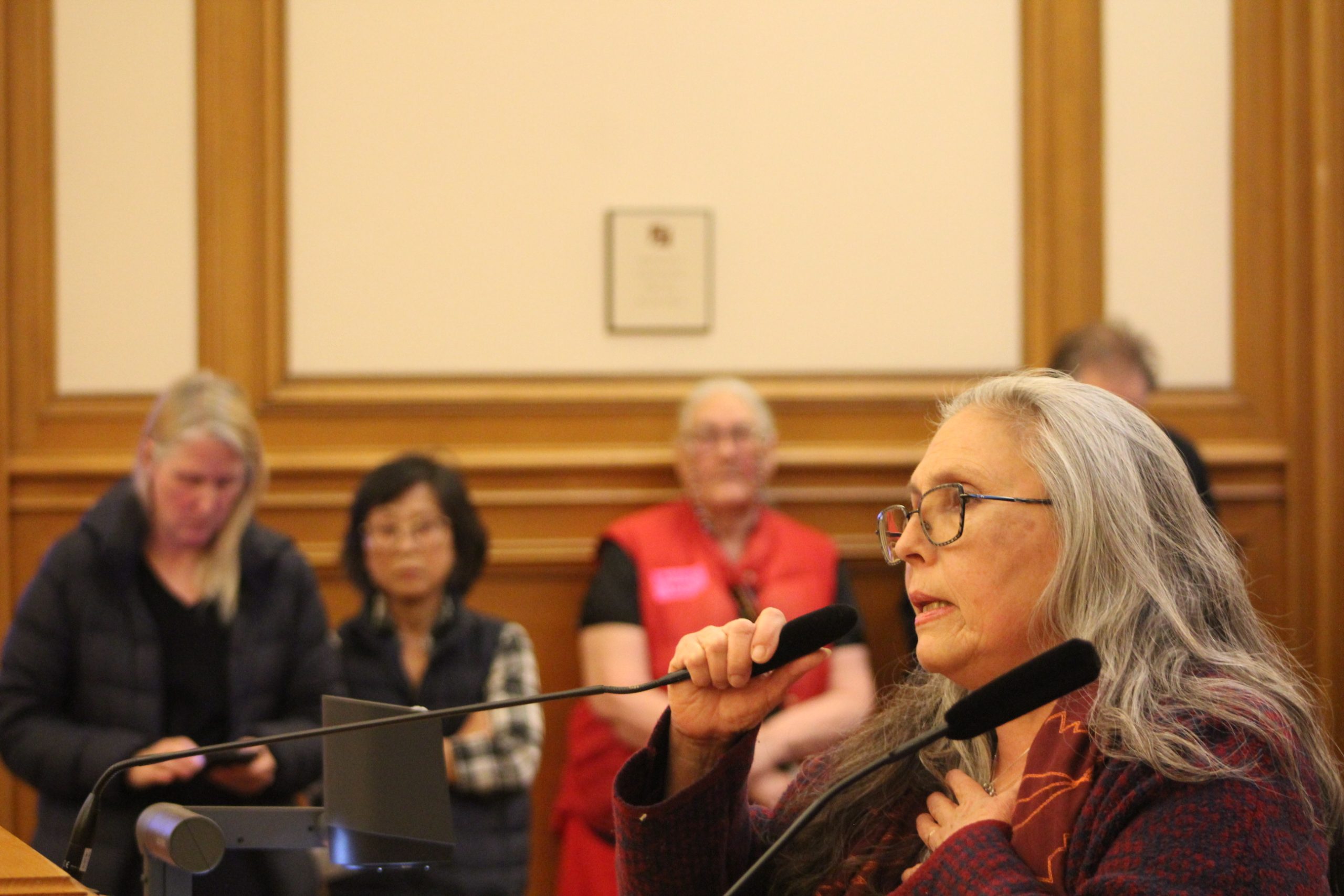
On Thursday, in a room filled with nearly 50 people largely urging the Planning Commission to adopt the plan, commissioner after commissioner lauded the plan and urged its adoption.
“It’s my great pleasure to make the endorsement of the Mission Action Plan 2030,” said Planning Commissioner Gilbert Williams, who called the plan a “direct result” of the “pain” felt by the Mission community during years of displacement.
“For me, growing up there and being there most of my life, it’s very painful what happened in the Mission,” said Williams, who has lived in the Mission or its environs for decades. “It is a little emotional for me to sit here and listen to everyone’s stories.”
Almost 40 people spoke at the hearing: Domestic workers and day laborers sharing difficulties finding housing, Mission natives lamenting having been displaced from the neighborhood, and longtime residents saying they don’t recognize the place they’ve long called home.
“I’m here because both my daughters were displaced from the Mission, the neighborhood where they grew up,” said Guillermina Castellanos in Spanish. “I’m here to represent all domestic workers and my daughters.”
“There are lots of needs, but what this Mission Action Plan 2030 makes clear is what the community has prioritized today,” said Chion from the planning department. Theresa Imperial, a planning commissioner, added: “The Mission still has a lot to fight, and MAP2020 leads that pathway.”
Voices of support were not uniform. Three people showed up to speak in opposition to the plan and three dozen submitted letters. They said the plan did not address the needs of the whole Mission community, and that its focus on affordable projects leaves behind other kinds of housing.
“The implementation [of the plan] has created a system of gatekeeping and biased decision making that excludes the majority residents and business owners in the Mission District,” said Lucy Junus, a Shotwell Street resident, who said that the plan only benefits a select few and leaves the interests and voices of other neighbors out.
Supporters laughed at Junus’ assertion.
Beth Malik, another resident of the Mission, said, “these large, 100-percent affordable housing [buildings] are not adding diversity and an economic future for everybody,” and that the Mission should focus on building housing at all income levels.
Since its implementation in 2017, when the Planning Commission first approved it, seven 100-percent affordable housing projects have gone up in the neighborhood, resulting in 777 units.
Eviction notices also went down. In the three years between 2015 and 2017, the neighborhood saw an average of 177 eviction notices a year. But from 2018 to 2024, the number has decreased to 128 a year.
Supporters say that is the result of pressure from the organizations that pushed the city to adopt this plan back in 2017. The new version adopted Thursday does not need to be presented to the Board of Supervisors, and will be implemented following minor amendments.
After an hour and a half of public comment, supporters stayed behind to celebrate, eating pizza and snapping pictures outside Room 400 in City Hall.

“It feels good,” said Oscar Grande, who now works at the planning department but was a Mission organizer for years. “We’re actually seeing decisions that are going to impact our communities in the future.”
“The loss of Latino residents in the Mission occurred while San Francisco’s overall Latino population went from 14 percent in 2000 to 16 percent in 2022, indicating Latinos are being displaced from the Mission in particular. “The goal,” the report read, “is to reverse this trend.”
I don’t understand the issue here. If the Hispanic population of SF is increasing as stated, then why does it matter where in the city they live? Surely “displacement” implies that they are being driven out of the city, and they clearly are not.
It is rather like complaints I hear that the Castro now has “fewer gays”. That might be true but gays now live all over the city rather than in just one area. That shows greater acceptance and that is surely a good thing, yes?
I had a similar thought when I looked at the stats – you could argue the income mix of those populations is different, people are still getting displaced but then to me the argument is reducing displacement by building for all income levels across the city instead of just trying to ensure the same group of people can stay in the same neighborhood which reduces mobility as life circumstances change. Cities are dynamic and policy to address these changes is pretty rigid.
The city funded poverty and ethnicity nonprofits only get exercised when their business model is threatened. Concentration of a population near where the nonprofits are comports with their business model, as it affords legitimacy for claims of representation when the nonprofits are deployed to pacify neighborhoods politically. A dispersed population diminishes the legitimacy of nonprofit representational claims.
A lot of folks are being dispatched to neighborhoods that are further from their established networks (family, friends, work) such as the Bayview and Excelsior. Commute times are increased and families are split apart. This also pushes out businesses that were patroned by these previous residents. The reason they are being pushed out is not because they want to move to those neighborhoods but because they can no longer afford the rent. People who are driving up the rent want to live in the mission because of the vibrant culture of the people they are pushing out. It’s a terrible positive feedback loop where everyone loses.
Tom. Surely you don’t understand the concept of “community“. Moves by the Planning Department like this give hope that the Mission might claw back from the tech invasion, towards its origin as a vibrant Latine district. The Mission is legendary, where peoples who identify have been able to find culture and sanctuary. That’s community. (And please don’t say “Hispanic“.)
“the Mission might claw back from the tech invasion, towards its origin as a vibrant Latine district.”
Gloria, the real “origin” of the Mission is as an Irish and Italian neighborhood. It only became Hispanic in more recent decades.
Sounds like you do not want the Mission to be diverse at all. You instead want to freeze it at one specific and historic point in time as some kind of Hispanic theme park. The Mission has always been evolving and always will.
Let me try to post again. It seems like ML censure comments about Asians and others complaining about racism toward them.
I don’t wholly understand this new plan to comment on it. The gentrification did affect the Mission and it’s now affecting the whole city. But agree with the natural revolving part. Latinx community, aka Spanish Quarter thrived in North Beach and Russian Hill, around the Broadway tunnel where Our Lady of Guadalupe Church held service in Spanish around 1850- 1900s. Also heard someone commented that she now lives in the Mission where her Irish grandparents lived before the Latinx and recently Asians moved in. BTW, some Asian seniors and at least one Af-Am business owner expressed feeling being unwelcome. And it’s true more latinx are moving into other neighborhoods, who post on sites such as Nextdoor. I do hope the Mission retain the cultural and business institutions that exist currently.
“These comments are approved in real-time ”
censor
verb
: to examine in order to suppress or delete anything considered objectionable
Hi Lyl —
These comments are approved in real-time so I’m sorry someone wasn’t hovering over the keyboard at the moment you submitted. I can assure that nobody is censoring or censuring your commentary.
JE
Having lived in the Mission for 30 years, I deeply understand the meaning of community. Many members of my community were forced to leave the Mission due to the devastating effects of failed City Hall policies and neglect. Now, we are faced with the prospect of the same officials—alongside a small number of non-profits, some of which I believe contributed to these conditions—retaining the power to enforce the same restrictive, shortsighted policies that have plagued this neighborhood for the past eight years.
For me, the hostility toward market-rate housing has left a devastating mark: A half a city block across the street from me sat empty and blighted for years, turning my neighborhood into a shadow of what it could be. I want to live in a vibrant, innovative, and culturally rich urban environment—one that evolves organically and reflects the creativity and diversity of its residents—rather than a stagnant, narrowly defined version of “culture” imposed from above by City Hall.
No need to rush, that is.
Your “vibrant, innovative, and culturally rich urban environment” is built on an economic, boom and bust monoculture. There is no rush to develop every square inch of available land. Let generations to come have a say in the land gets developed. There is no shortage of “market rate” housing. In fact, there is still quite a glut, and lots of vacant units aren’t even on the market. There is no need for any more “market rate” condos, lofts, apartments, and penthouses. We have plenty. The only market segment desperately needed is affordable housing for familes, i.e. 3BR and up.
“affordable housing for familes, i.e. 3BR and up”. Exactly – workforce family housing. The current conversation driven by the state’s number-of-units mandate completely misses the mark / is a total distraction from the core of the issue at hand.
In many cases, the Euros who left the nabe kept their properties and became landlords of the new arrivals.
Tom, the Euros who left the Mission when immigrants from the south began arriving in the ’50s and ’60s did so willingly, not because they were displaced by gentrification. It was quite the opposite: they feared the new arrivals would lower their property values, so they sold and moved to the Sunset and San Mateo County.
Families with deep neighborhood roots were and are still being displaced. The overall population of Latinxyzs (mostly young, single males) has increased because the system requires low-wage service workers to bring coders their food, among other services (primarily construction, domestic chores, and restaurant back-of-house).
Categorical errors, sloppy logic, and misusing statistics to advance a neo-liberal agenda might be common practice, but that doesn’t excuse it.
I think it’s important to remember that the very jobs being disparaged often provide immigrant populations with their first foothold in this country. Many of us share a similar immigrant journey. In my own family, my great-grandmother cleaned homes, my grandmother never graduated from high school and had her first child at 16, and my single mother worked as a waitress to make ends meet. My sister and I were the first in our family to attend college. These “stepping-stone” jobs are vital—they provide the foundation for upward mobility and opportunity. It’s frustrating and short-sighted when people overlook their value and dismiss their role in building a better future.
If you’re replying to my comment, the only jobs I disaparage are delivering meals to housebound techies. Everything else I respect. Just because I note that they are low-wage jobs filled by newcomers doesn’t mean I disparage those jobs or people, quite the contrary, these people are the true “essential workers.” Maybe you misconstrue my disgust with PC symbolism that glosses over the uni-lateral, top-down class war that must never be acknowledged.
The Mission Action Plan continues the failed strategy that has led to minimal new housing built (only 1,130 new affordable units) in the mission over the last 10 years worsening the housing shortage and homelessness crisis. There is no mention of working to increase housing supply in the mission through new construction to reduce the housing shortage. Instead new restrictions are proposed to reduce new housing construction. It extends restrictions in the 24th corridor preventing new housing and new businesses from opening. There is no mention of improving public transit or building housing around BART or MUNI. There is no mention of increasing building heights, or changing city laws that have prevented new housing construction. The plan does not serve the interests of San Francisco or the Mission which is in the midst of a housing shortage and homelessness crisis.
I would love to see more, but 1,130 new affordable homes in a decade in a single neighborhood is high by San Francisco standards. From 2011 to 2020, all but two entire supervisor districts (note that the Mission is but one of 3 neighborhoods in its district) built less than that. District 4, which includes the Outer Sunset and Central Sunset, built only 17 — yes, seventeen — affordable homes in a decade.
Source: https://sfplanning.org/sites/default/files/documents/reports/HousingBalance12_PC_20210422.pdf
Something is working in the Mission for our production to be so high compared to other neighborhoods, and construction of affordable homes has accelerated since the plan was adopted in 2017. So it seems to me the Mission Action Plan is a success. The community organizing that resulted in this plan is what compelled the City’s housing department to make public investments in housing in the Mission, which is the only way we get these units at scale because affordable housing is not profitable. It’s the kind of effort that what we need more of to raise the bar and build more affordable housing citywide.
The 2017 plan didn’t build enough housing to keep up with evictions (111 units/year v. 128 evictions/year), much less with all the other mechanisms for displacement (~ 1,500 Latine residents/year). Is there any indication anyone acknowledged that the existing plan was nearly a complete failure in that respect?
The Mission Action Plan MAP 2030 is extremely disappointing. In the midst of an extreme housing shortage and homelessness crisis, the building of 1,130 new affordable units between 2014 and 2024 can only be described as a massive failure of San Francisco planning commission policies. There is no mention in the plan of trying to encourage market based housing production, there is no mention of increasing building height restrictions, there is no removing other zoning restrictions or promoting building around transit corridors. There should be more flexibility to open small businesses in ground floor buildings without discretionary hearings, but through ministerial approval. In addition expanding special use districts will add layers of regulations that make it more difficult to build housing and start new businesses. 24th street corridor is struggling because of the cost of housing and opening new businesses. The 2030 plan needs to be revised. It does not serve the interests of the Mission or San Francisco and will perpetuate the housing and homelessness crisis forcing people to leave the Mission and San Francisco.
what it serves is the activist contingent and self anointed cadre of ‘community leaders’ sharpening both ends of the pencil; one in cradling the idea that the Mission is both ‘a Latino neighbourhood’ by definition, and shall always remain that way, and on the other end saying that this is where Latinos should live, irrespective of how that happens. It’s insular, petty and provincial in the classic San Francisco tradition. It comes with unintended consequences and implications for the rest of the city, and those outside the Mission
“no mention in the plan”. Mission Action Plan or no, substantial changes are ongoing city wide. Transit oriented zoning, accelerated permitting, waving impact fees for commercial-to-residential conversions and all that jazz. That’s not to say this will result in a groundswell of actual housing construction, as market conditions in general as well as government funding for Affordable Housing don’t look to improve much any time soon.
“The plan does not have any legislative power”
The nonprofit cartel should have learned from Eastern Neighborhoods rezoning of the Mission in the late 2000s that unless a plan is written in black and white language in code, it has no power at all.
I’d wager that most of our neighbors generally agree with the plan. But the plan was not crafted by us or for us, it was written in private with the usual suspect cast of designated city funded nonprofit stakeholders (some of which stand to gain economically if this plan is followed through on) and thrown at us.
The photo op is a nonprofit ritual that is used in annual reports to grant makers to show that their money is doing something.
And the revolving door of Oscar Grande from PODER to SF Planning must be a reward for PODER pretending to rep a community while only running interference so that luxe condo development in the Mission can proceed at developers’ whims. That’s what soft corruption looks like, a seat on the pension train for those who play ball.
Some families have moved or want to move from the Mission to other areas for better schools, especially if they have teenagers.
But the Mission is part of C-TIP which allows access to the best public schools in SF. This is coveted by many other neighborhoods!
I hope the Mission Action Plan 2030 works. San Francisco home prices have dropped but still remain unaffordable. Will allowing construction of a lot more housing throughout the city, per Scott Wiener, be the quickest way (will 10 years be enough time?) to improve affordability? We need goals and guidelines such as this plan and we also need more housing for everyone. If the Mission’s Latin population has declined 2% (to what proportion?) then was the Shotwell resident wrong for thanking that this plan “excludes the majority” of residents and businesses? It takes courage to speak out against the room and I’m sorry to read that she was laughed at. For example, I used to be derided for speaking up when I first moved to BVHP, but a lot has changed in 40+ years. BVHP’s population has become more diverse and public meetings are less dominated by generational factions than by a shared desire for public safety and the rejuvenation of 3rd Street. Now there’s even a SFMTA shuttle bus, albeit temporary! Considering the wide range of circumstances perhaps every neighborhood should have its own 2030 (or 2035?) plan.
A 2% change in 22 years is tiny.I absolutely do not trust any statistics from the government of San Francisco. The government of San Francisco definitely manipulates statistics. One example of the manipulation is usage of the Great Highway. People were told in advance about the usage count.Very likely the pro closure people rode back and forth many times No way to tell how many duplicate counts.If you went to the beach you were counted as well.Second example a city official stated at an appeal of the United Irish Cultural Center demolition that a venue of 800 – 1000 people would not affect traffic.How could anyone know how many people live in a district when some are not here legally?San Francisco is a disaster and community ambassadors do not help anyone except the non profits and people making money.More police presence and roads not filled with potholes will help.The Mission has lost much of it’s charm.Valencia with the moronic bike lane does not help.Shabby parklets need to go away.Cleaning crews and police will help.I get ill when I walk though the moronic skate park in civic center and see all the money SF is thowing away by eliminating parking for a poor choice of street usage.The community ambassador program is not even putting a bandaid on any problem.
Map 2020 is an overreach and Map 2030 extends that overreach. It will create a socially engineered environment where the often misguided ideology of a few non-profits and city hall dictate everything from what can be built to what businesses can operate and who can live here. While it’s crucial to protect vulnerable communities and take steps to prevent evictions, there needs to be a balance. All types of housing—affordable and market-rate—should be welcomed in the Mission. We deserve to be a vibrant, diverse community where everyone has a place and is welcomed.
“Will allowing construction of a lot more housing throughout the city, per Scott Wiener, be the quickest way … to improve affordability?”
Answer: No. Actually, the opposite might be the case, but on to that further below. At this time, tens of thousands of units are already sitting in the “pipeline”, planned, permitted or approved at various stages of maturity. The crux: Waiting to be funded and/or until RE market conditions improve, so housing construction actually “pencils”. Remember, Scott Wiener’s construction mandate includes no funding that would move things along towards actual housing construction.
Picking up on the topic of affordability. Under these conditions, Scott Wiener’s unfunded housing mandate has already lead to efforts to “unlock” this place, allowing developers to build whatever, wherever they see fit. Meaning the planning for distinctly unaffordable housing, i.e. ultra-luxury prestige projects. Bottom line, although a bit academic: Less affordable, newly constructed housing.
Don’t give Wiener any ideas–he might just “fund” that mandate by subsidizing private developer projects with tax dollars.
Enough with progressive’s tired, old and mindless kowtow to the poor. We need more tech bros and tech gals in the mission!
Lol. Hell no.
Fellow D-9 Residents,
This place is the best place to live in the City and I’ve lived all over it in 44 years last ten here and previous 12 in Tenderloin and I ran up and down our Hills facing the Bay for 30 years up Russian Hill and Over to Pacific Height then up the stairs and down sometime next to Feinstein and Blum’s old digs and the view from Angela Alioto’s house beats anything in the World but the Mission has all of that Sunshine and the brown Spanish language population and used to be colorful busy streets til they banned our vendors …
Free Jachorey Wyatt Please !!!
Go Niners !!
h.