

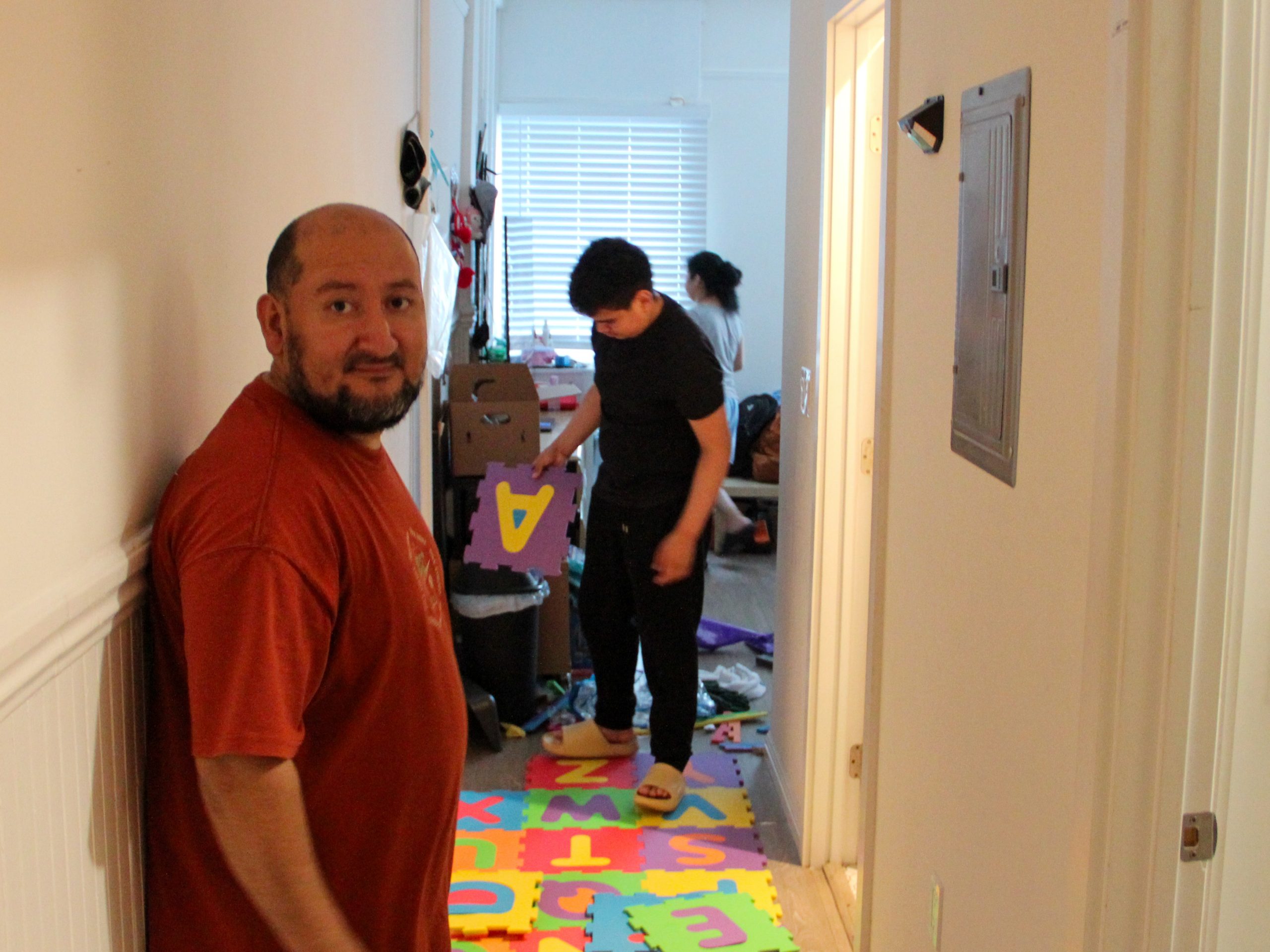

So here’s a good-news San Francisco story. Luis Zeron, who works at a bakery, and his wife Sandra Martinez, who works at McDonald’s, paid $2,100 last month for a one-bedroom unit on 14th Street across from the Armory. Going forward, their rent will drop by 21 percent to $1,650.
That is thanks to the San Francisco Community Land Trust’s recent purchase of the two-story, 16-unit building unit at 320 14th St., where the couple lives.
“We feel safer,” said Zeron, beaming and noting that the broken windows in the living room they have called home since 2018 have, since the San Francisco Community Land Trust came in, been replaced.

Yes, there is more work to do — there is still mold on their bathroom towel rack, and the bathroom needs new light bulbs — but Zeron sees the recent purchase as a “big win” for his family and the mostly low-income Latinx households who live in the building. About a third of the building’s 36 tenants have been living in their units for more than 20 years, and are expected to stay.
Not everyone will see their rent decrease, and some may see an increase depending on their income. But Kyle Smeallie, the San Francisco Community Land Trust’s policy director, said the nonprofit promises to do everything in its power to avoid upping the rent. “We do everything we can to meet residents where they are at,” Smeallie said.
The trust has 15 other properties across the city, including three in the Mission: One at 151 Duboce Ave., the Merry Go Round Shared Housing Cooperative at 2976 23rd St., and a building at 2840-2848 Folsom St. known as The Pigeon Palace.

Only one unit at the 14th Street site is unoccupied, and that will be rented to a tenant who makes up to 80 percent of the area median income, which translates to $83,900 for one person and $107,900 for a family of three, said Smeallie, the policy director.
Otherwise, current residents will be kept in their units. Residents will only be temporarily relocated if their units need considerable renovation.
For years, tenants said, they endured poor living conditions like mold, cockroaches, and broken windows and floors that were ignored by their former landlord, Veritas Investments, a massive real-estate company that owns more than 200 properties across the city. It eventually led to a rent strike in 2022, which was also part of a bigger citywide strike at different Veritas properties against the landlord.
“It’s a powerful display of residents’ solidarity,” Smeallie said.

The building at 320 14th St. went into default late 2022 and fell into the hands of the Prado Group, a private real-estate company, in November 2023. Prado addressed some of the urgent maintenance issues, and then sought to sell it to the San Francisco Community Land Trust and Smeallie said the deal closed last week without using any city money.
Instead, the nonprofit used state funds granted by the Bay Area Housing Finance Authority, an agency that helps to preserve affordable housing, and a low-interest-rate loan from the San Francisco Housing Accelerator Fund, a nonprofits that lends money to affordable housing projects. The loan will be repaid with the rent roll.
The San Francisco Chronicle first reported the San Francisco Community Land Trust’s purchase.
Gelber Barbera, who has been living in the building on the second floor for 15 years with his two sons, pointed to a broken piece of the floor in the living room. It’s been that way for at least a year, he said.

“I heard that there is a new boss here,” Barbera said in Spanish about the recent purchase as his son Justin translated. “It’s good. Possibly better than before.”
Francisco Galindo, who lives down the hall from Barbera, feels similarly hopeful. The 63-year-old moved into the building in 1996, and lives by himself in a studio unit. He recalled that Veritas used to only fix small things, such as a broken faucet in the kitchen. Big repairs, like fixing damaged floors or painting over the walls, would be ignored, he said.
Galindo said he hasn’t seen his rent going down just yet like his neighbors. But he said the San Francisco Community Land Trust has asked him for his pay stub and tax returns, so he is expecting a decrease soon.
“I feel more comfortable with them, and more confident in them,” Galindo said.

You could say it is beginning to feel more like Christmas. Some residents have put up holiday decorations, and the hallway looks festive. Galindo installed Christmas lights on his window and walls, and hung a big red wreath on his door. Zeron and Martinez put out a Christmas mat in the hallway.
Residents, too, are more cheerful. “My wife is so happy, and so are my children. And my neighbor Matthew,” Zeron said. “Hopefully, one day, we can own this place and call it home.”
the bathroom needs new light bulbs?
I am confused. They can’t change the light bulbs? 😞
The San Francisco Community Land Trust needs to be differentiated from the usual housing development and property management nonprofits because it is accountable, organized around participatory tenant empowerment.
From the SFCLT website:
“These organizations are community-governed nonprofits, which aim to be governed by a board that consists of 33% coop residents, 33% community organizations, and 33% members-at-large. The model’s unique advantage is its ability to target mid-size buildings that other affordable housing developers have traditionally avoided in favor of larger acquisitions.”
Nonprofit is a tainted term and carries negative connotations. Mission Local should include the distinction of “community-governed” to distinguish the SFCLT from the unaccountable, authoritarian nonprofit housing operators, such as Dolores Street Community Services which has shown us what it is all about with their appalling treatment of gay men with AIDS at Marty’s Place.
Socialism (either the left or right wing varieties) is never good news.
And only paternalistic nouveau-colonialists use “Latinx”. If it’s not your culture, move out of the lane.
This article fails to highlight a critical fact: because these units now fall under an exception to rent control, the tenants have lost those protections. That is why the Land Trust is asking to see pay stubs and tax returns for existing tenants – a form of means testing that is not allowed under SF rent control laws. When the big ticket maintenance items come up for this building: roofing, exterior paint, furnace etc., who will pay?
Annual Rents increases do not exceed City rent control rates, and if the tenant falls below the affordability threshold (if rent is more than 50% of their income) they are exempt from the annual increases. So, yes, income must be verified, but doing that is well worth the effort. The tenant is protected, for life, as they will never be displaced- and their rent remains “affordable”.