

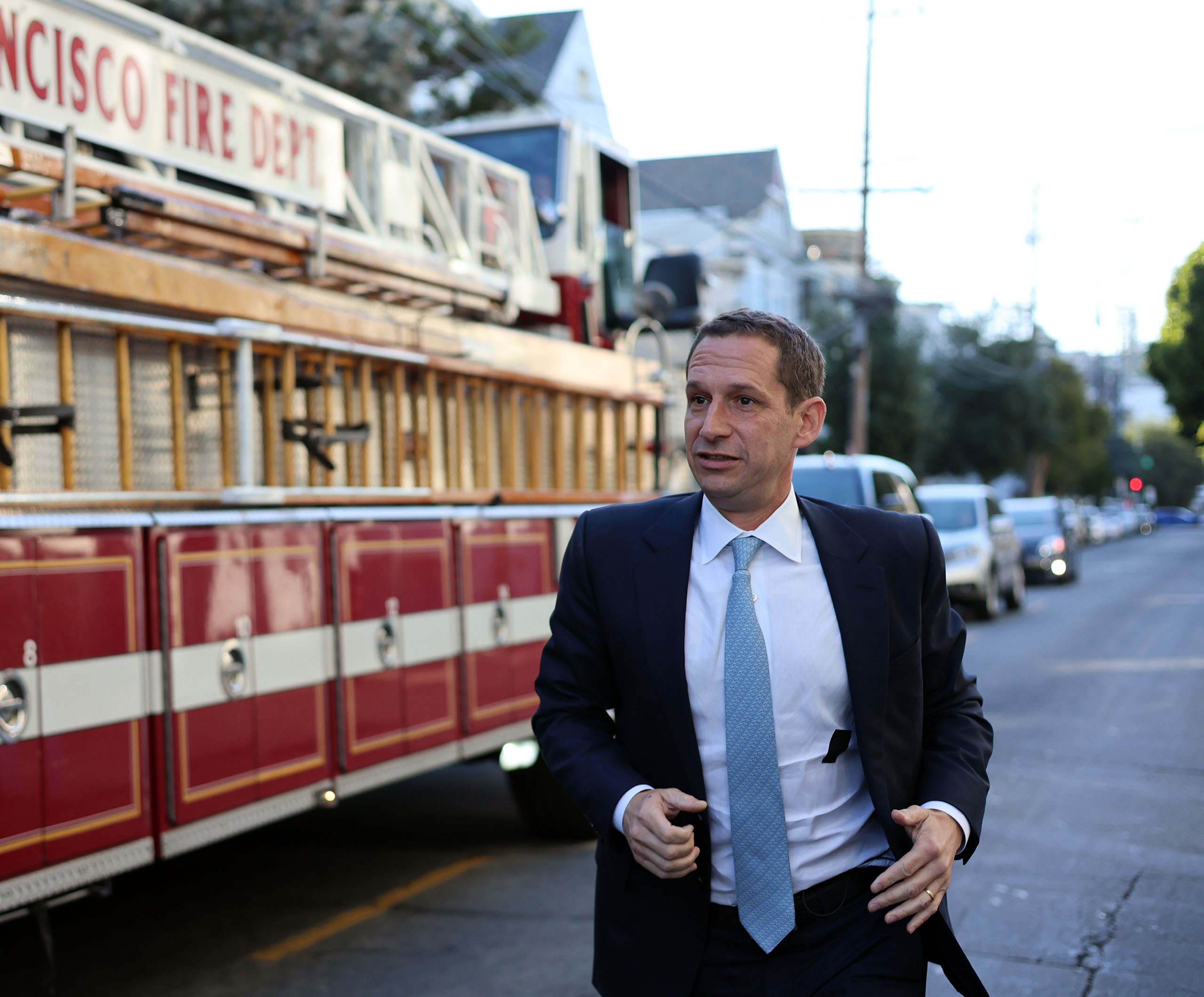

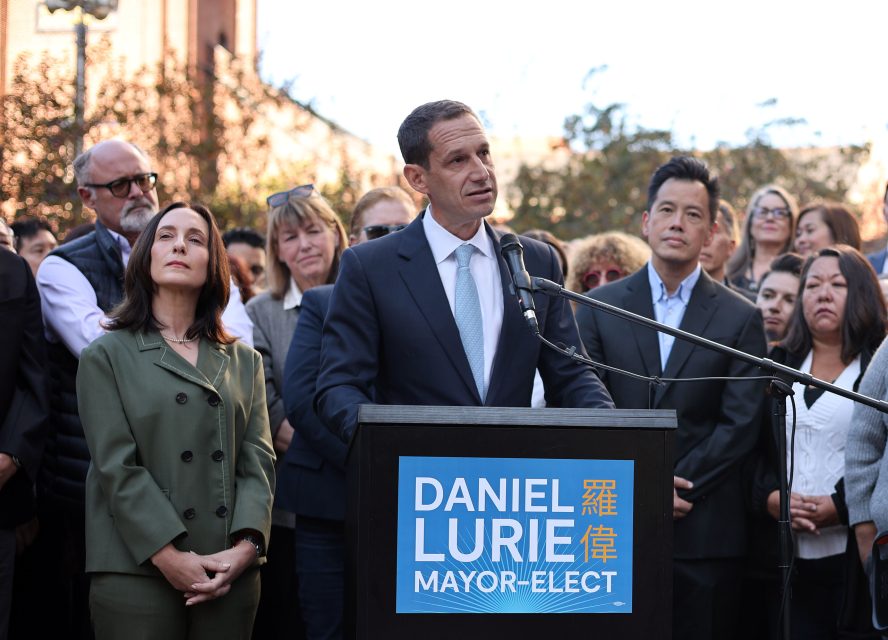
Mayor-Elect Daniel Lurie may not be able to enact the “fentanyl state of emergency” he repeatedly promised on the campaign trail; an emergency declaration would require the overdose crisis to be new and unexpected. It’s neither.
That’s what Mayor London Breed’s office learned in 2021, when it inquired about declaring a fentanyl state of emergency and was rebuffed by the city attorney’s office. Instead, the mayor declared a more circumscribed “Tenderloin” state of emergency.
Regardless, fentanyl remains a problem: 380 people in San Francisco have died between January and October of this year, although monthly overdose deaths are trending down. Addiction experts tell Mission Local that a mayor needn’t declare a state of emergency to address that.
Lurie “doesn’t have to evoke new powers,” said Dr. Keith Humpreys, a professor at the Stanford School of Medicine who focuses on addiction. “Just exercise leadership and articulate what the vision is.”
There is no question among experts that fentanyl has become an unprecedented killer. About 80 percent of the 813 overdose deaths recorded in San Francisco between January of 2023 and January of 2024 involved fentanyl.
There is, however, no unanimous vision of how to mitigate fentanyl’s devastating effects. Public health experts and advocates are often divided between “harm reduction” strategies that seek to treat users without requiring abstinence, and public-safety-first approaches with more visible policing and mandatory treatment to quell the open-air drug use and dealing.
The half-dozen experts Mission Local spoke to all said San Francisco needs a leader who can bridge this ideological divide.
An “unnecessary duel between the two approaches” has emerged, said Jonathan Caulkins, a drug-policy researcher at Carnegie Mellon University.
“If the mayor is bold, and the mayor really wants to lead — be in charge,” added Dr. Daniel Ciccarone, an addiction expert at the University of California, San Francisco. “Bring factions together.”
Streets owned by residents, ‘not the drug scene’
Humphreys, the Stanford researcher, acknowledged that a more visible police presence would not eradicate drug use. But it would, he said, help ensure San Francisco’s streets are “owned by residents and not the drug scene,” a justified fear of many city dwellers.
Humprehys says the city’s strategy should prioritize long-term recovery rather than temporary harm reduction. Still, he also noted that the divide between public health and public safety “cannot exist.”
Law enforcement and public health professionals need to cooperate, Humprehys said: After a police drug bust, there should be a methadone van on site. A successful mayor, he continued, would appoint people who agree to work together and contract a center to supervise them.
Dr. David Smith, an addiction medicine specialist who opened the Haight Ashbury Free Clinic in 1967, said he and other physicians advised Lurie before the election on policies that would help remove dealers and addicts from the streets.
“San Francisco has almost become too liberal,” Smith said. While he doesn’t want to see a “rebirth of the war on drugs,” Smith believes that mandatory treatment and conservatorship is needed to reduce the drug supply and demand.
Lurie’s “willingness to listen to experts” impressed Smith. He remains optimistic, he said, that Lurie’s announcement will at least prompt a more urgent debate about new, innovative treatments.
Cooperation speaks louder than words
Dr. William Andereck, a physician and medical ethics expert at California Pacific Medical Center, said declaring a state of emergency by press release, particularly one that would not come with any added powers, will not fix the city’s fentanyl problem.
“I think you could call in the National Guard and the Air Force and not get things done,” Andereck said. The mayor’s rhetoric can get people concerned, but “it’s not worth the political capital to try to put it into law.”
“A public-health approach is the only way to treat addicts, because they suffer from a disease,” Andereck continued. The “criminalization of users has not worked.” Still, he said, there also needs to be pressure to participate in rehabilitation programs and a better conservatorship process.
Andereck also noted the harm-reduction versus rehabilitation debate. Given limited resources, he said, the different camps’ desire “to protect their respective silos” is understandable. However, he cautioned, professionals “can’t be so arrogant” when “both have a role.”
The need for cooperation, Andereck added, extends beyond professionals. The public sector, he said, should work with the private sector to secure grants and support businesses affected by drug use. Officials, he said, should work with members of the public tired of seeing an open-air drug market.
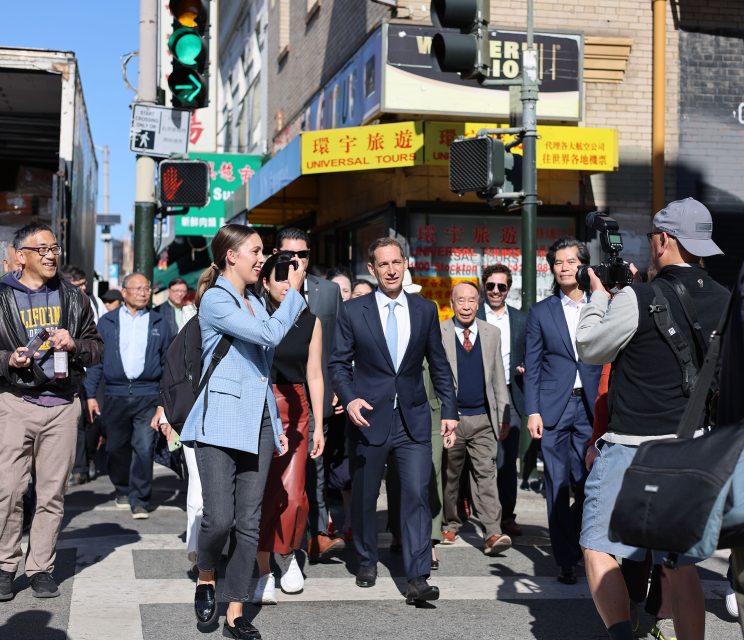
Ultimately, Ciccarone, the UCSF researcher, hopes to see Lurie enact policies that bring together different approaches. He’s a proponent of the “Four Pillars Strategy” proposed in a report released by Supervisor Dean Preston — who just lost his bid for reelection — last week.
The strategy, which successfully decreased overdose deaths in Zurich, Switzerland, aims to unite prevention, harm reduction, treatment, and law enforcement drug policies.
For example, police would be instructed to take an “aggressive approach” to informing users that they will be arrested. At the same time, they would remind users of the availability of safe-consumption sites where they would not be subject to arrest.
Ciccarone supports harm reduction. That said, he doesn’t just want to see the future mayor institute a “namby-pamby leftist solution.”
He described his idea of a good leader: “If they’re smart — and the guy looks pretty damn smart — they take a hard-nosed look at a solvable problem and they do the right thing.”
Active supply-confiscation policing should be a priority for all on-duty SF Police officers and the emphasis should be on sales, not users. Fentanyl (and meth) should be hard to get. I know for a fact that people from outside SF are able go to Civic Center and the Tenderloin and score drugs within minutes without any previous ‘connection’. Consistent ongoing police presence in known areas where dealing is taking place and confiscation of supply from anyone dealing or holding along with arrest (resource-intensive incarceration isn’t necessary for this to happen) , and fines assessed for dealing and holding over a very small amount if consistently put into practice would in a fairly short timeframe seriously effect the financial viability of street dealing. Addressing the currently cheap cost and easy availability of the supply by making it profoundly more difficult and expensive to acquire while continuing to provide compassionate support systems for users would be a huge step in the right direction.
“The strategy, which successfully decreased overdose deaths in Zurich, Switzerland, aims to unite prevention, harm reduction, treatment, and law enforcement drug policies. ”
It is critical to note that the Swiss model does not allow for addicts to bring their own street drugs to use. (for example – see https://pubmed.ncbi.nlm.nih.gov/24706398/). SF’s current program of ‘safe’ injection sites is a parody of the Swiss approach. There seems to be no attempt at requiring treatment, just a free for all with narcan at the ready.
No to consumption sites. Turn Bryant Street jail into a non-voluntary treatment center. 90 days in-house.
This is the harm reduction crowd’s go-to line: “criminalization of users has not worked.”
Well, San Francisco being internationally infamous as the world’s best place to buy and use fentanyl and meth out in the open and get away with it isn’t really working either.
So, informing drug addicts that they will be subject to arrest before telling them where they can shoot drugs without fear of arrest is an, “aggressive approach?” You’re joking, right? A methadone van should pull up at the site of a drug bust? What are they supposed to do, inform prospective drug customers that due to the arrest they are offering an on site alternative before the drug addicts simply find the next available drug dealer?
The so called harm reductionists had their turn and failed. Time for a new approach.
First , remove the dealers and supply.
Arrest them , increase the penalty.
How about making them take the drugs they distribute?
For the addicts , zero tolerance .Immediate removal from the public space , place them in a location with no access to further harm or drugs . Any drug treatment facility would kick a patient out if they fail to mature and take more drugs . Game over .
Also arrest them .
If they fail to stop then they need to remain removed from being allowed to be in public .
They are harming themselves and all.
Anyone taking fentanyl is incapable of making a logical decision .
Allowing them to continue to ingest poisons is inhumane and cruel.
Even in the best scenerio , most will not go to treatment and will not live long unless removed from being able to access more drugs .
In the lower polk street area , the addicts run around like rats .
The dealers kick them to wake them up .
Stop supporting the drug dealers harming the addicts .
The border patrol stops the supply . It is hard to understand why some in this city and the city cannot get it together like they do at the borders .
Taxpayer money is being wasted on putting a bandaid on cancer.
Millions spent to haul the same addicts to the er . Worse is allowing addicts to continue to take drugs in taxpayer funding housing . Pathetic
Bad local goverment and insane drug advocates who are pushing for stupid drug injectionsites which are illegal.
Please start to show conpassion for addicts . Not the dealers .
From what I understand, some fentanyl users aren’t using as much due to higher prices charged for weaker grades of drugs, so if law enforcement focuses upon drug dealers in order to reduce “cheap” drugs, those who are users will get intoxicated less.
Criminalization works far better than “treatment”. Most of these addicts will die addicts no matter how many billions are blown on their ‘treatment’. They criminalize addicts in Singapore and guess what? You will never see one single addict on the streets there.
Lemme guess where the safe consumption sites will be located—the containment zone in the Fecal Crescent that runs from the TL through Western SOMA, North Mission and Showplace.
The Gubbio project, a mix of nonprofit condescension and liberal white lade guilt tripping at St. John’s Church at 15th and Julian was begging for funding for a safe consumption site that is:
– Across the street from Centro Latino where seniors line up for food and socializing
– 150 feet from Friendship House Association of American Indians in-patient substance treatment programs
– 250 feet from Marshall Elementary School
– Adjacent to residential apartments on Julian
Who wants desperate users congregating to use and lit users dispersing into the neighborhood after their fix? Is the only thing to be concealed the ugliness of the actual substance use, with the before and after conditions, often equally appalling, to be borne by the adjacent community?
No matter how Lurie governs, odds are that the containment zone will be not be dismantled, it will be reinforced if anything, with the Mission nonprofits still getting paid to shut up.
I live on Julian Ave next door to Gubbio Project. They allow people to use drugs all day everyday out front, the coffee and snacks they give away are thrown all over our street for us residents to clean up. Gubbio never cleans up the garbage, they never pressure wash the sidewalk. I have to go in their and tell Lydia, hey there are 10-15 addicts out front smoking fetty. And she goes and tells them to not use, but not to get lost.
Why are residential areas (FILLED WITH KIDS) at the mercy of these non profits who actually make the smallest impact on solving the problem.
Last night at the police meeting on 18th and Capp, the cops said it’s all just wakamol. They move them around and around and nothing happens. WHY THE F don’t they wakamol these addicts to the warehouse districts on Bay View where families don’t live, where people don’t sleep.
My 10 year old get’s woke up at night but addicts that linger from Hotel Kailash drug den that go use in front of Gubbio.
It’s a nightmare and incredibly stressful to live amungst such utter incompetence.
The neighborhood needs to organize and then show up at City Hall to complain, one person after another, including those who can not make it at least calling in to voice their complaints. The bottom feeding non profits will ruin your neighborhood, they are ruining your neighborhood. And, likely at tremendous costs to the taxpayers
The problem here is that most Mission residents are overworked while the city funds staffers at the nonprofit cartel to run circles around us politically and to sabotage independent organizations on the rare instances when they arise. 20+ yr into it, I cannot figure out how to leverage a weak hand to beat tens of millions per year.
The nonprofits sabotaged the SF People’s Organization and Vision SF. When we were talking about building a San Francisco Progressive Alliance like in Richmond, CA, the nonprofiteers registered the name before we could get going. The late Bob Planthold warned me that they were doing this. And the nonprofits and labor were complicit in the marginalization of the SF Green Party in the 2000s.
There will be no community organizing in the North Mission under this regime, because the purpose of the regime is to keep the neighborhood unorganized, far from the table and on the menu as an opportunity site for nonprofits and developers.
Lydia is insufferable. When Ronen packed St. Johns with nonprofiteers to shout down residents earlier this year after Ronen effortless lied to us in City Hall about Mission Cabins, and I heckled her as a liar, Lydia tried to shush me as if I were a client. She was astonished when I told her where she could stuff it. The best part was that Breed bypassed the odious Dolores Street Community Services, which is engaged in shenanigans over Marty’s Place on Dolores now, in favor of Five Keys.
Along with Elizabeth Funk from Dignity Moves, the North Mission is both the turf of the city funded poverty nonprofits as well as middle aged white ladies who are looking for something to do after the nest emptied and decided that they were going to be professional minders of our neighborhood’s business.
The talk by the city funded nonprofits about representing Mission residents is proven false by the insistance of these agencies to do their business in ways that screw those they purport to represent–seniors, elementary school students, native Americans with substance problems and plain ole residents.
Let’s hope that Lurie shuffles the deck and holds these extortionists accountable for their political crimes.
Nobody can do anything about fentanyl, it costs 2 cents a dose to manufacture. Just legalize all “drugs” and offer only treatment and zero incarceration.
And take Narcan away…..that will balance your “free market” approach.
Let’s hope fentanyl doesn’t become the norm and become legal like weed. Thank you Jerry Brown for Prop 47.