
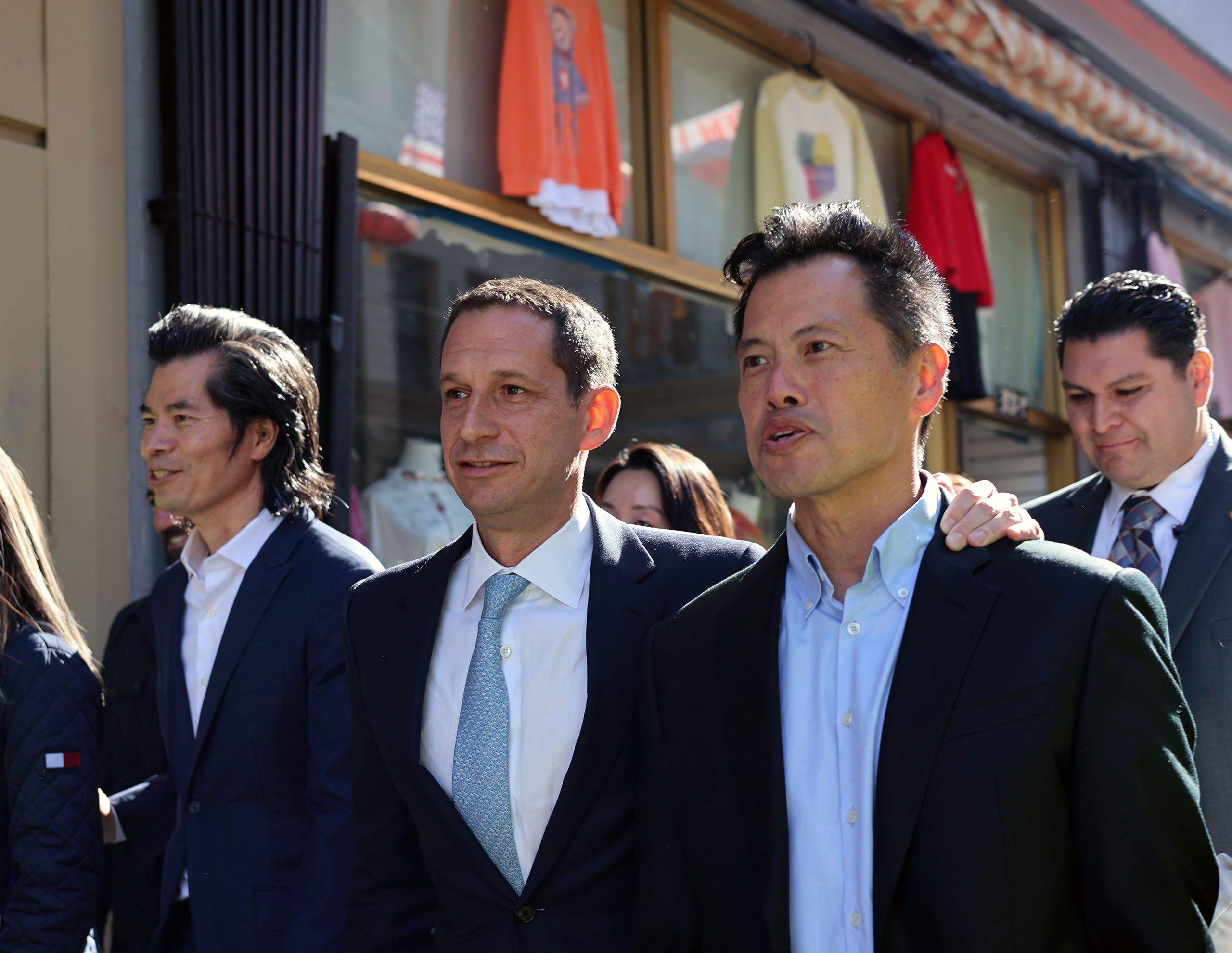

Despite being courted by all the major mayoral candidates, Asian voters from all walks of life favored mayor Daniel Lurie.
“I’m shocked that he dominated it,” said political consultant David Ho. “I expected him to get maybe a quarter or a third of the support. This is, like, overwhelming.”
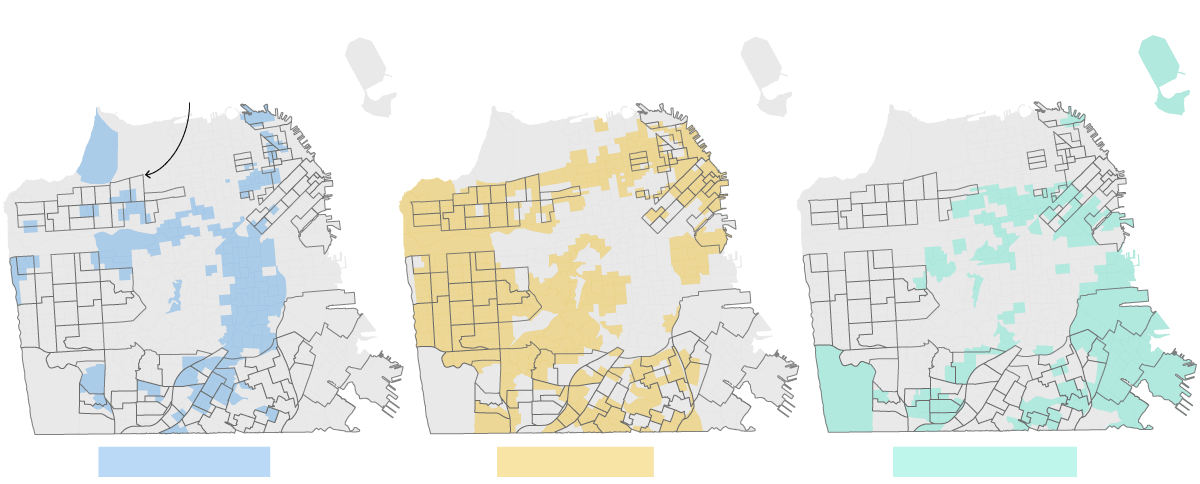
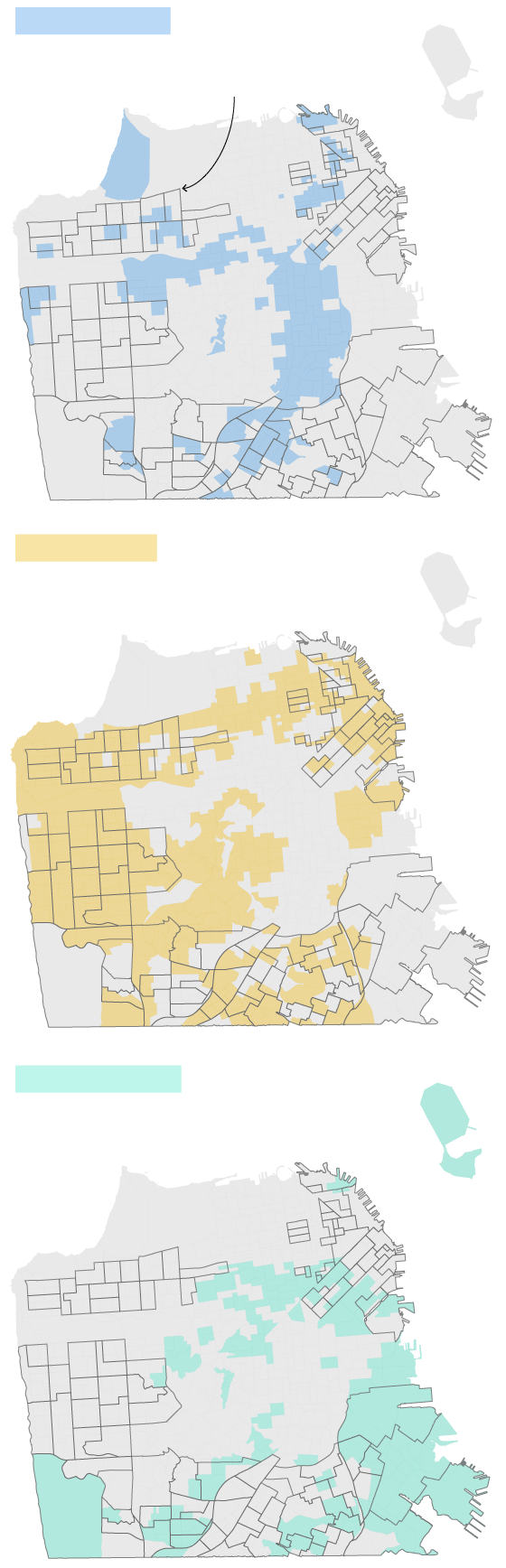
Almost every heavily Asian precinct marked Lurie as their first choice, from single-family homes in the Sunset and the Richmond to multigenerational families in the Excelsior, Portola and Visitacion Valley and the SROs in Chinatown.
Those votes, his campaign said, were key to the victory. “I feel pretty confident that the [Asian-American Pacific Islander] vote, the Chinese vote, was absolutely essential to Daniel winning,” Lurie’s campaign manager, Han Zou, said in an interview.
Chart by Junyao Yang and Kelly Waldron. Results as of Nov. 12, 2024.
How, exactly, did Lurie win the coveted Asian vote?
Sources within and outside his campaign said it started with hiring the right people. That included campaign manager Zou, who helped Matt Haney win his District 6 supervisor race in 2018 and his State Assembly contest in 2022. Those close to Lurie’s campaign described him as “an excellent campaign manager,” “a tireless outreach person” and “good at the ground game.”
Zou was joined by Kit Lam, the campaign’s Chinese community-outreach lead, a school board recall activist who came on the team early and with a fresh perspective, said Zou.
A disciplined and relentless field program was key, said Zou. “We knocked on the entire voter base that was coded ‘likely Chinese-speaking household,’” said Zou, matter of factly. “We called everybody that we had phone numbers for at least three or four times, at the end.”
The well-funded campaign — Lurie poured $8.6 million of his own money into his race, and had another $1 million in small-dollar donations — enjoyed a Chinese field team that, at its peak, had 23 canvassers and a dedicated team for each Asian neighborhood. They started with calls, went out with a list, and kept the operation going seven days a week.
In the end, among the 23,000 Chinese-speaking households on the voter file, the campaign knocked at least once on more than 21,000 of those doors. The remaining were either in a building or gated. (They knocked on more than 140,000 doors throughout the campaign.)
On top of that, the canvassers were equipped with campaign messages that “obviously resonated,” said Zou — namely, public safety. Lurie’s status as an outsider also helped. “The Asian community, the Chinese American community that I know, are eager for change,” said former city supervisor Mabel Teng, one of the few prominent Asian leaders who endorsed Lurie.
Lurie represented that change.
Moreover, he is not as conservative as Farrell. “There’s also this narrative that AAPI voters are very, very conservative and will go for the most conservative candidate,” said Alvin Lee, vice president of the Rose Pak Democratic Club. Asian voters’ choice of Lurie over Farrell, he said, “showed that’s not always the case.”
“There was a lot of pressure to do the usual things that San Francisco campaigns do,” said Zou, like “busing seniors to events,” high-visibility events replete with gangs of Chinese grandmas, and simply depending on interest groups to prescribe what the community wants. But the campaign eschewed that in favor of “constant back and forth with everyday voters,” said Zou, in the form of canvassing.
Lurie’s canvassers made and tested scripts, examined field reports nightly, and debriefed to make constant tweaks to what canvassers said. “Every minute that we spent out there,” Zou said, “was focused on converting a vote.” And these efforts made a difference; “Oftentimes, frankly, we were the only campaign who talked to these voters,” Zou added.
The campaign, however, suffered from a lack of endorsements from Asian leaders and Asian democratic clubs. Zou said more endorsements would have helped with access to groups of voters and to buildings, but they managed without them by being disciplined.
Political consultant Ho, for his part, finds it “fascinating” that Lurie’s campaign could be the first “where the Chinese vote didn’t follow its leadership.” Most of the Asian endorsements went to Breed and Peskin, but the Chinese voters bypassed community leadership across the board, whether progressive or moderate.
It helped, though, that Lurie received the second-place endorsement from the Chinese-language newspaper Sing Tao Daily; Sing Tao endorsed Aaron Peskin No. 1.
The endorsements, said Zou, were less important than the work done by a legion of canvassers. “The bulk of voters, for the 21,000 or so doors that we reached, are not looking at everybody’s social media and websites every day to see who they’ve endorsed.”
The campaign’s solution was to have Lurie show up in person. “Seven days a week, every day, he was in at least three, four, five districts,” said Zou.
“He really excelled at being a likable, earnest person,” said Michael Nguyen, chair of the AAPI Caucus of the Harvey Milk LGBTQ Democratic Club, which also endorsed Peskin.
How leading mayoral candidates fared in heavily-Asian census tracts
Census tracts with
Asian population
over 35%
Aaron Peskin
Daniel Lurie
London Breed
Aaron Peskin
Census tracts with
Asian population
over 35%
Daniel Lurie
London Breed
Note: San Francisco has a 35 percent Asian population. Census tracts outlined in black are above that.
Source: Department of Elections, as of Nov. 12, 2024., U.S. Census Bureau, American Community Survey 5-year estimates. Chart by Junyao Yang and Kelly Waldron.
On top of this, voters met Lurie through their media campaign, both news coverage in Chinese-language news media and the close to $300,000 spent on commercials in Chinese-language news media.
Leon Chow, who oversaw Mayor London Breed’s Chinese outreach, said that the high volume — instead of the message — of the commercials were key to Lurie’s victory in the Chinese community. “If you ask some of [Lurie’s supporters], ‘What do you think about Lurie’s platform?’” Chow said, they would be hard-pressed to name specific issues, “because that’s not what they saw in the commercials.”
In Chow’s opinion, Lurie’s background as an heir to the Levi Strauss fortune also helped; every Asian kid, no matter which part of the world they came from, grew up in Levi’s jeans. “The good thing about Lurie is that Levi’s is local. It’s right there,” he said. “So I think part of it is the brand, a lot of people know the brand … It doesn’t come from a parachute.”
For Ho, an elephant in the room is that “Chinese voters love rich people,” he said. “Why hide the fact that they have no problem supporting rich billionaires? I think that’s actually a plus.”
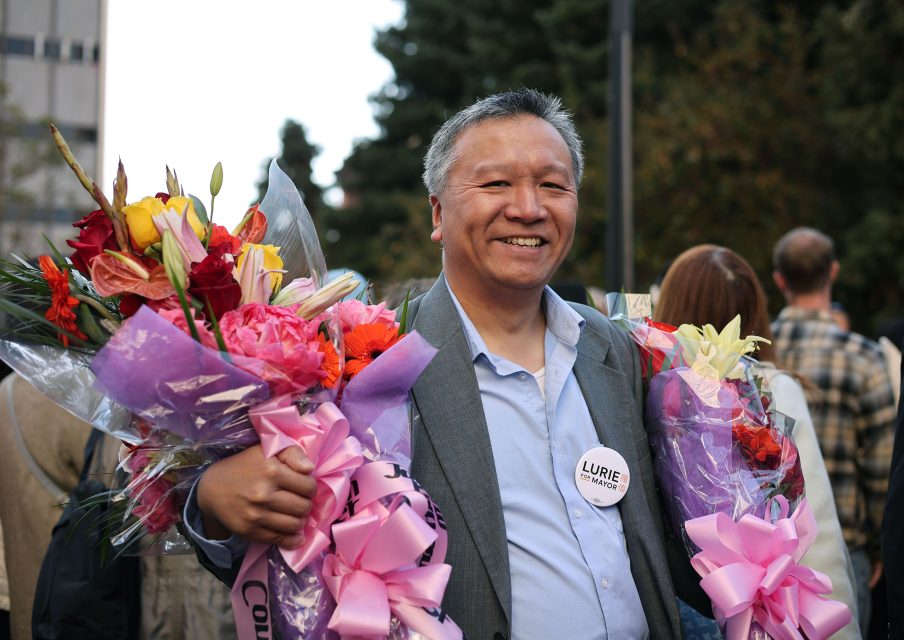
Another plus was the launch of the Chinatown headquarters, an idea suggested by a supporter. The office was open seven days a week, noon to 6 p.m., giving a space for voters living, shopping, or seeking services in Chinatown — which included residents from other areas like Portola and Visitacion Valley — to come in, ask questions, and enjoy the convening space.
Perhaps as a result, Lurie won half of the six precincts in Chinatown, where his competitor, Peskin, had worked as a supervisor for decades.
Peskin’s campaign lamented that they had a bit of a late start. “When we came out, a lot of people already said, ‘Oh, I already picked my candidate,’” said Anthony Ching-Ho Leung, Peskin’s Chinese community campaign director.
No coincidence that Lurie chose St. Mary’s Square in Chinatown to officially announce his victory last Friday, and nodded to the importance of Asian voters in his campaign.
“As Chinatown goes, so goes San Francisco. As the AAPI and the Chinese community goes, so goes San Francisco,” Lurie said on Friday. “We need a thriving community that feels safe. And they will have an ally in me every single day.”
Congrats. Door to door outreach works! And it’s obvious the Chinese were fed up.
I look forward to Lurie cleaning things up, but also making SF even more vibrant. We should lean in to being the Bay Area tent pole as a PacRim city, Latino hub, foodie destination, world class medicine, creative arts center, amazing outdoors and parks, SMB innovation, and tech forward city. And more. There’s plenty of infill space in our little 7×7 geography to make it happen. Make downtown a destination.
P.S. Waymo is great (I have no affiliation.). It’s the future. People love it. It’s great PR. We should get tech to serve the city more. How about big Roomba vacuums doing sidewalk or street cleaning 24/7? I’m ok with more data-driven drone surveillance for safety too. Let’s get out of the box!
PPS. We also need new cultural norms. Stop throwing trash in the street. Broken windows theory for streets. Love your city.
PPS. Also looking forward to rationalizing and right sizing government services.
Go to any Asian city on the planet, you will not see the result of toxic vagrant enabling policies anyplace like what afflicts San Francisco. Asians know progressive policies are a one way ticket to hell on earth.
It was an exceptionally well run campaign. Sure the money helped. But get this…Asians are sick of the incompetence and corruption at city hall too.
The good people of Chinatown know Peskin is a lying, vindictive and manipulative rat. But he’s termed out now on BOS. He’s no longer a threat. Change is welcomed.