

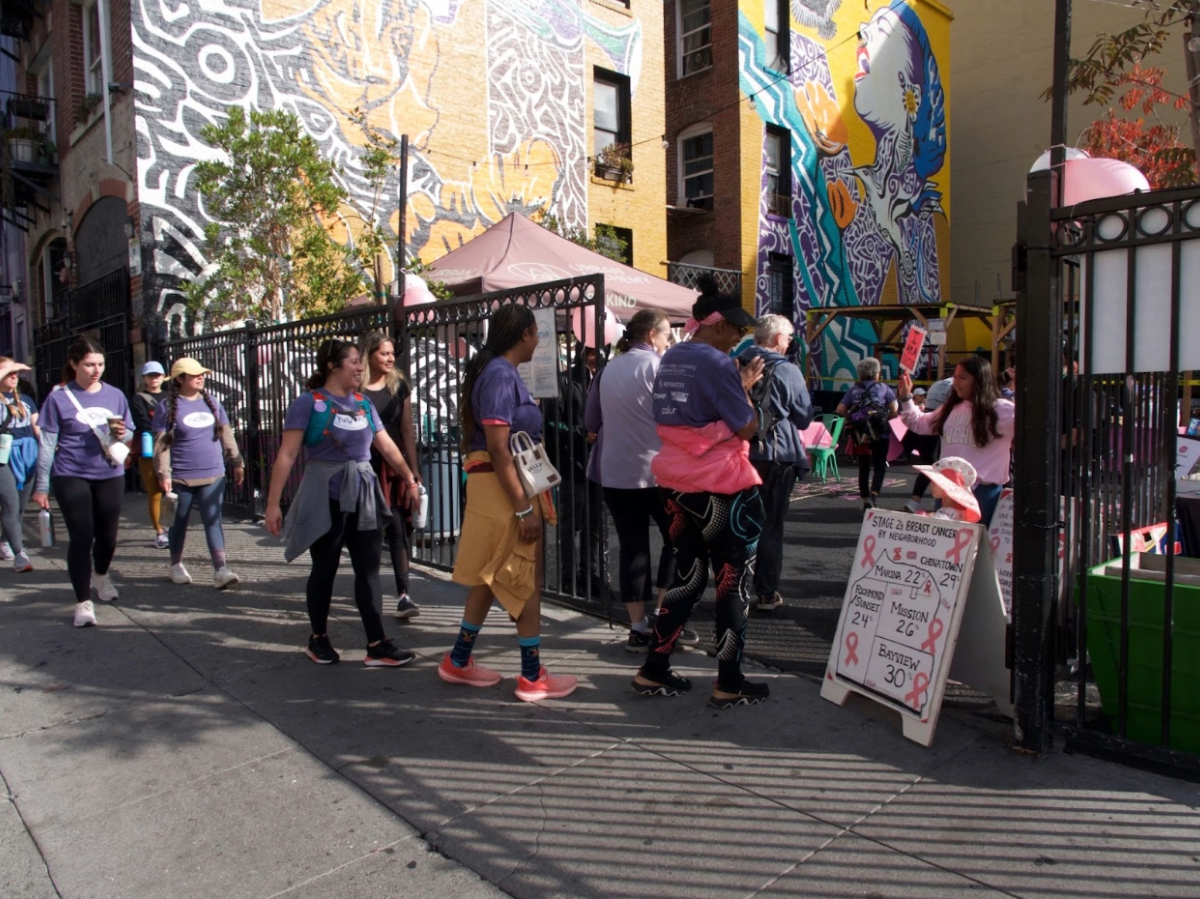

Dozens of walkers will trek from Fort Mason to the Bayview on Saturday for the seventh year in a row to raise money for the breast cancer organization NOVA-12.
The 12-mile walk represents the 12 percent of women in the United States diagnosed with breast cancer. The trail changes every two years, usually starting on the north side of the city and ending at the Bayview Opera House. The route is purposefully designed to address the racial health inequity in the treatment of breast cancer.
“People in the Mission, Chinatown and Bayview get diagnosed at a later stage,” said Monica Bien, a physician’s assistant at Zuckerberg San Francisco General Hospital. “So we’re trying to show how the freeways and redlining affected community health and wellness.”
The Mission, Chinatown and Bayview are all neighborhoods with majority-minority populations that experience the greatest disparities in healthcare access when compared to majority-white neighborhoods. Researchers at the University of California, San Francisco noted that Black women especially had the greatest disparities in breast cancer-related outcomes.

NOVA-12, a nonprofit, works with staff at Zuckerberg General who help patients fill out the applications and send them to NOVA-12 for review and relief. It helps patients with financial assistance.
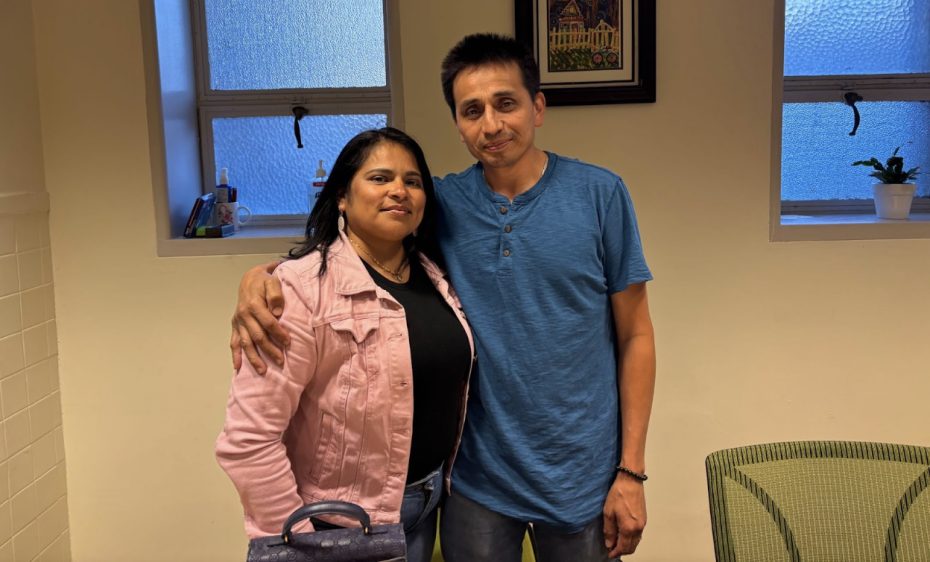
For Yessica Vasquez Vicente and her husband, Rudis, the money from NOVA-12 was what got them through the worst era of her treatment. She’d been working as the manager of a restaurant when she was diagnosed and was forced to quit.
“The financial support that I received helped me pay a little bit of my rent, and a little bit of leftover for food,” Vicente said. “That money helped us for a little bit to get through while we were both not in the position to make any income.”
Vicente will participate in the walk today for the first time with 18 other patients who benefited from NOVA-12 funding. She now works as a caregiver and hopes to one day open a bar in her home country of El Salvador.
Previously, AVON Foundation for Women hosted a walk to fundraise for breast cancer organizations across multiple cities. However, after its walk in 2017, it stopped sponsoring the walk in San Francisco.
Lee, who had been heavily involved in the previous AVON walks, decided to restart the event, hosting the first walk in 2018 under the banner of NOVA-12.
AVON declined to say why they stopped funding the breast cancer walk in San Francisco.
“We started kind of a very small grassroots walk. And called it NOVA because it’s AVON backwards,” Robin Lee said, the founder and chair of NOVA-12 and a former genetic counselor at San Francisco General.
The walk may not be as large as it was; Lee said only a couple dozen, on average, walk each year. But this is its seventh annual walk, and it still has many dedicated followers. NOVA-12 makes its walk as accessible as can be, letting walkers and volunteers sign up with no registration or fundraising requirement.
Lisa Mihaly is a nurse practitioner and professor at UCSF Medical School who has walked every year since 2005. She and a small group of friends who walk call themselves TITTS, for Taking It To The Streets.
“I had a really good friend who had just been diagnosed with breast cancer,” Mihaly said, “We did the walk together and we have been walking ever since.”
While NOVA-12 doesn’t have the same support that AVON brought, they don’t see it as a weakness. NOVA-12 works to keep the walk grassroots, despite donors like Pzifer sponsoring the organization.
Each year, NOVA-12’s fundraising goal has grown, and it intends to maintain that growth while keeping the nonprofit effective, yet local. The walk raises funds through corporate sponsors, and then individual walkers also fundraise by getting peers to pledge. Last year, it raised $65,000. This year, the goal is to raise $75,000.
“We don’t need permits because we’re small. We walk very spread out. We don’t close streets,” Lee said. “I do like the homemade vibe that we have. It’s very small, very intimate.”
To donate or sign up, you can click here.
Congratulations to elinor Hough and her fine article.