

Twenty years ago, when Sue Bushnell started the South Beach District 6 Democratic Club, she said political groups in her neighborhood were nonexistent. She formed the club, she said, because for years she had been volunteering and canvassing citywide, but noticed that her own neighborhood lacked much representation.
Democratic clubs at the time were “small, grassroots” groups, she recalled, that did exactly what Bushnell hoped to start doing in her own backyard: Organize and campaign for causes and candidates that would advocate for the neighborhood.
Official Democratic clubs must be registered with the San Francisco Democratic County Central Committee, and are not only based around a neighborhood but also a demographic or social group. There’s the Bernal Heights Democratic Club and the Noe Valley Democratic Club, but also the San Francisco Young Democrats, the Harvey Milk LGBTQ Democratic Club, and the Latinx Democratic Club.
Amy Beinart, the president of the Bernal Heights Democratic Club, describes her 300-member club as a community group.
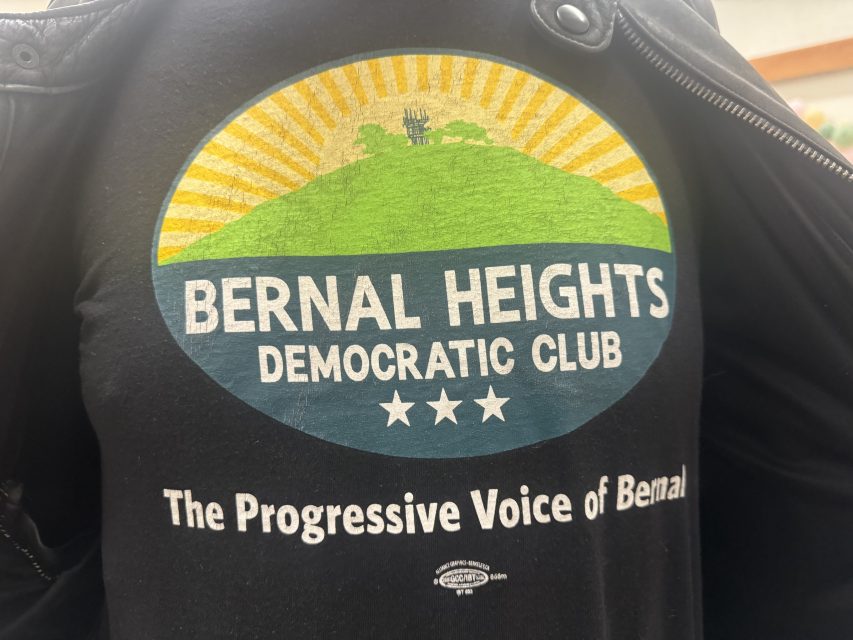
“We put out an endorsement card that we distribute to every door, every porch, every gate in Bernal. It’s all volunteer, hand delivered,” said Beinart, adding that her club also organizes social events outside of its regular meetings where neighbors can come together and socialize while discussing politics and neighborhood issues. The efforts, Beinart said, keep neighbors engaged in politics.
Vannessa Pimentel, the co-president of the San Francisco Young Democrats, said that for a long time in San Francisco, she struggled to find a space where she felt comfortable talking about politics. Then, she found the club.
Pimentel said the Young Democrats — which you can join at 14, but must leave after 35 — is a space where young people can feel comfortable learning about politics at a time of big disconnect between the Democratic Party and young voters.
“We want to keep the vibe of having a welcoming space for young people, because I know it’s very scary,” said Pimentel. “For example, for me, it was very scary to be engaged in political or community spaces, just because I felt like my experiences will not connect with the folks who are engaging in other political spaces.”
Today, however, the reality of the clubs is starkly different from the days Bushnell remembers.
Neighbors for Better San Francisco, TogetherSF, GrowSF and at least half a dozen other advocacy groups began appearing in 2020, and have replicated much of the Democratic clubs’ historical role — but on a much grander scale, and with a lot more cash.
“What you have today is these evolving groups that are well-funded and have radically changed the political scene,” said Bushnell about the new wave of political groups. Moreover, Bushell said, these groups are pushing a conservative agenda in San Francisco. “There’s so much money.”
Beinart agreed: “There’s a lot of money coming in to take very strong positions on ballot measures or candidates and blast out mailers or blast out television or print or social media advertising. It’s pretty shocking to see how much money is working our local elections right now.”
Moneyed groups funnel millions into clubs
Big-money groups have found their way into the formerly small world of Democratic-club politics in a major way, despite the fact that some of their money comes from Republican donors.
Among the 27 sanctioned Democratic clubs in San Francisco, the Ed Lee Democratic Club, United Democratic Club, District 2 Democratic Club, Alice B. Toklas Democratic Club, Westside Family Democratic Club, and San Francisco Eastern Neighborhoods Democratic Club have received hundreds of thousands from big-money groups in the past two years.
The Ed Lee Democratic Club, for example, has received more than $1,700,000 from Neighbors for a Better San Francisco since 2022. Neighbors is led by William Oberndorf, a longtime Republican donor who has given at least $13 million to Republicans at the federal level, according to finance filings. Oberndorf has funded Neighbors with more than $1 million.
The group used some of that money to back initiatives such as the 2022 recalls of then-District Attorney Chesa Boudin and three members of the school board. The United Democratic Club, similarly, has received $186,600 from Neighbors since 2022.
Meanwhile, progressive clubs such as the Richmond District Democratic Club, South Beach District 6 Democratic Club and San Francisco Young Democrats are scrambling to stay relevant and, at times, even to survive.
Emma Heiken, the newly elected vice chair of the Democratic County Central Committee and the chair of its clubs committee, said that each club’s bylaws stipulate from whom they can accept money. The committee, Heiken said, encourages clubs to fundraise on their own — but to decline funds from Republican donors.
“We also clearly do not want the Democratic clubs taking money from Republicans,” said Heiken.
That becomes tricky when the clubs accept money from places like Neighbors for a Better San Francisco. Besides Oberndorf, Neighbors has also taken money from individuals like crypto executive Chris Larsen and John C. Atwater, who have collectively donated millions to Republicans, though they also donate to Democrats. Neighbors has received at least $600,000 from the two.
When asked about some Democratic clubs taking large amounts of cash from organizations like Neighbors, Heiken said, “I think you should ask the Democratic club about that.”
In the March election, the progressive slate for the Democratic County Central Committee lost power to a slate backed by some of the same big-money groups funneling funds into the Democratic club ecosystem.
Jim Ross, a longtime political consultant who was Gavin Newson’s campaign manager in his 2003 mayoral victory, notes that the influence of moneyed groups is nothing new in the city. An earlier example, he said, was a group called SFSOS, funded by Gap billionaire Don Fisher and backed by late Sen. Dianne Feinstein. It played a similar role in the late ‘90s and early 2000s, opposing 2006’s school-bond Proposition A and supporting the Care Not Cash 2002’s Proposition N.
For Ross, the big difference in today’s political scene is the number of players with capital.
“It’s always been maybe one or two groups, whereas this time, it feels like there’s a new group every day,” said Ross. “You have a lot more people with a lot more money and they want their own show. In the past you could find a little bit more commonality of interests amongst the very wealthy folks who were creating those groups.”
Effect of new groups on Democratic clubs
For smaller clubs, mobilization and recruiting is difficult and competing against the groups becomes an uphill battle.
“We laugh at our meetings, because it looks like an elderly club,” added Bushnell. “We are not attracting younger members.”
As a result, the power of neighborhood Democratic clubs has diminished, while the well-funded groups have often out-organized and out-fundraised the clubs. The smaller, less-resourced clubs, as a result, find themselves in a place where their existence is now at risk.
Still, they retain a position in the political machinery. They help to select delegates for state nominations. Each gets allocated votes for nominating people to statewide conventions, where delegates can vote on races like state assembly, senate and governor.
“They have an actual role in the party apparatus that allows advocates and activists to engage in the Democratic Party and the selection of state representatives,” said Ross.
And locally, many candidates seek the club’s endorsements to secure its funding, volunteers and name recognition.
But the clubs backed by the new political groups have more of that funding, and the political groups themselves have been more successful in recruiting new members.
TogetherSF invites groups to co-host privately run events, for instance, and makes meeting their representatives easy: anyone can select a date and time online, and learn more.
TogetherSF has also hosted neighborhood trash cleanups, which have become a recruitment tool: Through these events, TogetherSF picks up emails and new members. Happy hours, too, are part of the recruitment efforts.
“It’s hard to compete with them,” said Pimentel.
The old clubs, by virtue of age or diminished numbers, have not put up much of a fight.
In some ways, the Democratic clubs that get funding from the new big money groups have more clout because their endorsements mean their chosen candidate will get financial backing from those groups.
In the last few years, the influx of resources — and boots on the ground — coming from newly formed political groups has added value to their endorsement. In District 9, for instance, Trevor Chandler, the endorsed candidate of GrowSF and TogetherSF Action, is benefitting from some $60,000 in outside PAC spending from tech executives, like Larsen and Yelp CEO Jeremy Stoppelman.
Despite the heavy outside support, Chandler seems to still value the neighborhood clubs’ endorsements: When the Bernal Heights Democratic Club re-voted and endorsed Jackie Fielder, after initially failing to reach consensus, he decried the decision.
Beinart, for her part, believes in the power of endorsements from clubs like hers. Asked if she thinks the value of the Bernal Heights club’s endorsements is and will stay strong, she did not hesitate.
“I do. I really do,” said Beinart.
Of course, money in politics is a major concern, but the clubs’ challenges seem deeper than just funding. When a club president notes “We laugh at our meetings because it looks like an elderly club,” that’s a sign that community engagement needs work. For example, the BHDC Executive Committee hasn’t been willing to discuss ways to make it easier for working parents to attend meetings and participate in endorsements as meetings are scheduled at prime kid “bedtime” with no option for remote participation.
The newer groups are succeeding with simple things like cleanups and accessible meetups – suggesting there’s real appetite for civic engagement, just in more welcoming formats. Rather than viewing newcomers with suspicion, perhaps established clubs could focus on creating spaces where diverse Democratic viewpoints can work together on neighborhood priorities? After all, Bernie showed in 2016 that grassroots fundraising can compete when the message resonates.
“The newer groups are succeeding with simple things like cleanups and accessible meetups – suggesting there’s real appetite for civic engagement”
My family has participated in a bunch of the cleanups, and it’s been fun. Really odd to hear supposed community activists complain about getting together to do a thing for each other and propose… a meeting during kid’s bedtime instead.
Don’t we pay $1/3b for a DPW that is supposed to clean up the public realm so that we do not have to? I am sure that will get better after commissions are slashed.
Characterizing much-needed trash cleanups as some kind of ploy is reminiscent of Jackie Fielder’s attempted attack on GrowSF: “They try to trick people by putting forward non-controversial ideas that everyone can get behind.”
SF progressives love looking for conspiracies everywhere, but perhaps it’s just a bunch of people trying to do what’s best for their neighborhoods and the city.
Maybe if the folks at Mission Local listened to folks like Emily Mills years ago, when she was sounding the alarm on TogetherSF and Refuse Refuse – they wouldn’t have been able to get more entrenched.
https://x.com/sf_mills/status/1664728857642151936?s=46&t=e8a-a4W_rfmviAzr3mLweg
It is not like Mission Local could have written a bombshell report that would have forced these astroturf operations to shut down by shaming their shameless funders.
The only way to beat concentrated money is with organized residents. There are reasons why resident organizing in San Francisco’s progressive neighborhoods has been inhibited outside of the nonprofits and Democratic clubs.
Either San Francisco residents figure out a way to hang together politically, or our visions for a San Francisco free from corporate dominance will hang separately.
Thanks. Great story per usual.
1. Let’s remember how these Bernal Heights Democratic Club endorsements came together. They voted on it and didn’t like the outcome so they voted again… Your standing is not going to gain from that sort of exercise
2. We effectively have a one party state, so what we are seeing is mercenary style groups to try fill the void on the other side of the coin
Didn’t Emma Heiken run on the same slate that was backed by Neighbors in March, which was backed by the Republicans. The irony of telling clubs to not accept Republican money when her own campaign was supported by them. Pot calling the kettle black here? SF Dems for Change are a joke.
The Harvey Milk so-called “Democratic” club refused to endorse LGBTQ Democrat Scott Wiener and Democrat Adam Schiff. Why would any mainstream SF Democrat want to get involved with them?
Because Wiener and Schiff are to the right of Reagan.