

Only five days are left before San Francisco voters need to make a host of decisions on the president, mayor, and 15 local ballot measures. Add to that, six districts are also selecting their next supervisor.
We’ve been following the local races closely and this week we’re posting an analysis of all the answers to our “Meet the Candidates” series. You can read about District 11 here.
To round off the series, we asked the 34 supervisor candidates where they stand on the mayor’s race, and various local and state propositions, and 30 of them responded.
Here are three main takeaways.
1. Peskin is the most popular first choice for mayor, while Lurie leads in second choice votes
Aaron Peskin — the progressive mayoral candidate and the current president of the Board of Supervisors — leads as the most popular mayoral candidate: He’s the first choice for nine of the 27 supervisor contenders who have made an endorsement. Four out of the nine candidates supporting Peskin are running in District 9.
Daniel Lurie and the incumbent, Mayor London Breed, tied for second place. Each had six votes.
Mark Farrell tied with underdog and Republican Ellen Lee Zhou for third place; each has two votes. Farrell is a Democrat, but has run a law-and-order campaign.
District 11 Supervisor Ahsha Safaí and longshot candidate Keith Freedman came in last; each had only one candidate supporting them.
We also asked candidates who they would rank next, using San Francisco’s ranked-choice system. Lurie led as the most favorable candidate for second-place picks — with six votes more than Farrell, who came in second. Peskin came in third and Breed in fourth place.
2. Clear alliances formed in four contested districts: Districts 3, 5, 7, and 11
As candidates sprint to the finish line, some have created alliances to combat front-runners.
In District 3, Moe Jamil, Sharon Lai, and Matthew Susk have teamed up in an effort to prevent Danny Sauter from gaining victory. Their second-choice picks says anyone but Sauter, who ran against Peskin four years ago and lost with 43 percent of the votes.
Sauter, in a counter move, did not rank anyone as his second-place choice.
In District 5, Scotty Jacobs and Bilal Mahmood are forming an alliance for ranked-choice voting, hoping to create an alternative to Supervisor Dean Preston. Even though no one ranked Autumn Looijen as their second choice, Looijen ranked everyone else, except Preston.
None of the candidates are voting for Preston. And Preston didn't rank anyone as his second choice, either.
Similarly in District 7, the incumbent, Myrna Melgar, is only voting for herself. Her opponents, Matt Boschetto and Stephen Martin-Pinto, are ranking each other No. 2.
In District 11, Ernest “EJ” Jones and Chyanne Chen have teamed up — campaigning alongside each other and placing each other as their second-place choice for the district.
While Chen has no support from any other candidates except for Jones, Jones has scored two votes — Jose Morales ranks him No. 3 and Oscar Flores ranks him No. 4.
Democrat Morales and Republican Flores are also ranking each other No. 2. Michael Lai is voting for Morales as his No. 2.
In the other two districts, there were no clear-cut alliances, but some candidates did reveal their preferences.
None of the District 1 candidates listed any opponents as a second choice.
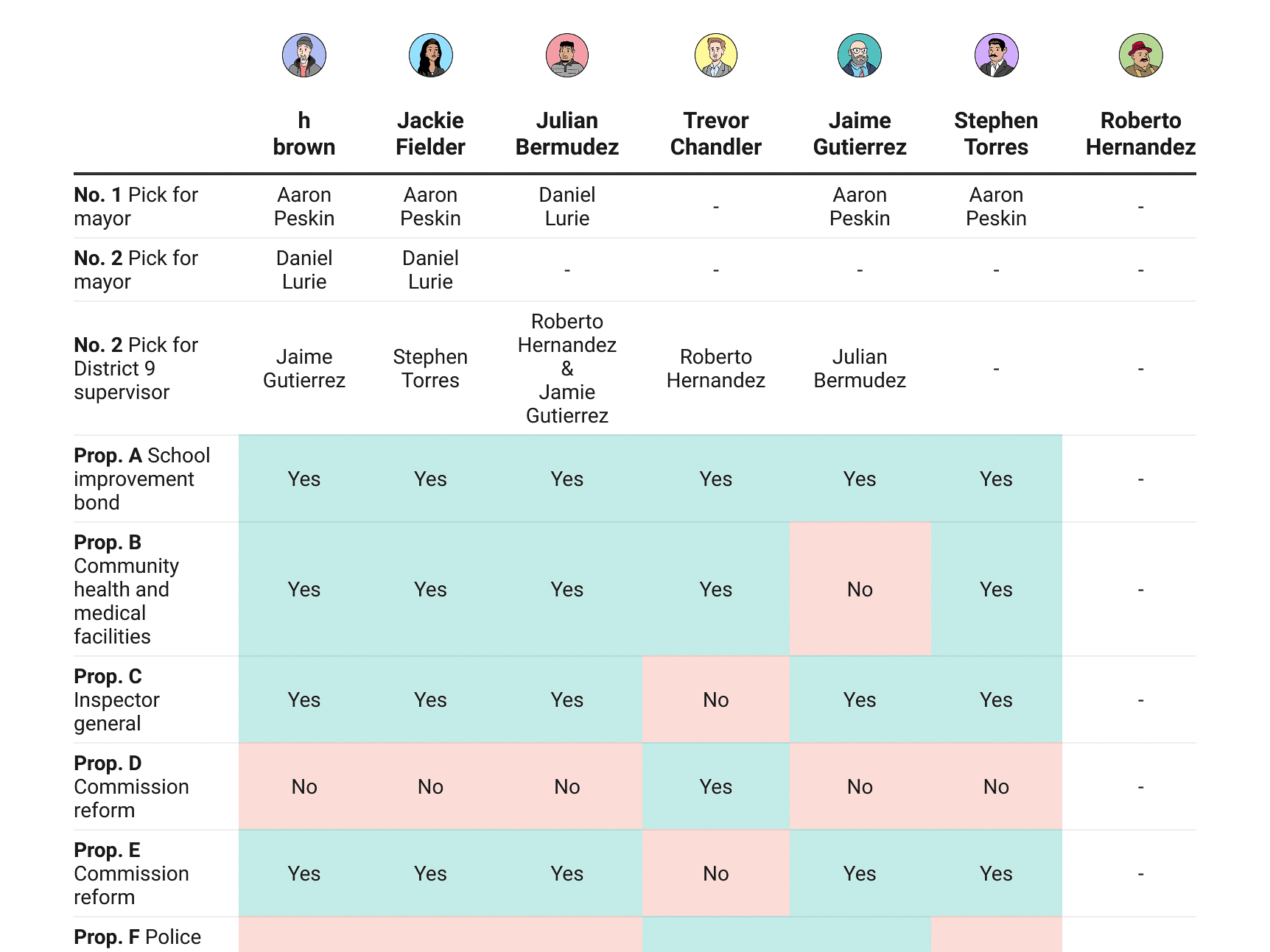
In District 9, Roberto Hernandez, the only candidate who chose not to disclose any of his stances, is the most popular second-choice candidate, with support from Trevor Chandler and Julian Bermudez.
"I am still consulting community, labor, small business and other key stakeholders to finalize my positions on each of these important measures," Hernandez said in a statement.
"Over the next week, I'll be continuing to research, explore, and weigh all the multifaceted factors impacting this year's ballot," read Hernandez's statement. "So that on Election Day, I make the most informed decisions that align with my values and the best interests of our city and state."
Jaime Gutierrez also has two votes, from h brown and Bermudez.
Jackie Fielder said she will vote for Stephen Torres as her second choice.
3. Propositions D and E are the most divisive measures
Of all the 15 local ballot measures, propositions D and E are the most divisive among the 34 supervisorial candidates. Prop. D, which was put on the ballot by the political group TogetherSF Action, will cut the number of city commissions from 130 to 65, increase mayoral power, and decrease police oversight.
Prop. E, on the other hand, is a competing proposition sponsored by Peskin and put on the ballot by seven supervisors. The measure would require the budget and legislative analyst to report on the fiscal impact of the 130 existing commissions and establish a task force to determine changes, eliminations, or consolidation of the commissions.
If both measures pass, the one that gets the most votes will be enacted.
More than a dozen candidates oppose Prop. D, which is far and away the most expensive measure on the November ballot. Supporters have raised more than $8.74 million, and much of that is also being used against its countermeasure, Prop. E.
Most simply voted against both.
Below are the six charts of candidates' stances. Find the issue you are interested in and see where the future supervisors from District 1, 3, 5, 7, 9, and 11 stand.


Thanks for this article, it adds weight to a suspicion I’ve had for a while that many of the minor candidates are intended as spoilers. For example, Scotty Jacobs in D5 who only recently activated his campaign, promises progressive ideas such as universal basic income, yet he supports Mark Farrell and his most unprogressive (regressive?) agenda. We won’t fully know until after the election how many billionaire bucks have gone to those campaigns.
I’d like to share my experience with the SF Chronicle editorial board:
https://calclemency.medium.com/the-hypocrisy-of-the-editorial-board-s-d2f4a5a05a16