



Starting in August, homeless outreach teams swept through San Francisco, tasked with offering encampment residents bus tickets out of town — or, if they declined, shelter beds.
The goal of the city’s “very aggressive” tent clearing, according to Mayor London Breed, was to make street dwellers “so uncomfortable on the streets of San Francisco that they have to take our offer” of shelter. The city has for years urged those dwelling on the streets to seek a bed inside, but the mayor’s ultimatum — made in an election year — was clarified in a July memo: Accept shelter or face arrest.
But unhoused people Mission Local interviewed during these sweeps claimed they didn’t want a bed; they already had one. They chose not to sleep in city shelters, many said, because they preferred being on the street.
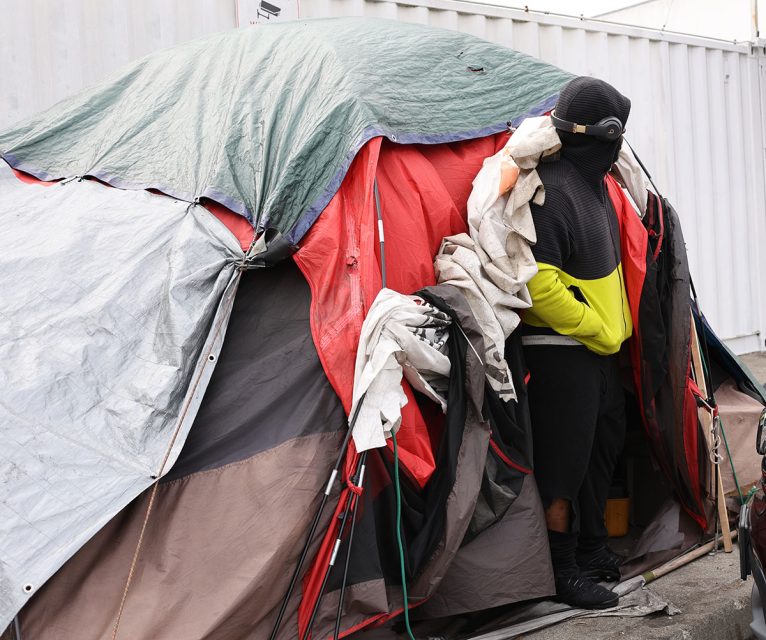
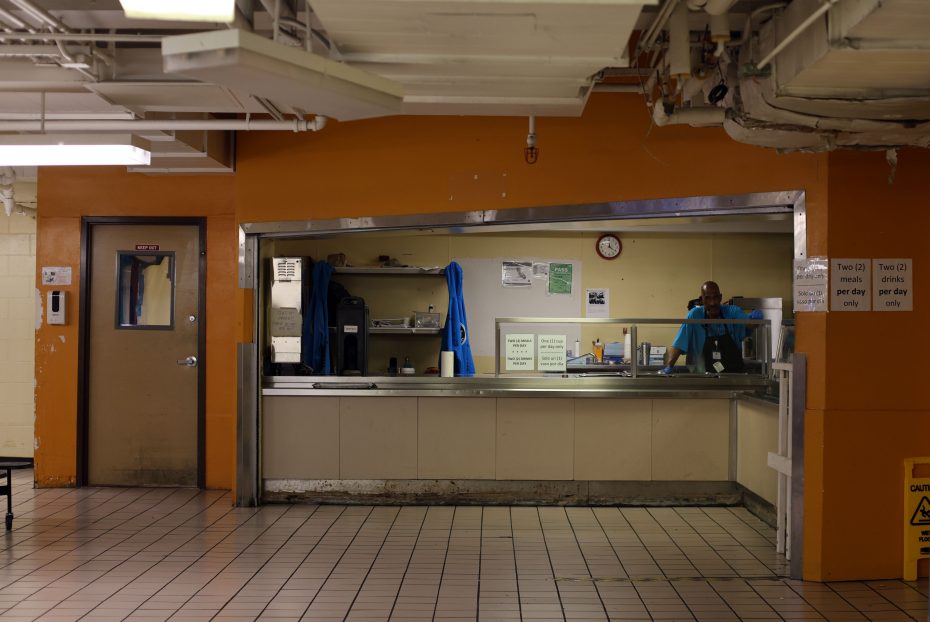
Some complained of the shelters’ unsanitary conditions and dearth of food; residents are served two meals a day, the sites’ employees said. Others, particularly women concerned about sexual assault and harassment, have long complained about security and the lack of freedom to walk in and out of the shelters at will.
Rules that govern all city shelters forbid, among other “disruptive” behaviors, drug use, destruction of property, and the possession of unchecked weapons. Still, those affected by the sweeps described high rates of theft, crowded and chaotic living quarters, and unsympathetic staff. They criticized the congregate shelters’ lack of privacy, saying they would rather sleep in their own tent than in a room with dozens of strangers.
Unhoused people who did leave the streets, meanwhile, explained how they are making the most of life within the shelters’ confines. Mission Local toured three different temporary housing options to see what’s on offer.
Next Door on Polk Street
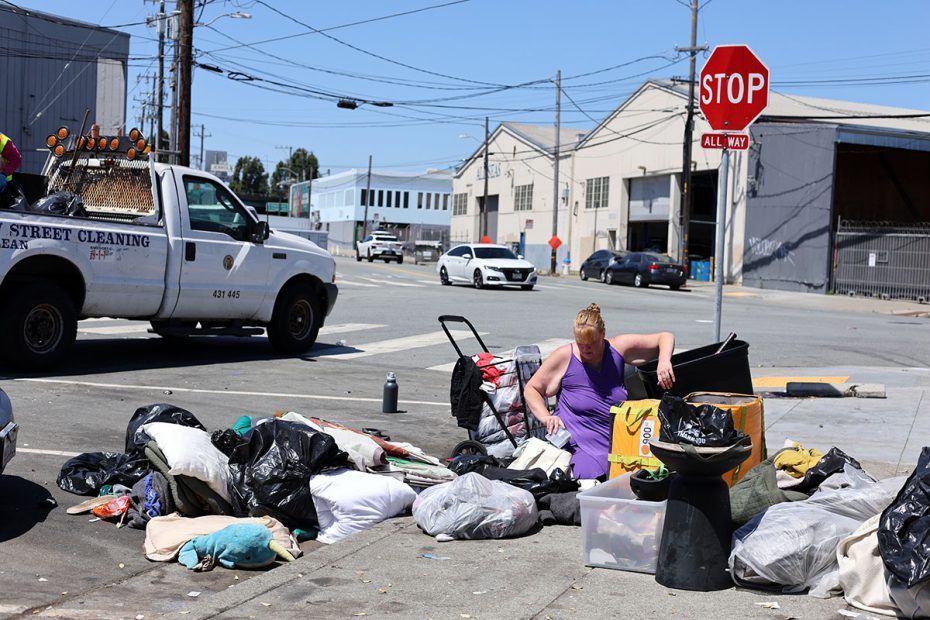
People, alongside bags of their belongings, fill the sidewalks leading up to Next Door Shelter at 1001 Polk St. The three-story maze of metal beds houses up to 334 people, and has offered shelter to San Franciscans for more than 30 years.
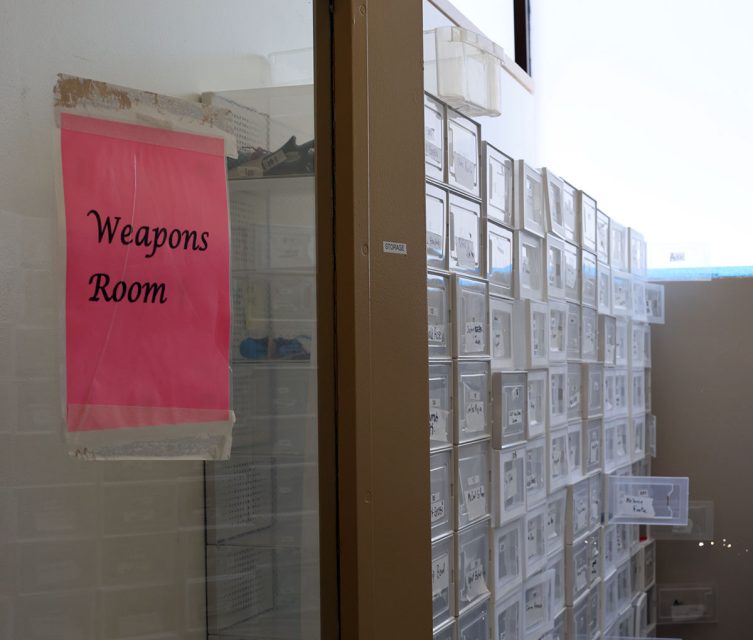
Before entering, residents and visitors alike must pass through a metal detector, checking weapons like knives and butane torches at the door. Across the city’s shelters, residents are required to sign in and out; it’s a simple way to keep track of peoples’ whereabouts while maintaining a low barrier for entry, staff said.
Staff can’t force guests to stay or return. But this system, coupled with periodic wellness checks, allows them to monitor how often the shelters’ resources are being used. If someone is gone for more than 48 hours, they forfeit their bed.
The shelter’s managers said that, given the wait lists, they try to balance letting people come and go freely while ensuring that beds don’t become storage spaces.
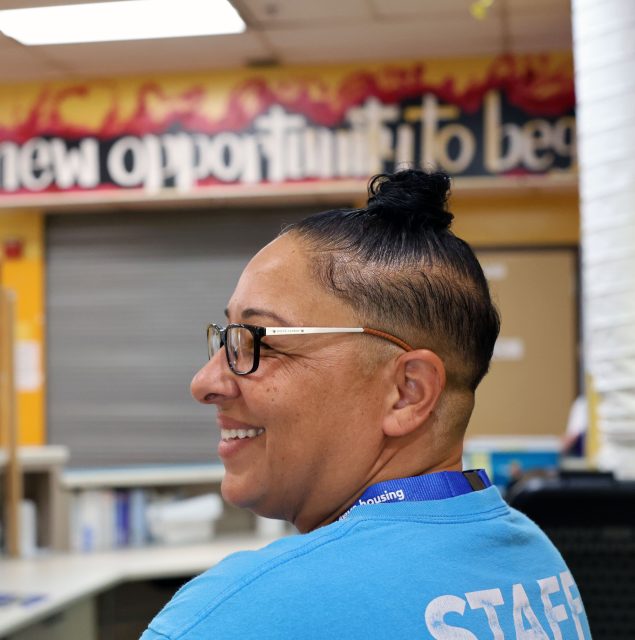
Next Door is at capacity most of the time, according to Brandi Marshall, the director of housing at the nonprofit Five Keys, which operates this shelter and five others in San Francisco. Some beds are reserved for participants of the County Adult Assistance Programs, which provide welfare to San Franciscans who cannot work.
In the last year, 112 Next Door residents found permanent housing, while 758 others have moved in, according to the city. Marshall estimated that 20 to 25 people a week forfeit their beds.
On any given night, up to half of the beds are empty. But most of those, Marshall said, are considered occupied; some residents work night shifts or prefer to be out at night, and to sleep during the day.
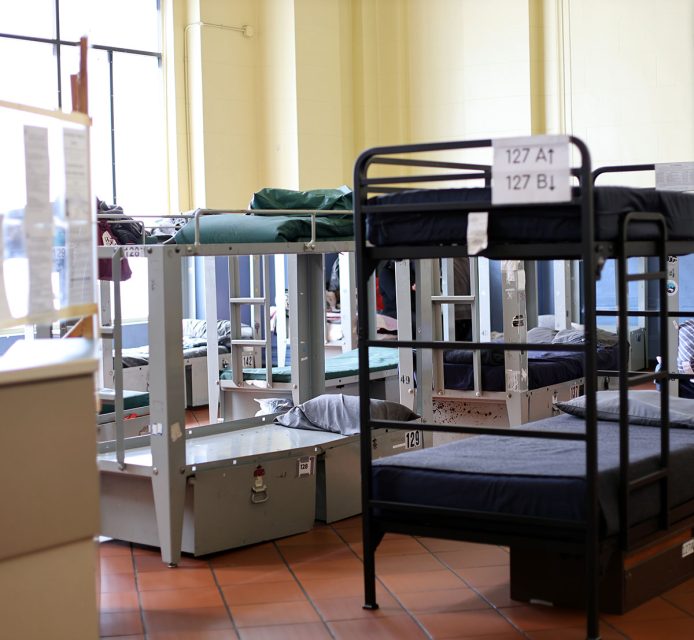
For the most part, floors are separated by gender (staff announce when a visitor of the opposite gender enters the floor). A few televisions, computers, and Covid-19 isolation rooms are dispersed throughout. In the basement, down a series of echoing stairwells, are a library and cafeteria.

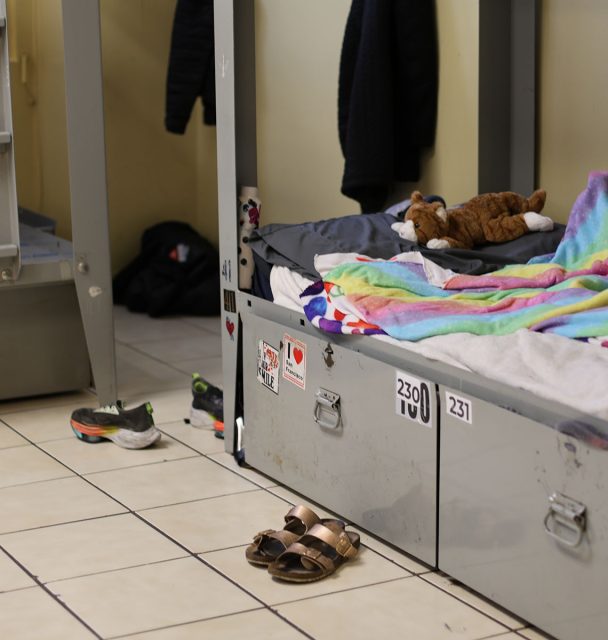
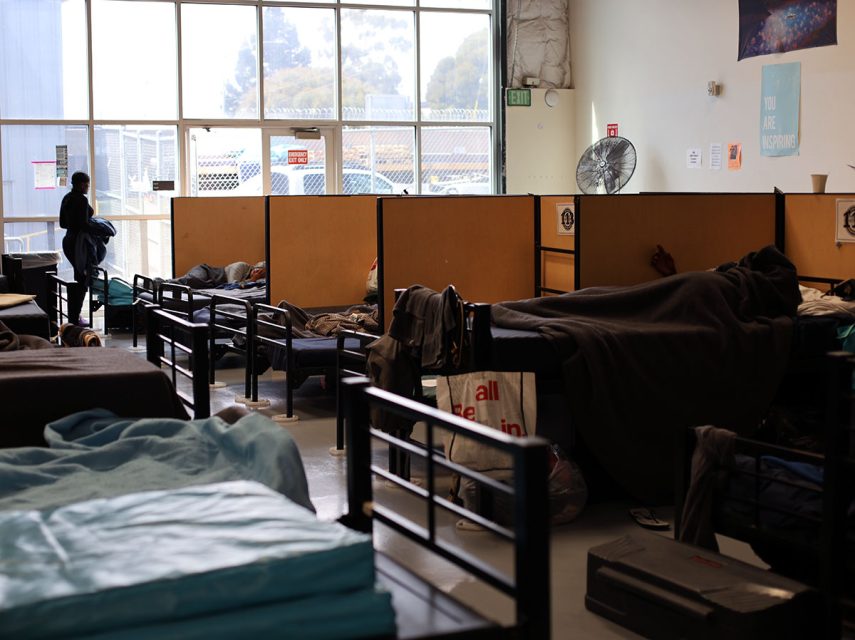
The metal bunk beds are a new addition to help increase the shelter’s capacity, said Emily Cohen, the deputy director for communications for the homeless department. At midday on a Tuesday in August, many are empty. But some are occupied by sleeping figures wrapped in their sheets. Others are piled with personal belongings: A Spider-Man blanket, plastic bags of clothes, stuffed animals. One woman’s kitten, Zaza, prowls along the top of a cement divider.
Residents can bring their pets and, at most, two bags, a rolled-up tent, and a bike to Next Door. Their belongings must fit underneath their beds or within their locker.
The city tries to make the most of the space it has, Cohen said. That means that some buildings, like Next Door, a former car dealership, have their eccentricities. “This reminds me of a prison setup,” said Marshall, the shelter’s housing director, pointing to a small room enclosed by glass at the center of the women’s floor that is used as a common area. “COs would be right here,” Marshall noted, using the acronym for “corrections officers.”
Five Keys prides itself on employing people with experience in the criminal justice system, CEO Steve Good said. Street dwellers who chose to abandon their shelter beds told Mission Local they disliked being monitored by formerly incarcerated people, but Good said that this “irrational fear” was often just an excuse not to return.
One Next Door resident, who asked to be identified as Mabiel, has lived in the shelter since he was released from prison. Sometimes, Mabiel said, life in the shelter reminds him of life in jail. Check-ins with staff can feel like reporting to a deputy. And the lack of privacy can be claustrophobic, he said. Nonetheless, he has remained for nearly two years, in the hope of being matched to city-funded housing.
As he waits for a single-room occupancy hotel to become available, Mabiel said that he avoids sleeping face-down, because he can feel everyone’s eyes on him. At night, he said, he covers himself in sheets.
“The only privacy you have is in the toilet, when you go to take a shit,” Mabiel said. Sometimes not even then, he added, describing how he’s often had to listen to his neighbors watching pornography on their phones.
There are about 100 residents on both the third and fourth floors, and about 55 on both the first and second floors. Across all four floors there are six bathrooms with 22 stalls, 18 showers, and four urinals. On the afternoon Mission Local visited, all looked sparse, but clean.

For Mabiel, the prevalence of drugs in the shelter — worse than in prison, he said — can be overwhelming, despite the shelter’s rules against drug usage. Some of his neighbors, he acknowledged, choose to remain at the shelter instead of accepting housing because they don’t want to live alone with their addiction. But others, he added, use the shelter as a free place to sleep while they’re high.
For his part, Mabiel said he focuses on building relationships with staff, seeking counseling, and learning to navigate the city’s housing system. Even though he often feels ashamed of his living conditions, Mabiel said he understands that he’s lucky to have food and a roof over his head.
“I don’t like the idea of being in a shelter,” he said. “I wanted to leave yesterday, but I’d rather be here than be in the streets and getting in trouble.”
The Bayshore Navigation Center
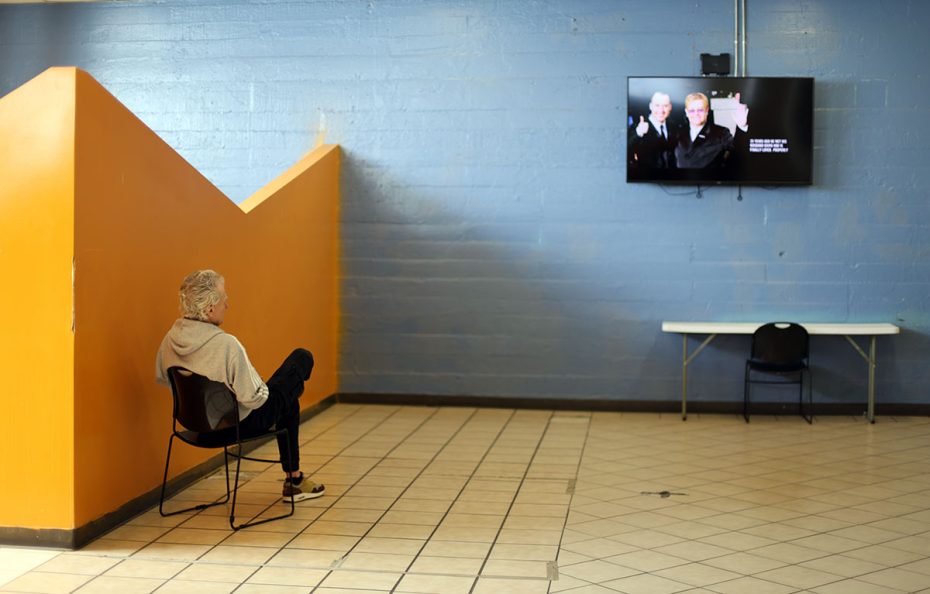
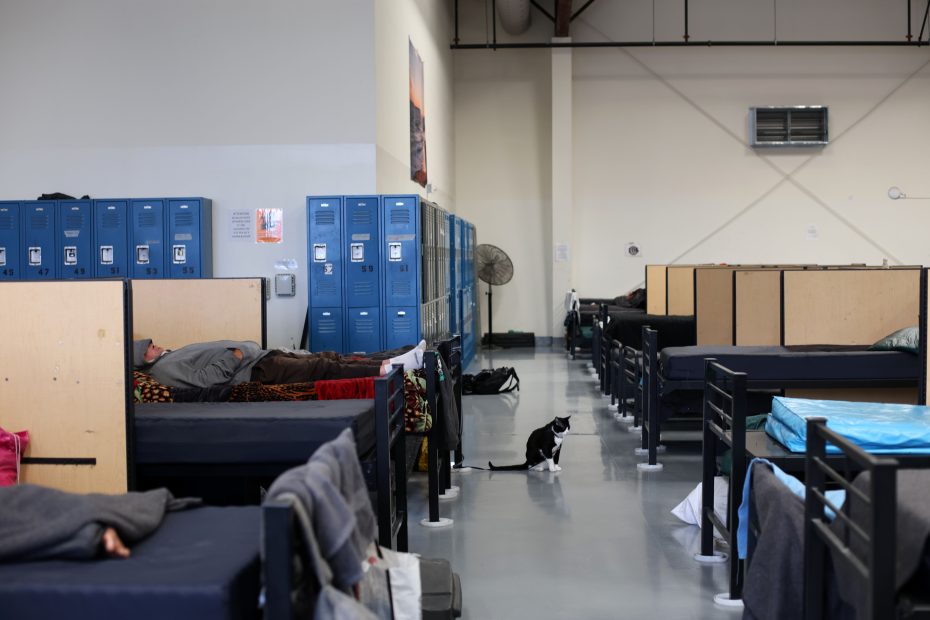
The navigation center sits opposite a block of encampments near Bayshore Boulevard that were cleared by city authorities on Aug. 1 (and later popped up on Jerrold Avenue). While residents of these encampments alleged prevalent theft, disregard for their possessions, and a lack of support while staying in the shelter, the residents inside tell a different story.
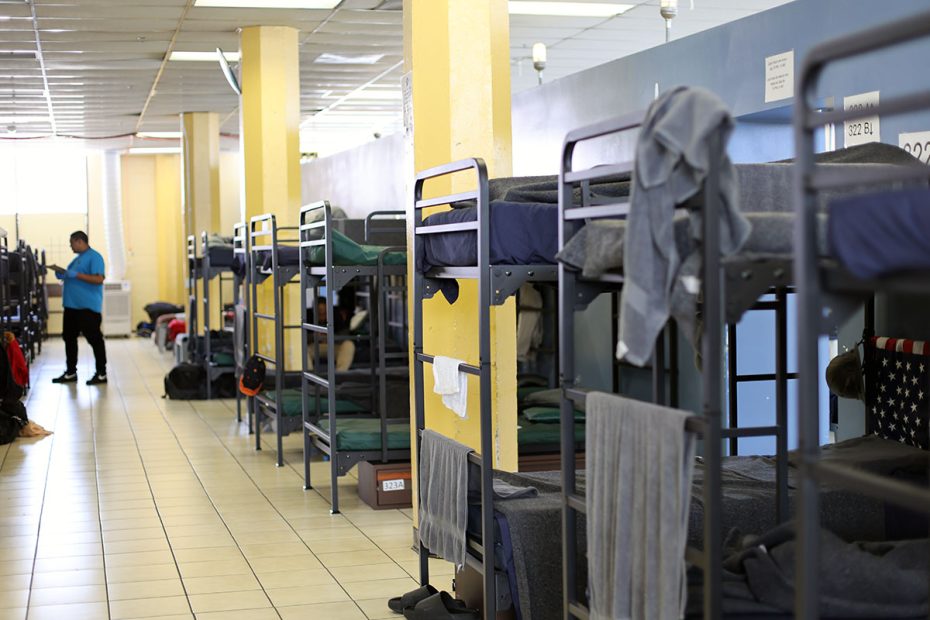
The city’s navigation centers, staff said, offer “intensive case management,” and aim to have as low a barrier to entry as possible. In addition to regular amenities like bathrooms and common areas, Bayshore’s fenced-in center contains outdoor spaces landscaped with succulents, a smoking area, and a multi-story cat tree. Stored underneath one bed is a bulldog in a crate and, under another, a litter box patrolled by a surly free-range tuxedo cat.
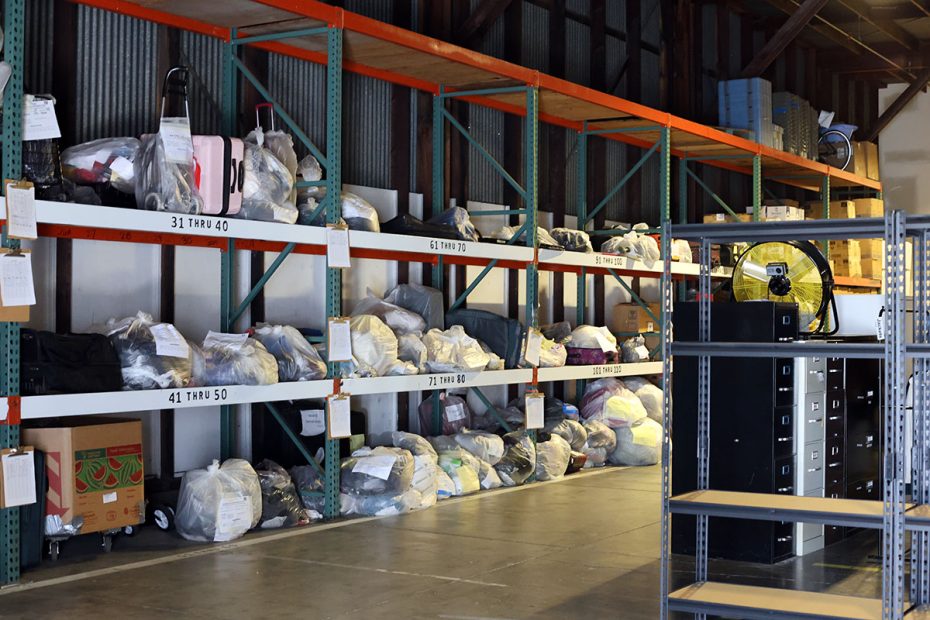
Some of the bags of belongings seized by the city during neighborhood sweeps are stored in a cavernous room on site. The room also stores guests’ extra belongings, even though they are only supposed to have what fits underneath their bed and in their lockers, said Marshall of Five Keys, which also operates this center.
Still, like typical congregate housing, all residents share a single room filled with rows of 128 beds. Arguments between neighbors, when they arise, can be heard throughout.
According to Marshall, the center is always full, but less so at night, when about 20 beds are unoccupied. Around 10 people a week are removed from the system for abandoning their beds.
Half the time, the director estimated, these residents turn up later, asking to return, a request staff try to accommodate. Meanwhile, Marshall added, 130 people have left in the last year because they found permanent housing.
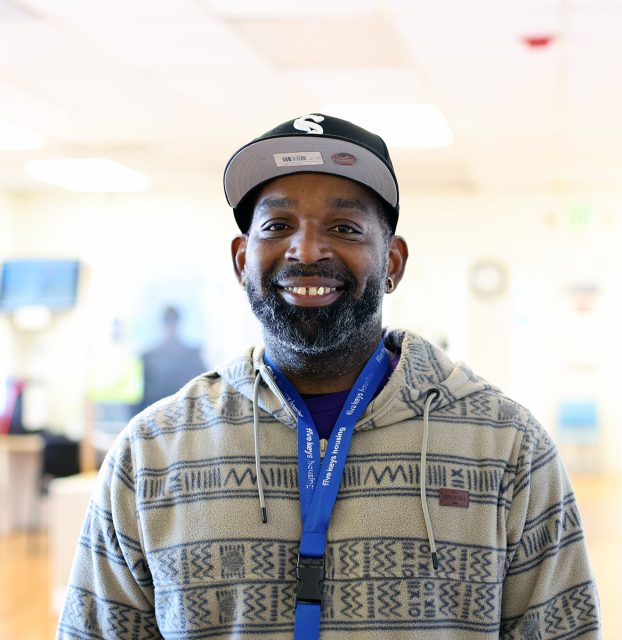
“Most of the folks that are in shelter but still go outside to sleep, they just want their freedom,” said Craig Neely (no relation to the author), an on-site case manager supervisor who has worked at the center for four years.
One of the most challenging aspects of his work, Neely explained, is convincing people with “trauma” to trust him. Neely, who has been homeless and incarcerated himself, said that while he tries to encourage people to use the shelter “full time,” he can’t force it. After all, “not everybody wants to help themselves.”
But some, like Avery Baxter, do.
After completing a year-long substance-abuse program in Fremont, Baxter, a 45-year-old Oakland native, said he came to Bayshore because he’d heard the site had good case managers who could help him find housing. The services they’ve provided have been instrumental to his recovery, Baxter said.
Most of Baxter’s nights are spent at the navigation center. But when he needs his own space, he stays at a friend’s apartment, pitches his tent at the beach, or takes his pit bull, Passion, to the skate park. Even though the skateboards drive Passion crazy, Baxter said, being there is a source of comfort for the skateboarding enthusiast, who was once profiled by Jenkem magazine.
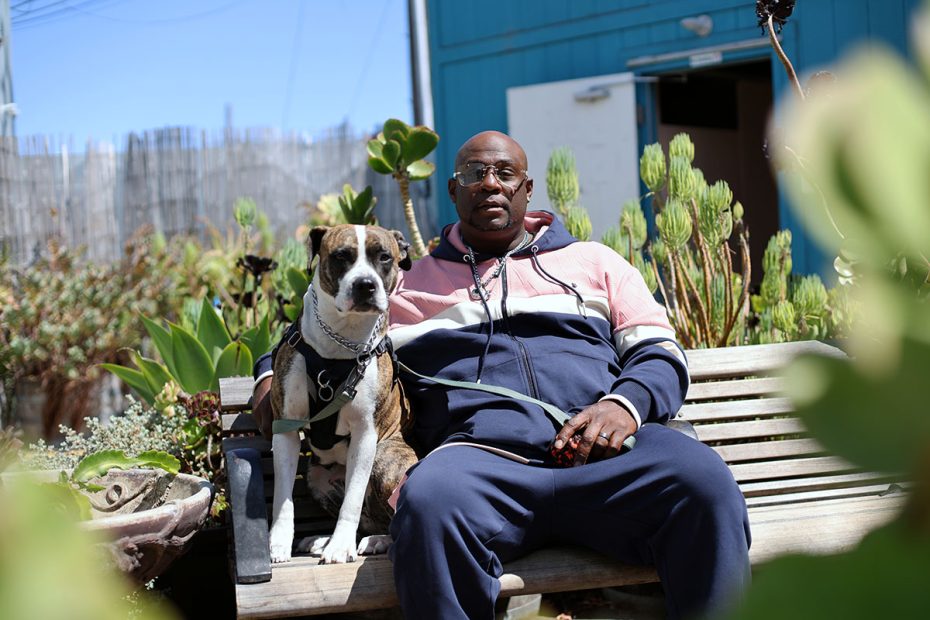
Now, Baxter said he looks back on that interview with sadness. High on meth and living in a tent at the time, he was unable to fully take advantage of the opportunity, he reflected.
At the shelter, Baxter said he avoids temptation by sticking to his routine: Check in, shower, and speak mostly to staff. “Here you could do any drug you want and you can get lost in it,” he explained. “And it’s not the place to get lost. You might as well take advantage of the benefits.”
Mission Cabins at 16th Street
After side-stepping vendors blanketing the 16th Street BART plaza and a line of people hanging out on Mission Street, the tranquility of Mission Cabins’ 24,000-square-foot complex across the street is an inviting surprise.
The cement within the 1979 Mission St. complex’s eight-foot-tall wire fences (the space was initially a parking lot) is spotless. A couple of residents sit quietly at kelly green metal tables that gleam in the sunlight. Otherwise, “ambassadors” in blue Five Keys shirts are the only people wandering around.
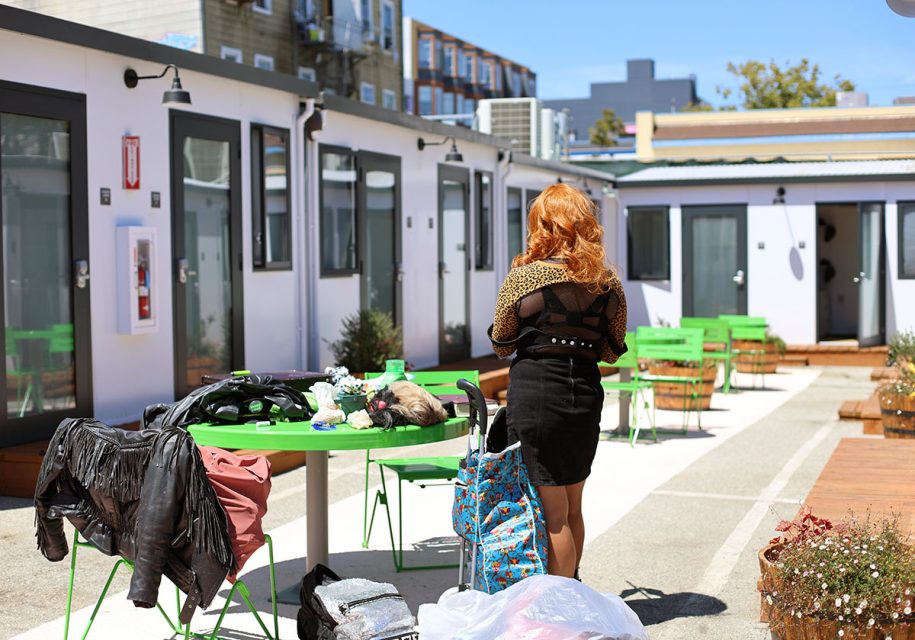
The site, constructed as part of a two-year project, offers tiny homes to 68 adults — 56 units for singles and four for couples — by invitation only. Mission Cabins and a similar site at 33 Gough St. are a couple of the only city-funded shelters that offer individual rooms.
Both residents and staff recognize that Mission Cabins is “unique.” It’s the “privacy factor” of having your “own space” and a “real door to close,” site supervisor Jacoby Morales said. Sometimes, he added, people come knocking and have to be turned down.
Still, convincing residents to sleep in their city-provided bed rather than on the street is an everyday challenge, Morales said. “They’ll come here, they’ll sign in, show that they’re still showing an interest … but then they’ll go sleep at their tent.”
When Mission Cabins first opened in April, many of its residents weren’t used to returning every night, Morales said. But, he continued, they grew more comfortable when they learned of the services available to them. In the last five months, three residents have been asked to leave for abandoning their cabins. Another five have left because they found housing, according to Morales.
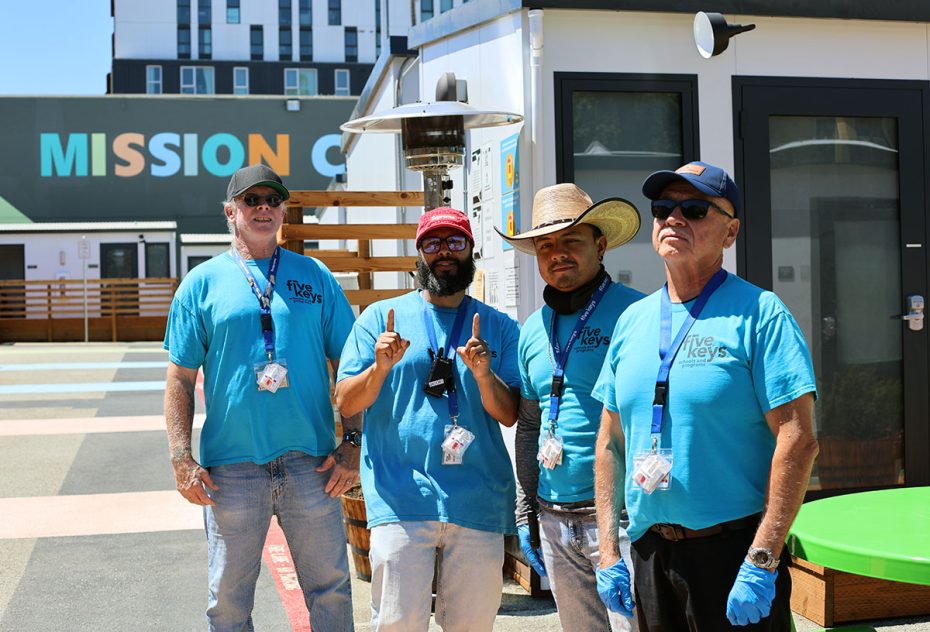
Morales, who said he struggled with homelessness himself as a child in Monterey County, acknowledged that transitioning from living in a tent to a place with rules and security checks can be “scary” and “uncomfortable.” Some people have been hesitant about moving in because they don’t want to give up their belongings, the supervisor said, describing one woman who arrived with bags of rocks and knives. He said he understood her apprehension; she’d been defending herself on the streets for two decades.
Skylara Starzz, who has lived at Mission Cabins since mid-June, said she’s been in San Francisco for over 20 years and homeless for “a very long time.” This is her first experience with city housing, she said, praising the site’s staff for creating one of the only private places in the city where she’s felt safe.
“I’m just glad that we’re not on concrete,” Starzz sighed, rubbing the worn fabric of her fingerless gloves. “It’s so freaking hard out there.”
What a fantastic article. I often wonder about the shelters in the city and what’s available for the houseless population. While I feel so sad for those who struggle with addiction and those who genuinely want to improve the quality of their lives with limited options, I am happy to know these shelters and navigation centers provide some sort of refuge and resources for those who want it. With 8,000+ houseless people and less than 1,000 beds available (per Google), I wonder how all this talk of “affordable housing” addresses this issue. Seems like we need more shelters and transition programs that are well-staffed.
The answer: even homeless people don’t want to be around homeless people.
Yeah, well, this is why you can’t just slap a label people.
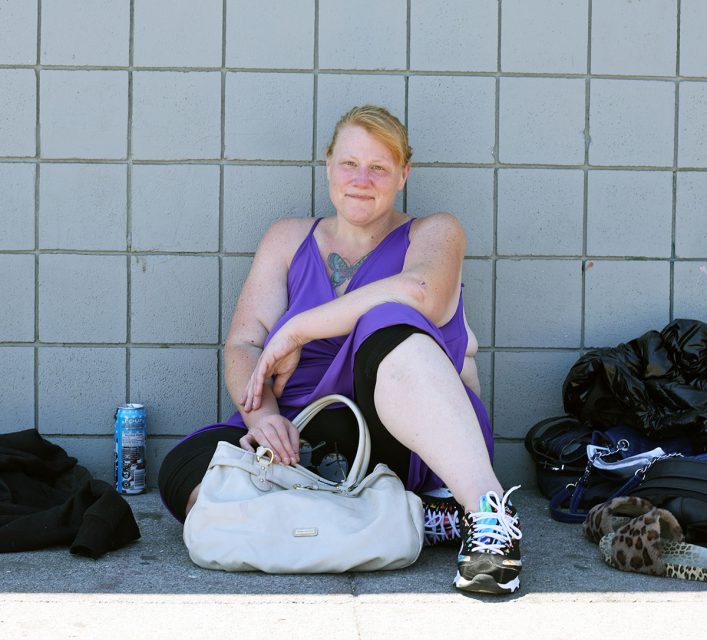
People like “Becca” need to be in asylums, she’s making life hard for the rest of us. Her public eye sore of bags containing all of her crap is enough to cause unnecessary enforcement on those who carry just a backpack and don’t get in the way. Frankly, I hate Becca, and every nutjob trashing the street like her.
Becca and all the other freaky homeless people are not my problem, and blanket enforcement of homeless people because of the freaky worthless ones like her trashing the street is not okay.
I’m a college student and I always find a trash can and I always find a bathroom and I stay out of the way, but that doesn’t stop the cops from harassing me in the middle of the night because they can’t tell the difference between “Becca” and “Poor College Student” while over 60% of young people live with their parents.
People talk about forcing the homeless into shelters and I’m here to say if anyone tries to force me into a shelter or any other kind of internment camp, that I will not go peacefully and there will be blood in the street.
Really fighting the stereotype that the homeless are violent and unpredictable, huh?
The vast majority of folks on the street in San Francisco need mandatory treatment for mental illness, drug addiction, or both to help them get back on the right track. Anything else is just window dressing.
There is absolutely no evidence to support your claim and so do much evidence to the contrary. The vast majority of the people living on the streets you don’t see and never hear about. It is the very visible and very small minority that you are lumping all the rest with. Most people without shelter in San Francisco are hardworking people and families who don’t get the benefit of the doubt.
What’s the advocate’s plan for designing emergency housing for homeless people that appeals to homeless people and can scale to meet the challenge?
Or is the party line effectively “be compassionate, do nothing until there is permanent housing,” a party line that is all but guaranteed to sustain public squalor and boost conservative prospects politically?
Thank you Mission Local and Abigail Van Neely for this excellent, thought provoking article. For 2 years during COVID lock down when the CDC required that all congregate shelters shutter, a group of my neighbors tried to help an unhoused neighbor (who lived in a tent on the sidewalk) get more permanent housing through city services and departments; it was ridiculously difficult and demoralizing. The hurdles and barriers for unhoused people are Kafkaesque. +6 years of Breed’s policies of sweeping, bagging and tagging, citing and arresting and clearing families living in RVs are pointless and cruel. Sweeping the city’s unhoused people to the Tenderloin and blaming that district’s supervisor is gross. Breed must go.
These single adult shelters are NOTORIOUS, not a place you would EVER want to send a loved one or anyone you care about. And they’re full! Instead of asking why people are turning down beds at these horrible shelters we should be asking why this city doesn’t have more beds for people or ones in better condition? It is shameful and a disgrace to treat vulnerable women this way.
Thank you for pointing out the obvious truth. As long as the shelters are run like Charles Dickens novel poorhouses people will continue to refuse them & rightly so.
I truly wish the staff at the shelters would be held accountable for being a abusive to the residents! It’s sad how a human being would prefer to sleep outside in the cold rather being in a shelter because of what’s allowed to go on in the shelters! Such as sexual harassment, sexual abuse, verbal abuse from the staff, lack of nutritional meals, lack of staff not wanting to help residents find housing because the amount of money the shelters receive from the city for every resident! I’m speaking from experience and I will advocate for the homeless! Thank you
I agree 1000%. Thank you for this truthful & thoughtful comment!
Dear Abigail, Thanks for the complete reporting here on adult shelters. I would love to see the next article focusing on family homeless shelters, as those aren’t open during the days and very different. Thanks
An important, thoughtful and in-depth piece of real reporting. Well done and thank you.
Yes they do choose the streets I know this I used to be homeless 20nyears who and I have visited some shelters reason still the same the staff power trip .. they make you feel like they are doing you a big favor and treat you like dirt ..I didn’t need that I already felt like dirt .. I needed supportive people but I guess I was unlucky but that was in many shelters..and it’s still the same today..IF YOU ARE GOING TO WORK IN A SHELTER YOU MUST NUMBER 1 HAVE COMPASSION. AND HAVE A HEART ..I understand there are rules that need to be followed but when staff treat like worse than the domestic violence situation you got out of that’s bad..Just my thoughts .. HEY SHELTER STAFF DO BETTER DONT THINK IT CANT HAPPEN TO YOU ONE STAFF I KNOW LOST HER JOB AND NOW SHE IS AT THAT SAME SHELTER AS A CLIENT .. KARMA BITES HARD JUST SAYING
Really appreciated this coverage!! Thankful for Mission Local and how heavily involved parties drove the reporting in this piece — informative and human-centered 🙂
They want the bed but they are never done running in circles to get their dope or do their errands…the drugs make them literally run in circles til what they had “a bed” a “meal” or whatever has pasted and they can’t get it any more. All homeless people want to have a bed, some like walking around all night long doing absolutely nothing, but most want a place to lay down every now and then atleast. But their lifestyle won’t allow it ..they gotta constantly be on the go go go to get nothing and go nowhere to meet noone ..it’s the drugs and brainwashing…it any their fault.
If they refuse, then lock them up. Their Plan B, should not be the sidewalk, nor are we willing to accept this another day.
Your not right at all these are people you are talking about with rights the same as you the issue is much more complex then you could imagine.i have been on the street myself and still work closely with people who are still on the street the majority are good people with extraordinary talents and skills who need a little assistance and dont deserve to loose there sence of privacy because of there current situation.shame on who ever thinks this way put yourself in there shoes if your mind is big enough and you will see that there is more to the story and people should be helped no matter where the choose to live.finaly public property is just that public property for residents to use as they wish.
Hi Christopher,
You can’t force me into a shelter and if the next option is jail, then I’m going to be prepared to resist with lethal force.
I will not hesitate to take the life of any man who attempts to remove my freedom to life, liberty, and the pursuit of happiness.
You will not force me into a congregate shelter or any other form of internment camp and if you try, you will die.
Careful, folks. We got a badass over here.
Not sure what your situation might be, but generally, I am having a hard time identifying the happiness part in all the squalor around encampments and such.
In addition, you might want to think about the possibility how it is you who ends up on the receiving end of this “you will die” thing, as opposed to somebody else.
What a great article. thank you so much.
A great report!
Proper mental health care and long term housing and treatment far from the Big Cities.
Less bureaucracy and more Humane treatment will work.
Great article.
You don’t want a free room and you want to make the rules too. Wadda you want, a free room at the Hilton. Get off your ass and get a job and support yourself like most of us. Beggars can’t be choosers. You want to live on the streets and do drugs well sorry, a bed in a shelter is actually more than you deserve!!
Please read my comment and have a little more empathy. You don’t know peoples situations. I would love to see you try and last one night at these shelters
Congratulations! You found people to vent your hatred and disgust on! Good job. Do you feel better about yourself now?
It makes me sick to my stomach when I see that the shelter 5 keys prides themselves with anything! I used to be homeless and after a long struggle picked myself up and worked to move away from California, specifically San Francisco! And get my own 1 bedroom apartment that I pay for myself. I have stayed at 3 shelters in San Francisco and all 3 were an absolute nightmare but the worst of the 3 was a 5 keys shelter on 6th street called the Baldwin and the other on Ellis Street which used to be a hostil. My case manager at the Ellis street shelter cornered me in his office bathroom and asked if it made me nervous then asked me what would I say if he asked to date him. He offered to help me with many services if I had sex with him when I said no! He then said I owed him for helping me with a previous roommate situation and that he had stuck his neck out for me in order to make me comfortable. In the same shelter one time getting into the tiny cramped elevator that would only hold 2 people, a staff member followed me into the elevator and asked soon as the elevator closed he proceeded to grab my butt and other places and asked to go with me to my room. He followed me to my door and opened it because only staff have the keys to the rooms, as I walked in I had to hold the door trying to close it while he had his foot in the room. I eventually got him to leave. There were some employees either drunk or high and nodding off in their chairs on their floors that they worked. Some actually did drugs on the steps. I couldn’t go back for over 48 hours due to an unforeseen incident and they got rid of and kept my belongings some which were expensive and when I go back to get them, they said they didn’t have anything of mine!
The next 5 keys shelter on 6th street the Baldwin was another nightmare. I had my own room this time and I had my dog with me. One day a group of maybe 4 males knocked on my door to do pest control as they do once a month but this time I was naked and trying to get dressed. When they knocked I had said I wasn’t dressed and to please give me 5 minutes, they said I had one second to open the door or they would because again they were the ones with the keys. A second later the door flung open and a male staff peaked his head in as I ran to the door yelling and closing it again. They yelled back and got the supervisor who was a man and he opened the door again but this time I was dressed and he told me that I needed to leave the building while they went in my room to put a pest trap in my room. I have never needed to leave my room before when they do pest control I stated and I said no I don’t trust you guys. The supervisor then said ok I am kicking you out you need to leave this second! I started to pack my things and they would not let me. They grabbed my dog and a lady staff said she was going to put my dog outside and that then I would probably follow so I could get my dog. My dog started running down the hallway and I ran out of my room accidentally bumping the shoulder of the supervisor and he then yelled she just assaulted me! That act of violence just got you kicked out for sure and black listed! I had no shoes and no jacket and no leash for my dog and none of my belongings sitting outside of the building trying to plead with them to get my things or at least my shoes, jacket, leash for my dog, iPad, iPhone and a few other expensive items. After 3 hours one of them came out with the things I asked for. I was again out on the street with nowhere to go and scared. 1 day later I fortunately got my housing and went back to collect the rest of my belongings that they said they would keep for me. Again waiting hours outside. Once they gave me my stuff and I got to my new place, I noticed I was missing a lot of things and my paintings that I had painted had holes in them like they had been punched or kicked through. My clothes had a gross substance all over them. I went back to try and get my things that I was missing and they said they had given me everything. I could not do anything about it. I found out later that some of the staff go into peoples rooms and either take or mess with the residents belongings.
And people wonder why homeless people don’t want to go to shelters! It’s because they are run my convicts who still have the street mentality and are using and don’t care for others. They are bullies and I know that I am not the only one this has happened to. I’ve tried to tell someone with authority but nobody will listen or maybe just don’t care. I really hope things change. I’m just happy I got out and am now in a better place in life no thanks to the cities services that claim to help.
It is a strange experience to see a photo of a bunk I slept in at the Next Door almost 25 years ago. It looks exactly the same. It was on the first floor which was considered preferable to another floor with wall-to-wall cots!
For years I tried to blot the experience out of my head because it was so traumatizing.
Who is to say a shelter is preferable to the street? I would prefer dying before having to go through that experience again.
No one need be homeless ever, period.
Correction to my comment: 15 years.
If the root causes of homelessness were correctly addressed by someone we could actually see it decrease. I have been researching and charting success rates of several western states on encampment clearing costs and current programs in place to help these people. California has spent well over 20 billion (that’s twenty thousand x one million folks) since Jan 2023 on homelessness with 95% of that money funding VERY temporary solutions.
(30 – 90 days in most cases)
Some examples of encampment clearing and “support costs” you are welcome to fact check:
(Again for the most part the maximum length of shelter is 90 days)
~This is not cost to help and shelter the entire population of homeless in these locations in all instances obviously, these are for the most part just individual encampment cleanup projects.
Napa $15 million, 120 people = $125K/Person
Berkeley $4.9M 72P = $68,055/P
Monterey $8M 70P = $114,825/P
Richmond $8.6M 115 115P = $74,782/P
SL Obispo $13.4M 200P = $67,000/P
Los Angeles $13.9M 200P = $69,500/P
San Diego $17M 300P = $57,000/P
San Francisco $6.5M 273P = $23,809
Plus the Los Angeles skid row clean up. This was $59.5 million dollars to help 3000 people lose their worldly possessions and get shelter for an average of a whopping 30 days.
This is just a handful of literally hundreds of these wasteful attempts that have obviously failed as homelessness is reported up 10% in California.
I am not trying to blast anyone, I am just showing quietly transparently hidden public information.
I have built a 5013c business model the addresses the core problems of EVERY state I have researched. Yes, it is the same problem in every state. I think there is a joke about what doing the same thing over and over expecting different outcomes……
So I cannot just go get government funding to “privatize homelessness”; this much I have figured out. If I could get $60k to clean up and put up one homeless person for $90 days while being praised for cleaning up the streets (especially on a big election year)…. Ok I don’t even need to finish typing any of that… Did I mention California has spent WELL over 20 billion dollars for homelessness to rise 10%? If it has actually gone down significantly but newly displaced homeless have caused the spike someone really needs to speak up for themselves. If this were the case someone in the white house needs to speak up to the American people and be honest about the state of our country.
It is time to stop using this topic as a political opportunity and admit it needs to be privatized. Be honest with your citizens that you currently have no clue how to fix the problem. If the leaders of the cities listed above cannot see a problem with the costs they have reported they should certainly find new jobs.
Soon my research findings will be published as I launch my plan starting in Phoenix, Arizona. I will demonstrate how to gain ground on the opioid and meth epidemic along with general homelessness… Because the problem is one in the same.
Homelessness isn’t a joke.
The worst thing about being homeless is the other homeless. Homeless constantly victimize other homeless. It’s horrible.
Sleeping next to this many strangers is unnatural and dangerous. Many have mental disorders, violent and behavior problems. If you sleep there, you are a moment away from being dragged out of your bed, thrown on the ground and beaten to death. This type of housing is NOT the solution.
Good Analysis 💪💯… Did My Time.. eight years in purgatory hell… SF ghetto 😎 Homeless Industrial Complex Bigotry Personified 🇺🇸⭐💥🔧
Abigail, Thank you for your courageous article! Insightful, honest, courageous! I’m right down in the midst of a homeless-heavy area right now, and have seen what certain agencies are doing. I’ve also seen the unhelpful machinations that pass as assistance. There’s so much “playing politics” and worse, whereas L.A. & San Diego are actually doing good in this area. Makes ya kind of wonder? Thanks for shining a light!
Let’s all remember the Matrix program. Our homeless are not criminals. Why put them in jail? Do we not have any other ideas? And how long will they be kept in jail for no reason?
If people are checking in to the shelter but not using the beds, why? Is it because they know that if there is no shelter space available their encampments cannot be cleared? Seems like they found another loophole to abuse the system.
It’s because in Next door & other similar congregate shelters your bed is 3 feet away on all sides with other peoples’ & there’s always inevitably some person who has mental health issues that cause them hygiene issues & they stink & make you sick to your stomach with their smell. At the Cabins & 33 Gough there are no flush toilets. They only have porta-johns & those are only serviced twice a week. They stink. Gross. Stand outside the fence at 33 Gough on the sidewalk right next to the porta-johns & see how long you wish to stand there smelling that. What the author conveniently left out & the photos are incapable of conveying is the disgusting smell of these places. All you have to do is pretend to be homeless, call 311 & keep calling every day until you are “lucky” enough to get a shelter placement. Go there & see for yourself what it’s like before chastising anyone else for not wanting to be there. Not to mention the behavior disordered formerly incarcerated people who are hired to staff the places: people who’s disordered behavior got them incarcerated & who have no business being given authority, which they inevitably abuse, because it’s irresistible ingrained behavior for them to abuse any authority they get, especially being given authority over such a vulnerable group of people. It’s a very poorly thought out system which when you witness it firsthand gives one the feeling that you are in a Charles Dickens novel.
This is an industry. Hopefully with a new mayor the worthless non profits will disappear. Obviously they do not want to solve a problem, because then their jobs will disappear. There are too many non profits. The crooks in SF government need to go.That includes all the Supervisors. ALL.
The Problem of the Shelters is the Staff ! They’re Lacking of Necessary skills to run the Shelter. They’re also Lazy and Neglected on their Jobs. That’s why !
I am lucky to be a lifetime resident of Boston, MA. We have a ton of resources, access to world-class healthcare and Boston Healthcare for the Homeless. They offer every medical and case management service you could possibly need, genuinely compassionate staff and they do not stigmatize anyone. Theyre current approach is harm reduction, but they are missing one key element that makes it effective: safe injection sites. I used to be against the idea, but after watching so many people unintentionally die from taking contaminated black-market concoctions, of which they know nothing about and can’t possibly practice any kind of safety precautions. So they die from being misinformed or deceived while in a desperate state of mind. Safe injection sites will provide privacy, discretion, safe, measurable, uncontamin ated pharmaceutical-grade dicetylmorphine (heroin), the ability to measure the amount they do, new equipment that is safely discarded, and medical staff to monitor. We have a methadone clinic, but it hardly works at all for many because it’s not heroin, there are too many rules to follow and it forces you into territory where there is too much temptation to confront every day. Safe injection sites would keep everything out of sight and, most importantly, people will stop dying so frequently! Its a no-brainer. Of course, homelessness and addiction are complex, individual, multifaceted problems, so it takes a lot more than just keeping people from dying….but that’s a good start! Most of the people i have known who were successful escaping homelessness did it voluntarily when they decided it was time to change. I think it has to be a free-willed decision to take back control of one’s life. There are a lot of kind, compassionate people out there who are willing to help. I stubbornly refused it for many years. In 12 years of being homeless, I NEVER once stayed in a shelter – for precisely the reasons in this article. They are dehumanizing places. However, I did wait 7 months on a waiting list and was lucky to get into a shelter that is only 12 people, mostly privately funded, and you are given your freedom. The best part is you can take the time you need to get your life in order. When I was homeless I found it impossible to think even a day ahead. When everything is uncertain day to day (especially your safety!), how do make any plans for the future? Conscientiousness is not a good strategy when you’re homeless. At the same time, taking control of your life and having meaningful goals are essential elements for escaping it. It gets complicated and feels hopeless most of the time.
Accept shelter , or face arrest or leave .
Most people would take what they can get for shelter and services .
How about sending homeless to places where there are jobs and it is affordable .
China puts their homeless to work and they can then pay for their own way and live in a government dorm.
My friends left because they want to have a job and pay for themselves .
What about a camp like the United Nations refugee camps ?
Away from neighborhoods .
Any drug sales and usage then arrest them and mandatory treatment ,and or jail.
How many homeless in sf or who are in shelters even have a job ?
How long do the handouts from taxpayers to support them need to be continued?
Temp shelter food clothing services then the taxpayers should be done .
No one owes anyone anything .
Take it or leave .
Homeless contribute nothing here .very sad
We need to stop coddling addiction & squalor and the ideologues who enable them. Time to sweep away the cuckoo nests and return to sanity.
Nobody is “coddling” addiction.
Telling addicts it’s okay to be addicted, opening so-called safe injection sites, giving them clean needles, housing, etc, without conditions are prime examples “coddling”. Gaslighting doesn’t change the obvious
What bothers me the city of San Francisco and the state provide housing for border crossers don’t vett them and yet the American homeless are denied even with shelters due to monviolent police records often these people struggle to find food banks for food and showers to clean up and find jobs.
Really our immigrants? I rarely see these persons panhandling and asking for food. They are on the corners early in the morning asking to be picked up to do a days work. Are the homeless people willing to do that?
Your’s is an important question. How do we separate those who deserve our support and those who should only be detained and contained by the system? If you want work….get it, find it. If you want to live a wasted life we’ll offer you a jail cell without the traditional bars. Expect no better, complain not.
Deborah, according to LinkedIn you don’t even live here.
Not only do you not even live here, but you are seriously deluded about reality. No, “Border Crossers” are not “coming across the border with nice, new, Gucci, and Louis Vitton [sic] designer clothes” or being given “10K Debit Cards.”
Campers, (no pun)
I have two solutions and only one will solve the problem and then, only in the long run.
First, construct 4 huge Combo RV/Tent Campgrounds each able to accommodate 2,000 dwellers.
Put two of them on the undeveloped couple of hundred acres on the Oakland side of Treasure Island where the City agreed to put them when they took ownership of the parcel.
Put one at the Ft. Miley end of half of Lincoln Golf Course and put veterans there adjacent to VA medical facilities.
Put another at the Parking Lot end of Harding Golf Course and take the space from the control of MSB (head hunter) who bought control of it when he bought the PGA.
Those would be the best situated Homeless ‘encampments’ in America.
Then, do your hard sweeps because there would be absolutely no excuse for sleeping in front of your house.
Second is to offer anyone either checking into a City Space or County Jail Ten Grand to have a vasectomy (I had one 50 years ago and best 25 bucks I ever spent) or a tubal ligation.
Ten Large in hand, offer them $1,000 a month UBI style for a year to get back on their feet.
It worked in a place like Stockton a hundred miles from here (the 1k a month cut crime in half genuinely not with cooked SFPD books).
If you come home and the kitchen sink faucet is on full blast and flooding your whole neighborhood you don’t start buying more and more mops.
You turn off the faucet.
First people in line for the procedures would be addicts and the poor and our present programs are producing more of those daily which we don’t need.
These conclusions are after 80 years of being poor and then working with the poor and behaviorally disturbed.
I back my conclusions with two teaching degrees from Clemson, the second in Special Education with a specialty in working with the behaviorally disturbed who cause ALL of the problems in the shelters.
Try it.
You’ll like it.
Within a year DPH will wonder where all the ‘crack babies’ went.
Go Niners !!
h.