


Back in the 1990s, at the Engine Works building at Capp and 17th streets, B-boys danced, the Mission Burrito Project passed out food to the homeless, and members of the Mission School art movement hung out, including photographer David Schubert and artist Margaret Kilgallen, who painted a mural in the building (it’s since been removed).
Fast-forward two decades, and the converted warehouse was still an arts scene: The beach-goth band The Growlers performed secret concerts, punk bands recorded albums, and bike messengers idled between deliveries.
Using the space now are an artist who paints sideshows and city life, a mechanical engineer who builds lighting contraptions with LEDs, and a DJ who creates digital art to be projected during performances.
But now, that legacy is threatened. The artists who live at Engine Works were recently notified that they are being evicted under the Ellis Act, which allows property owners to exit the rental market and displace their tenants in the process.
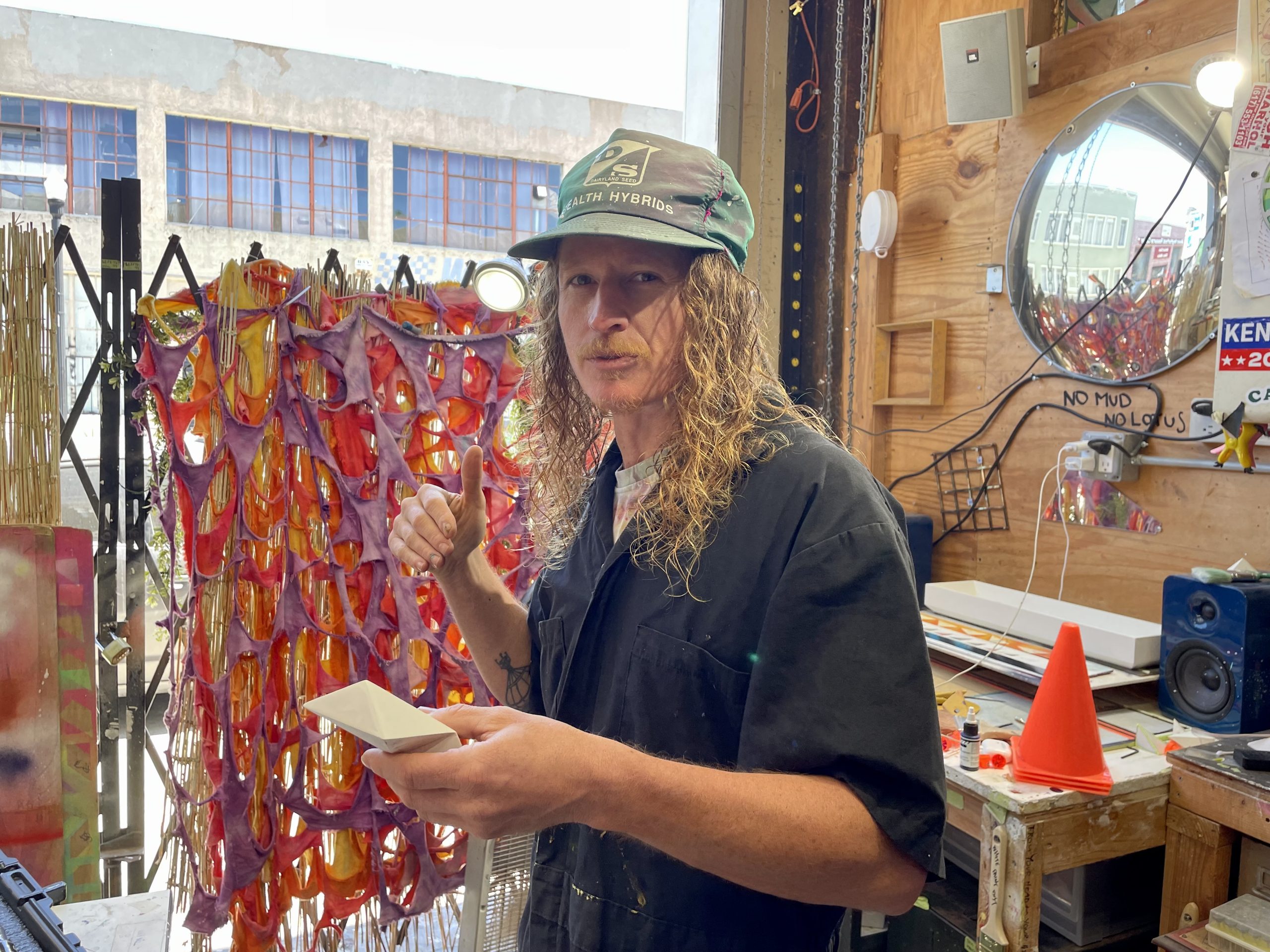
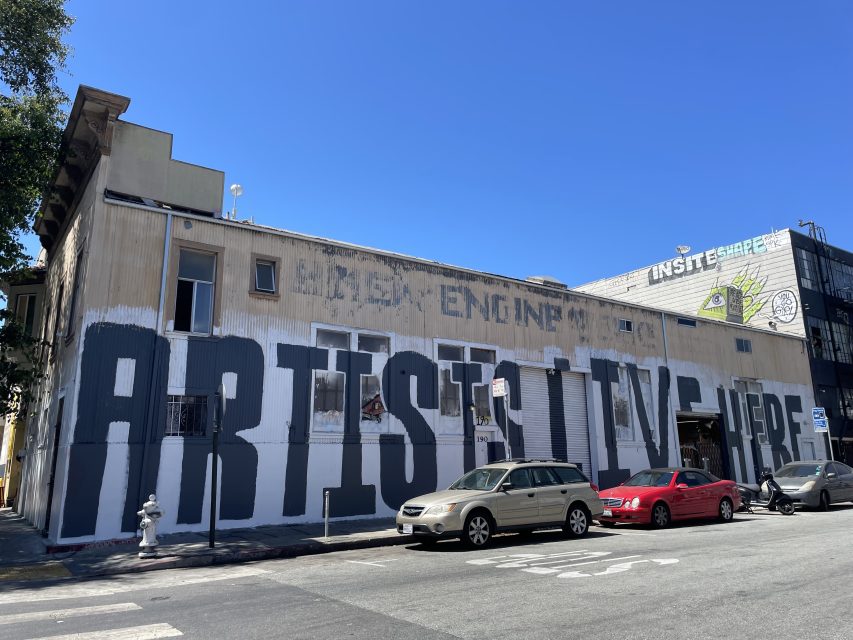
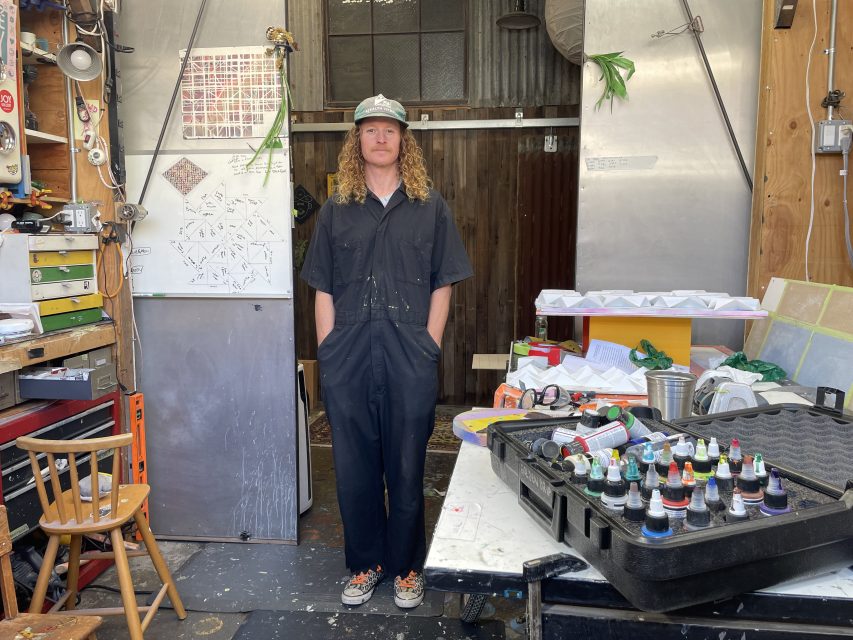
“This place has always been home to groups of alternative kids,” said Sean Newport, who has lived in the building since 2010 and currently uses studio space to make 3D geometric art out of painted wood. He recently painted “Artists Live Here” on the outside of the warehouse in large, black block letters.
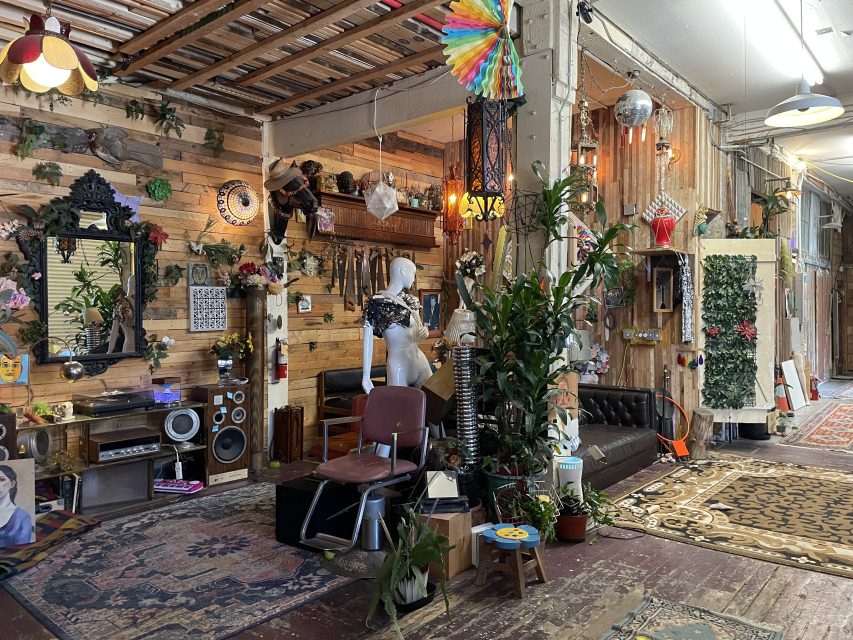
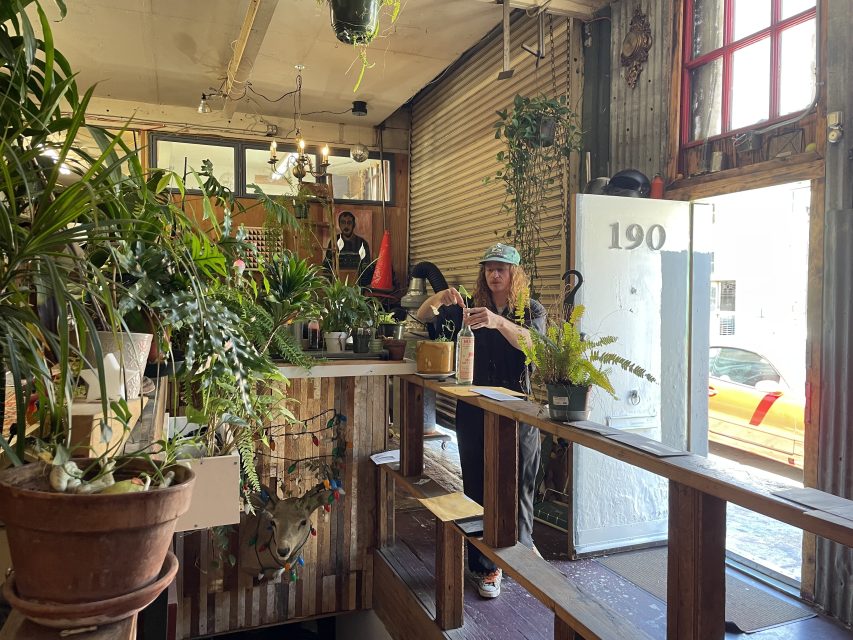
Engine Works is located in an industrial pocket of the Mission, but inside, the warm lighting and wooden walls give it a homey feel. Persian rugs cover worn floors, and the walls are decorated with eclectic art (including several of Newport’s pieces). Flowers and plants lie on every surface, with some corrugated metal from the building’s skeleton poking through on the walls. For $5,000 a month, three people live there and two rent studio space, though several tenants have already left ahead of the eviction.
Kent Putnam, a car-dealership owner, bought the building in December 2023 and, according to Newport, plans to turn the building into an ashram for hosting yoga retreats. Newport said that Ananta Chaitanya Das, a monk at the yoga studio Bhakti SF, walked through the space before it was bought and is already using the second floor; Newport says he can hear them chanting.
“We don’t need an ashram. We need more creative people living and thriving in San Francisco,” Newport said. He said he plans to get legal representation to fight the eviction, and has nowhere else to go if he is kicked out. “I don’t want to be homeless,” he said.
Putnam and Das did not respond to repeated requests for comment.
Gentrification and safety
But the artists’ residency faces another problem. The Engine Works building, a warehouse with a corrugated metal exterior, might not be meant for habitation. Three complaints filed with the city in 2016 and 2018 allege that the building has been illegally used for living, instead of for commercial purposes. The complaints also describe blocked exits, construction work done without permitting, and hazardous electrical work.
The complaints were investigated by the Department of Building Inspection and ended with the city posting “orders of abatement,” which means that some violation has occurred and needs to be addressed.
Artists living in informal housing is nothing new: Numerous now-legal artist spaces across the city, including Project Artaud and Developing Environments, started through people illegally occupying studio spaces that offered affordable rent.
Such informal living arrangements used to be very common in the city, said Debra Walker, a police commissioner and longtime San Francisco artist who lives in Developing Environments, but successive waves of gentrification have slowly displaced artists, who can’t afford to live and work elsewhere.
“There are fewer people occupying these kinds of buildings now than five years ago, 10 years ago, because the owners wanted to use them for industrial or business or tech or whatever,” Walker said.
Plus, illegally occupied buildings can be dangerous to live in because they don’t have all of the required safety features for residences. In Oakland in 2016, 36 people died in a fire at the Ghost Ship, a warehouse zoned for industrial uses, not residential or entertainment purposes. The night of the blaze, the artists’ collective living in that building had been hosting a concert with around 100 guests.
Following the fire, many owners of warehouse buildings evicted residents due to safety concerns, Walker said, adding that evictions are not “just people greedy to get more money out of the building.”
According to Newport, after the Ghost Ship fire, Engine Works residents living in the basement were made to leave, but residents on the first floor were allowed to stay.
The city also worked with artists to try and improve the safety of spaces similar to Ghost Ship in San Francisco. “Whenever there’s a Ghost Ship fire or something like that, they become proactive and go figure out what’s going on in their district,” Walker said.
It is possible to make informal living arrangements legal, though — but only if the building owner is supportive. The owner must file paperwork with the city and retrofit the building to make it safe to live in, which is often costly.
According to Newport, the previous owners of Engine Works had started the process of changing the site’s permitting to allow both residency and working space but, during the pandemic, those plans fell apart.
“We were paying rent through covid, with the hope that they were going to make our space legitimate. And then they put a For Sale sign up,” Newport said.
‘Artistic integrity’
Since he moved into Engine Works, Newport has amassed sweat equity in the building: He has spent his own money and time renovating the space. “It was a piece of crap when we got the place, but we fixed it up; we made it a home,” Newport said, explaining that he had paid for plumbing and electrical work.
“It took me a lot of work, a lot of energy, and a lot of my money to maintain and facilitate this space. I can’t just turn around and start it again,” he said. “I don’t know if I even have the energy to start another community, like I did before.”
Newport’s fight against eviction has been long in the making. In June 2023, when Putnam was considering buying the space, Newport organized a petition signed by 336 Mission artists and residents, urging him to consider finding a different building in the Mission for the ashram, or make accommodations so the existing tenants could stay.
“I met with my house, I met with my neighbors, and they were all very adamant, like, ‘Sean, we need to fight for this, because if this building goes, there’s, like, five other art spaces on our block,’” Newport said. “They want us to fight it, because if we’re going to get it, then they’re going to definitely get it next.”
Calisto Bertin, a former resident, rented space to use as a recording and practice studio in the building in 2012, producing demos of electronic music and learning about traditional music production. At the time, several other bands and artists were also making music in the building.
“I think it really helped me thrive as an artist, knowing that I could just walk into this space at any time and have the ear of a couple people who have great artistic integrity,” he said.
Even after Bertin gave up his studio space, the connections formed there remained. He kept his motorcycle at Engine Works, and whenever he was in the Mission, he would pop by to hang out. “It wasn’t just unique to me,” Bertin added. “Anyone who had put in time there was generally welcome whenever.”
The building has been a community anchor. Newport remembers throwing an “Inside Lands during Outside Lands” party in 2012, where multiple buildings housing artists on the block teamed up and opened up their spaces, attracting crowds that filled the streets.
Bertin said the gentrification-fueled displacement was ironic; many of the newcomers to San Francisco originally came for its artistic culture. “It’s kind of like the snake eating its tail,” he said.
Eden Santoro, another former resident, agreed. “I feel like the city itself is kind of trying to capitalize on the history that it has, as a place that is welcoming to artists, but I don’t know how much longer it will be able to do that if artists can’t afford to live there,” Santoro said.
Santoro now manages a band called Sell Farm. In February, when Santoro stayed at the Engine Works while in San Francisco with Sell Farm, Newport broke the news about his pending eviction.
“He told me in the morning. I’d just woken up and was making breakfast and sat down at the table and he was like, ‘Hey, we’re getting evicted.’ And both of us just cried at the table,” Santoro said. “It just felt like there was nothing we could do to solve this problem.”
“It’s heartbreaking,” Santoro added. “I think of all the people that will not be able to be a part of this in the future.”
The inside of that place looks just like ghost ship did –lots of wood and lots of decorational things to make smoke in a fire.
The smoke was what killed people, not the fire, in the Ghost Ship place. People couldn’t breathe from the thick black smoke and they just collapsed on the floor.
Unlike NY, here in San Francisco many of us live in wooden buildings built in the early 1900’s (or even older).
The wood is super dry and will go up like a torch in minutes.
And yeah, we got couches and stuff that will kill us with smoke pretty quick.
And the car in the garage has a full tank. Boom.
The Ghost Ship thing was a tragedy but now it’s just a nagging mommy talking point (or landlord/insurance cudgel) – “don’t you go livin’ in a funky place doing art or The Ghost Ship will get ya”.
Ugh.
“We don’t need an ashram.”
Well, you don’t own the building so you don’t get to make that choice.
But but but…. This can’t happen to me! Can’t you see I’m cool?!
Look up renting in the dictionary. It’s described as ” paying for the temporary use of something”. Not “a back door way to cling to a property for life, without having to buy it”.
No good deed goes unpunished.
I fully support your efforts Sean.
Depressing. So much empty unused space all over the city. To evict artists in a landscape that once had a thriving art scene?
I hear the dream of the 90’s is still alive in Portland.
This is not a ghost ship scenario. 10x less people. The city SHOULD step in and stop displacement of artists in favor of yoga. There are enough yoga studios. (I also can’t imagine who wants to come to a yoga retreat and then step outside to garbage, hookers, poop and needles.) Yes times change but that’s the function of government- to maintain some balance of culture and profit in a city that claims to be an epicenter of art.
I myself moved my business into SF in 2010, where we fabricated for both income and art. By 2015 we were out, due to cost, and the talk of the artist and fab community was the illegal use of warehouses for software offices. You simply couldn’t find a place to rent that in all seriousness wasn’t 4x the price when we moved in to the city.
Let’s not forget that either. There was an entire decade of illegal property use that went ignored by the city, spurring absurd rental rates. I’m talking 50 people crammed side by side at tables in a 1500 sqft warehouse with no insulation…but that’s not unsafe because they didn’t sleep there, right?
I lived in two live-work lofts that were simply run like any apartment building- hike the rent by whatever the market will bear every year. Built with subsidies intended to keep artists in the city, then rented to tech workers who technically qualified as “live-work” because they were running a server or freelancing, with no rent control restrictions due to the building’s age, and in one case, run by one of the largest real estate portfolios in the country. They were also hands down the worst landlord I ever had. Does that sound right to you?
So yeah…you can say the world moves on, deal with it, but when you look at a case like this- a building maintained and improved by a tenant, whose labor and maintenance clearly aided in the sale of the building, it makes you ask what the point is of a city that actively tries to attract artists and then offers them no protection. They fall sqaurely under commercial real estate rental, and in this case the tenant has effectively no rights. In fact living in a commercial space is often used as grounds to evict artists as a violation of the lease.
If “no more yoga” becomes the rally to do something about helping artists live in SF, then great.
Campers,
The City should be borrowing every dime they can and spending billions on property then protected as part of our Municipal Land Bank.
Not my idea.
Henry George’s actually.
h.
I hope Putnam has bad karma for doing this. I am sure there are other properties he could have purchased for his ashram that would not require evictions. Better yet, his ashram would be better suited to a rural area, not in the middle of a thriving city.
They’re absolutely right; the city banks on its history as a hub for arts and culture, but the rising cost of living or working in the city and the rapid loss of creative studio spaces (and live/work spaces especially) means that San Francisco is spelling out its own future as a drab corporate city. More needs to be done to retrofit and invest in these types of shared spaces — kicking people out over & over and just assuming they’ll stay in the city at a higher cost, more restrictive space isn’t going to work.
There’s so much vacant commercial space in the city wasting away that would love to have a bunch of chanters plying their craft. Hey Putnam, if you displace some of the last few Mission artists, your “ashram” is going to have loads of bad karma no amount of mantras, candles, and sage will surmount. Or maybe “ashram” is a ruse, and he intends to condo it?
Before 2000, when the City was teeming with artists and warehouses (and which gave the SF its irresistibly wonderful character), there were no tent cities, no fentanyl deaths on the streets, no smash and grabs. The doom loop was not caused by poor governance. It was caused by the displacement and “disruption” (as the disrupters trashily call themselves) of San Franciscans who had settled themselves in what they thought were there homes for good, only to be caught victim of the scourge of Big Tech. Big Tech caused the Doom Loop that consequently made them flee, with none of the allegiance to the City, in sickness and in health, that the real San Franciscans, whom they disrupted, had.
THIS is what people refuse to understand. The city has a rich history in both creative and performing arts. People who work in tech seem to be deeply offended and take it personally (hence downvotes on your comment) when mentioning how Big Tech forced the city to evolve in more ways than one, but it’s true. An entire industry boomed and the city adjusted accordingly. These artists are wanting to preserve a way of life that, sadly, is no longer possible here. If you are a full-time artist, the city isn’t the place for you. There are many artists here but many create outside their full-time jobs and rent workspace at studios across the city. This makes me wonder what the SF Arts Commission is doing to support local artist culture in general.