


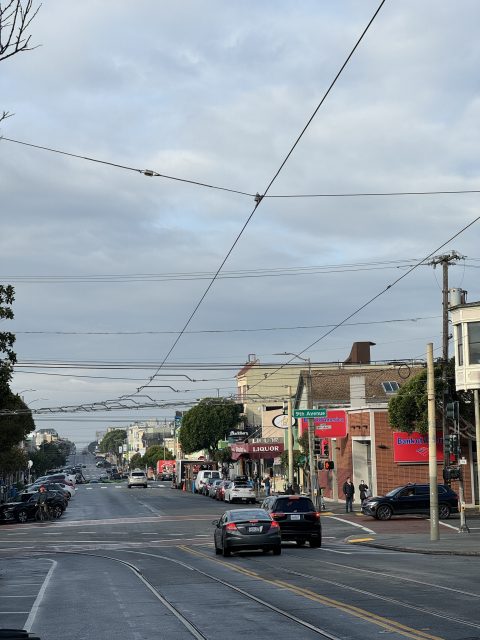
West Portal Avenue, one of the Westside’s main commercial corridors, looks very much like it did 70 years ago. A Muni line still runs through its center. The buildings are the same height as the facade of the Empire Theater, which operated on West Portal Avenue for some 96 years until 2021.
Housing production is slow: Between 2019 and 2023, only 37 of the city’s 16,822 new units were built in the Inner Sunset and Ingleside planning districts, 0.2 percent of the total. When city officials proposed redesigning a major West Portal Avenue intersection after the deadly crash in March that killed a family of four, merchants and others erupted in protest.
But the district is evolving, at least politically. Through the years, the area has generally elected more moderate supervisors. But, in 2012, residents elected a progressive when Norman Yee won by a slim margin. In 2020, Myrna Melgar replaced him, promising more housing, more density and more investment in public transit.
The question now: Have enough residents become tired enough of change to oust the incumbent?
“The group of challengers mirrors the typical historical candidates that have represented the district,” said David Ho, a San Francisco political consultant, who led the campaign for Melgar’s predecessor, Yee, and was raised in District 7. Those previous supervisors, who were generally considered more moderate, include Sean Elsbernd, who is now Mayor London Breed’s chief of staff, and Tony Hall, who is retired.
Melgar’s opponents include Matt Boschetto, scion of a family that sold a $830 million janitorial business and a political newcomer who has not voted in previous local elections, and Stephen Martin-Pinto, a firefighter and Marine veteran who was a registered Republican until 2023.
While they might seem unlikely to unseat an incumbent, it’s not impossible: Melgar, like Yee before her, won in 2020 “by a hair,” said Ho. She received 18,561 votes, compared to 16,370 for her opponent, Joel Engardio; Engardio actually won more first-place votes, but Melgar beat him in subsequent rounds.
Melgar will have to overcome the same challenge once again, Ho said, pointing to a staunch moderate base which has partly helped Boschetto outraise her by $89,464.
“Myrna has her work cut out for her,” Ho added.
But so do her opponents.
It is very difficult to oust an incumbent, particularly one without a tarnished record or scandal while in office: Engardio was the first San Francisco supervisor in two decades to do this when he ran in District 4 in 2022. (Engardio, whose home was redistricted into District 4 along with three moderate-voting precincts, beat out then-Supervisor Gordon Mar by 460 votes.)
Boschetto “can say a lot of things about Myrna, but I don’t think he can say she’s incompetent or corrupt,” said Jim Ross, a veteran political consultant and Gavin Newsom’s former campaign strategist. The question for Melgar’s chief opponent is: “Why should he replace Myrna?”
Boschetto and Martin-Pinto have tried to criticize her for past comments, like a 2020 statement about needing to “disband the police,” but Melgar has since hewn more closely to her constituents: Last year, Melgar supported a $25 million bill to secure more funding for police-officer overtime, and in a weekly Q&A with Mission Local, Melgar said she supports increasing police staffing levels.
When it comes to similar bread-and-butter issues, Melgar has been able to appeal to her suburban voting base. “A lot of that district connects more to the peninsula than it does to the rest of San Francisco culturally, socially — politically, even,” said Ross. “They go to the Westlake Joe’s, not the Joe’s in North Beach.”
Melgar, who was born in El Salvador and moved to San Francisco as a child, has leaned into the duality of her district’s voters, finding allies across the political spectrum: From Board of Supervisors President Aaron Peskin to Mayor London Breed, and from groups including the San Francisco Tenants Union and San Francisco YIMBY.

Her experience has given her credibility. A graduate of San Francisco State University, which is in District 7, Melgar moved to Ingleside Terraces in 2011. She is an urban planner by training and, before becoming supervisor, sat on the Planning Commission for nearly four years.
Even Melgar’s staff is a political mixed bag. Her team includes legislative aide Emma Heiken, a member who was elected as part of the moderate SF Dems for Change slate to the Democratic County Central Committee, and Jen Low, a progressive and Norman Yee’s former chief of staff.
John Whitehurst, the political consultant who works for Melgar, said people try to characterize Melgar as either a progressive or a moderate. “I just say she’s Myrna,” he said.
“Her politics, overall, reflect that of the district,” said Eric Jaye, another campaign strategist in San Francisco. He added that Melgar has generally done well as a supervisor, and has not had any major hiccups nor given voters a reason to turn her out.
Hot-button election issues
Instead, Boschetto and Martin-Pinto have taken a stance against Melgar on what might appear to be innocuous proposals — and have found traction by escalating the discord surrounding them.
One is the proposed renovation outside the West Portal Muni Station. In April, Melgar, along with Breed, requested that the San Francisco Municipal Transportation Agency reorganize traffic flows in front of the station, shortly after a driver crashed through the adjacent bus stop, killing an entire family of four — Diego Cardoso de Oliveira, Matilde Moncada Ramos Pinto, Joaquin Ramos Pinto de Oliveira and Cauê Ramos Pinto de Oliveira.
The proposal sparked backlash from local merchants, and Martin-Pinto and Boschetto immediately sided with the merchants, who felt they had been blindsided, and spoke out against the changes. In a candidate forum hosted by Mission Local, Boschetto said that if he could make one bold or unpopular decision, he would stop the traffic proposals from happening. Ultimately, Melgar created a task force to review the proposal and a reduced version was approved.
Likewise, both Boschetto and Martin-Pinto have opposed Proposition K, a measure co-sponsored by Melgar to permanently close the Upper Great Highway to vehicles. As with the traffic changes in West Portal, the proposal has created backlash among some residents.
“It’s more of a gotcha issue,” said Ho, who added that it is one that largely doesn’t impact District 7 residents, who don’t all live within the vicinity of the Great Highway. Still, he said, “It’s smart to capitalize on a hot-button issue.”
Indeed, Boschetto is doing just that. He and his family have contributed $65,000 to a ballot measure committee he controls called “Great Highway for All, a Matt Boschetto Committee.” The PAC in his name allows him to run on a wedge issue, but also to fundraise outside city campaign contribution limits and prominently feature himself in campaign material.
In a more general sense, Ho added, Boschetto is appealing to the idea of “everything seems to be changing now, can we go back to the old days?”
A slowly changing district
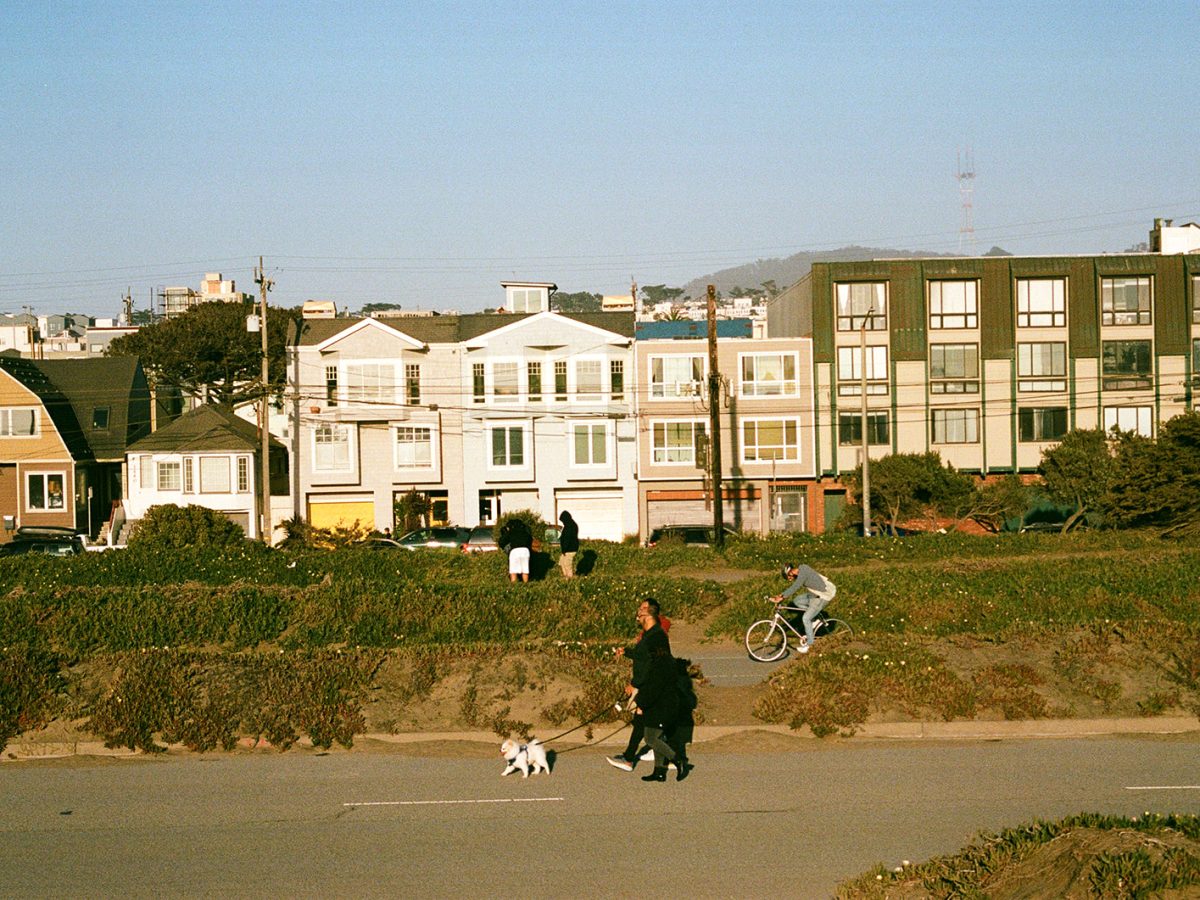
For most of District 7, those good old days never left. The area is, geographically, the largest supervisorial district in San Francisco, and covers a broad swath of the Westside: From the Inner Sunset down to West Portal and along 19th Avenue to Stonestown and Parkmerced.
Much of its housing stock is San Francisco versions of Levittown: Planned communities of low-density areas zoned for single-family homes. The district has more homeowners than renters, and more than half of its homes are occupied by their owners; in the city overall, that number is about a third of homes, according to the campaign data firm Political Data.
Melgar, for her part, is pushing for change: She endorsed the Planning Commission’s upzoning plan, which would allow for more units to be built along select corridors; her opponents have been more critical of the proposal.
In June, Melgar said of a group of neighbors who were decrying new development that they were “not her people.”
That tenor may serve her well come November: While District 7 has leaned more moderate than other parts of the city in the past, the redistricting of 2022 redrew the area’s boundaries, giving the district more progressive pockets. Namely the Inner Sunset, which was previously part of District 5, was grafted into District 7.
Even with that expanded base and the advantage of being the incumbent, however, consultants cautioned that her main difficulty may be the general political environment, locally and nationally.
“Voters are concerned that City Hall is not listening to them,” said Jaye, the campaign strategist. Polling shows San Franciscans think the city has been on the wrong track for going on two decades.
“Every incumbent is swimming against the tide,” Jaye added.
Whitehurst, Melgar’s consultant, agreed that is a challenge, as well as the fact that many in the district still aren’t open to change: “People want the date and time to stop when they arrive in San Francisco,” he said.
“The reality is that things always change,” he added.



District 7 is a fan of change – good change. If supporting a leader like Myrna Melgar means we are evolving, please make me a troglodyte. We have received no good change from Myrna.
Melgar listens only to Melgar. She doesn’t hear or care about her constituents.
Her record?
Melgar politicized a tragedy and essentially told her community of angered West Portal business owners to shove it after a meeting, and proceeded to implement her own plan on fixing streets that didn’t need fixing.
Melgar wants more housing in Stonestown, but has no transportation solutions for the west side. Bikes for all?
Melgar wants a fake “park” instead of a roadway, knowing fully that it will harm her constituents and anyone who needs to travel on the Great Highway, a road essential to their livelihoods.
She and the SFMTA engineered a car lane removal on Lake Merced Boulevard to put in a concrete protected bike lane at significant cost when there was a BIKE PATH already available. Now we have a painted lane that sits UNUSED and traffic that no longer flows. Again, fixing a problem that didn’t need to be solved in D7.
Melgar sent her aide Jennifer Fieber to a Parkmerced residents meeting with her notepad and never came back – never followed up. Melgar showed up over there exactly once – when she dropped by the coffee shop to campaign.
Melgar QB’d the unlawful RV convoy from Winston to someone’s fenced off lot to Pomeroy. When Pomeroy threatened lawsuits after being dumped on with RV’s for years, 20 unvetted (per SFHSH rapid re-housing rules) RV inhabitants moved in to Parkmerced. She had four years to come up with solutions, and only did so when she could make herself look respectable for the local media during an election season. The residents of PM were told they were all families. They’re not so sure. She turned a deaf ear repeatedly when residents asked for a meeting with her and management for clarification.
Squalor and crime have now moved into D7. We have not seen this on any level before. Melgar lets RV squalor fester on Lake Merced Boulevard – broken laws, broken windows, ADA violations galore – her and the city’s indifference destroys residents’ safety and quality of life.
She happily voted to de-fund the police and SF is now down 500 cops from baseline levels. Citizens have seen the results all over the net and news for years- bipping, break-ins, Do you feel safer in SF?
Melgar will not prosecute ANY Honduran Fentanyl dealers.
She lets her ideology trump common sense reality EVERY TIME.
Melgar has not only been ineffective, but a disaster for the residents of D7. This upcoming vote is crucial for determining the future of not only D7, but San Francisco – the MOST important vote in over 30 years for not only cleaning house of harmful ideologues, but a borderline corrupt, phone-it-in mayor, also.
Matt listens. Matt shows up. He was pulled into this race by his concern for the community. His family built a successful business from the ground up and should not be denigrated for their success. He is a long time local with a common sense approach who cares about his home and is concerned about the safety and quality of life of all his hopefully soon-to-be constituents.
No supervisor prosecutes Honduran fentanyl dealers, or anyone else. What does that have to do with this race? Your candidate isn’t running for DA.
Just a mention of how she is using her position.
Sup. Dorsey pushed for The City to make an exception to its sanctuary ordinance and help federal authorities deport accused or convicted drug dealers. Melgar voted against the proposal and then led a protest against the proposal on the steps of City Hall.
She stated, “To focus on a nationality specifically, and to concentrate a solution on stripping folks of due process and their civil rights, follows a playbook that was used by the German government starting in 1935 and is totally counter to our San Francisco values.”
https://www.sfexaminer.com/news/politics/sf-supervisor-defends-hondurans-after-city-drug-trade-report/article_c4bb5f90-25c0-11ee-8301-4bd4d3fbc311.html
Yeah, sorry, bro, I will never bother to vote for someone who doesn’t bother to vote. Period. There’s nothing more pathetic than a trust-fund baby who believes that the silver spoon he was born with somehow qualifies him to do anything.