

Mission Local is publishing campaign dispatches for each of the major contenders in the mayor’s race, alternating among candidates weekly until November. This week: Mark Farrell. Read earlier dispatches here.
An eye-watering $24 million has already been poured into San Francisco’s forthcoming November election — with half of that spent on the mayor’s race alone.
Mayoral candidate Mark Farrell’s fundraising is a good chunk of that. In total, Farrell has over $1.8 million in his corner. About a third of that is from direct fundraising to his mayoral race, another two thirds from a handful of large donations to a ballot measure committee he created to support TogetherSF’s proposition to reform the city’s commissions, expand the mayor’s powers, and diminish the Police Commission’s might while elevating the police chief’s.
Let’s take a closer look.
New pro-Farrell PAC
Farrell may soon join Mayor London Breed and Daniel Lurie, both of whom are backed by political action committees in the race that are amassing vast sums, with a PAC of his own: A pro-Farrell independent expenditure committee, “Safer San Francisco for Mark Farrell for Mayor 2024,” was spun up on July 25 by Angus McCarthy.
That name may be familiar to close readers of San Francisco’s corruption saga: McCarthy was the ex-president of the Department of Building Inspection oversight commission and the subject of an investigation called for by the Board of Supervisors over irregularities in permitting applications at his home.
PACs and ballot committees can receive unlimited funds — unlike campaign committees, which are subject to a contribution limit of $500 per person.
Though the pro-Farrell PAC has only taken in $10,000 so far, it could start amassing more soon, like Farrell’s rivals: Lurie’s overall fundraising has eclipsed that of his opponents at $6.6 million, $5.2 million of that from the pro-Lurie PAC; Breed overall has raised over $2.8 million, $1.9 million of that from the pro-Breed PAC.
None of the candidates can coordinate with the PACs that support their campaigns, but those PACs can fully invest in campaigning for the candidates.
Farrell’s ballot committee and commingling funds
Meanwhile, Farrell has already raised over $1.8 million through his ballot measure committee, which can accept unlimited donations and is not subject to the $500 contribution cap. Farrell must use this money to support the measure, but he can still prominently feature himself in TV ads and mailers so long as he does not mention his mayoral race.
Farrell’s team has drawn scrutiny for commingling his ballot committee’s expenses with those from his own campaign: The campaign has racked up over $125,000 in shared expenses. Those payments have covered a portion of the Farrell campaign staffers’ salaries and office rent, according to filings.
But it is not clear the ballot measure is sharing office space in practice. This week columnist Emily Hoeven from the San Francisco Chronicle paid a surprise visit to the Farrell campaign headquarters. She was told by Farrell’s campaign manager, Jade Tu, that their team did not have any literature on the ballot measure and that their office was primarily used for the Farrell campaign — counter to the claims in finance filings.
Paying for the office — and other campaign infrastructure — through his ballot measure but using it largely for his mayoral campaign would be an end-run around campaign donation limits. Farrell could effectively subsidize his campaign costs by accepting unlimited donations into the ballot measure committee.
This month, filings showed a handful of new donors to that committee, including billionaire John Pritzker ($100,000 this month, $200,000 total), tech investor Blake Byers ($50,000), and entrepreneur Tom Chavez ($25,000).
“ [Farrell] is very focused on a very center-right coalition that tends to be people that have money,” said Jim Ross, a longtime Bay Area political consultant. The “universe of people” who Farrell is trying to appeal to are typically homeowners, business owners — those with means, Ross said.
Given that, you would expect Farrell to have raised more directly, said Ross. But that’s not the case, when three of the top candidates are also targeting that same base. “The top three candidates are splitting that wealthier, ‘people with money’ universe,” said Ross, referring to Breed, Lurie, and Farrell.
And they are certainly getting involved: As of last week, 24 percent of all funds poured into the local November races came from only 10 donors. And for the most part, those donors are not splitting their tickets across multiple mayoral candidates.
For instance, Miriam Haas, Lurie’s mother, has given $1 million to the PAC supporting her son; Chris Larsen, the CEO of Ripple, has backed Breed and given $400,000 to the PAC supporting her; and Thomas Coates, managing partner at a real estate firm, along with his wife Linda, have contributed $500,000 to Farrell’s ballot measure committee.
Interestingly, the Coates donation is linked to Neighbors for a Better San Francisco, a wealthy public pressure group that has backed Farrell and Lurie and faced criticism for its apparent ties to the Farrell campaign.
On June 18, six days before Neighbors announced it would officially stay out of the mayor’s race and would not create a PAC to back any candidate, the group refunded Coates $500,000.
Then, within 10 days, Coates and his wife sent that same amount to Farrell’s ballot measure committee. Coates, a longtime District 2 resident and fierce rent control foe, has a history of backing Farrell. The timing suggests he believed the donation would do more good for Farrell in his ballot measure committee than in Neighbors’ war chest, particularly once Neighbors opted to stay out of the mayoral race.
Several other Neighbors donors, like Pritzker and Bill Oberndorf, have also sent money Farrell’s way.
Farrell is steadily fundraising
In terms of direct fundraising, Farrell is behind Breed, Lurie, Board of Supervisors President Aaron Peskin and District 11 Supervisor Ahsha Safaí. This is likely because the Farrell campaign also has not yet received any public financing, but it will.
But Farrell also started much later than some of his opponents — and on average, has been gathering larger contributions to his campaign.
Streams of money raised month-by-month

Daniel Lurie
Peskin joins the race
Farrell joins the race
London Breed
Ahsha Safaí
Mark Farrell
Aaron Peskin
February
March
April
May
June
July
2024

Daniel Lurie
Peskin joins the race
Farrell joins the race
London Breed
Ahsha Safaí
Mark Farrell
Aaron Peskin
Jan.
Feb.
Apr.
May
Jun.
Jul.
Mar.
Note: Includes funds received through public financing.
Graphic by Kelly Waldron. Source: San Francisco Ethics Commission.
Farrell’s campaign received higher contributions than those of his opponents: $402 on average, among donors who gave at least $100 in total (smaller contributions are not itemized and those small donors are not disclosed).
Farrell is reliant on his home base
Farrell lives in Jordan Park, and for seven years served as the supervisor for District 2, which includes the Marina and Pacific Heights.
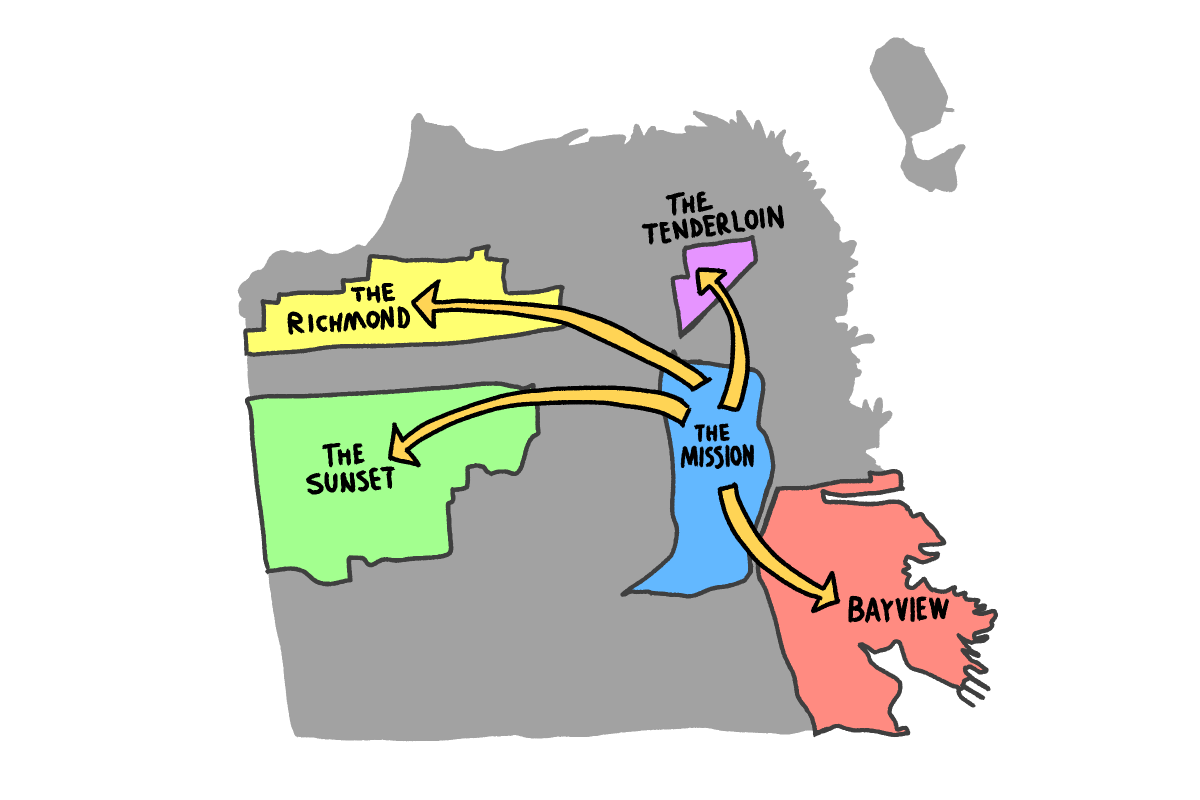
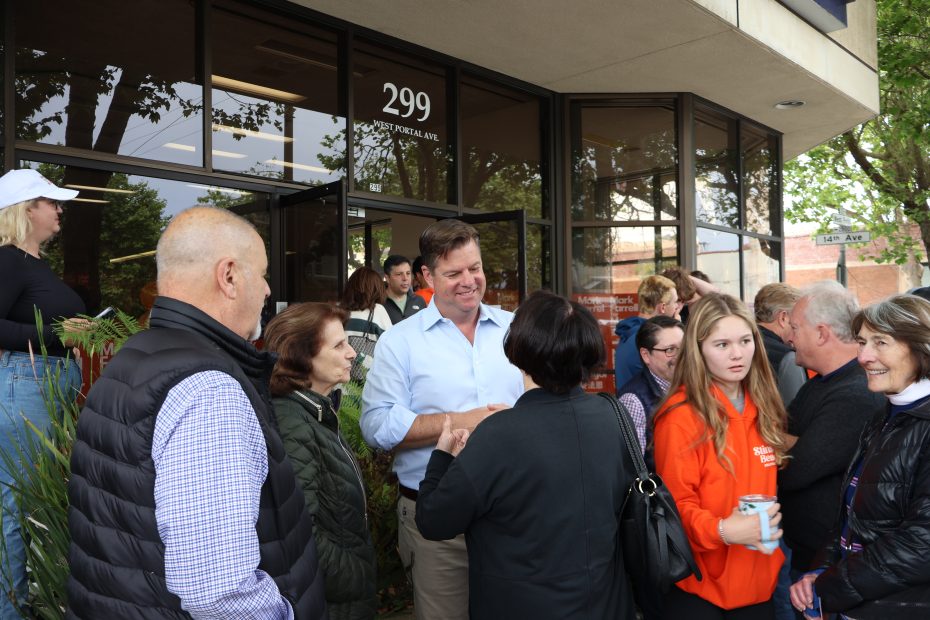
A closer look at where his donors to his campaign live shows that the majority of his supporters come from areas that generally lean more conservative, including his home base and the surrounding areas such as the outer Richmond. Farrell also appears to have a strong base in West Portal, where his campaign headquarters is located.

Look, he’s just a small business man. Not like a lawyer or investment banker. He’s just the “pop” of “mom and pop.” Oh, and based on the graph, the struggling small business owner’s entirely non-corrupt and non-ethically compromised campaign hasn’t gotten much of the green lately.
Bobbing around like a soggy crouton on a soup of corruption. This doesn’t bode well for City Hall ethics should he win.
What do we make of the defense that the ballot placement on the Props was just decided? (Apparently making it tough to have printed materials yet?)
Since he is ethically challenged, I don’t buy it.