


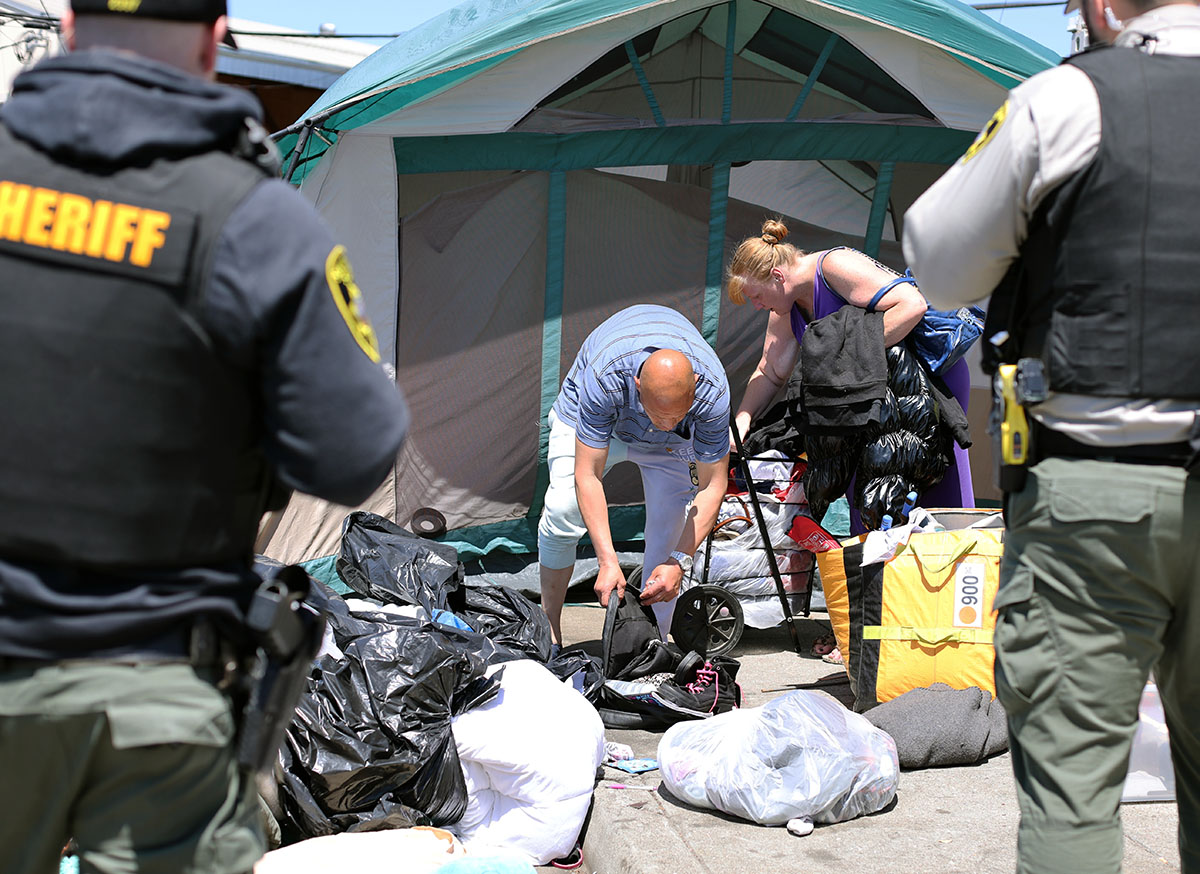

On July 18, Mayor London Breed said that the city would begin “very aggressive” sweeps of homeless encampments. The goal, Breed said later, is to make street dwellers “so uncomfortable on the streets of San Francisco that they have to take our offer” of shelter.
Already, police have begun confiscating tents and other belongings in the Mission, and the city put out a public schedule of encampment enforcement. Mission Local is documenting the sweeps as they unfold on Thursday.
At 6:30 a.m., Division Street is quiet. The five homeless residents, expecting a sweep, have been up for an hour, scanning the streets for crews from the Department of Public Works.
By 7:26 a.m., two Public Works trucks are doing laps around Division Street. Cory, 53, is beginning to pack up his tent, deflate his pad, and put the rest of his belongings into his cart.
Lukas Illa, from the Coalition on Homelessness, arrives to tell Cory that he recommends packing up and getting out. Yesterday, they said, the San Francisco police officers arrested those who refused services and shelter.
“I’m so sorry this is happening. This is all fucking bullshit,” Illa says.
“It’s nothing new,” Cory says. “I’ll come back and see what’s going on once I pack up all my shit.”
Illa peeks their head into a tent to talk to Chez, 32, who is still in his encampment, despite disassembling it partially earlier this morning. Yesterday, Chez spent the day preparing for the pending sweep.
They walk Chez through what the policy is, and again recommends getting up and out as soon as possible.
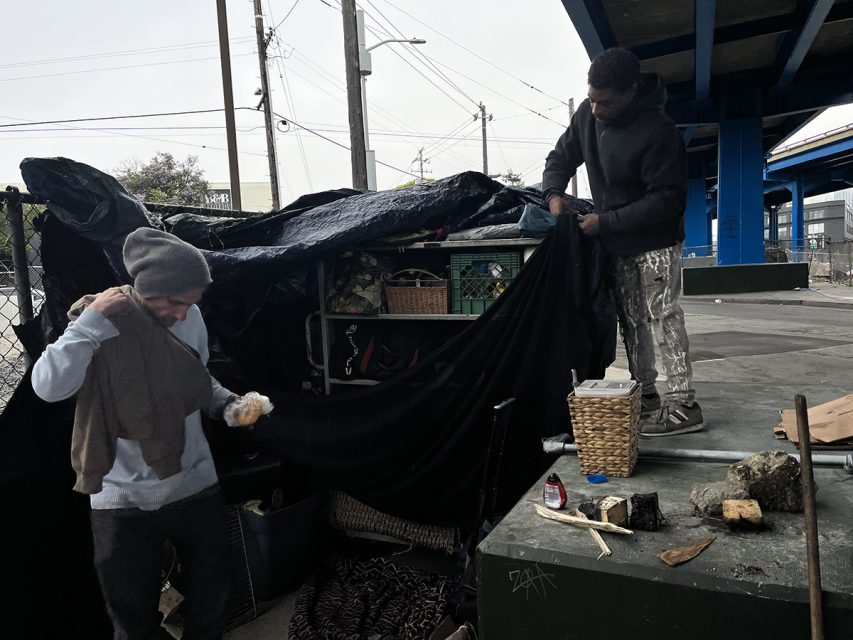
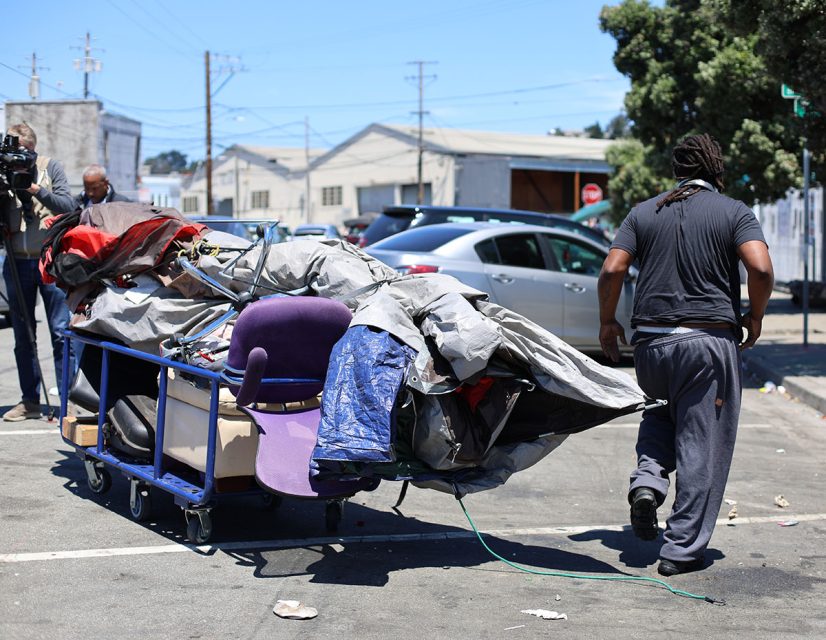
By 8 a.m., Cory has moved to the intersection of Potrero and Alameda streets, his dog, Blueberry, close behind. He’s planning to drop off his cart at his UPS storage container, and then return to scene to observe the sweep.
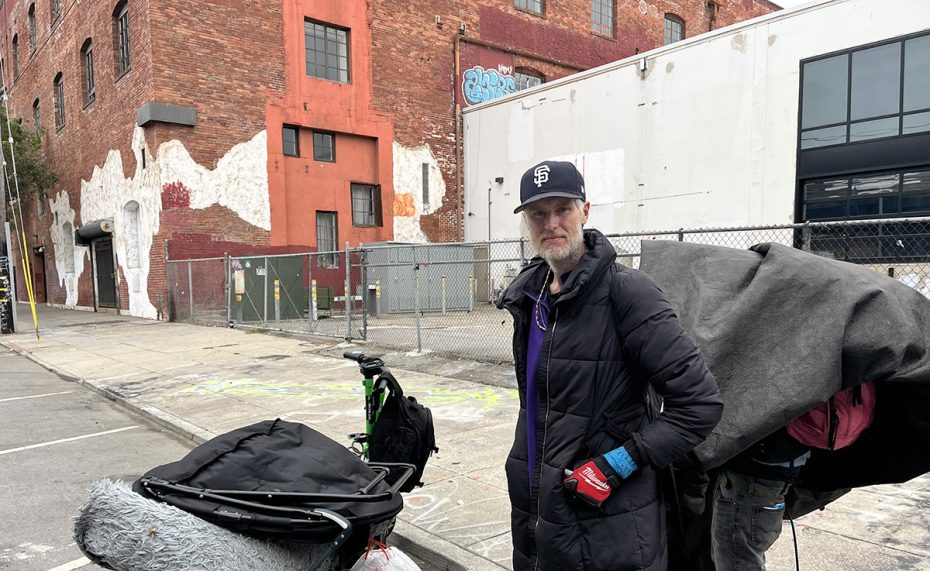
Mike, 40, says he’s been on the streets of SF for a year and a half, and has been through 15-20 sweeps. His things are all packed, and he’s in a rush to get off the targeted blocks. His friend waits behind him, a fleece blanket rests on his back and shields his face.
Mike says this is the first time in months that they have received notice.
Cutting through an abandoned lot on Potrero, the two men are out of sight minutes later. They do not know where they’re headed. If beds are empty, maybe to a shelter. If not, they’ll walk to a different part of town.
A suitcase, a few crates, a stool, and a burlap sack full of clothes sit abandoned on the corner.
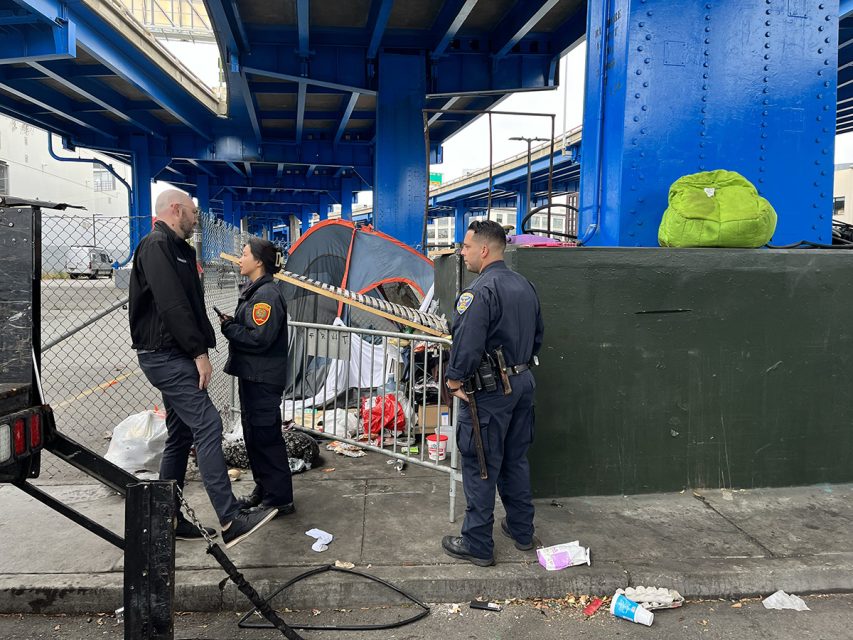
Near 8:10 a.m., four police cars and about a dozen Public Works trucks swarm into the five-block area, where about seven homeless residents have left or are still packing up. They descend upon on an encampment on Divison, right under Highway 101.
The encampment’s residents, Juan and Joy, got out five minutes before.
The couple never saw a notice on their block, but Joy said she had a bad feeling in her bones the night before. She began packing then.
“When you’ve been out here as long as I have, you just know,” she said. “They are predictable like that.”
While city workers load their leftover belongings into garbage trucks and power wash the area, Juan is fighting not to laugh on a corner a block away. The city’s response, the number of police officers, and the probable cost of the whole operation are hilarious to him.
About a month ago, he was arrested in nearly the same spot for “illegal lodging,” and had missed his court date. He couldn’t risk another arrest.
“Last time, there were eight police that arrested me. Eight!” He gestures to his small frame, and wipes tears of laughter from his eyes. “It’s crazy. It’s just crazy.”
The couple’s narrow escape was credit to a neighbor that shook their tent at 6:30 a.m., warning them. They rushed to pack, and when they saw a garbage truck go by, they knew it was time to go.
At 8:30 a.m., Juan leaves the corner of Division and 8th where he had been watching their encampment get cleared to find Joy. She’s sitting, head down, on the curb between a cart and a loaded bicycle on the corner of De Haro and Alameda streets.
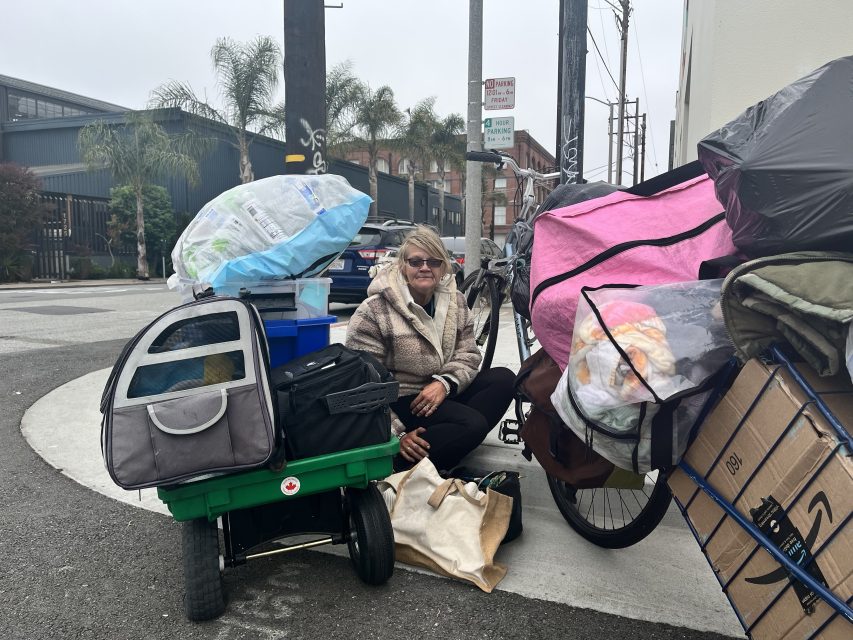
She wants to go to the railroad tracks nearby where she heard sweeps rarely occur. But Juan is set on returning to their spot on Division Street the minute the police and Public Works leave.
Joy said she is worn down, but used to the feeling.
“Why does it have to be a spectacle?” Joy asks. “And the amount it must cost them … “
Across the street, Chez drags his cart to a stop and takes a seat on the side of the road. He’ll be there until city workers clear out. Then he’ll return to Division.
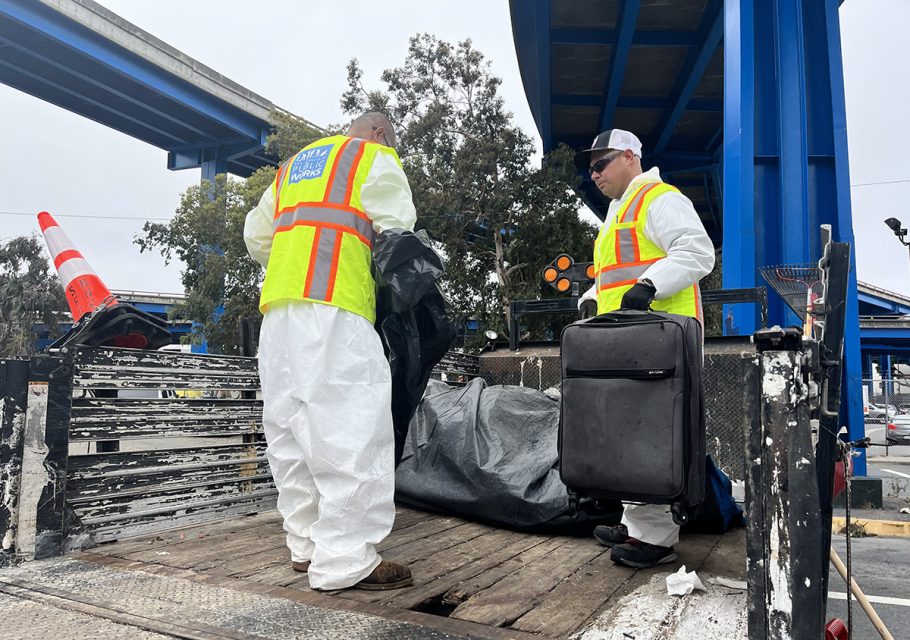
Around 8:45 to 9 a.m., back on Division, Public Works staff move onto the next site: a large empty blue tent on the corner of 9th. In minutes, police gather and two pick-up trucks and one trash truck are on hand. Three workers with Public Works surround around the uninhabited tent and begin taking it apart.
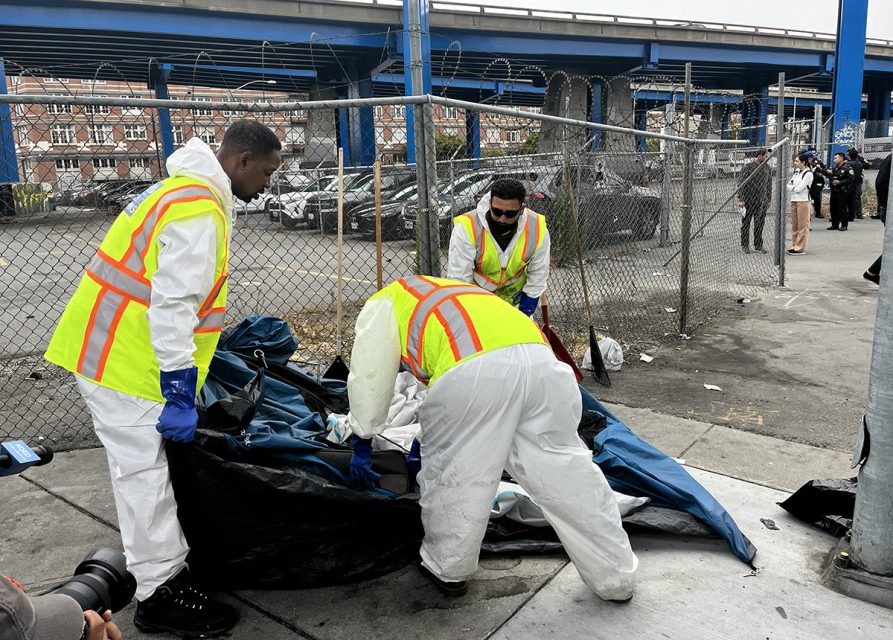
Inside the tent, there’s a sleeping bag, a suitcase, a backpack, and a few pieces of clothing in the corner.
The workers drag the the remains of the tent onto the bed of the truck, items still inside. Illa is demanding that the city workers follow city policy and bag-and-tag the items. Eventually, the representative with the Department of Emergency Management agrees.
“This happened because I demanded it to happen. I said this tent is unattended, not abandoned; they never bag-and-tag,” Illa said.
Once the tent and suitcase are in the back of the truck, Illa checks again to see if it is being bagged and tagged. After some more conversation, the city workers get some trash bags and start bagging the items. The truck drives away at 9:15 a.m.
By the time the sweep happened, nearly all the campers had left or were leaving.
—Zenobia Lloyd
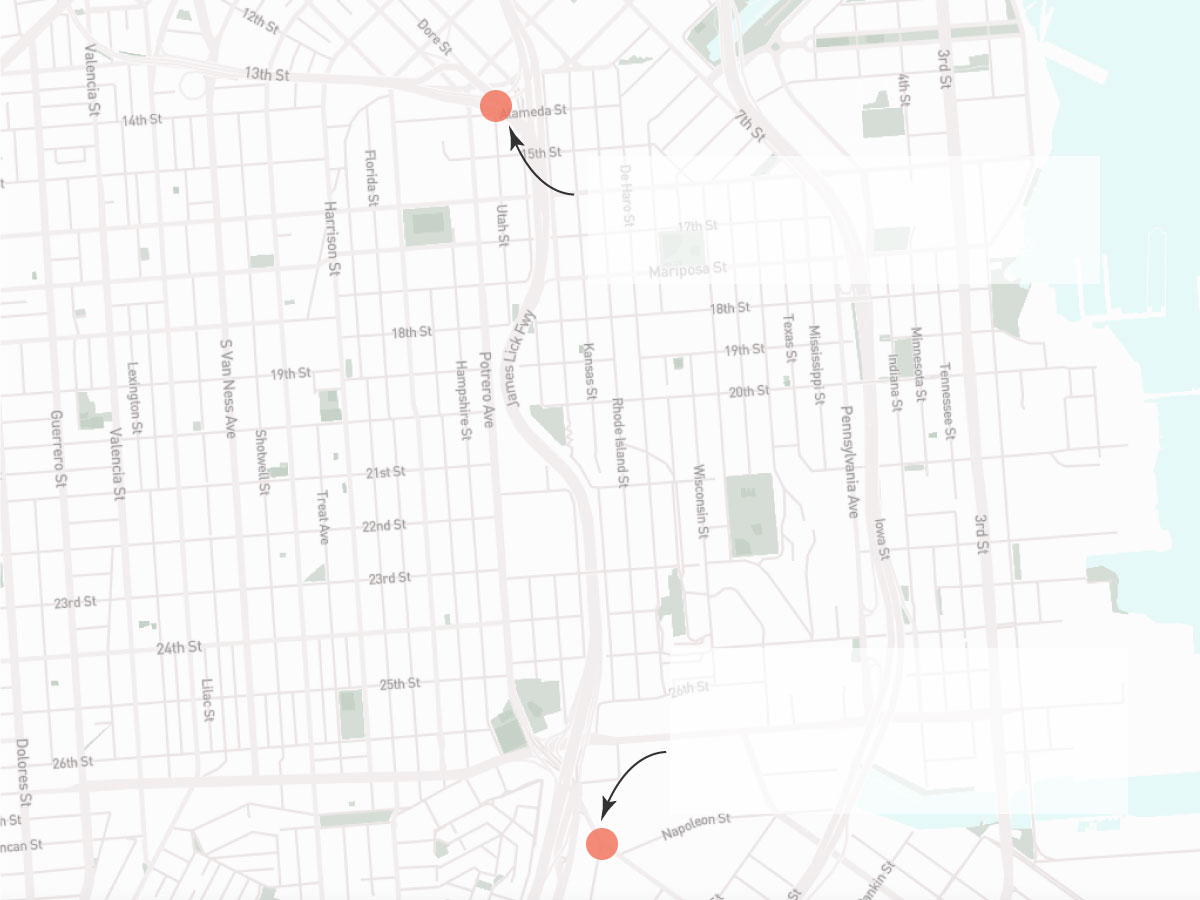
Division Street Sweep
On Division Street under the highway.
The sweep started at 8 a.m.
Bayshore Sweep
Over on Bayshore directly
across from a Navigation Center.
The sweep will start at 1 p.m.
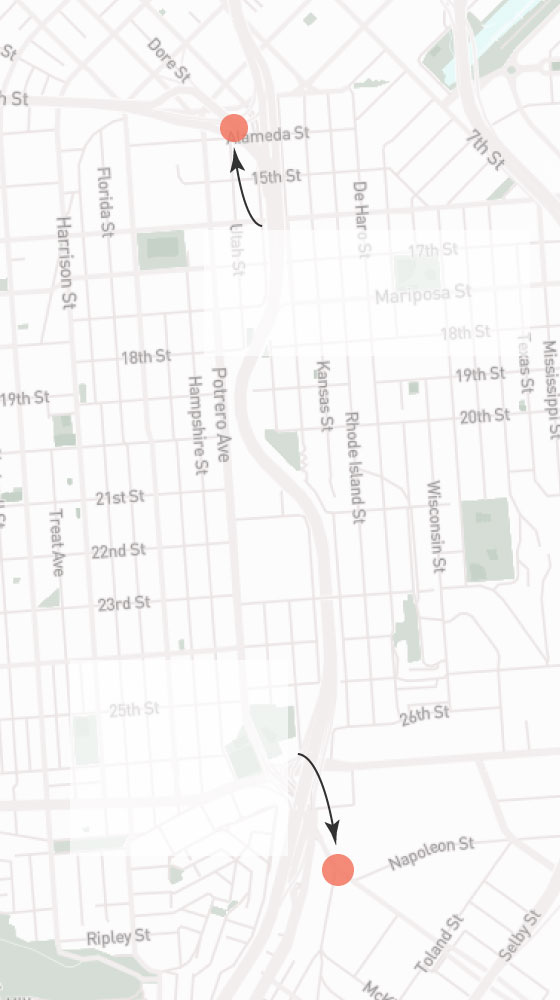
Division Street Sweep
On Division Street
under the highway.
The sweep started at 8 a.m.
Bayshore Sweep
Over on Bayshore
directly across from
a Navigation Center.
The sweep will start
at 1 p.m.
Map by Xueer Lu. Last updated: 11:30 a.m. Aug. 1, 2024
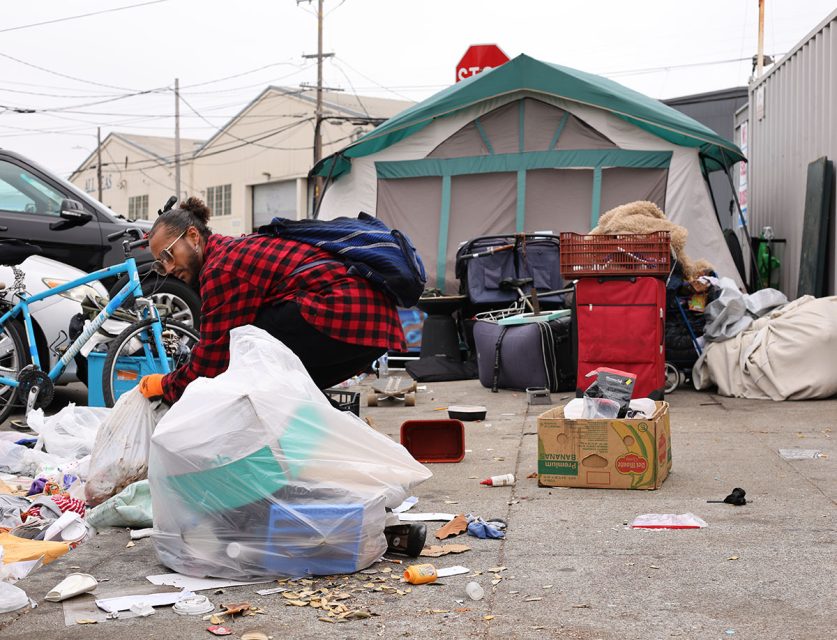
Meanwhile, at around 8 a.m. on Barneveld and Jerrold Ave. near Bayshore Boulevard, another dozen or so homeless residents in two different encampment groups await a 1 p.m. sweep. A few of the residents say they have beds at the navigation center across the street, but prefer being outside where, they explain, there’s more privacy.
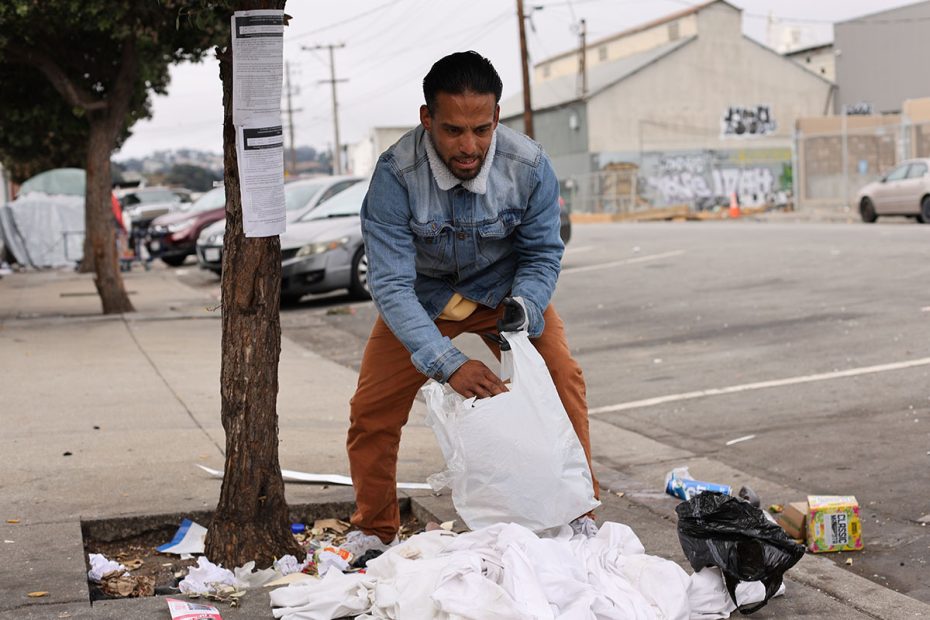
While the Division Street camps are being swept, residents of Barneveld Ave. are cleaning up their belongings, and removing trash from the street “to make things easier for [the Department of Public Works employees],” says Miguel “Pineapplez,” 33, who is one of the residents who has a bed at the nearby navigation center.
Pineapplez anxiously packs up his things, looking up and down the street for city employees as he talks.
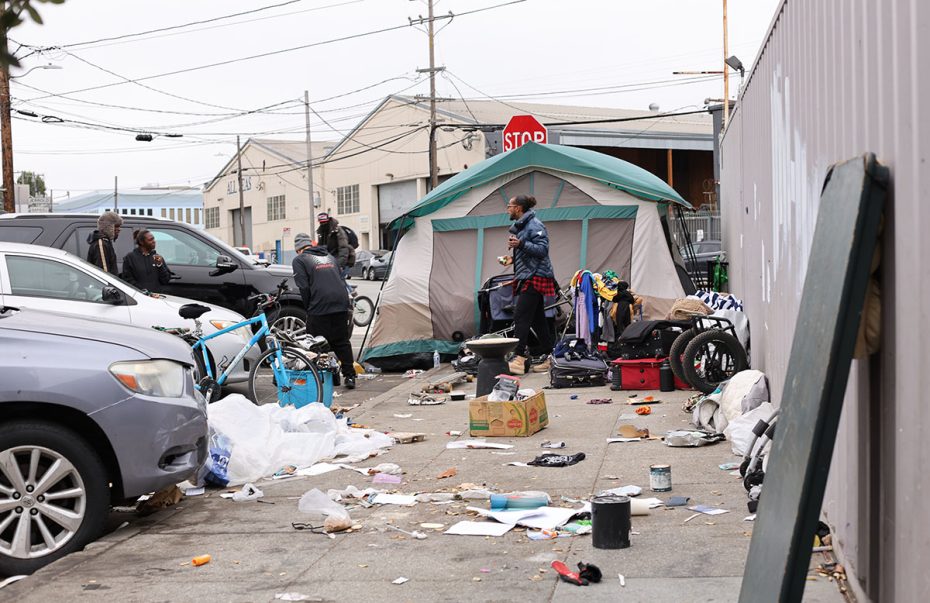
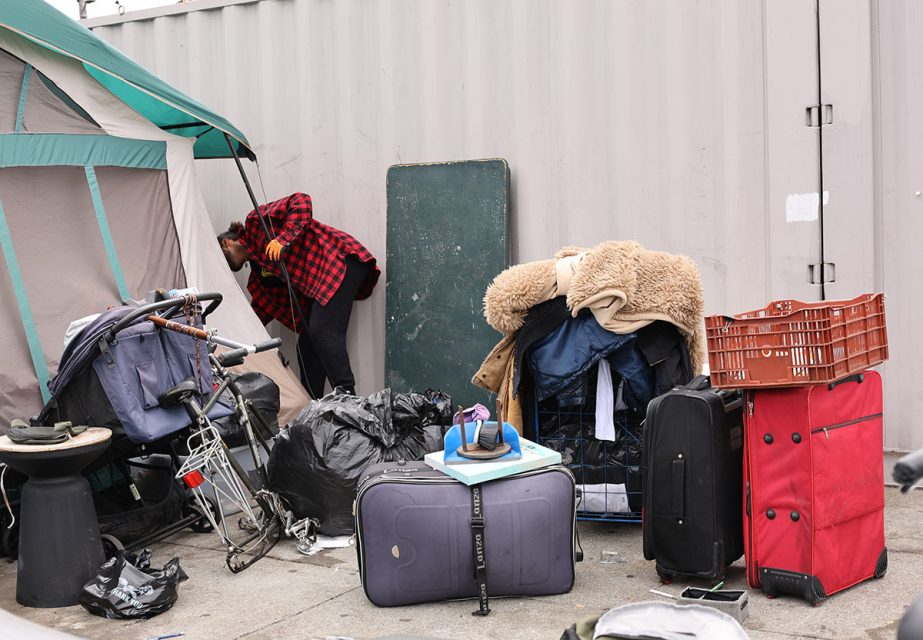
The street residents around Bayshore expect their furniture and tents to be confiscated. Sweeps happen every week, they say, and they rarely get their belongings back.
“They kicking us out of here, bro … why help them do anything?” asks Deshan Card, 32, who also has a tent on the block. Justin Genochino, 40, a friend who used to live with them, continues to help clean up the street.
“It’s our city, too,” Genochino responds.
At the same time, residents of the other encampment on Jerrold Avenue pack up their things directly across from Fire Station 49.
Damien, a friend of the group, describes being “51-50ed” by fighter fighters a few weeks prior — taken in for an involuntary psychiatric hold.
The campers had originally planned to move to another block today, but learning that the mayor has promised aggressive sweeps, they consider a bigger move.
“People here don’t have legal resources and they’re really barely available,” Damien says as he describes previous encounters with law enforcement.
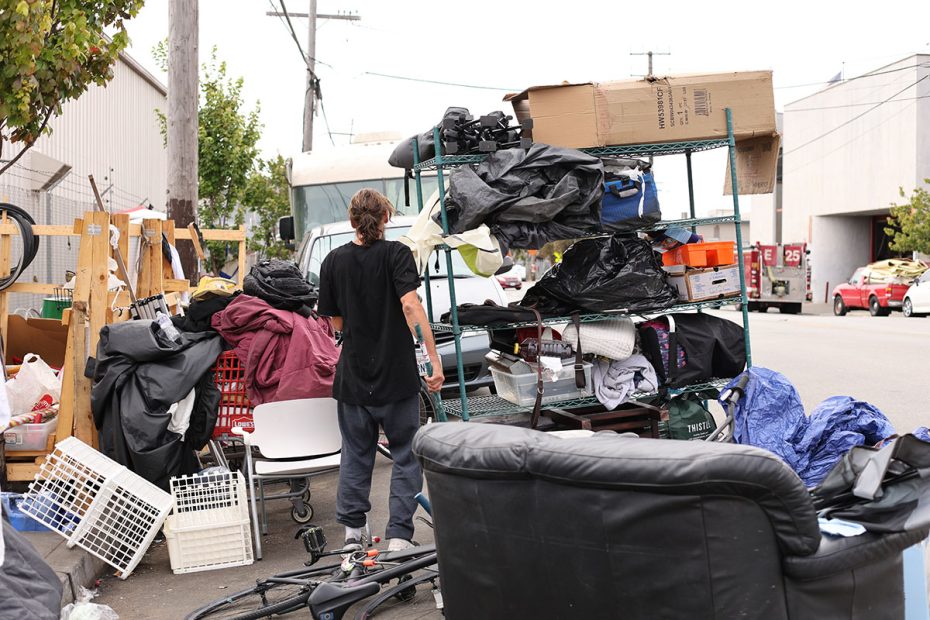
“They have violated and disrespected us so many times,” says Pineapplez.
City employees have confiscated the strollers and dollies Pineapplez used earlier to wheel his things around. Not having them makes it especially difficult to move, he says. Now he carries his bags by hand.
Pineapplez usually tries to leave before city employees force him to, but a notice taped to a tree by his tent failed to specify what time they would arrive. As a result, most of the morning is spent waiting and worrying.
He says that sometimes, if the agencies drive by and see that people are already packing up, they leave them alone that day.
“I think they’re trying to keep us on our toes.”
Other times, he says, the Department of Public Works and police come without notice and he often returns to find his things gone. On a few occasions, when he tried to collect his possessions, he was told there was nothing under his name.
When asked where he plans to go next, Pineapplez says he might try to find a less visible spot underneath the freeway. But moving “takes a lot of work and a lot of time. So a lot of times we don’t get to go too far,” he adds.
Pineapplez understands the city’s goal to end outdoor homelessness. “But they have to understand, even if some of us have a shelter bed, we still are fighting for like a little bit of privacy, a little bit of alone time,” he says.
One of Pineapplez best weeks in recent memory was when he got Covid-19 while staying at the shelter. He was sent to an isolation hotel room, where he got to be “at ease … peaceful.” He was alone with his own shower for the first time in ages.
“It was such a blessing. I was so thankful I hardly left the room.”
At 12:59 p.m., city agencies have arrived in Bayview.
The scene is mostly calm, with one Public Works staffer and one police officer taking photos.
The camera crews and photographers also arrive. In seconds, a site that was relatively calm feels sped up, confusing.
Most people have already left the street. Those left continue to pack up, but are now surrounded by journalists. City workers have not begun removing belongings yet.
One fire department paramedic asks a couple in one tent if they want shelter. When they decline, the EMT says she understands.
A group of city officials is standing aside as people finish packing up. No one is offered a bus ticket out of town, despite Mayor London Breed’s executive order directing all city workers to do so before providing other services to unhoused people.
Waiting nearby: three police officers, four sheriff’s deputies, and one paramedic.
People are drifting in and out to pick things up. Everyone seems to know the routine.
By 1:15 p.m., around a dozen officers and another 10 workers with Public Works, the Department of Emergency Management, and the Homeless Outreach Team have arrived. Deshan Card is instructed to pack up his tent.
Ronald, who has a shelter bed in the navigation center across the street, is arrested under California Penal Code section 647(e), which prohibits illegal squatting or lodging. He is handcuffed and escorted to a police van as he yells at officers.
His girlfriend Becca, the only woman living on the block, cries to a Department of Emergency Management officer, who escorts her back to their tent to collect two bags of her things. Her sobs can be heard from outside the tent.
“We let them know that the policies are changing,” an officer says.
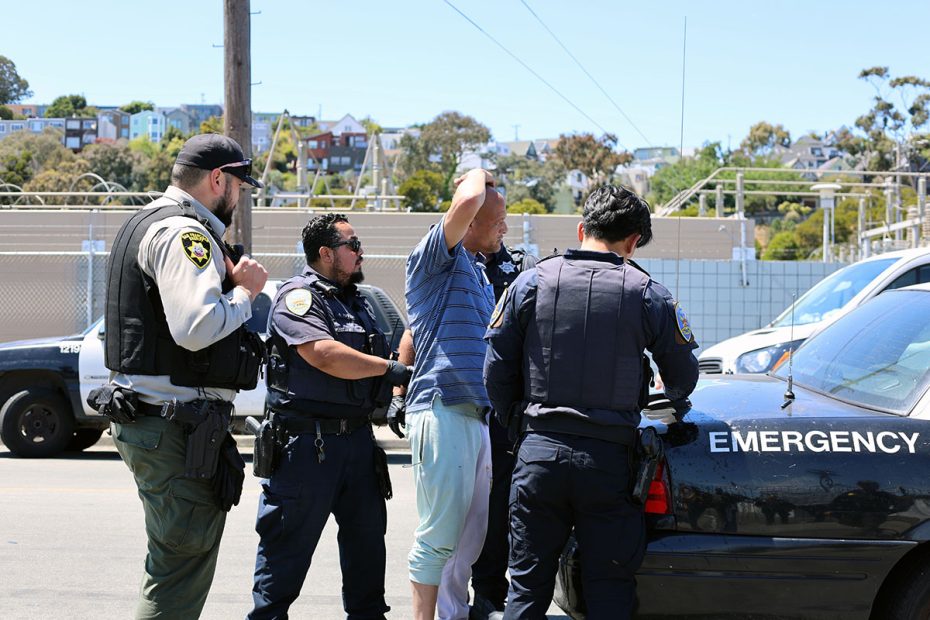
In the meantime, Public Works agents in yellow vests enter the couple’s tent to “bag and tag” their belongings.
Ronald, who was arrested, is fingerprinted and then released. He will have to appear in court. Officers warn him not to return to his tent, which triggers a screaming incident.
Becca is sorting through bags trying to find her phone and begs Ronald to help her so “people can stop staring at me.”
Ronald, however, is dumping bags of their things on the street. The navigation center where he has shelter, he says, “aren’t going to let me take it anyway.”
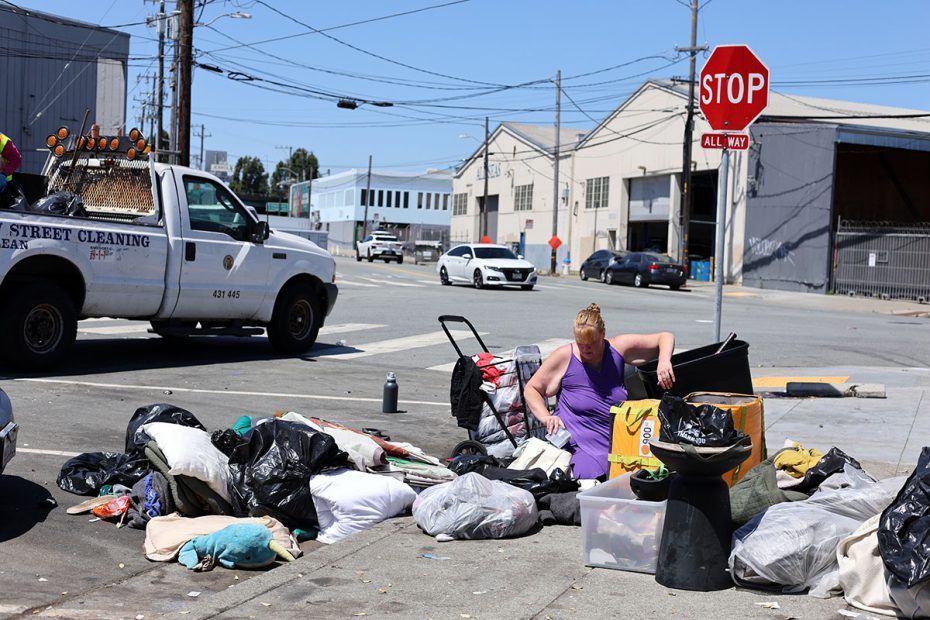
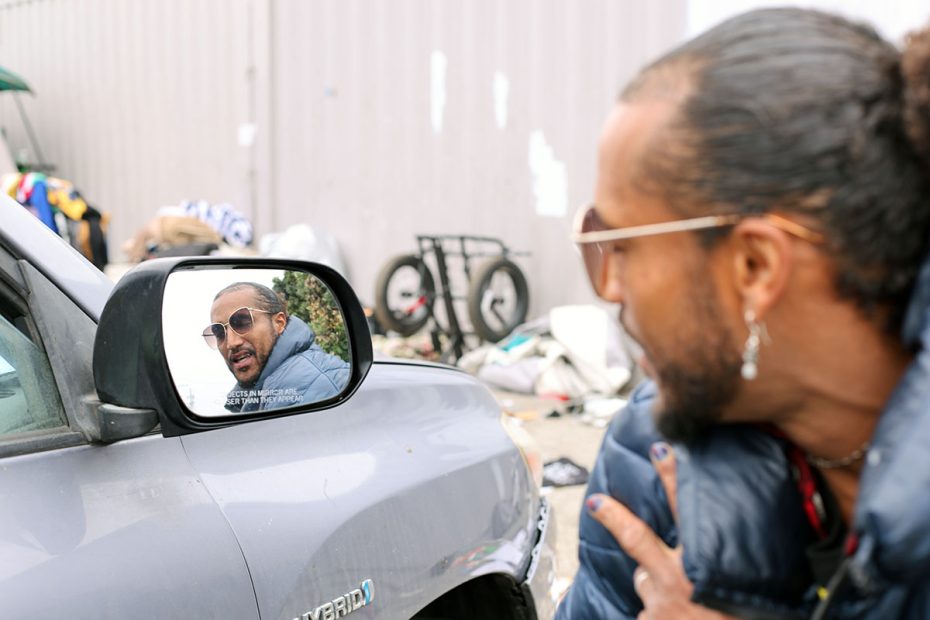
By 3 p.m., the tents across from the navigation center had been removed, and the street cleaned. The car with the bent mirror in front of which Pineapplez practiced his dances is towed.
Bags of Ronald and Becca’s things are tossed into a Public Works truck. Becca sits across the street as Ronald wanders up and down the block, shouting. She says she had not been given any information about where to collect her belongings, and was merely informed that there was a bag and tag policy and that she had a bed at the navigation center.
No additional services or literature were provided to anyone on the block.
Becca says the couple plans to find a new spot under the freeway.
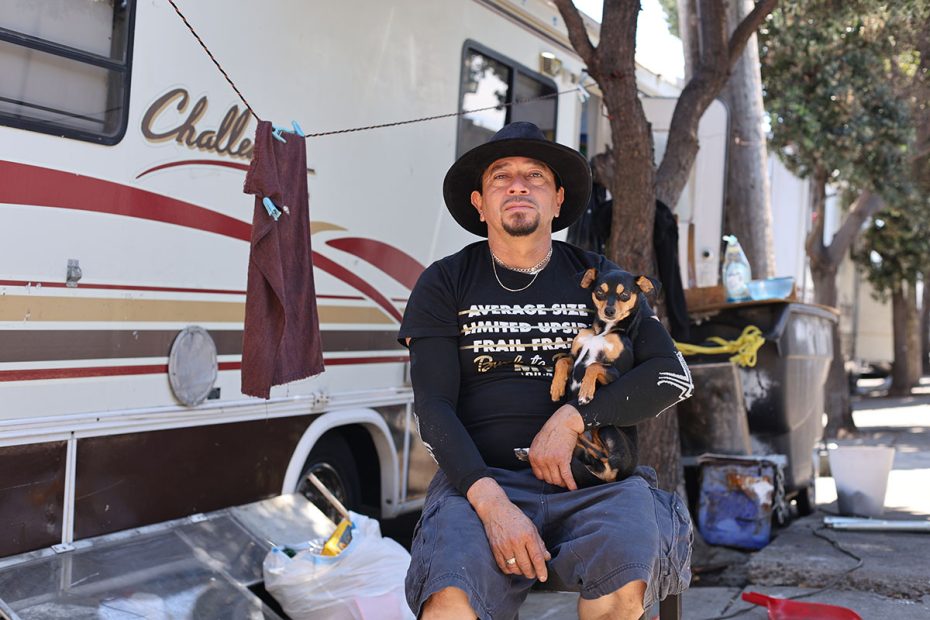
Fearing that his RV will be towed, Rafael Solomé Romero, 52, paces up and down the block, only returning inside when he hears it won’t happen until Monday. Last time, it cost him $2,000 to reclaim his vehicle.
Two officers and the fire department paramedic move to Jerrold Avenue where most of the six or so residents who were there earlier in the day have already packed up and left.
The workers make one remaining resident pack up his tent while employees tear down the remaining two wooden structures.
Across the street a former resident of the encampment watches. He’s sitting in a chair; three suitcases beside him.
— Abigail Van Neely
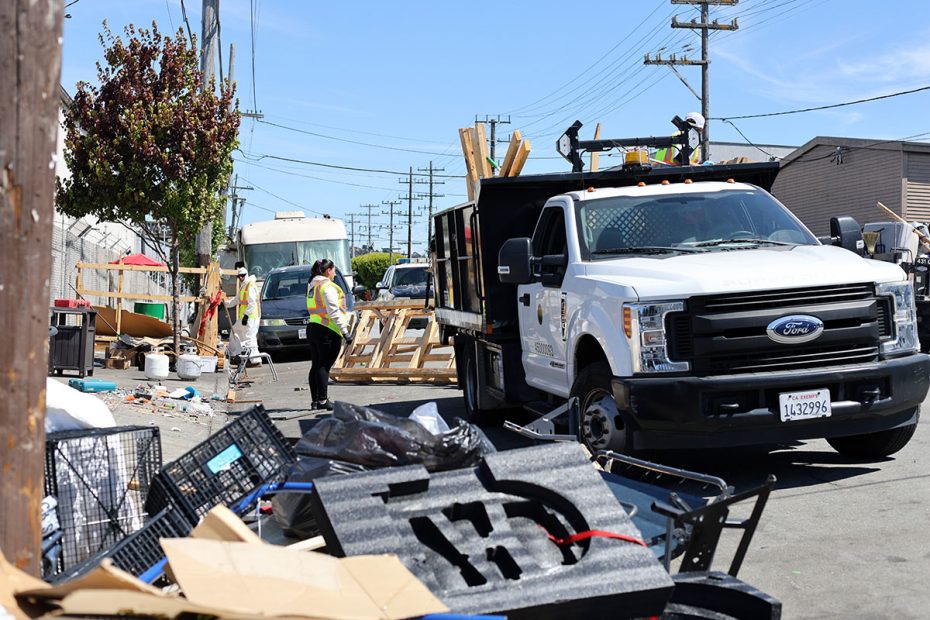
> A couple of the residents say they have beds at the navigation center but prefer being outside. There’s more privacy, they explain.
I believe HSH assured the regular residents of San Francisco this never happens.
Yes! Thank you, Governor Newsom and Mayor Breed!
Please sweep Folsom Street next.
How long does Pineapplez expect the San Francisco government to pay for private lodging that meets his standards? 1 month? 12 months? Forever?
SF has to make a commitment to create a humane space for people while maintaining the streets outside shelters so as not to disrupt the neighborhoods that host them. Maybe not private showers, but some place clean, quiet, and allows for dignity.We should put more money into quality shelters and less into corrupt non-profits and failed Housing First programs. The city needs to triage its street homelessness through more shelters and more recovery beds. For now, that is where the money should go.
Yeah Lucas total BS to deny a spot in a shelter, deny offered services and choose to be arrested.
Thank you London.
I do feel bad this is happening to them but you’d be surprised at the number of people who actually prefer to live on the streets. I agree with a previous comment about how we’ve tried the less “aggressive” way of addressing homelessness and it seems to have worsened. I hope they take up the offer to either reconnect with family or relocate. Ultimately, it’s their choice. The resources are and have been there to help them recover and find housing – which is likely why they come here. It’s easy, comfortable. Hoping this approach works!
Thank you Zenobia Lloyd and Abigail Van Neely for shining a bright light on these events and people. This is exactly what credible independent journalism is all about…….transparency and accountability to the public .
Who the heck would down vote a commendation of professional, transparent independent media?
We had years to do this the easy way, with advocates proposing and moving their affirmative agenda. But advocates sat on their hands, marked time, lost 6 consecutive ballot measures and demanded the City effectively “be compassionate, do nothing.” Meanwhile, popular disgust with public squalor has only increased year after year.
When are we going to get advocates for homeless people who can play this political hand in a way that does not end up with homeless people being used repeatedly as monetized political piñatas?
I dunno either but “monetized political piñatas” seems like a pretty apt description.
As understood – much of the homeless budget is spent keeping people in their homes. Awesome.
However, going to speculate each homeless person on the street is monetized at around $100K a year split up amongst our “service” entities.
If you’re ass deep in that revenue stream – one might imagine you want to keep it politically flowing.
I want the City to be as compassionate as possible but ultimately, living on public streets is unacceptable and it’s appropriate to ensure it doesn’t happen. Thank you Mayor Breed and Governor Newsom.
Thank you! Thank you! GET THEM OUT IF HERE!
Covering these “very aggressive” sweeps ( that both London Breed and Mark Farrell sanction) is critical. I notice that local tv news (not my thing at all) KGO, KPIX and KRON are all basically reading from Breed’s 11 member Comms team’s press releases. Here is straight up cruel and inhumane punishment of poor, vulnerable and unwell people. It takes courage to cover these events. It takes courage to document these horrors. All very disturbing and haunting to watch human beings commit these acts against other human beings. Thank you Mission Local.
California “liberals” racing each other to enact measurements with maximum cruelty on the poorest of the poor. One’s very existence becomes illegal, not allowed to sleep, have possessions, pets, a community, facing either jail or exile. The only solution is supportive housing, which has worked around the world. But better to ship them out of sight and call it a victory.
Where are they supposed to go. They have more privacy on the street.
Privacy to do drugs and fence their stolen goods. Twice my office on Jerrold had homeless steal stuff from my employees and disappear into their tents.
News has it they’re offered bus rides out of town. Back home, where even more privacy can be found.
As if they’re all just runaways. As if there’s a home to go to. What about the many homeless who have jobs but must sleep in their cars? There are many but it’s never considered.
Yeah well, nice try pulling at the heartstrings. This is about the trashing, torching sidewalk campers. Before the pandemic, the gypsy bus used to depart at the nav center at SVN/Division on a regular basis, we need to return to that.
They are grown adults. They don’t need people in the comments section of a new blog wondering how they will participate in society. Everyone else manages to do it just fine compared to them.