
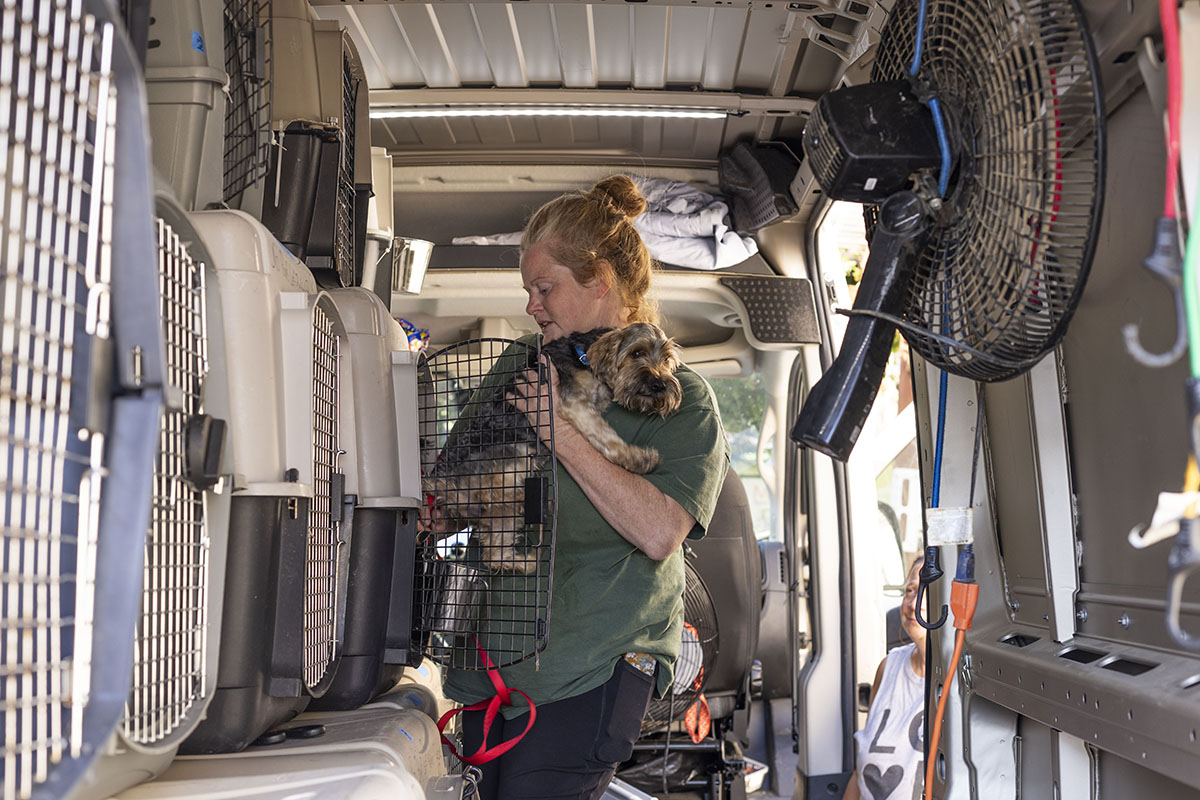

Tabitha “Tabby” Ross pulls her van to a stop in front of an abandoned building in an Emeryville shopping mall. After 11 hours on the road, she springs into action, sliding the side door open to reveal a Tetris board of bungee-corded crates stacked three high. Forty-six dogs and five cats sit inside.
As Ross begins unloading the kennels, placing a large one containing four puppies under the shade of a tree, the passenger door swings open. Zoey, Ross’s eight-year-old daughter, clambers out to join her mom.
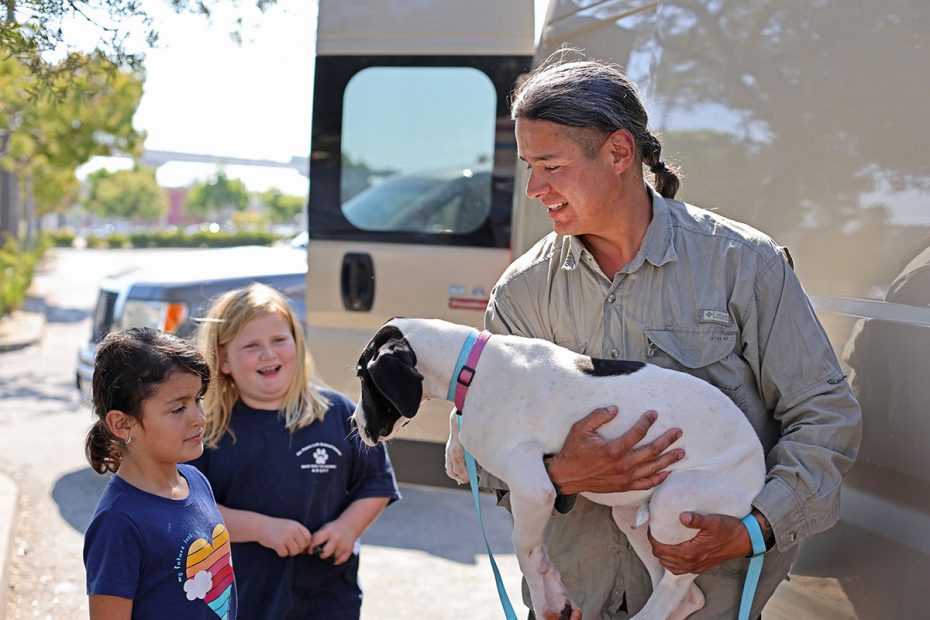
Every Thursday for the last decade, Ross has made the 250-mile journey from her home in Wasco, California, to this meet-up spot in Emeryville. Along the way, she stops at overcrowded shelters in the Central Valley to pick up animals destined for Bay Area rescues. If not for Ross, most of the animals in her van today would have been euthanized.
Ross isn’t the only one who drives animals around California. Every day, a sprawling network, including some 35 steady volunteer transporters, brings pets to places where they’ll have a better chance at finding their forever homes. Most of the animals travel from overflowing shelters in the Central Valley to the Bay Area, including to San Francisco-based rescues Muttville and Rocket Dog Rescue and the San Francisco SPCA. Some, especially big dogs that are hard to adopt out in cities, go even further north to Sonoma and Napa counties, Tahoe, and the Pacific Northwest.
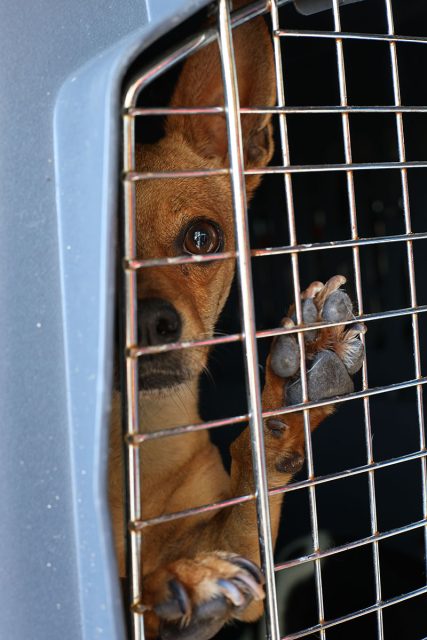
This work has become even more important — and difficult — in the past few years as animals have inundated shelters across the state.
The crisis is especially acute in the Central Valley. Shelters in cities like Fresno and Bakersfield receive dozens of dogs every day, but only a few get adopted. With such an imbalance, shelters have no choice but to euthanize. In 2019, Fresno County’s animal shelter euthanized almost 400 animals. In 2022, it euthanized more than 1,000, according to data on the shelter’s website
Teresa Walker, the founder of No Paws Left Behind, the organization that organizes Ross’s transports, said that a few weeks ago, in preparation for the flood of dogs that always comes after July 4 — fireworks make them panic and bolt — the Kern County shelter euthanized 150 dogs in one day.
The present crisis is, in large part, due to millions of animals having their spay and neuter surgeries delayed during the pandemic. And the problem continues: Though the San Francisco SPCA will occasionally send vets to the Central Valley to do one-day clinics during which they spay or neuter some 80 animals, there’s a shortage of vets in the Central Valley, and many people simply cannot afford the cost of neutering.
Making matters worse, the number of transporters has been dwindling, leaving rescue coordinators like Jennifer Colletto scrambling to fill in the gaps. Former volunteers are no longer able to afford the gas prices, have moved out of state, or have simply become overwhelmed by the “emotional and demanding” work, Colletto explained. But long-time transporters like Ross persist.
“I feel happy, because I know there’s a lot less dogs in the shelter,” Ross says of the transports. “But there’s still a ton that need to be saved.”

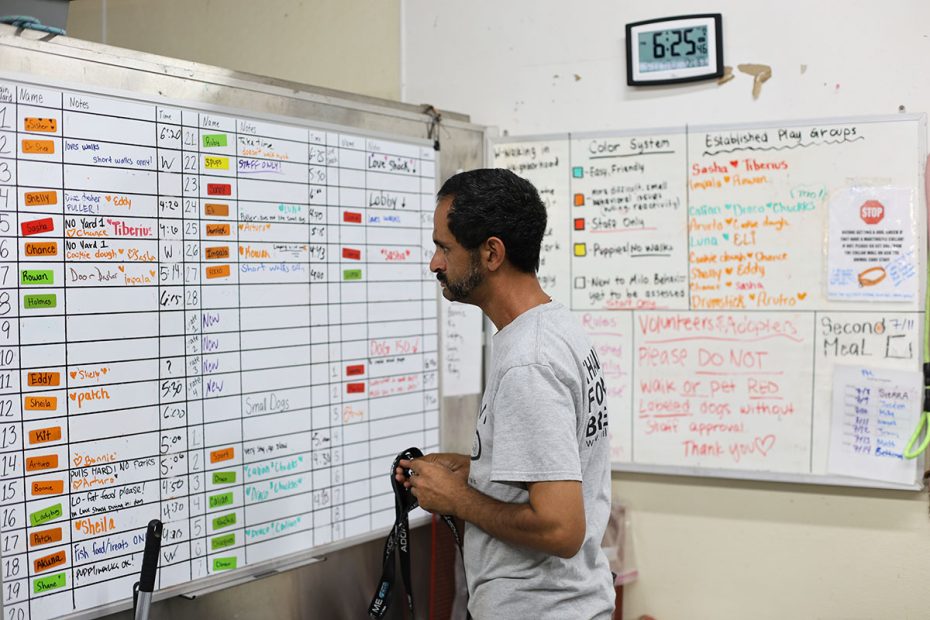
‘Transport queens’
Most Thursdays at the Ross household begin at 5:30 a.m. After loading a half-asleep Zoey into her car, Ross picks up three dogs surrendered by owners in town — locals know to contact her directly — and heads for Bakersfield.
There, Walker waits with No Paws Left Behind’s van and 11 more dogs from Kern County Animal Services. The women briskly sanitize, load and secure the kennels for their 50 four-legged passengers. Walker has arranged transports north for the past 20 years. She retired her last van after racking up 300,000 miles.
But on this day, there’s a hitch. Though Walker has just put a new air conditioner in the van, it doesn’t work consistently. With a heat wave sweeping the region, this is less than ideal. So, the pair rig up fans and procure ice packs for dogs to sit on.
By the time Ross gets to Delano, it’s 90 degrees Fahrenheit outside. They collect a pregnant chihuahua and two terrier puppies. It’s 103 degrees when they pick up more dogs in Lindsey and Visalia, and 112 degrees when they drop off a dozen in Lathrop. The fans whir steadily, but it still smells undeniably like dog, they report.
Despite the challenges, Ross is unfazed. When she nonchalantly mentions that she makes this journey every week, she means every week. If Thanksgiving, Christmas, or New Year’s falls on a Thursday, she might not go that day — instead, she'll go Tuesday or Saturday, or whatever day she can make happen.
As they drive, Ross and Zoey listen to Taylor Swift and Billie Eilish on the radio. Zoey is also fond of the opening song of the "Secret Life of Pets" movie, Ross says when she calls a reporter with periodic updates from the road. They feed the puppies during gas refills, but don’t stop for lunch themselves, instead snacking along the way.
Audio by Abigail Van Neely.
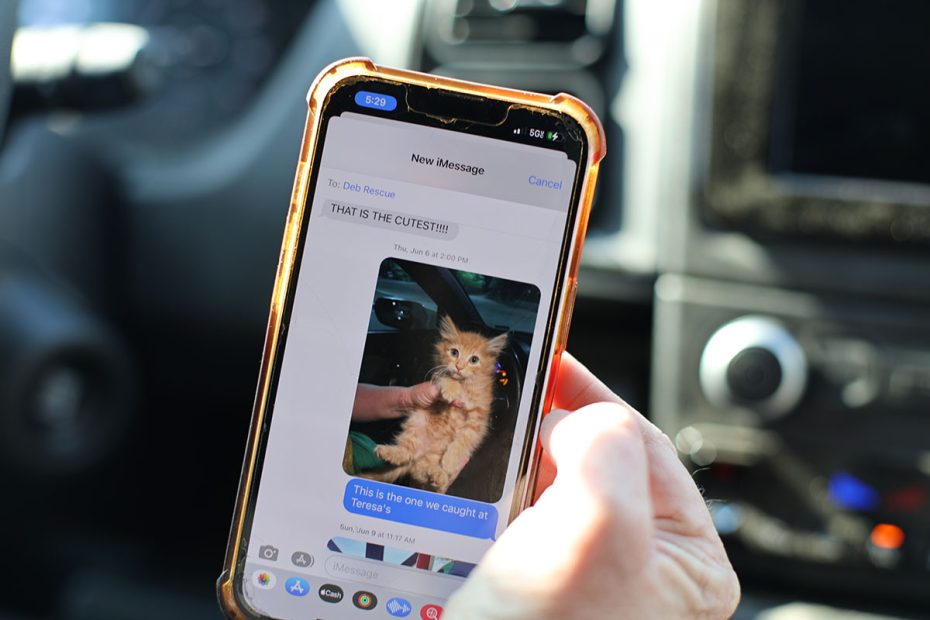

As they drive, the animals mostly stay quiet. Most dogs experience “road hypnosis,” Walker says. Ross calls it “motion sickness.” Seasoned transporters recommend “calming gummies” and classical music if the howling gets unbearable. Disinfectant, potty pads, and treats are also essential.
Meanwhile, from her base in Sonoma County, Colletto is sending out yet another group of transporters. Every day, she arranges 25 to 50 transports, drawing on both her network of frequent transporters and the 4,000-plus members of the California Rescue Transport Facebook Group who volunteer when they can to drive, or even fly, animals to parts of the state where they will be more likely to find a home — in exchange for nothing more than some gas money and supplies for the animals.
Coordinators know which breeds each rescue prefers, and organize “transport relays.” If one driver can only go from Bakersfield to Fresno, they will find someone who can make the rest of the trip to San Francisco.
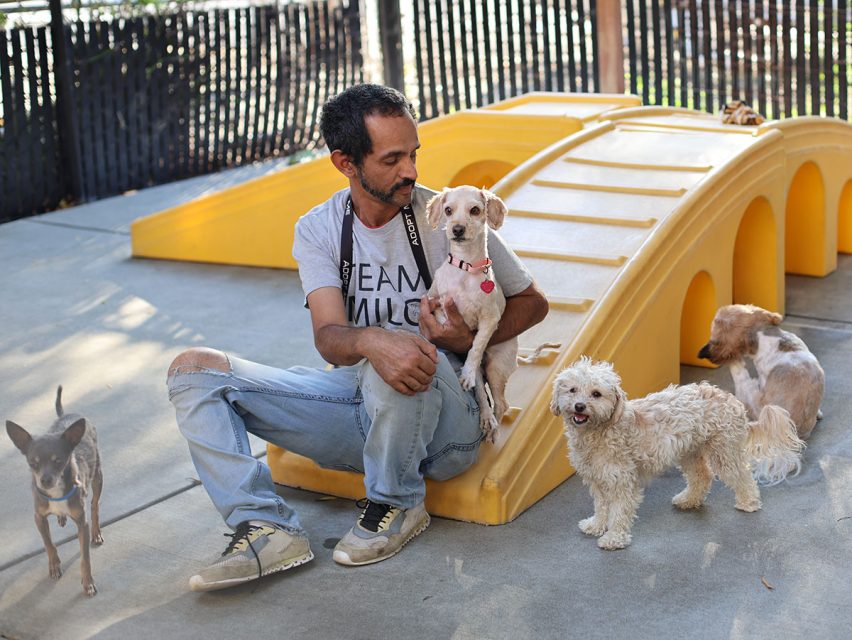
Colletto, one of the Facebook group’s most active coordinators, said organizing so many trips requires a round-the-clock effort. She’s on Facebook messenger during naptime at the daycare where she works, during lulls in her kids' baseball and soccer games, and in the aisle of the grocery store. Sometimes, her phone vibrates nonstop as plans come together in the middle of the night, she said.
Colletto has planned travel for thousands of animals over the past 10 years, working with more than 100 rescues and 50 shelters. She’s even transported turtles, snakes, goats, and an injured pigeon to safety.
Her efforts have led some rescuers to dub her the “transport queen.”
“I've made the impossible possible sometimes,” Colletto admitted. The current overpopulation crisis, however, has made her work challenging. “The need is so incredibly overwhelming that I'm having a difficult time pulling the miracles off that I've been blessed to do,” she said.
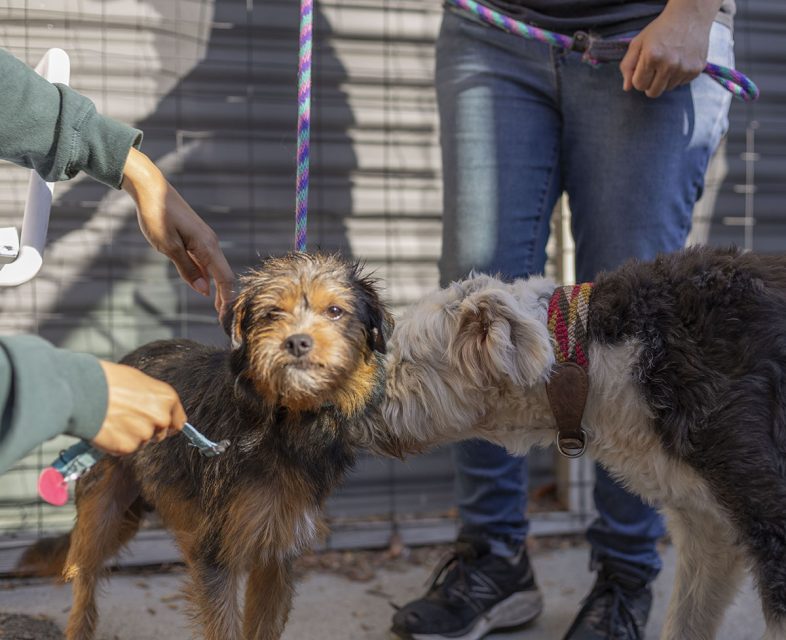
After all, the Bay Area and San Francisco have experienced their own influx of dogs and cats. San Francisco Animal Care and Control, the municipal agency that takes in all animals found or surrendered in the city, has filled up to such an extent over the last year and a half that it has asked the public to hold off on surrenders more than a dozen times.
To address crowding in its shelter, Animal Care and Control has also been transporting strays, especially big dogs, further north. They’ve sent dogs to Tahoe, Portland, Seattle, and even Canada, said Katy Jones, who oversees the transports.
Although she understands the desire to help any animal in need, Jones sometimes worries that San Francisco’s own strays are being overlooked.
“It can be hard to see the influx of dogs from different areas as a municipal shelter,” Jones said. She’ll think, “‘We have a full shelter. Can you take a look at our kids?’”
Animal Care and Control’s crowding has affected the activities of the San Francisco SPCA, a large private nonprofit shelter that takes in roughly a quarter of Animal Care and Control’s animals. Typically, the San Francisco SPCA transports 15 to 30 animals from the Central Valley every week, but recently it canceled a week of transports to accept more animals from Animal Care and Control.
‘Rescue Tetris’
Back in Emeryville, Ross begins to offload her cargo. Dianne Aranscibia from Rocket Dog Rescue emerges from a white van with two slip leashes. She fastens them onto two nearly identical border collie mixes named Benson and Handsome that “get really nervous when they’re apart from each other,” she says.
Ivan Martinez from Big Dog Rescue in Sonoma County also arrives, and loads a shaggy white mutt and a Great Dane puppy into his truck.
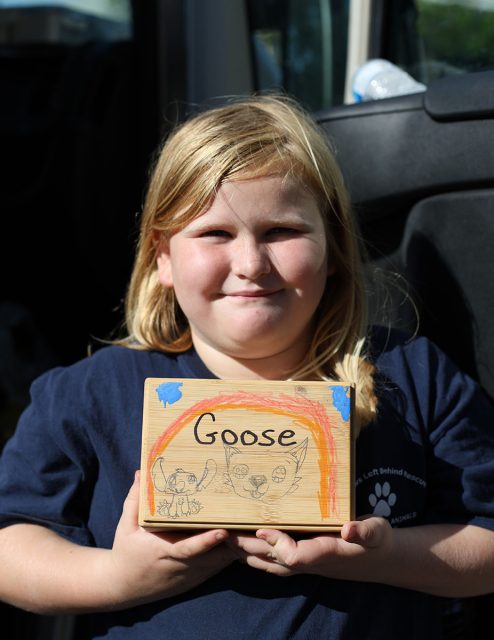
As the dogs are unloaded, Zoey reveals a small wooden box with ‘Goose’ written on it in child’s handwriting. “That’s my dog,” she says. Goose, the family’s shepard, recently died at age 13 and was cremated, Ross says.
Ross asks Aranscibia if she can take a trio of puppies saved from a county shelter on their “Put to Sleep Day.” The woman who rescued them just “couldn’t let them be put to sleep,” Ross explains.
Aranscibia says she’ll either talk Rocket Dog’s founder into taking them, or take them herself.
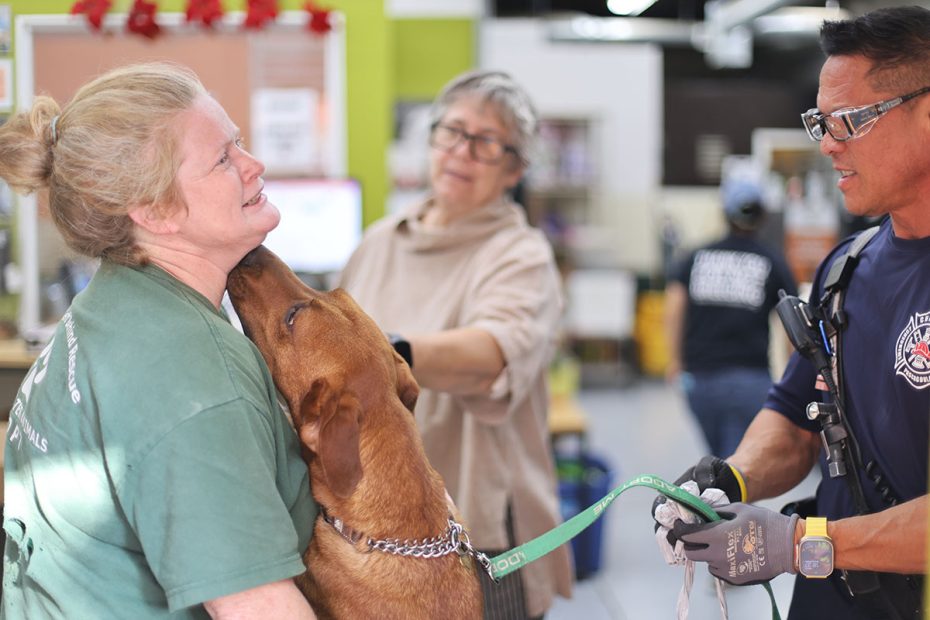
When all the crates are finally back in the van, Ross and Zoey continue to their final stop: The Milo Foundation in Point Richmond, where Family Dog Rescue will also pick up their dogs. There, a small army of volunteers and employees wait to click collars on the dogs. Zoey makes a bee-line to the “kitten room.”
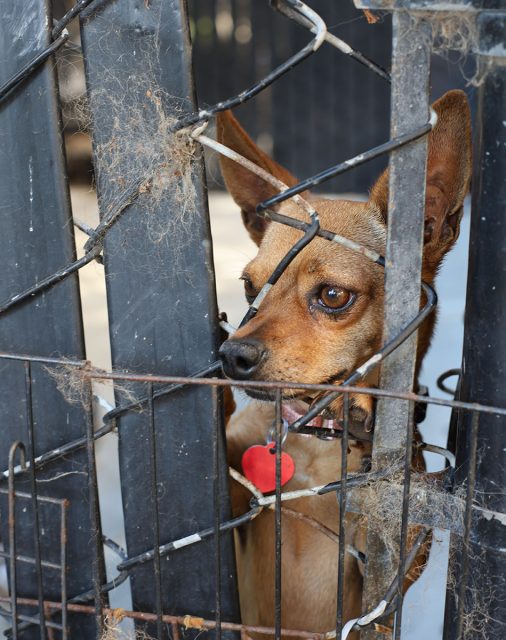
A wide-eyed ragdoll cat is gently passed down from the top of the van’s tower of crates. A spry miniature poodle leaps onto the cement and immediately relieves itself. A shepherd with a long caramel-colored coat emerges, cautiously stretching its legs.
An eclectic pack of chihuahuas, terriers, and other ambiguous yappers enter an outdoor pen. Larger dogs are led into a maze of indoor kennels and greeted by a chorus of gruff barks by residents.
Miles away, Benson and Handsome settle into their new home. At Rocket Dog Rescue’s Oakland sanctuary, they sniff around a rose garden before heading into their new kennel. They try out the beds, which are covered in striped and leopard-print fleece blankets, lap from water bowls, and greet the dog sharing the kennel next to theirs. In the next days and weeks, they’ll be taken to adoption events in San Francisco and other places in the Bay Area.
“One piece goes out, you put it in another piece,” Milo’s founder Lynne Tingle said when asked how she makes room for new animals. “Just don't say no. Just say yes. Make it happen. Make it work.”
As someone in rescue the world needs to make spay and neuter mandatory or at least way cheaper otherwise this amount of dogs will never stop. Also shelters need to do better about vaccinating because rescues like Milo keep breaking with parvo and dogs are dying.
Wonderful article. These dedicated volunteers are amazing and dedicated. Praying for more low cost spay/neuter options in the valley and better education and enforcement of breeding regulations. Prevention is key. There just are not enough people who can devote their lives to this heart wrenching problem.
Thank you, Mission Local, for this important story. The network of transport volunteers also operates locally in the Bay Area, bringing kittens to local rescues and volunteers to foster. They are tireless.
Please, people – if you plan to have a pet, please adopt from a rescue or a shelter. There are plenty of pure-bred cats, dogs, birds, and small mammals who need homes. Backyard breeders are a big contributor to the overpopulation problem. Even the “must have” animals are sometimes abandoned.
great article about transporting dogs
In case no one has noticed the two shelters in Contra Costa County are euthanizing healthy treatable adoptable animals local small rescues here are drowning in abandoned cats and kittens that are local shelters won’t take
Healthy treatable adoptable animals are being killed every day at Contra Costa Animal services and Antioch Animal services because our local officials don’t understand when you don’t provide adequate spay and neuter resources the old facilities you have do not have the capacity to house these animals until they can be adopted
Not one on the Antioch city council or the Contra Costa border supervisors are speaking out about expanding their facilities because now there is a animal control officer at Contra Costa County now responsible for making the decisions about euthanasia not even the animal service director
The Central valley has had many new resources such as spay and neuter clinics developed. And you’re right the Central valley because again they’re elected officials have not seen the fact that you have to put in spay and neuter resources if you don’t want to domestic animal overpopulation the ignorance regarding elected officials and the biology of how animals reproduce is stunning
Wake up California is in a domestic animal overpopulation crises it doesn’t matter which county you are in all the shelters have limited intake they’re no longer open emissions leaving an animals out on the street unaltered and unvaccine just to reproduce it doesn’t matter if you’re in a fluent Bay area Community or the dreaded Apple valley in San Bernardino the ignorance of this overpopulation is statewide
And all of this is being promoted by Large Animal welfare organizations such as UC Davis Koret shelter medicine Maddie’s fun best friends large SPCA is like the San Francisco SPCA Cal look for your welfare animal association
When animals are transported up here from other counties animals in our own shelters die
Go to fix our shelters Facebook page for more information about what you can do about this overpopulation and educating
your legislators, either they are not teaching biology anymore are they all flunked
Simple equation unaltered animals will reproduced, we cannot transport adopt and killer way out of this
How did we become a society that uses taxpayers dollars to kill healthy treatable adoptable animals?
I admire these wonderful people rescuing the animals. I adopted one of the dogs rescued from Central Valley. He was so scruffy and clearly had been neglected. He was brought to the SPCA where they extracted 13 teeth and neutered him and vaccinated in the first week. I wasn’t going to get another dog but just visit the SPCA to give some love but when he put his arms around my neck and clung on I knew he had just picked me to be his Mom. He’s had some abandoned issues, separation anxiety . He will never again be hit, put in a cage or abandoned. He literally eats breakfast, lunch and dinner with me and not begging but hoping for a bite of my food so he can continue with his meal. He is a true companion.I love the tapping of his little feet following me everywhere.He has given me immense joy and happiness. I love him so much. Thank you SPCA for this joy and the people who so kindly rescue these animals, God bless them.
We have two 8 yr old central valley crack kitties that we foster failed from 4 weeks with at the SFSPCA, they’re awesome.