
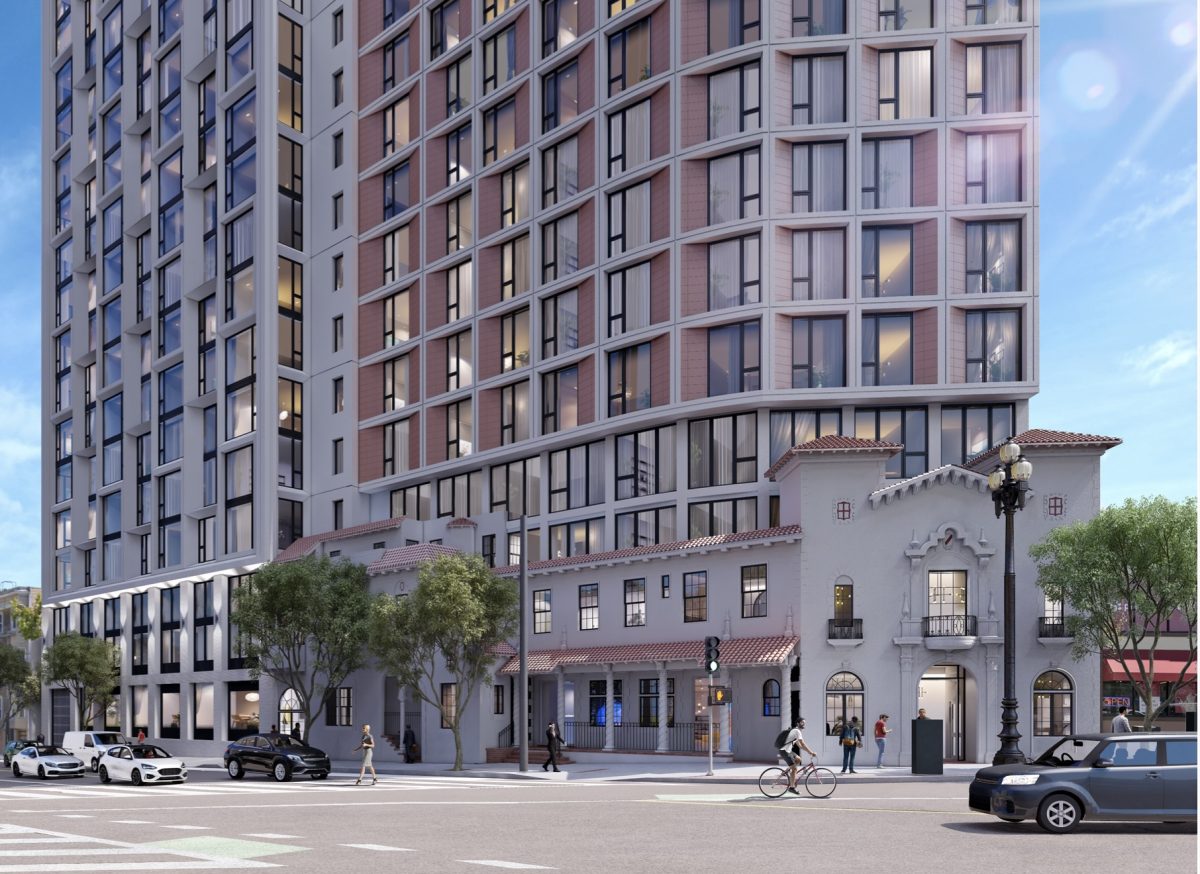

San Francisco’s Planning Commissioners heard preliminary information on Thursday for a proposed housing project at Market Street and Duboce Avenue that could bring 200 units of mostly market-rate housing to the Duboce Triangle area.
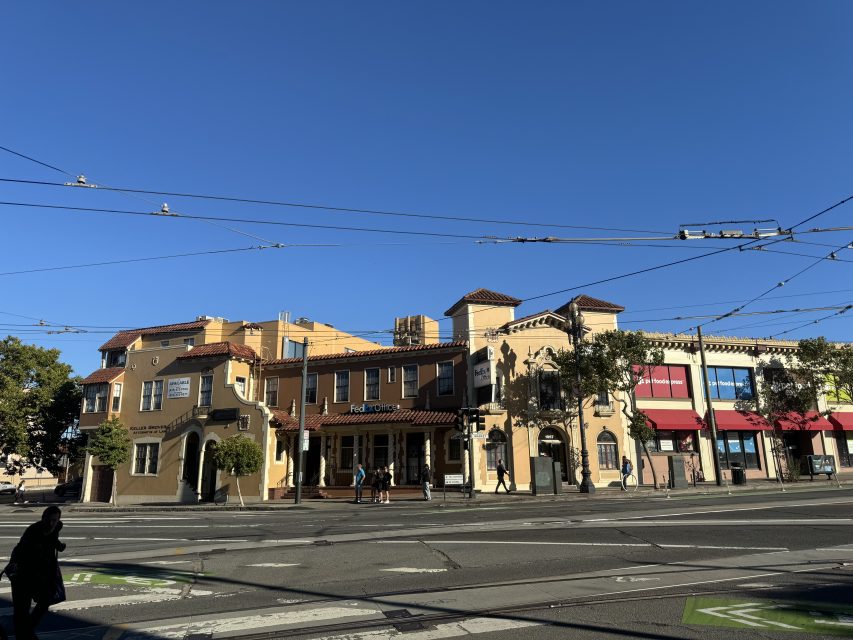
The project includes 98 two-bedroom units, 80 one-bedroom units, 12 studios, 10 three-bedroom units and 61 parking spots in an underground garage. It would replace a Mission Revival-style two-story commercial building currently on-site, but preserve the building’s facade.
The plan also offers 28 units of affordable housing, or 14 percent, at 50 percent of the annual median income, meaning an income limit of $52,450 for a single person or $74,950 for a family of four.
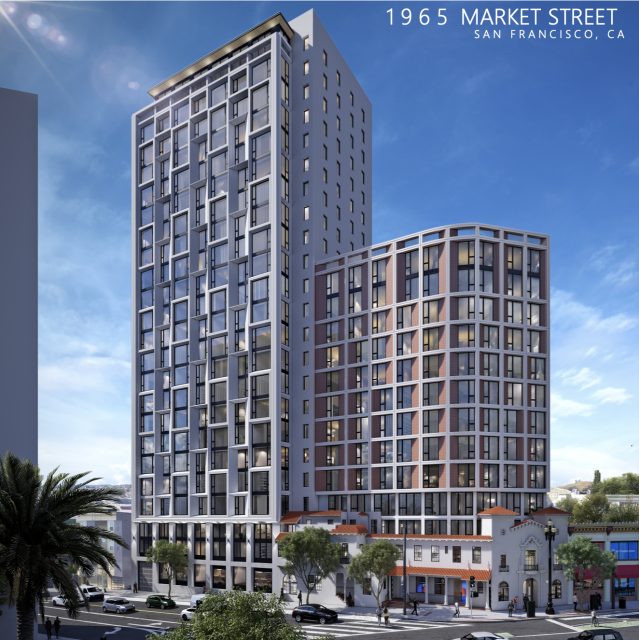
The project would be divided into two buildings, a 23-story mixed-use building with 200 units, and a 12-story building facing Market Street that would be wrapped by the historic Spanish Colonial building located at the corner of Duboce and Market.
To streamline construction, developers are taking advantage of SB 423, a new law introduced by state Sen. Scott Wiener and signed by Gov. Gavin Newsom last October. For cities like San Francisco that have failed to meet the state’s housing goals, the law eliminates the requirement of public hearing under the California Environmental Quality Act and neighborhood notification requirements.
The city successfully built enough units for the higher income sector but fell short for the low and middle-income bracket.
Two days after SB 423 went into effect on June 28, lawyers for the developers submitted a notice of intent to the Planning Commision in accordance with the new legislation.
According to the Planning Department’s 2023 housing inventory, in the last five years the city has annually built an average of 48 extremely low-income units (up to 30 percent of median income), 439 very low-income units (up to 50 percent of the median income), and 355 of low-income units (up to 80 percent of the median income).
“In our minds, this is exactly the type of project that we should hope uses SB 423 moving forward,” said John Kevlin, the attorney representing the developers. “We’re going to achieve expedited approval within six months of application filing in exchange for paying prevailing wage, expanded healthcare expenditures and using union labor on the project, which is all legislated as part of the SB 423 program.”
Kevlin and Riyad Ghannam, the architect leading the project, addressed about a dozen questions coming from the commissioners on timeline, affordability, permits and historic preservation.
The most contested question, however, came regarding tribal consultation which, under SB 423, would require the Planning Department to notify tribal representatives about the project to give them an opportunity to speak with archaeologists from the city’s agency.
Both commissioners Lydia So and Gilbert Williams insisted on clarification on what the tribal consultation is, and who these tribes are. Williams said he had never heard of the requirement before.
The city’s planning project manager, Kate Conner, took the microphone and assured the commissioners she would send them the information they requested.
As for the timeline for the project, commissioner Kathrin Moore asked Kevlin how soon they would start construction at the site. Kevlin said that it is very difficult to say, because permits for such large buildings can take a long time, but he added that, based on his experience, such projects can take up to three years.
Moore seemed unsatisfied with the answer, and said developers should commit to a specific time frame, since they are taking advantage of the expedited process through SB 423.
“Everybody needs to step up, including site permitting, in order to achieve the rather draconian requests that are coming from Sacramento,” said Moore. “This is what we are not doing.”
Can’t wait for these ridiculous planning commissions to be sidelined once and for all.
61 parking spaces is 61 too many. Church metro station, Safeway, and Whole Foods are within a block! This is not a neighborhood where you need a car! Each one of those 61 garage spaces is going to result in someone who drives, who could live anywhere, taking the place of a potential car-free household that wants to live here specifically for the off-the-charts level of walkability.
Those of us who are lucky enough to live in San Francisco might forget this but there are tons of people in the suburbs (so many!) who drive every day and hate it, because they can’t afford the city, but would gladly move here and ditch their car if they could. That’s who should be prioritized in new housing, not rich people who are going to bring their suburban lifestyle to the city and complain about parking everywhere they go.
We should have a moratorium on off-street parking spaces in developments in the northeast quadrant of the city, unless they’re reserved for load-in or people with disabilities only.
Scott,
I don’t have the link but just watched guy who builds or sells electric bikes visiting a variety of Chinese cities and their factories and virtually nowhere were there any private vehicles.
Musk says he’ll stop selling cars within 10 years and just provide one at your door on call new every time and will cut 80% of traffic and Chinese are even more severe already !
Looking further down the Road I can see all of the garages like this all over Town converted to Hydroponic Gardens.
The dark floors are for shrooms.
lol
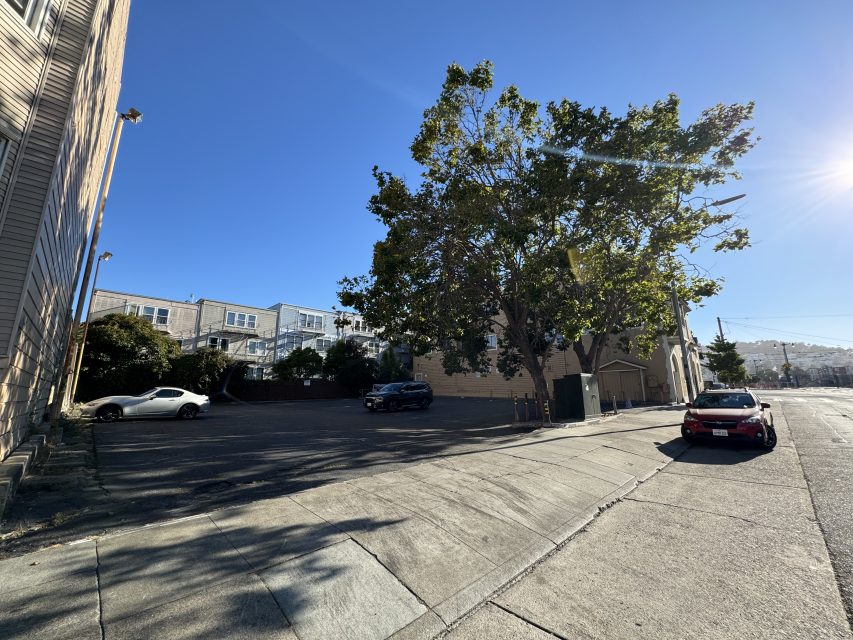
Building is on my daily walking tour atop first plateau and it already has a parking lot that will accommodate more than 60 cars.
Owners do crap job of keeping lots and gutter perimeters free of trash on both sides of complex but much worse on Duboce side and I know cause I sometimes get disgusted and pause and pull a Manny’s/City trash bag out of my back pocket and clean it up myself.
I’ll miss the Fed Ex Copy machines and the Pet Food store tho.
h.
“but there are tons of people in the suburbs (so many!) who drive every day and hate it, because they can’t afford the city, but would gladly move here and ditch their car if they could.”
The price points at which this would happen will never exist because market forces foreclose that possibility. Developers will never build out to crater the value of their assets by flooding the market with supply, they will maximize profit and sustain prices by taking their sweet time.
High housing prices attract upscale residents who can afford to pay. Upscale residents either own their own cars or take Uber/Lyft.
Off street parking is problematic. But the rise of TNCs means that Auto Trips Generated arises not only from parking from those who can afford to, but from cars that circle endlessly waiting for fares. TNCs deflated the entire Shoupian model of parking behavior and economics. It is time to move on.
Urbanists are as clueless on real estate economics as they are on how private autos function in SF’s transit economy.
There should be one of these next to every Muni metro station on Market street.
The fact that we have TWO gas stations instead of housing towers at Castro and Market is just goofy as hell.
“Both commissioners Lydia So and Gilbert Williams insisted on clarification on what the tribal consultation is, and who these tribes are. Williams said he had never heard of the requirement before.”
Seriously? AB52 has been on the books for nearly a decade and is attached to basically any project with meaningful subgrade work with any kind of Initial Study document. Anyone on the planning commission not aware of basic CEQA requirements should be removed.
San Francisco has higher housing density than any other city in California, yet is targeted for failing to meet the State’s housing goals. Does something ring untrue here?
Even if one of these massive housing developments were built in Hillsborough or Walnut Creek or Orinda, that city would still have less housing density than San Francisco. The way the State’s housing goals were set up punishes cities that already do a good job of housing density, and rewards those that rely on automoble transportation and sprawl.
The size of this building is so completely out of scale and out of character with everything around it. I’m all for putting this space to better use, but sheesh, what is being proposed is just ridiculous and there doesn’t seem to be any way for the neighborhood to get involved to make it better for everyone
God forbid we have a large building on Market Street!
I’m all for large buildings on Market Street, and I think the developments that have gone up between Van Ness and Castro in the past 10 years or so have been a great thing, but none of them come close to something this size. I think it’ll be a monstrosity. But feel free to snark away.
You can’t get involved because State Senator Scott Wiener is only interested in developers’ profit.
He’s pushed through legislation that blames and punishes San Francisco because “San Francisco” hasn’t built enough housing. Wiener went to Harvard and has been in politics long enough that he should know that cities don’t build housing, developers do.
Time after time developers walk away from projects or delay them forever because their pencils don’t like the math. This is not some scheme cooked up by the city. It is simply that labor and material costs are high.
Anyway there are already plenty of empty market rate units. The state and federal governments need to subsidize affordable housing so the people who actually have to live in the city can live in the city.
The jet set and zoom to work crowd doesn’t need to live here. And as the pro-growth market-rate crowd likes to say, no one has a right to live in San Francisco so those who don’t need to live here can just go somewhere else.
Developers and other real estate interests sure had fun and made gobs of cash Manhattanizing the financial district and SoMa. Look how well that turned out. It was a good run for them for sixty plus years but now they want financial support to re-dream their nightmare into more profits by magically making all those corporate towers into housing.
If developers drag ass on starting construction long enough, and developers fail to build sufficient housing to meet the targets assigned by Sacramento to San Francisco, then Scott Wiener will probably pass a new law mandating San Francisco pay developers cash money for the privilege of holding entitlements.
How many off-street parking spaces along a bike lane and the F Market are coming with this Transit Oriented Development again?
Ever get the feeling you’ve been cheated? Ah ha ha ha. This is no fun.
When it comes to developers, I always feel cheated. There are a variety of developer driven market rate housing projects that sit empty (the Oak for example) or are dead (the Hayes) or dragged on for years because of greed and corruption (555 Fulton) or are leaning (Melinnium) or have plumbing that falls apart so everyone has to move out (the waterfall building on Fremont) or never filled ground floor retail (8 Octavia) …. etc.