
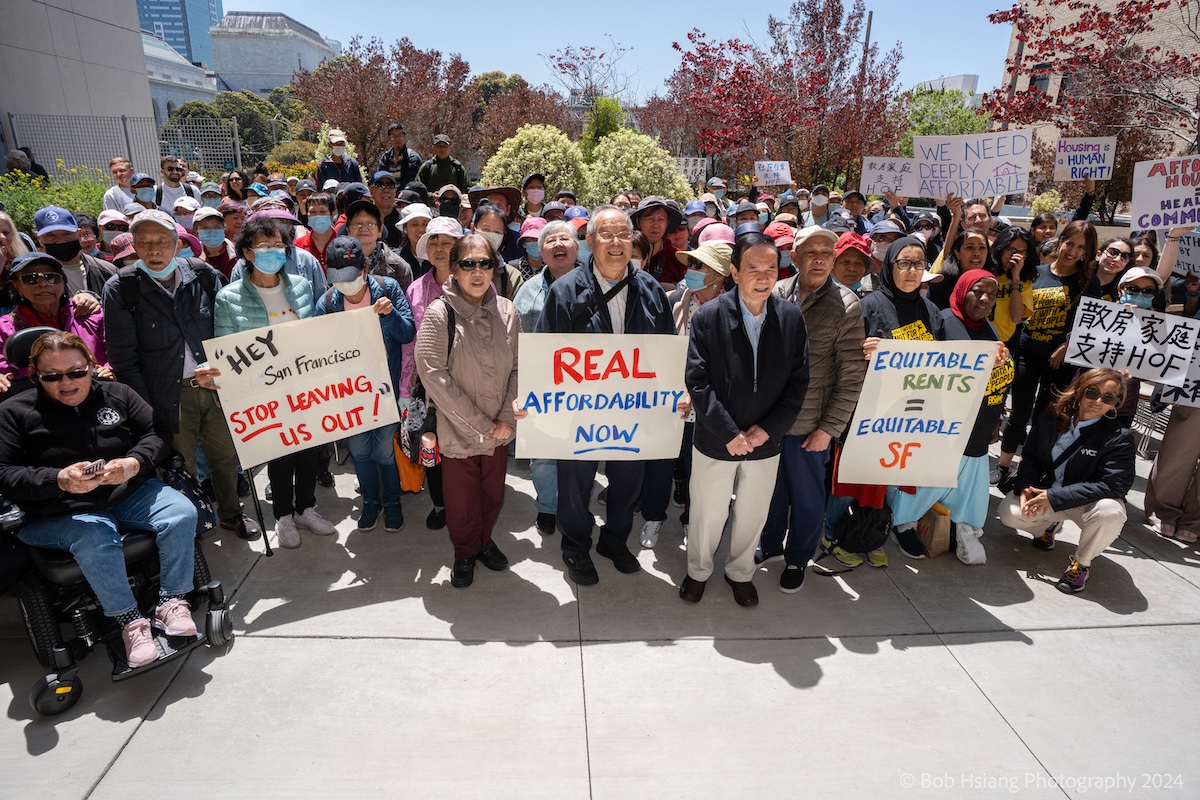

The Board of Supervisors’ Rules Committee voted Monday to advance a November ballot measure that will fund deeply affordable housing for seniors, people with disabilities, and low-income families.
Now, the measure needs the support of at least six of the 11 supervisors at today’s full board meeting to put the measure on the ballot. So far, the legislation already has eight co-sponsoring it.
Introduced by supervisor and mayoral candidate Aaron Peskin in May, the “Affordable Housing Opportunity Fund for Seniors and Families” seeks to secure $8.25 million annually for 20 years from the general fund to subsidize affordable units available through the city’s housing portal, DAHLIA.
Most “affordable” apartments are currently out of reach to people making less than 30 percent of the area median income. That’d be $31,450 for a single person and $44,950 for a family of four.
Maria Fernanda Gucheta experienced this frustration first-hand when she won the housing lottery in January. She, her husband and young daughter arrived from Colombia almost a year ago. After months of sleeping at shelters, she thought she’d finally had a stroke of luck.

But the excitement and happiness at the prospect of stable housing did not last long as city requirements began to pile up.
Six months later, Gucheta is still waiting for a unit. She and her husband have a monthly income of $3,200 — just below 30 percent of the area minimum — and the city is also asking the family for a credit score, which, she said, they don’t have because of their short time living in this country.
San Francisco’s current median household income is $104,900 a year for one person and $149,850 for a family of four. Meg Heisler, policy director for San Francisco Communities Against Displacement, said such the high median incomes have made it difficult for seniors, parents and people with disabilities making close to minimum wage to qualify for the units listed under DAHLIA, even when applicants win the affordable housing lottery. In most cases, she said, applicants are required to have a monthly income ranging between 40 and 50 percent of the median income to qualify for the desired unit — that’s $52,450 for a single person and $74,950 for a family of four.
Currently, most of the offers require an income of at least 40 to 50 percent of the area median income ($3,990 for an individual, and $4,904 for a family of four) for the cheapest one-bedroom listed at the time this story was written.
This measure would allow elderly and disabled applicants with lower incomes to apply for these units. Presently, the only units available to them are rooms in single-room-occupancy hotels.
“It certainly frustrates the families and the seniors who are asked to vote for affordable housing measures every year but feel like they’re totally shut out of affordable housing,” said Heisler.
The word affordable “has lost meaning for a lot of people. And we’re trying to solve that problem by saying, ‘No, actually, we can make it affordable, but we do have to make an investment,’” Heisler added.
“They keep asking for all of these requirements that we don’t really have, because we’ve been in the country for such a short period of time. It’s been really complicated getting housing,” said Gucheta. “Even at the shelter, they keep pressuring us to find a place to go. I just hope the board of supervisors can hear my plea.”
How the measure was born
The proposed law came about thanks to the board’s passage of a similar measure, the “Senior Operating Subsidy,” in 2019. It secured $4 million from the general fund to subsidize affordable housing units for seniors making between 15 to 25 percent of the area median income for 15 years. Two particular buildings were identified to test the first phase of the measure: 40 units of affordable senior housing at 1296 Shotwell St. in the Mission District and 13 units at 735 Davis near the Embarcadero.
The Senior Operating Subsidy did not require voter approval because the legislation only guaranteed a one-time payment, which the state later matched. The Affordable Housing Opportunity Fund for Seniors and Families would, however, secure annual funding during its 20 year duration.
Brenda Cordoba, the president of Faith in Action Bay Area, an organization fighting for affordable housing and tenants rights, said she remembers how the excitement of having 1296 Shotwell built quickly turned into frustration after seniors applying for the affordable units in the building realized they did not qualify because they did not have a high enough monthly income.
“I remember this one older man named Don Javi. He had just faced eviction, and he was so excited to receive a unit, but couldn’t qualify,” said Cordoba. “He got so sick from being so stressed, having to find housing at his age in a city so expensive.”
Cordoba said that Javi eventually received a unit in the building after the board approved the Senior Operating Subsidy. “It changed his life completely. He was a new man, full of life.”
Cordoba’s organization is one of 26 groups hoping to repeat the previous outcome with this new measure. For her, this fight is personal, because it will not only support seniors, but also people with disabilities, a community close to her heart, given Cordoba’s own disability.
“I would love to be able to have my own apartment, but I can’t. I make $600 a month,” said Cordoba. “People deserve decent housing despite their disabilities. Seniors, and especially people with disabilities are the engine that keeps me going.”
Housing measures on the November ballot
Regional measures:
Voters will also vote on a $20 billion regional measure introduced by the Bay Area Housing Finance Authority (BAHFA) that intends to build 36,000 new homes and preserve another 36,000 by buying and rehabilitating already affordable apartments. The general obligation bond is to be split between the nine Bay Area counties with Francisco to receive $2.4 billion. The measure would pass with a 55 percent support if Prop 5 passes. If Prop. 5 does not pass, then it would need at least 66.67 percent of the votes.
Statewide measures:
Proposition 5, will lower the threshold for municipalities from 66.67 percent to 55 percent when voting on bonds financing housing and infrastructure projects.
Proposition 33, which would repeal the Costa Hawkins Rental Housing Act that prohibits municipalities from imposing new rent control measures, will also be on the ballot.
Maria Fernanda Gucheta and her family just came to San Francisco less than a year ago and they want scarce and expensive subsidized housing? Why should new comers jump the line over people who have waited for years for the privilege of subsidized housing? What gives them the right to just show up in one of the most expensive cities in the world and expect to get special rights many thousands of others have been waiting years for?
Money doesn’t get it: Nothing is MUCH less than it used to be …
Nearly everyone would be better off – especially taxpayers funding the program and benefit recipients – if these folks just got the proceeds in cash, for them to spend as they see fit. Of course, that solution doesn’t involve payoffs to politically favored nonprofits and contractors so it will not be considered.
Is Gucheta here legally? That should be in the story, either way.
Because you don’t mention it, we assume that she’s not here legally. If that’s the case, city taxpayers should not be subsidizing her housing.
great argument raul. we can’t have affordable housing for seniors and disabled people who are on fixed incomes because someone who is here from another country might not be here legally (although there is nothing to suggest their legal status one way or the other). Why not just get rid of all infrastructure, military, fire, police, public services in general just in case an undocumented person gets any benefit out of it.
If you ever live long enough to become a senior citizen or disabled and are unable to work, would you like to be able to find affordable housing or are you prepared to be living on the street?
If I were old and had been waiting for subsidized housing for years, it would upset me if some new arrivals just jumped the line…
“we can’t have affordable housing for seniors and disabled people who are on fixed incomes because someone who is here from another country might not be here legally”
Raul didn’t say any of those things…