

As part of the latest effort to court Chinese voters, Chinese media reporters have become popular hires for San Francisco campaigns or politicians: Several former reporters with KTSF, the Bay Area Chinese-language TV station, have taken jobs in the offices and campaigns of local and state politicians.
The exodus was led by two former on-air reporters for KTSF Channel 26, who joined Mayor London Breed’s re-election campaign and Sen. Scott Wiener’s office recently.
“We wanted to build out our Asian media and community outreach operation,” said Joe Arellano, a spokesperson for Breed’s campaign, which recently hired KTSF’s 7 p.m. prime time anchor, Ho Yin Mo, as its Asian American and Pacific Islander field organizer.
“When we heard that Mo was available, we jumped at the opportunity to hire him, because we know that his profile on KTSF really resonates with a lot of individuals, and his background and his experience,” Arellano said.
Similarly, Sherman Wan, another reporter and anchor from KTSF, joined Wiener’s office this May as a district representative, after predecessor Francis Zhang left for District 4 Supervisor Joel Engardio’s office. The campaigns of both Danny Sauter and Sharon Lai, both running in Chinese-heavy District 3, have also brought on former KTSF reporters.
Both Wan and Mo are young, 28 and 26, and proficient in Cantonese, Mandarin and English. They have been roommates, and their employers — Breed and Wiener — are simpatico; Wiener just endorsed Breed for mayor last week.
While not every campaign has a Chinese-speaking anchorman on the payroll, Arellano said he’s “100 percent” sure that Chinese-speaking journalists are popular among all campaigns this year, as interest in courting Chinese voters “has been off the charts” for mayoral candidates.
Both Mo and Wan acknowledged that they had offers from other politicians as well. “I think this year, a lot of candidates, they’re looking for someone who could speak Chinese and English,” said Mo. “I think this is a very positive trend.”
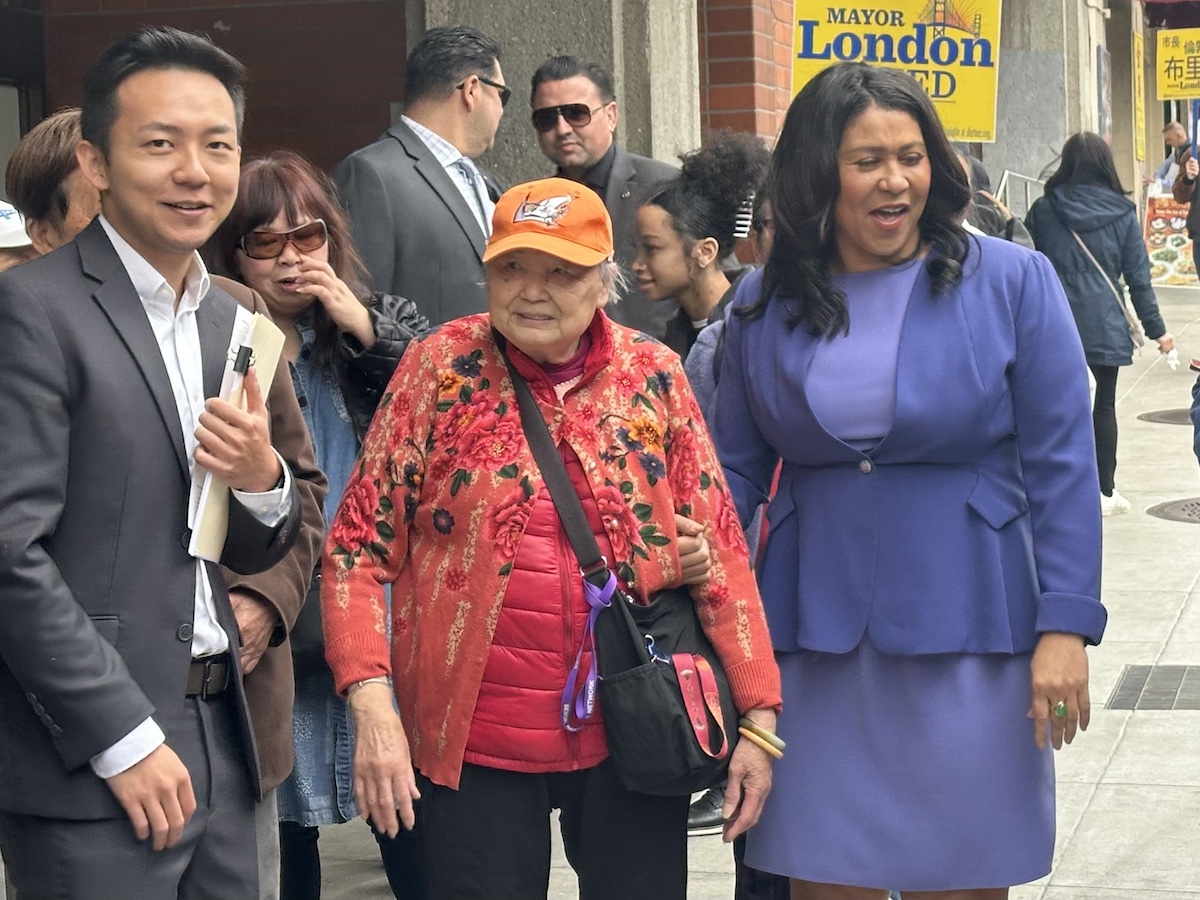
And it’s proven to be a wise decision: Mo is “somewhat of a celebrity with Chinese seniors,” a voting bloc that’s known for being difficult to reach, said Arellano. During Breed’s campaign events in the Chinese community, “as soon as a lot of the Chinese seniors see his face, they immediately recognize him and flock to him,” Arellano added.
While some candidates struggle with lack of access to Chinese reporters, others have made use of their resources. Take District 3, for example. It includes Chinatown, but Nob Hill, Russian Hill and North Beach also have many Asian residents. So Sauter, one of the front-runners, has a campaign team of four that is half Chinese, and includes former KTSF reporter Anna Liu, who helps them out on a part-time basis.
“She helped us in [the 2020 District 3 race] as well,” Sauter said. “She has a fantastic combination of experience in media and communication, but also really understanding the issues and the priorities of the Chinese community.”
Similarly, Lai, one of the two Asian candidates in the race, and who has wide support in Chinatown, has Karen Chan, another former KTSF news reporter, as a volunteer advisor on strategies to court the Chinese community.
Even the fact that Mo was hired won Breed coverage in the Chinese-language press.
Mo hurriedly pushed back on the “celebrity” moniker. “I’m just doing my job,” the 26-year-old said. “Obviously the candidates themselves, they cannot be everywhere … this is why I should be out there in the field, talking to people, listening to what people might have to say about the mayor, listening to the voters’ concerns and then pass along that information to the candidate.”
Wan, for his part, said he “got a chance and wanted to make some changes” in his career trajectory.
Mo said the stories he covered about Breed as a reporter made him respect her. Breed’s Prop. E and Prop. F, which passed in the March election, were especially resonant for him. The former loosens rules for police and the latter requires some welfare recipients to be screened for drugs.
And, while a career change was attractive to both Mo and Wan, there is a more material benefit: Political jobs are much more lucrative than reporting positions.
While it’s unknown how much they each made at their reporting jobs, entry-level reporters at KTSF make between $20 and $30 per hour, which amounts to between $41,600 and $62,400 annually. In comparison, this year’s mayoral race is known for being loaded with money — a candidate for a Mark Farrell campaign position was purportedly offered $15,000 per month.
Originally from Hong Kong, both Mo and Wan joined KTSF around two years ago, not long after graduating from state universities — Mo from the University of California, Berkeley, and Wan from the University of California, Davis. Before KTSF, Wan also spent two years as a radio host at Sing Tao.
Wan said that it is more than the money that makes the switch attractive. “When I was a reporter, I met people who experienced crime or experienced racism. What should I do at that moment? Just writing a story,” he said. “If I change to another role, I can join the system, or maybe I can [make an impact] more deftly.”
It’s been an “exciting” experience at Wiener’s office, where Wan is responsible for building ties with the San Francisco Asian community, processing casework, helping with issues from constituents, running Wiener’s WeChat account and doing occasional on-the-spot translation work for Wiener at events or interviews.
And though not a campaign position yet, that could change: If and when Rep. Nancy Pelosi’s congressional seat comes available and Wiener jumps into the race, as he is expected to do, Wan’s role would become instrumental.
In lower-profile outfits than a mayoral campaign or state senate office, there is also a need to have an erstwhile Chinese media reporter on the team. After the November elections, the new supervisors in heavily Asian districts, meaning Districts 1, 3, 7 and 11, will all need a Chinese speaker as one of their legislative aides. Of the limited number of candidates who can satisfy all the requirements, Chinese journalists are usually a good choice.

Newbies in campaign
Political consultant David Ho said working on a campaign is different from any other job one can hold, and most of the new hires recruited from journalists are “pretty green.”
“If you’re talking about high-level campaign work and strategy, and implementing a Chinese language campaign, I think it’s been challenging for most of them,” he said.
Apparently, the candidates are also aware of the obstacles.
In Breed’s campaign, Mo has been paired with veteran community organizer Leon Chow to take care of the team’s Asian community outreach. Chow is celebrated as a “Chinese working-class hero,” a longtime former SEIU and Unite HERE! community organizer and a former board chair of the Chinese Progressive Association, who, in 2012, also ran for District 11 supervisor and dropped out when his residency and voting registration history were questioned.
Other mayoral candidates have been creative in enlisting staffers with various connections to the Asian community. Daniel Lurie has the combination of Han Zou, a door-knocking savant, and Kit Lam, who earned a reputation during the 2022 school board recall election and worked in Engardio’s office. Mark Farrell has Jade Tu, a high-profile anti-Asian-hate activist who just won a seat on San Francisco’s Democratic County Central Committee, and Sherman King, a longtime Chinese community leader.
A regular in Chinese-language media, Board of Supervisors President and mayoral candidate Aaron Peskin has abundant access to Chinese-media reporters, but why did he choose Anthony Ching-Ho Leung, a small business owner from the Sunset who’s also involved in tech and real estate, as his Chinese community campaign director?
Leung has “such a strong network” in parts of the city that Peskin may not, and “he is someone that Aaron trusts,” said Peskin’s campaign spokesperson, Kaitlyn Conway.
“A lot of these people, community members, community leaders, I’ve known since I was a kid,” said Leung. That level of relationship “is something that you can’t really replicate very easily.”
For the reporters who have left the press, none yet say they regret the move. Wan said he still misses the time “holding the mic on the scene” at KTSF at times, and values getting to know San Francisco as a reporter, when he covered APEC, the Chino Yang flap and the plight of Hong Kong natives who migrated to the United Kingdom, for instance.
But, he said, “I’m also in the community right now. It’s just kind of changing the method, or changing the way.”
And what happens after Nov. 5?
“Typically, most candidates, especially the incumbent mayor, don’t promise jobs just because you work on the campaign,” said Ho.
Mo, who’s on Breed’s campaign, said he hasn’t thought about the future beyond the election. “What I’m focused on right now is just giving my all and contributing to the team and helping the mayor win in November.”