

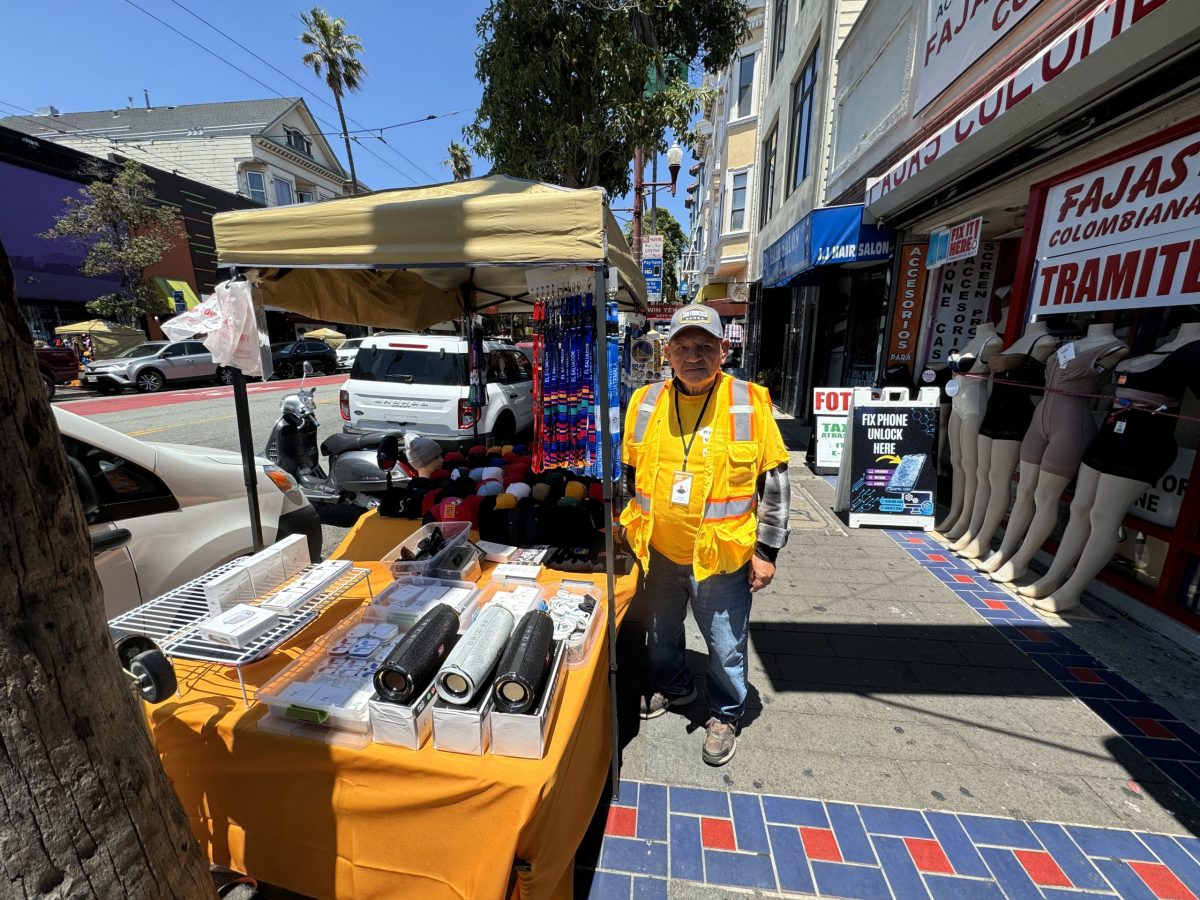

At noon on Friday, Maria de Jesus was selling jewelry and other accessories at one of six booths along the east side of Mission Street. Four other vendors had set up shop on the west side, selling speakers, earrings and more.
They looked, and were, official. The booths had similar canopies, and the vendors all wore a uniform of yellow vests and yellow T-shirts.
“We’re happy, because we’re back and there’s more people here, more transit,” said de Jesus, in Spanish, of the pilot program on Mission Street between 23rd and 24th streets.
De Jesus and other vendors have been banned from Mission Street since November 27. During the ban, they have been sequestered in two and then one designated area. The ban, still in effect beyond the one-block pilot, has prevented the BART plazas from being overrun with vendors, but it has also kept permitted vendors from making much money.
The pilot program of 10 vendors that started on Friday is the city’s fourth attempt to find some balance between allowing vending and keeping the sidewalks and BART plazas passable.
It’s unclear if this latest pilot will succeed. But the mood was definitely up, and the return to Mission Street marked a victory for the vendors.
“It feels like the first day of school (being out here on Mission Street),” said Rodrigo Lopez, the president of the Mission Street Vendors Association. “I’m really happy that the city heard us and supported us.”
“[We are] happy, because we are back on our street. We are recovering what was taken from us,” because of those selling illegally, said Luz Ledesma, another vendor on Mission Street.
Ledesma and de Jesus, along with eight other vendors, were the lucky ones chosen this week by a lottery.
Ledesma had tried to sell at El Tiangue, one of the two sanctioned places the city set up after the ban. But mostly, she and the other dozen or so vendors that went into El Tiangue sat and saw little business.
It felt illogical to sit there waiting for customers, Ledesma said, saying that she made $25 a week while others who ignored the ban, continued to sell on the street and make money.
But on Friday, back on Mission Street, she felt differently and, by 1 p.m., she had already made $50.
Based on city laws, such as a required two-feet of spacing from storefronts, the city, in partnership with the Mayor’s Office of Economic and Workforce Development, determined that 10 booths would fit nicely on the block. They worked with the Mission Street Vendors Association to agree on the block that would be used for the pilot.
The vendors were chosen by a lottery; they had to have been members of the vending association since at least 2021. Fourteen vendors entered, one failed to show up and the final 10 were chosen by a computer program.
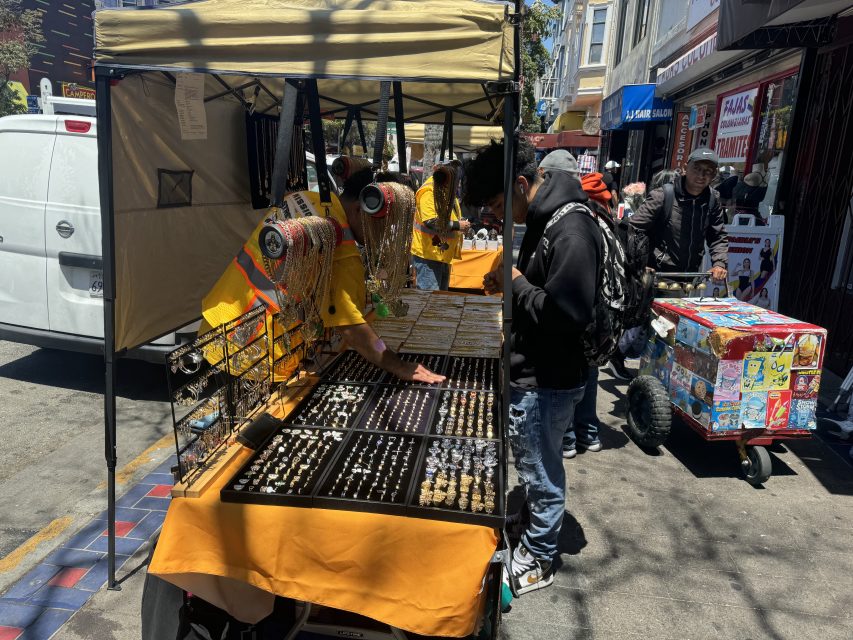
“I didn’t win, but I keep supporting and helping,” said Lopez, noting that the support includes setting up vendors with methods of payment other than cash, such as credit cards and Venmo.
What’s still unclear is whether illegal vending will resume. On Friday, a group of five to 10 employees from the Department of Public Works strode up and down the block in their bright orange and green vests, patrolling the area.
Despite their presence, at least one unpermitted vendor managed to work. Estela Estrella took boots and hygiene products out of a large black backpack to sell on the sidewalk. She had already been asked to leave by the Department of Public Works, but seemed undaunted. “I come here daily,” Estrella said, “They [the Department of Public Works] have already taken my things four different times.”
According to the Mayor’s Office of Economic and Workforce Development, eight to nine of the vendors selected for Mission Street also hold permits for La Placita, the one remaining sanctioned space for vendors.
At La Placita, less than two blocks away at 24th and Capp streets, their absence was notable. Generally, 20 booths sell from La Placita. But on Friday that number had been cut by nearly half. And, despite the music playing from speakers, the space felt vacant, as there were no customers.
It is too early to determine if La Placita will suffer from the new pilot program, or if this new opportunity will benefit the vendors of Mission Street. For today, however, the spirit among the street vendors was positive.
“Everything is good so far. I think we’re gonna do well,” said Maria de Jesus, one of the Mission Street vendors.
The city government really, really hates brick and mortar businesses.
I have never understood the obsession with these vendors. They are bad for quality of life as they make it difficult to navigate Mission Street and they blend in with the people reselling stolen goods.
Why is it that planters with plants are “hostile architecture,” but street-blocking vendors selling trinkets to compete with taxpaying brick and mortar stores are OK?
How many hundred ‘s of thousands of dollars will it cost to supervise 10 vendors?
How much money is San Francisco spending to enable people who do not pay taxes or may not even live here?Sorry this is a big mistake. I do not want my tax money to enable this.SF does nothing for street artists,but people selling random stuff or cheap jewelry from aliexpress get help.Every elected person needs to go away.
Ill bet none of the rent paying merchants were pleased….unless traffic in their shops improved.