


Cushion Works is a small, eclectic gallery in San Francisco’s Mission district, located in a building that also houses an active cushion factory as well as artist studios. Its current show, ”Xerox,” is a spare installation by painter Rafael Delacruz featuring his paintings and photos, and projected images by Japanese photographer Seiichi Furuya. Delacruz discovered Furuya’s book, “Memoirs 1995” (Foto Museum Winterthur, 1995) almost 10 years ago, and began an off-again, on-again correspondence with him.
The show’s tile, “Xerox,” can mean the copy machine itself, the black-and-white copies made by the machine, the international corporation, or the process that Delacruz uses to construct the images for his paintings. Jordan Stein, who runs Cushion Works, writes that Delacruz is often drawing, photocopying drawings, and cutting photocopies together to make new drawings. There is a folder on his phone called “Xerox dreams” that holds these images.
While Delacruz’s approach is scattershot, Furuya’s photographs are straightforward and function like a visual diary. He left Japan in the 1970s after studying photography, and traveled the world. He met and married Christine Gossler in Gras, Austria, where he has lived for most of his adult life. His work is populated by images of his Austrian wife, Catherine, and their child, their apartment, coupled with images of the architecture of East Berlin, where he worked as a translator (1984-1987) before the wall came down.
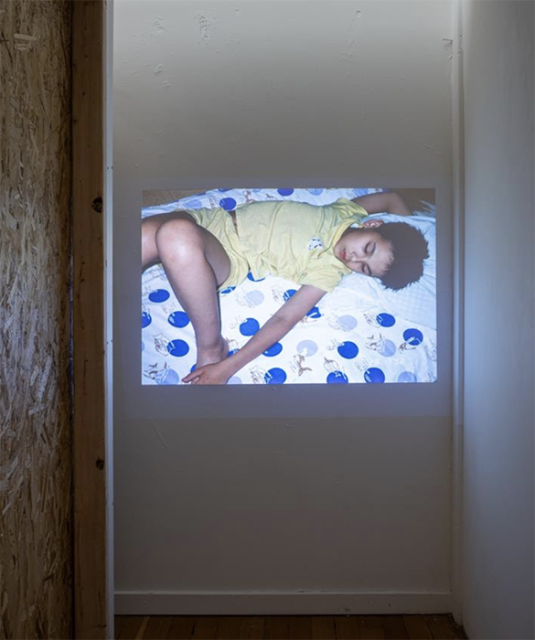
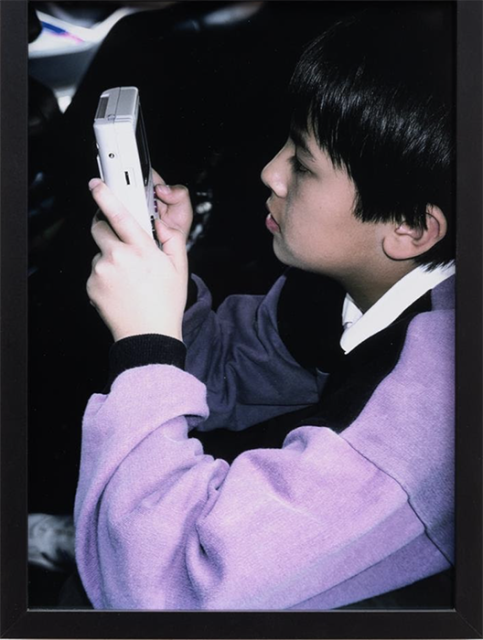
In the installation at Cushion Works, an unframed photo of his son is juxtaposed with a blocky Communist-era building in East Berlin. A small projection booth is constructed inside the gallery, where there is a series of digital projections of each page of Furuya’s book, “Memoir 1995.” His published photo books are spread on a table in the gallery, including one that frankly documents his wife’s physical and mental decline, as well as her eventual suicide. Furuya’s photographs are time capsules of people and places he cared about.
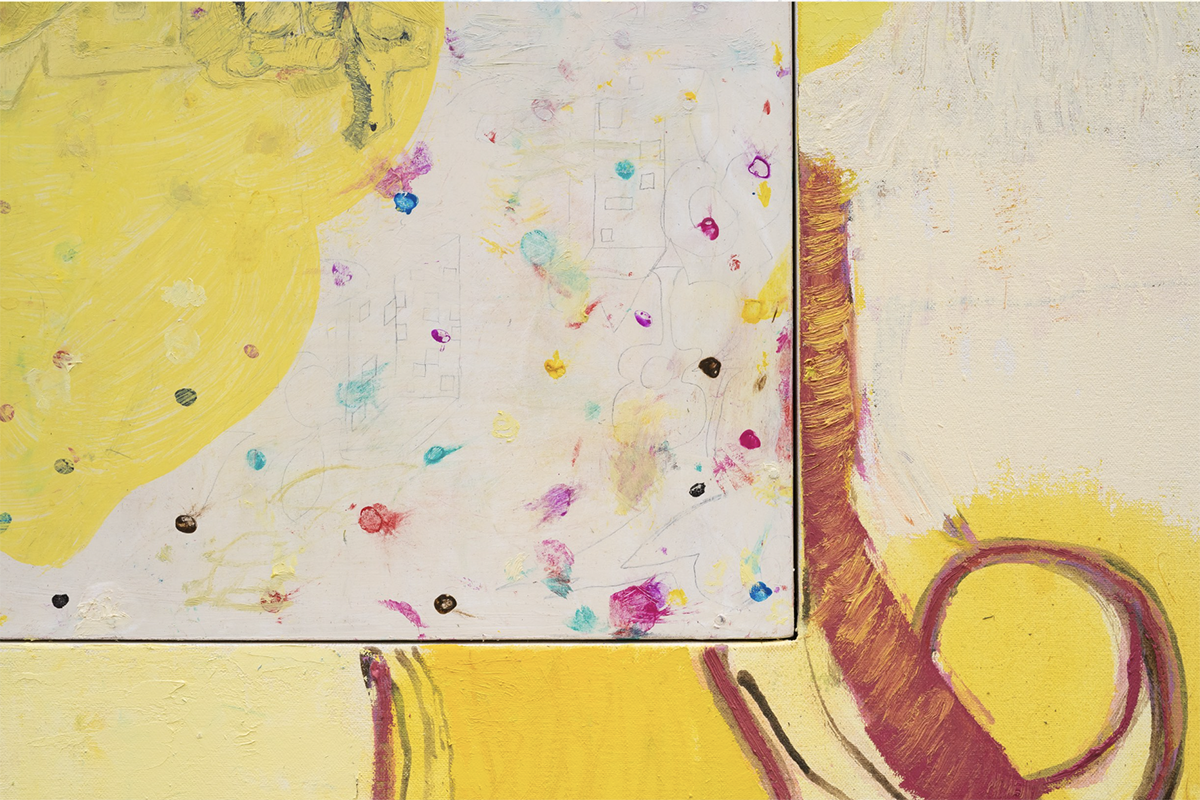
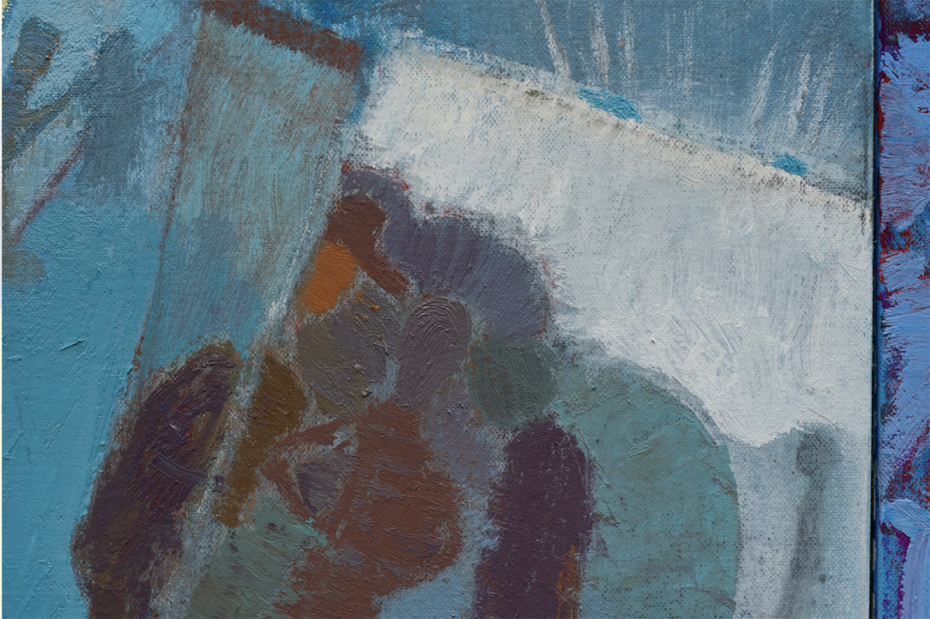
Delacruz is a self-taught painter, originally from San Francisco, but now living in the East Bay and New York. This exhibit features four small paintings embedded in a painted canvas frame built around them. His colors are luminous, though the soft focus and the images are hard to decipher. There is no foreground, so the dream-like images seem to float. The paintings are hung on an interior framed wall draped with a cloth backdrop dyed with black beans, a humble food creating a neutral grey. It looks like a trade show or an art fair within the walls of the gallery. It highlights Delacruz’s mischievous take on the rarified world of art markets, galleries and museums, or the ornate frames of traditional paintings.
Straddling continents, generations and different languages, Delacruz is drawn to Furuya’s sensibility, the beauty of his photographs, the lines and shapes drawn with light and shadow, the quotidian nature of his photographs. Furuya is better known in Europe, and has several published photo books not easily available here. But, by happenstance, Delacruz found a copy of one in Moe’s bookstore in Berkeley. The chance meeting of these artists through Furuya’s book and their subsequent correspondence seems like an event where synchronicity is at play. Is synchronicity the logic of the universe, a meaningful coincidence, or simply chance that leads to a connection and an art show in San Francisco?
Cushion Works (website)
3320 18th St.
San Francisco, CA 94110
Show runs until June 6