


Welcome back to our “Meet the Candidates” series, in which District 9 supervisorial hopefuls respond to a question in 100 words or fewer.
Our week 10 question: How would you use your power as supervisor to combat climate change?

h brown
About all a supe can do is to call for committee hearings on topics like this.
Again, I’d promote someone else’s idea: Tidal power.
A Gonzalez hearing featuring a firm called ‘Hydro-Ventura’ calculated they could power all of Northern California with units installed in Bay trenches.
Zero pollution as ‘fuel’ is power of Pacific Ocean translated by compression into air suction to rotate turbines.
Something like that.
Go Niners!

Trevor Chandler
The most significant way we can reduce San Francisco’s carbon footprint is reducing our car usage by making public transit safe, clean, and reliable. We must also significantly expand our tree canopy, fully implement the SF Climate Action Plan, and meet all goals of Chapter 9 of the SF Environment Code.
We can also protect San Franciscans from extreme weather changes with common-sense updates to our outdated window code. By removing costly barriers to installing modern, energy-efficient windows, we can protect residents from poor air quality caused by fires.

Jackie Fielder
Bordered by freeways and crossed with high traffic streets, District 9 suffers disproportionate pollution.
My goals include building affordable, green social housing along transit corridors; cutting red tape on window replacements; and tapping federal funding to establish a green bank. To cut emissions from private passenger vehicles, including ride-shares, I would provide incentives for biking, walking and rolling; invest in public transit; and make streets safer for bikers, pedestrians, and wheelchair users. PG&E’s delay of decarbonizing must stop.
To finance San Francisco’s climate action plan, we need a green bond, green bank and a tax on polluting corporations.

Jaime Gutierrez
The city owns its own electrical power source: Hetch Hetchy Dam and reservoir provide clean-air electricity that is free of greenhouse gases. This electricity could power San Francisco homes, businesses and infrastructure at a lower cost to its citizens, and possibly create a city-run EV-charging-station network.
This would fall in line with the state zero-emissions mandate that wants no more fossil fueled vehicles sold in California moving forward from 2035. Why do we continue to allow PG&E to monopolize San Francisco power, and sell it back at a higher price? Does this seem wrong?

Roberto Hernandez
We must act locally to combat the climate crisis globally.
As Supervisor, I’ll guarantee completion of the Village SF, a nationally recognized urban farming, community wellness, and neighborhood sustainability initiative based right here in the Mission, and led by members of our Native American community.
Other climate priorities will include habitat restoration, sustainable transit, clean energy incentives and tech partnerships, while collaborating with other districts and cities on effective solutions.
Through climate town halls, we’ll engage our residents and businesses to ensure we’re responsive to both the urgency around climate change and the realities of day-to-day life.

Michael Petrelis
Start with riding my bike, or using Muni to travel to City Hall, and around the Mission, as is my personal habit now.
I’d propose requiring City agencies that use vehicles to purchase only electric automobiles, reduce the number of SUVs, and mandate a bicycle fleet for official business.
Create a fund for community food gardens, planting one at City Hall, and expand composting efforts.
Ban bottled-water purchases by City departments. San Francisco tap water tastes great!
Tax billionaires, and use the money to make SF MTA rides free, create cement-barrier bike lanes, offer residents free bicycles, and fund existing repair shops.

Stephen Torres
District 9 stands to be heavily impacted by accelerating climate change. The first peoples of this place understood that we must work with nature, not against it. Ways we can do this:
- Municipalizing PG&E
- Hardscape removal, swales, daylighting and habitat restoration along watersheds like former Mission Creek, to beautify neighborhoods and mitigate flooding
- Community led re-envisioning of the Central Freeway
- Expand green building/infrastructure
- Permanent funding for maintenance and expansion of the urban canopy to cool/insulate our neighborhoods
- Truly affordable housing and expanded public transit
District 9 is San Francisco’s heart. Our future is only sustainable with a healthy heart.

Julian Bermudez
By promoting and investing in practical solutions for climate change, that can make everyone’s lives easier and cleaner.
An idea that I have been working on for a while now are “Recharge Stations.” They are water fountains with shade provided by a solar panel that power USB ports used to charge devices. It also provides a seat or two, so people are able to take a break from walking around. Residents have told me that they would walk more if there were more bathrooms and water fountains available. Let’s aim to make our streets a bit more walkable and cleaner.
Candidates are rotated alphabetically. Answers may be lightly edited for formatting, spelling, and grammar. If you have questions for the candidates, please let us know at lydia.chavez@missionlocal.com.
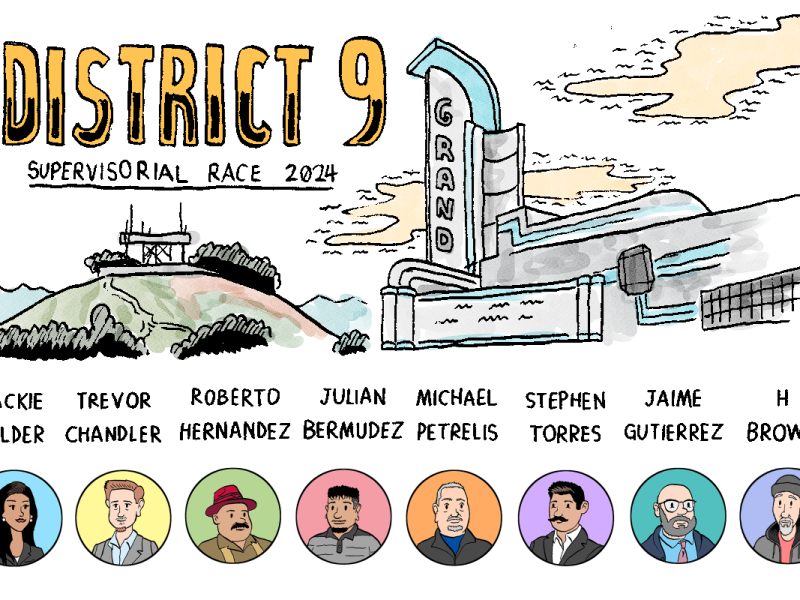
Read the rest of the series here. Illustrations for the series by Neil Ballard.
You can register to vote via the sf.gov website.
Will and team: love this series. Please consider doing a question on Vision Zero; bonus if the question uses the Transpomaps SF car fatalities data to ask about specific deadly streets in each district (like Cesar Chavez, Van Ness, and 16th in D9).