
You’re not going to believe this, but the businesses on San Francisco’s Industrial Street tend to be — wait for it — industrial.
There’s lighting and tile design and auto body shops and windows and doors and, in a concession to modern times, ghost kitchens for food delivery apps. But, incongruously amid businesses like these — since all the way back in 1980 — there’s also the Big City Montessori School.
Owner and teacher Amanda Riccetti has been here since opening day. Her parents founded this school, which serves some 75 students between ages 2.5 and 6, and she’s seen the city transform from her corner on Industrial and Loomis streets. It hasn’t always been a march toward progress: The open space on Loomis abutting the school went from being a bereft vacant lot to a cute little soccer field to a taxi parking lot to a covid-testing drive-thru. It is now back to being a bereft vacant lot. A recycling plant came in (which induced a major rat problem), as did the massive Lowe’s on Bayshore Boulevard (which did not). Things change in an industrial neighborhood. And Riccetti is okay with that.
“We’ve never been anti-growth,” she says. “We’ve never had a problem with business.”
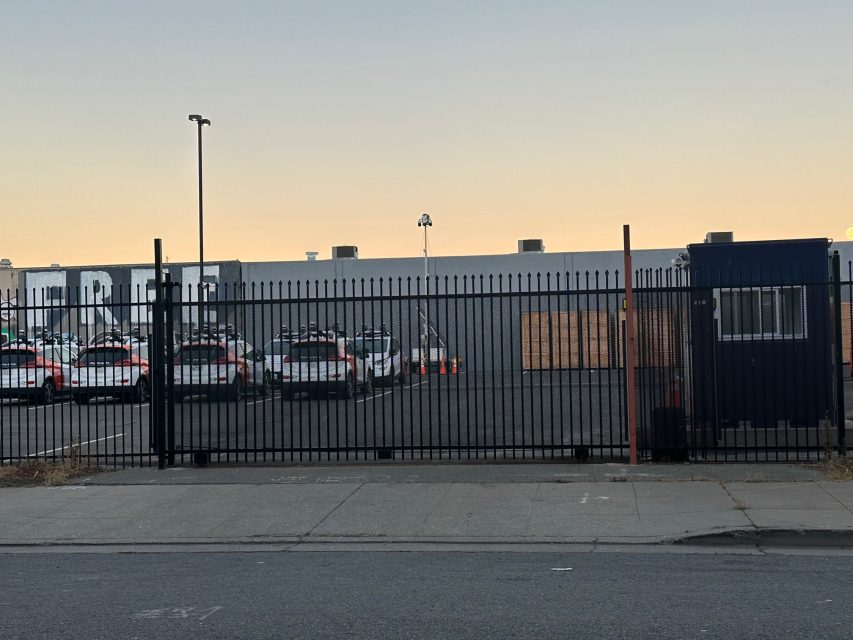
So Riccetti was aware that Cruise has leased the 0.67-acre scrap of land one lot down the road at 241 Loomis St. and is moving its autonomous vehicles in and out of the gated blacktop. She was also aware the company was hoping to install a 24/7/365 charging station for its electric cars; someone in her office looked that one up on the internet.
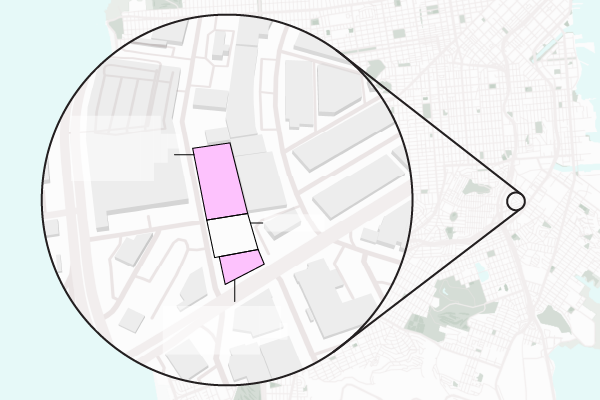
She was not aware, however, that Cruise last year put forth a proposal to generate the electricity to power its charging station by placing a 97,359-cubic-foot hydrogen tank at 241 Loomis. Cruise noted this on a pre-application document it sent city departments in December, also indicating that the tank would be located “approximately 215 feet” from the Montessori school.
In its pre-application document, Cruise called this proposal “a temporary hydrogen refueling station.” But the word “temporary” was doing a bit of work. Within its submitted materials, the company noted that the temporary facility might be used for two to eight years. The electricity to recharge Cruise’s autonomous cars would be derived from a “hydrogen trailer (on wheels) to provide an interim power source” until PG&E got its electric capacity for the area up to speed, and this hydrogen trailer — carrying about 500 pounds of flammable gas — would be replaced “every 1-2 days” by a new trailer being trucked in on city streets.
Well, this Riccetti did not know. And nobody from the city reached out to inform her about it.
“I would hope that having children so close by is something that would be considered,” she said after taking a deep breath. “You know, I would really want to know more about this.”
And she’s not alone there.
In a chain of correspondence between fire, planning, building and public health department personnel obtained by Mission Local, assistant fire marshal Kathy Harold fired off more than a dozen safety questions across multiple emails. Fire Department personnel told Mission Local this month that none of Harold’s questions has yet been formally addressed.
The department’s “main concern,” Harold wrote last year, “is this fuel being transported through the city and the gas catching fire and exploding and taking out a block of people and structures.”
Barneveld St
Loomis St
Mission
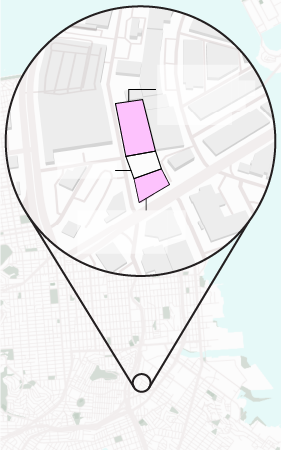
Cruise aims to store its hydrogen trailer at the 241 Loomis St lot
Bernal
Heights
Bayshore Blvd
Vacant lot
Waterloo St
Bayview
Industrial St
Portola
Big City Montessori School is some 215
feet to the south
Loomis St
Cruise aims to store its hydrogen trailer at the 241 Loomis St lot
Bayshore Blvd
Industrial St
Vacant lot
Big City Montessori School is some 215
feet to the south
Mission
Noe
Valley
Bayview
Portola
Map by Will Jarrett. Basemap from Mapbox.
David Letterman once did a bit in which he pondered whether a “guy in a bear suit” could get into the Russian Tea Room. The answer: An unambiguous yes.
But if you’re wondering what you’re probably wondering by this point — Can you just plunk down a trailer (“on wheels”) containing 500 pounds of hydrogen 215 feet from a school? — the answer is more ambiguous.
A more general question, however — Can you put an even larger hydrogen tank even closer to a San Francisco school? — is settled. You can. It’s been done. Many of you have driven or taken the 14 or 49 buses past it without likely even knowing.
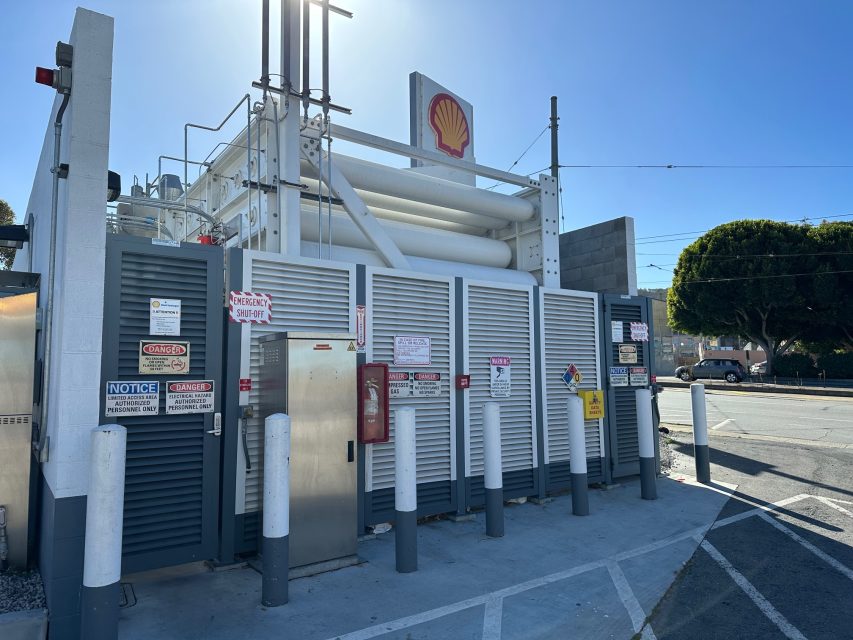
In 2020, a hydrogen fueling facility debuted at the extant Shell at 3550 Mission St., which straddles Mission and San Jose Avenue — one of three hydrogen stations installed in the city that year. With up to 1,235 pounds of hydrogen on site, the Shell facility is actually far larger than the proposed tank on Loomis Street. And Dolores Huerta Elementary School, across San Jose from the facility, is closer than 215 feet. Even a mediocre high-school outfielder could wing a ball from this hydrogen fueling facility over the street, over the fence and into the playground.
What’s different here is that this facility is not only permanent (not “on wheels”), but built with a sense of permanence. It resembles a tiny fortress: Imposing bollards surround a locked concrete bunker-like structure, with concrete walls strategically placed to mitigate any unforeseen combustible lunacy here. And, while the fuel here must, naturally, be periodically replenished, it is not happening on a near-daily basis.
Placing a hydrogen fueling facility in San Francisco was novel, even in 2020. But, in the end, it was not novel to put a highly fortified tank of flammable gas on an extant gas station.
That isn’t exactly the same as what Cruise put forth in its December pre-approval document. And that’s why the specifics of the company’s proposal were viewed with no small degree of wariness, both by city officials and by chemical and fire experts who reviewed it at Mission Local’s behest.
Requests for comment to Cruise were not immediately returned.* But the tiny Fort Sumter erected at 3550 Mission St. and the hydrogen trailer on wheels it last year proposed to install at 241 Loomis — which would’ve been replaced on a daily or near-daily basis — were not wholly analogous. And that’s what seemed to occupy the fire department.
“How much fuel is being transported through the City, and what route is being used, time of day and number of times per week? … What safety guidelines are in place for 1. Leaks, Fires, vehicle protection, explosion’s? [sic]” were among the questions posed by Harold, the assistant fire marshal, in a June 2022 email to colleagues at the planning, health and building inspection departments.
In January, she followed up with more questions: “Impact protection around hydrogen and generator? … How are the generator and trailer being seismically secured? … Are you planning to use electrical cords as permanent wiring? … I’m sure there is a lot more. Thank you.”
David Manuta, a chemical consultant specializing in fires and explosions, told Mission Local that he sees a sizable distinction between a fortified storage and fueling facility like the one at the Shell station and the trailer (“on wheels”) Cruise, in its pre-application document, proposed to swap out every 24 to 48 hours. “The Fire Department is asking a lot of the right questions … those all have to be answered,” he said after reviewing Cruise’s pre-application document.
Mantua was uneasy about a plan to truck 500 pounds of hydrogen through the city on a near-daily basis and to leave a trailer of hydrogen 215 feet from a school. “Hydrogen is about the most flammable fuel there is,” he said. “When we move gas or oil around, it’s much safer to do that in pipelines than to transport it. And this is much, much worse than transporting oil or gas.”
Meyer Rosen, a chemist and consultant focusing on explosions, fires and chemicals, also noted that the odds of a mishap are never greater than during transport and/or hookup — and the plan on Cruise’s pre-application document called for a lot of both of these. A spark, he said, could come from a source as innocuous as a cell phone.
Rosen said it would be challenging to construct adequate blast protection for a trailer being replaced on a daily or near-daily basis.
“Having this next to a school?” he asked. “Gee, that seems like an accident waiting to happen.”
Parsing Cruise’s pre-application materials and the flurry of emails between city officials they inspired, it was clear the autonomous vehicle company and San Francisco’s regulators did not see entirely eye-to-eye. Cruise, for one, claimed that its researchers found “no special City regulations that apply to hydrogen fuel storage/handling.” Fire department personnel, however, didn’t seem to buy into that line of argumentation.
“The Fire Department regulates hydrogen and hydrogen fueling,” Harold wrote, unambiguously, in June 2022. “The Fire Code has a difficult time keeping up with current technologies and for hazards not addressed in the Code, the Code leaves it up to the Authority having Jurisdiction on how they will regulate the activity.”
Cruise also claimed that installing a hydrogen-powered electrical charging station and swapping out the hydrogen trailer on a near-daily basis would require “no new building permits” as “the project only involves temporary components (vehicular trailers and equipment not attached or affixed to the ground or any other permanent structures).”
So, this is where the whole “on wheels” thing came into play. City officials I spoke with said they did not foresee Cruise pulling an end-run regarding local oversight of its proposed hydrogen tank the way the company did with its autonomous cars traveling through the city.
And yet, in January, the Department of Building Inspection’s Stephen Kwok wrote to his city colleagues that “where unoccupied mobile utility trailers are placed on the site and remain on wheels, the mobile trailers would not be considered structures.” Even for two-to-eight years, it would seem.
The Fire Department this month told me that it can “insist on certain safety conditions” — but only to the standards applied to the elements on site. And those standards could differ for a “temporary” trailer rather than a permanent structure.
It’s a complicated case. Lotta ins, lotta outs, lotta what-have-yous. These are the strands Amanda Riccetti now has to keep in her head.
“We have our questions about safety,” she says. “And respect.”
Update: After publication, a Cruise representative got back to us: “Cruise is not going to use hydrogen trailers at the site. We were thankful to engage with PG&E to be able to source the necessary power to 241 Loomis sooner than initially expected to support our all-electric fleet, negating the need for any temporary energy sources.”
Cruise, she said, abandoned this plan in April.



The real story her is: why will it take PG&E 2-6 years to add sufficient service to this site? If they could get things in place quickly this wouldn’t be a problem. PG&E delays in SF have been really extreme lately. Would love Mission Local to look into this.
100% agree. I have overseen Level 3 DC fast charger installations (what Tesla calls Superchargers). Statewide, 2-3 years is the typical timeframe to get PG&E to hook it up. This is at the property owner’s expense — which is generally in the $300K to $2.5M range in addition to all the electricity you’re then going to buy from them. Heck — my neighbor put solar on her roof and it took PG&E 6 months just to hook that up. PG&E is really slowing down the transition to a green electric future in the state.
Seems to be a thing how people drop some service at a site and think they can summon
a PG&E substation like a valet produces a car at restaurant parking. Just look at Ronen and Walton trying to lean on PG&E out at that $140k a pop trailer park at Candlestick.
I have a hydrogen powered Toyota Mirai. People ask if I am afraid to be driving around with a tank of hydrogen.
“Isn’t hydrogen flammable?”, they ask, leaning on their gas powered cars…
A hydrogen fueling assembly would help meet our climate goals. It needs to be done safely, and maybe this wheeled contraption is not the right solution. But hydrogen vehicles should be a part of our future.
Even though this situation was resolved before it got going, it was great investigative journalism–so lacking in our society now. Great work and keep it up! Thanks!
I think it’ s time for another donation to help support the Fourth Estate.
Handling Hydrogen seems like it requires specialized staff- I wonder if cruise has these personnel.
I’ve also never heard of a “hydrogen trailer” like this. Would be interesting to hear some other examples of where something like this has been used. I have a feeling in the middle of a major city is not their typical usecase
There are multiple public hydrogen filling stations in SF for hydrogen-powered cars (I’ve driven one for almost eight years now) and hydrogen trailers are on our streets on a daily basis to keep those stations operational. This is safe and vetted technology that’s been around for years now.
This article demonstrates great fear of the unknown and great ignorance.
Hydrogen is much more difficult to ignite than other fuels like gasoline. In the case of a leak, the hydrogen is gone into the atmosphere in seconds, no longer posing a threat, while gasoline pools on the ground just waiting for an ignition source.
Would the same hysteria resulted if Cruise had wanted to run a diesel generator at the site? Aside from the noise issue, I think not. This article is more about fear of the unknown than any significant risk.
I’m in my eighth year of driving a hydrogen-powered car; there are three public hydrogen stations in San Francisco and trucks loaded with hydrogen traverse our streets daily. The reason you don’t, or didn’t previously, know that is that it’s done safely and it’s all approved at the state and local levels.
Joe, I expect better of you than hysteria over essentially nothing.
Hydrogen dissipates quicker, but is easier to ignite than gas. Explosions are not unheard of (see Santa Clara 2019).
There’s a distinction made here (by chemists) between the stations you refer, and the mobile station that was proposed.
Cruise should be kicked out of SF following the myriad of incidences they have had (car on woman’s leg last week ?)
The amount of empty cars in my neighborhood are astounding. Some nights it averages 1 every 5 min with no one in them. They don’t help traffic flow at all.
And the CEO saying a few weeks ago that SF should be ecstatic for his presence was ludicrous. The only reason SF became a testing ground for this is that someone at City Hall got paid.
What could’ve gone wrong? Nothing, Joe. Because they go into their cruise-control PR-speak and gloss over or ignore details. They’ve established “disruption” as something inherently good. They proclaim advantages of AV’s by making simplistic statements–like they’re safer than human-driven cars, assuming that all cars will be robo-cars and that they operate in a vacuum. But like Uber/Lyft, they ADD MORE vehicles to the streets, creating longer queues at lights and often drive empty. And they boast about it! That WAYMO lot (in which a huge fire occurred) on 14th St. should be a huge affordable housing with no car parking and a frequent electric shuttle for residents who are unable to walk, take MUNI or bike/scoot.
What could’ve gone wrong? Nothing, Joe. Because they go into their cruise-control PR-speak and gloss over or ignore details. They’ve established “disruption” as something inherently good. They proclaim advantages of AV’s by making simplistic statements–like they’re safer than human-driven cars, assuming that all cars will be robo-cars and that they operate in a vacuum. But like Uber/Lyft, they ADD MORE vehicles to the streets, creating longer queues at lights and often drive empty. And they boast about it! That lot (in which a huge fire occurred) on 14th St. should be a huge affordable housing with no car parking and a frequent electric shuttle for residents who are unable to walk, take MUNI or bike/scoot.
Am I the only one to notice that DBI did only a single inspection on this project. And that was the final inspection, by someone who has now been promoted, and this Stephen Kwok saying “it’s on wheels” is the same person who slipped in an ADU in his house using all sorts of verbiage like this.
In San Francisco the ability to do something on one’s property is generally heavily regulated if it can affect anyone outside of your property. Just ask anyone whom has had their neighbor make a complaint against them.
This shows again how DBI looks to shirk any real responsibility it has to watch out for public safety. Remember those windows falling out of the sky this last year? DBI just never thought about updating a program, that every other large city already has, until it almost hurt many people. So why on earth would putting a hydrogen refueling station in a vacant lot next to school be a problem….well it’s not for DBI.
Pretty wild how the temporary infrastructure people of all kinds erect on our streets and sidewalks to accommodate the reality that the city makes it near-impossible to build is a huge burden on everyone.
Images of the hydrogen-filled Hindenburg dirigible’s spectacular explosion need to start blowing up (heh) on social media. Cruise would love a copy, too.