

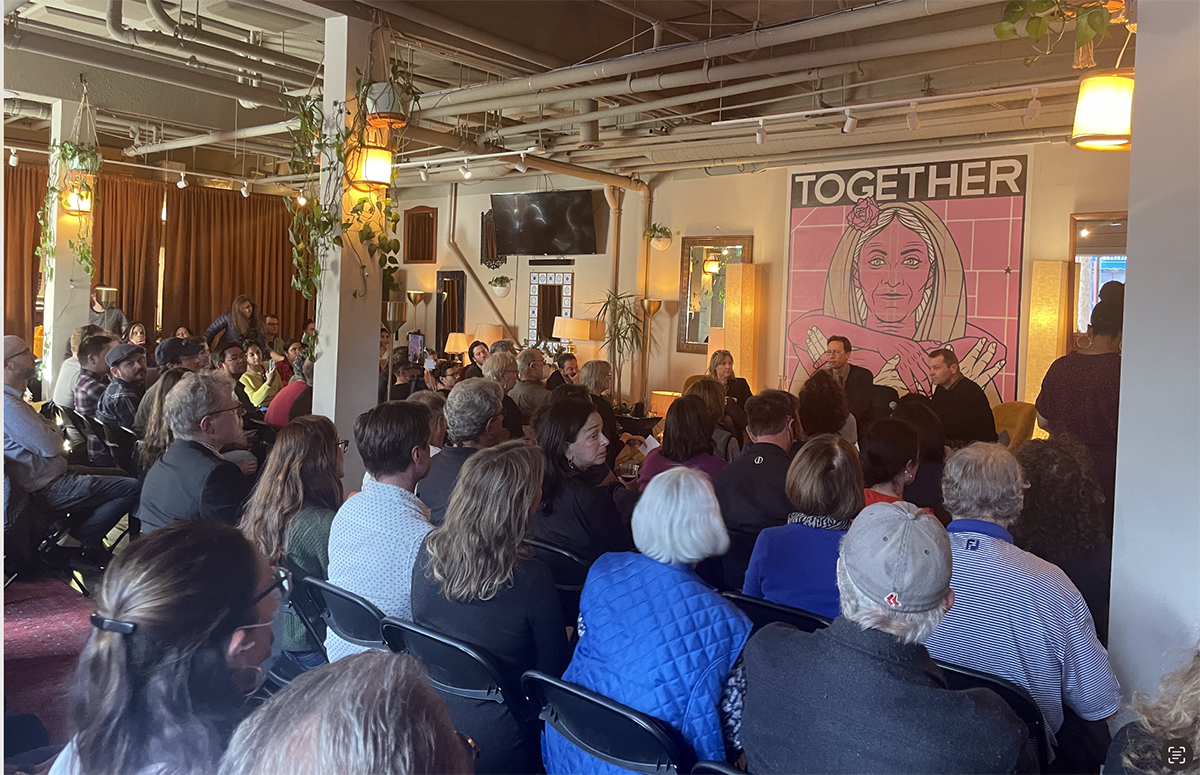
Today is Joe Eskenazi’s first monthly conversation at Manny’s. Demian Bulwa, director of news at the San Francisco Chronicle, and Julie Makinen, editor-in-chief at the San Francisco Standard, will join him for the evening, to discuss how the media, readers, and public officials responded to the murder of Bob Lee.
The conversation begins at 6:30 p.m. Stay tuned for our live updates.
The panel has run through audience questions.
Eskenazi will be back at Manny’s in the last week of May!
Bulwa says that Nextdoor can be a “starting point” for reporting, but that people in his newsroom are aware of the pitfalls.
Audience question: “Do ‘citizen reporters’ on Nextdoor influence reporting?”
Makinen says it’s a great privilege to be able to question authority in the United States, referencing the five years she lived in China.
She says that this morning at a press conference, the District Attorney was “pooh-poohing” some of the reporting of the Bob Lee case.
“Why did police and prosecutors wait nine days to arrest this person?” says Makinen, of Nima Momeni. She says the police must have known very quickly that he was a suspect, and that he could have fled.
“The real question there is whether we should not do the coverage,” Bulwa adds.
“That’s what we were trying to avoid by bringing context and statistics to the story,” says Bulwa.
Audience question: “By cementing the fear and misapprehension over local crime, doesn’t it make it harder for SF’s minority and unhoused residents?”
An audience member describes this as “too tabloid.”
Makinen asks the audience member if photos of victims of war or earthquakes bothers this audience member.
She says yes.
“I’ll admit something, as someone who has overseen many newspaper front pages,” says Makinen. “You usually need a photo to go with the story. In the first few days of the Bob Lee case, there wasn’t a lot to look at.”
Audience question: “What was the thinking behind printing the photo of Lee’s blood drops on the sidewalk?”
This is to Bulwa.
He says he didn’t know, that it was “probably a decision made by the photo staff, trying to document exactly what happened.”
“What can we say about the demographics of the victims and the perpetrators?” Makinen asks. She says she plans to keep track of this and hold the newsroom accountable.
“A lot of news organizations are going through this process, of auditing their coverage,” she adds.
Makinen says her newsroom has been surveying readers, that one reader asked if he should accompany his wife when she walks her dog at night, after the Bob Lee killing. She says people are using crime stories to make personal decisions.
“We try to find different ways to veer from that,” says Bulwa.
He says he tries to “elevate” stories that have a “deeper meaning.”
A professional reporter has asked about people complaining about news being depressing, but simultaneously wanting more crime stories.
Eskenazi says he thinks it depends on the crime, that property crime is probably underreported. He says violent crime is probably underreported in marginalized communities.
“Crime against people of means and white people is probably not underreported,” he adds.
“It’s definitely an issue we think about a lot,” says Bulwa. He adds that homicide counts are accurate, however.
“I think that is a real question,” says Makinen. “Are people reporting fewer crimes because they sense a futility in doing so?”
Audience question: “Some people say statistics can’t be trusted because a lot of crime goes unreported; can we get to the bottom of this?”
Audience question: “There may be people in the room who knew Bob Lee … can we have a brief moment of sadness for a suddenly lost life?”
“Each of our outlets has broken different aspects of the case,” says Makinen.
“My newsroom was one of the first to report it was Bob Lee,” she says. She also said her newsroom added some interesting reporting around the suspect and his sister.
“But overall, I think our coverage was pretty balanced,” says Bulwa.
“Frankly, we had trouble delivering in a quick way exactly what happened,” said Bulwa.
“We did not get that terrible video,” he adds.
“In the case of the Bob Lee story, how do you think you guys did? And what did we learn here?” asks Eskenazi.
“The stakes of people making their points here are very high,” says Bulwa, saying that there is national attention on the city.
“SF is a seat of vast wealth, privilege, and beauty,” says Makinen, “as well as all these other issues. That juxtaposition of the best of the best, the most incredible architecture, history, tech companies, food, scenery, cable cars — there’s a lot of iconic things about SF. Then there’s this other side of it that’s so the opposite.”
“I don’t know why SF’s set of problems seems to be so difficult to process,” says Eskenazi.
“Is this not the case in other places?” asks Bulwa.
“The crime narrative is ever-present,” he adds.
“Why is it so hard for people to wrap their heads around visible misery, high property crime, low violent crime?” asks Eskenazi.
“We have to remember the stakes,” says Bulwa, of the original Bob Lee narrative, and how it could impact treatment of people on the street.
“If educated people say ‘I don’t believe these statistics,’ is that a failing?” asks Eskenazi.
“Probably the answer is yes,” says Bulwa.
Eskenazi asks if the media has failed, if people disregard statistics.
“But if people are constantly told to be fearful, it builds on itself,” says Bulwa.
“It’s difficult for me to just tell [people feeling unsafe] ‘look at these statistics we’ve got,'” Bulwa says.
Makinen says crime is very personal, especially for victims of crimes.
“That feeling of violation is very hard to remove once you’ve felt it,” she says. “It stays with you for a very long time. You can be a rational person and still feel that fear of being violated. Even if you, in your own mind, know you have a low chance of being victimized again.”
“San Francisco does have tremendous problems,” says Bulwa, calling the city government “dysfunctional” and calling it the car break-in capital of the country. He also mentions overdoses.
“People are feeling unsafe because of these other things,” he says. “It isn’t our job to reassure them; we’re going to give them facts.”
Makinen says she sees a parallel to Washington, D.C., in the ’90s, when she was a reporter at The Washington Post.
“When something bad happened with crime, people would rain down hellfire on city leaders,” she said, because leaders had lost the benefit of the doubt, though crime wasn’t worse than anywhere else.
“People want that narrative,” says Bulwa. “We have to recognize that this narrative is part of something larger, that this affects policy.”
“Do we worry about conflating separate and independent things?” asks Eskenazi, mentioning kids brawling at Stonestown, Bob Lee’s killing, Whole Foods closing.
Eskenazi asks Makinen how San Francisco compares to all the places Makinen has worked.
“I think San Francisco has certain very visible problems that people don’t see in other American cities,” she says.
“I think America’s fascination with crime goes far beyond the [print media],” Makinen adds.

“I would say that newspapers are just a small part of that ecosystem,” Makinen says. “Crime is a huge part of entertainment in America.”
She says her partner is a visual effects editor on “Law and Order.”
“Crime is endlessly fascinating,” Bulwa adds. “You’re launched into a life-and-death story.”
“Part of the good news is it’s not that popular,” says Bulwa.
“People are insane about weather and water,” he says, of other popular topics.
“How do news outlets kick their crime habit?” asks Eskenazi.

Makinen says staff members had concerns about crime coverage, and that the newsroom has embarked on “self-inventory” of their crime coverage.
Eskenazi asks Makinen about how her experiences covering crime in other places has influenced how she covers crime at the Standard.
“If you can’t say why it’s important, it’s probably not worth diverting resources to the story,” Bulwa says.
Bulwa says coverage should focus on crimes that impact people or are illustrative of something.
“We don’t run names of people in minor sweeps, we don’t run mug shots,” he says. “We’ve tried to completely change how it is approached.”
Eskenazi asks about the evolution of crime coverage in the print media.
“The goals of what you’re looking for and who you listen to have changed a lot,” he adds.
Bulwa says questions raised about why suspect Nima Momeni wasn’t charged with domestic battery, is an example of this kind of illumination.
“Once the case does attain some interest, it is an opportunity to introduce accountability,” Bulwa adds.
Bulwa says “racism in the coverage and the interest level” is also seen in missing persons coverage.
“I don’t know that I have a great answer for that, except that we are going to cover a big story, and once it becomes big, there are ways the coverage can be illuminating,” he says.
Eskenazi asks whether Lee’s identity as a wealthy, white man has made people more interested in the case.
Bulwa and Makinen say yes.
“What do we do about that?” Joe asks.
Makinen says people feel a personal connection to the product, Cash App, that Bob Lee created, making people more interested in the case.
“People somehow felt they had a connection,” she says.
Bulwa says that the Bob Lee case doesn’t represent something larger.
“Everyone is locked in,” says Bulwa. “Everyone around me is asking, ‘what happened?'”
“I don’t think we can describe it as equitable,” he adds.
“How come these stories did not warrant the level of coverage that so many outlets devoted to Bob Lee?” Eskenazi asks, of the other homicide victims in the city.
“We try not to do fear-based stories,” says Bulwa.
Makinen says in the print days, this wasn’t put in stories.
“In the online news world, where you’re constantly doing updates, saying what you don’t know is much more the norm,” she says.
“That’s something that we, and around the industry, we are trying to do more,” says Bulwa.
“Do we, as journalists, know how to say what we don’t know well enough?” asks Eskenazi. “Is this something we need to say more?”
“I would say, wholeheartedly, yes,” says Makinen.
“If someone isn’t telling the truth, do we just ignore this person?” asks Makinen.
“What are we to do about large numbers of people saying things that there is no statistical basis for?” asks Bulwa, of Musk and others.
“I don’t think the coverage was perfect,” said Bulwa. “We tried to cover the circumstances of the killing and the reaction.”
“Are you ever worried that your reporters are going to have to take apart what was inadvertently put together?” asks Eskenazi.
Eskenazi asks whether narratives can emerge before enough information is known.
Makinen says there was an “excellent column on this.” She says that this is fueled by high-profile people, like Elon Musk.
Bulwa says interest has always dictated what stories get coverage.
Eskenazi asks whether Twitter has become a “de facto assignment editor.”
Makinen says she was interested, because there “might be something unusual,” as it was a stabbing, which make up less than a fifth of homicides. This, and the location, piqued interest, even before the name was released.
“How do things start to roll when you decide this is the big story of the day, if not for a while?” asks Eskenazi.
“At what point do you think ‘We have to cover this heavily,’ and how does that look?”
Bulwa says The Chronicle tries to cover “every murder, every killing.”
“In this case, the interest was just massive and immediate. When the interest is so massive, you do want to tell people what’s going on. We do want to put extra resources and that can be unfair,” he adds.
“What do you and your staff begin doing?” Eskenazi has asked Bulwa and Makinen, of the morning of April 4, the day the press learned of the stabbing of Bob Lee.
Bulwa said a news reporter for The Chronicle that lives on the other side of the country, who starts working earlier in the morning, began working on the story.
Joe Eskenazi, Demian Bulwa, and Julie Makinen have taken the stage.



